

Trauma-Informed Education with Alex Shevrin Venet
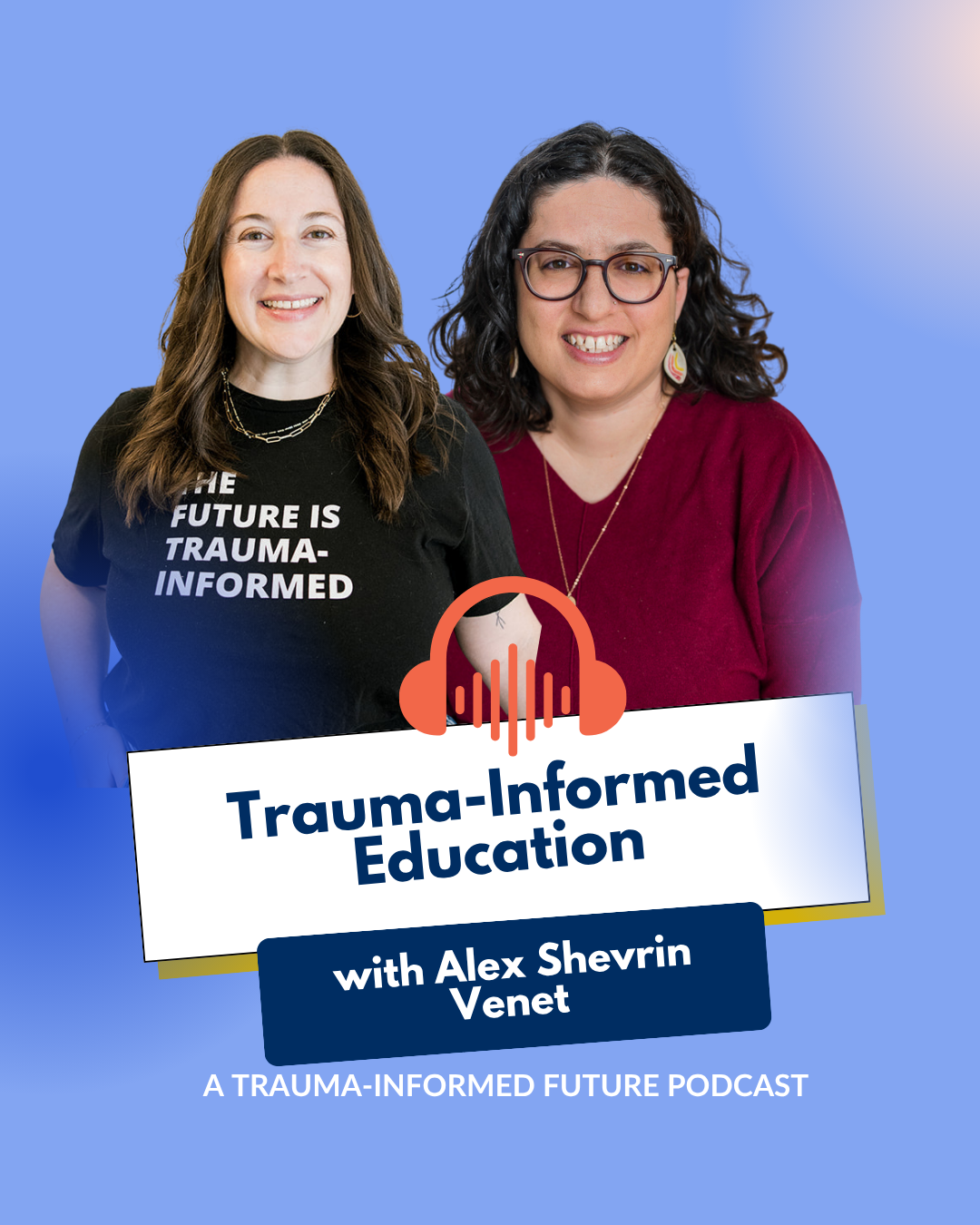
What if trauma-informed education isn’t about managing students but transforming the systems they learn in?
In this episode, host of A Trauma-Informed Future podcast, Katie Kurtz sits down with educator, author, and trauma-informed education expert Alex Shevrin Venet to explore what it really means to make education trauma-informed. They unpack why equity and justice must be central, how schools can unintentionally create harm, the limits of “resilience” as a feel-good solution, and why trauma-informed practice requires us to rethink, not simply add onto-existing systems. Alex shares some seriously important takes on PBIS, educator burnout, boundaries, and why sometimes the most trauma-informed choice is to leave.
Learn more about Alex:
Alex Shevrin Venet is an educator, author, and professional development facilitator based in Vermont. She teaches graduate teacher education at Vermont State University. Previously, she was a teacher and leader at an alternative therapeutic school, community college instructor, and after school teacher in the upper elementary grades. Alex works with educators around the country to strengthen their trauma-informed education practices, with a focus on empowering teachers to create systemic change. She is the author of the bestselling book Equity-Centered Trauma-Informed Education, which has been integrated into teacher education programs in several states and has been cited in education research more than 350 times. Her follow-up book, Becoming an Everyday Changemaker: Justice and Healing at School, provides teachers the tools to implement trauma-informed practices starting where they are.
Connect with Alex:
Website: unconditionallearning.org
Instagram: @unconditionallearning
Show Transcript:
Katie Kurtz (she/her): [00:00:00] welcome to a Trauma Informed Future podcast. I am honored to be here today with Alex Shevrin Venet. ,Welcome, Alex. So excited to be here finally. I feel like we have been in each other's orbits for some time on the internet, and now being in person having a conversation, which I am really eager to dive into.
So welcome, welcome.
Alex Shevrin Venet (she/her): Thanks so much. Yes, I am excited to finally chat. And, you know, we'll get into all of my work, but one of the things that I say to educators a lot is that trauma informed education doesn't exist in isolation. There are people working on trauma informed everything. And so, I always reassure them there's people out there picking up that work in other spheres.
And so something I appreciate is that y- you and I are working in slightly different spheres, and it's nice to know, like, we're, we're part of a big team.
Katie Kurtz (she/her): Yes. Yes. I love that. I have been really embracing , and describing that [00:01:00] this work is like a trauma informed movement. Which- Mm-hmm ... , i, when I pause to think about it, it really is because it's consistent evolution.
It's rooted in so many social justice movements. And the t- and that is really being embraced by folks like Jesse Kohler at Campaign for Trauma Informed Practice and Policy, like really helping people know that they can join it. We're continuously moving forward, right? It's not stagnant. And there's so many interpretations and facets , and trauma informed education has actually been really at the forefront of the movement at least when the formalization of, the practice 10, 10, 15 years ago.
And so I'd love to just start by you sharing a little bit about yourself, whatever feels good for you, your journey through this practice.
Alex Shevrin Venet (she/her): Yeah. So I, growing up, pretty much knew that I wanted to be a writer and a teacher, and so I'm living the dream. But when I went to college, I went to [00:02:00] school for education with a focus in English.
I kind of pictured that I was just gonna work in a public school because that's what they prepare you for, and so I always just pictured going into a mainstream school environment. But I graduated into a recession, and a lot of the public school jobs that should've been available weren't available because people didn't wanna retire.
They, you know, needed to hang onto that job a little more. I actually had an offer that was rescinded because the person said, "Actually, I don't wanna retire." So I was looking for jobs, and s- I started looking outside of kind of, you know, just the things that were listed as blah blah blah public school English teacher.
And in expanding that search, I saw this job listing that said counseling teacher at a therapeutic alternative school. And I really had no idea what that meant, but I said, "Something about that sounds cool. Something about that sounds aligned." And so I went in for the interview to learn more. I ended up working there, and it really changed the trajectory of my life in a lot of ways, which is wild to think about.[00:03:00]
So what counseling teacher meant was that at this alternative school, we had students who in their public schools weren't getting enough support with social, emotional and behavioral and educational challenges. And they were referred to us through their special education program to basically get that support.
And so counseling teachers were people either from an education background or from a counseling background or from something kinda different like outdoor ed, you know, alternative programs. And all of us were cross-trained in counseling skills and teaching skills so that as we were working with students, you know, we are working on our objectives about literacy, but we were also supporting them with what now we would call social-emotional learning, SEL, or helping them work through a moment of anxiety or just basically showing up in a much more holistic way.
We weren't doing full-on therapy, right? These students all had therapists and [00:04:00] social worker. You know, they had that support as well. But the idea was these teachers are really doing expanding that role beyond just the academic. So I worked there for a long time, and as I was kind of getting to a place where I started thinking about what's next, I was going to teaching conferences, I went to grad school, and I would be talking to people about what we did at this program, and they would go, "Wait, what's that strategy you're doing?
Wait, how are you working with those kids?" Right? Like, "Oh, I, I knew a kid like that with behavior like that. How are they succeeding over there?" Like, really, really curious. And I started thinking about, you know, these practices that we're using, they're not that hard. You know? Like, you could do them anywhere.
You don't have-- A lot of them were possible because our school was designed in a certain way, but a lot of them you could use anywhere. And so I got really interested in translating some of those and bringing them out. Now, this was around the time when trauma-informed education, you know, the school that I was at had been doing these practices before [00:05:00] that was a phrase.
But around the time that I started thinking about where do I go from here, this, this word, you know, had entered in the lexicon, this phrase. And so I got really interested in learning about where that framework came from, how people were talking about it currently. I eventually decided to leave that school and really focus on professional development and supporting teachers to use these practices.
And as I was doing that, I was kind of aligning what I was doing with this, you know, overall framework, trauma-informed practices. But then I started to notice this thing as I was looking at other people's resources, which was that, Their trauma-informed frameworks felt like they were missing some things.
And I see a big - for our, for our listeners, I see big nod from Katie. 'Cause you know where I'm going with this. Yep. I started seeing that, you know, there was a lot of focus on strategies to kind of like address behaviors, but there wasn't as much about how do we actually adjust the environment of the school that those [00:06:00] behaviors are happening in.
There were a lot of things that I felt like kind of were, it's like, wait, where's the discussion of gender in this? Where's the discussion of of, of race in this? You know, where are some of those nuanced things that, you know, this isn't a one-size-fits-all. I also noticed some things like there was a really popular book at the time about trauma-informed practices, which thank goodness is not as popular these days.
But it had this whole section about like collaborating with SROs, which are the police officers that are stationed in schools, like collaborating with SROs as partners in trauma-informed education. And that just like didn't really sit right with me. At the same time, I also was digging into the literature, reading research connecting with people.
And so like I wanna be clear, like I didn't invent the idea that equity and justice are central to trauma-informed practices. But what I did do is say, we need like a good mainstream resource that really connects these ideas and helps people think about this. [00:07:00] And so that led me to write this book and create this framework called Equity-Centered Trauma-Informed Education, building off of all of these amazing scholars and practitioners that I learned from and really emphasizing the idea that you can't do trauma-informed work without equity and justice work at the center of it.
It's just not a thing to do that. And similarly, your equity and justice work needs to be trauma-informed. And so, that book came out in 2021, and my work since then has really been around supporting teachers to implement that and to deepen their practice around it. I have a follow-up book around kind of the change-making piece of things.
And today I work with teachers all over to try to dig into this.
Katie Kurtz (she/her): Thank you so much for sharing that. I love it because I see myself up in such a parallel timeline. Also graduated during, the recession. Like, what does one do? I guess I'll go to grad school. And what's interesting is I, I- my [00:08:00] introduction to trauma-informed care happened when I was in in the early 2000s when I was in- working in residential treatment, and then was trained by SAMHSA while working in a school.
I was working on a violence prevention grant in a school district, and it was the first time I was really in a district. And I , will say pretty confidently, probably my last time. I really appreciated my experience in schools. I have trained and worked with schools in the past. It's just not my lane.
It's a really challenging system to work in. Lots of great opportunities and a lot of challenges. And so through that, I have so much respect for people who do trauma-informed care work who are part of this movement in education. I work in higher ed with colleges and universities.
It's just,, out of all the industries, when someone's like, "Oh, can you work in this school?" I'm like, "I could- "... but I'm not, and so let me refer." Like, I, I think I refer to you and your books at least once a week like you as a [00:09:00] resource to people because I think what you highlighted here is so crucial.
You know, when trauma-informed care,, really started becoming a term people were using it specifically didn't include, you know, the added sixth principle of- Mm-hmm ... culture, whatever they're calling it, gender considerations or whatever palatable word, , whomever is choosing. Mm-hmm ... and that's a...
I, say the same thing, like it's incomplete. These are intersected practices. And equity and justice are principles of trauma-informed care, like we need to be centering that and vice versa. So I love your, your journey and sharing that, and also just, , so many mirrors , and I've-- I can't wait to dive in.
You mentioned hot takes, and I'm all- I'm always here for, , busting the trauma-informed myths and, and sharing the hot takes. But I'm curious if you can just start by, we think of, okay, trauma-informed education, [00:10:00] like what is, what is that? Like, what are we... When we talk about that, that sounds really important.
I think a lot of us, especially people listening, are like, "Yeah, of course." You know, I talk a lot about like trauma-informed healthcare and trauma-informed human services, mental health, like but- Trauma-informed education means so much, and you kinda talked about it like , it's not just these specific tiny isolated interventions.
It's, it's the system. Mm-hmm. So you, can you just help, like, break it down a little bit of, like, when we talk about trauma-informed education, what exactly are we talking about?
Alex Shevrin Venet (she/her): Yeah. So I kind of break it down into three parts, and, you know, these aren't, like, too dissimilar. Those of you who are familiar with the SAMHSA trauma-informed care, Rs, you know, I, I forget if it's three or four Rs or whatever, but-
similar idea, right? So one piece of trauma-informed education is responding to the ways that everyone in the school community may have [00:11:00] experienced trauma in the past, the way that they are experiencing trauma now, and shifting the school environment to with that in mind. So that might look like you know, things like redesigning the school day so that kids have a chance to check in about how they're feeling every day, which you might think would be a very simple ask, but actually, a lot of kids can go through their school day and no one ever asks them how they're doing.
So we gotta start with the real basics, right? It might look like thinking about how we design our lessons, recognizing that trauma can impact attention and executive function. So, like, thinking about the ways that trauma impacts learning and adjusting in that way. There's a whole host of things you can do to sort of, be responsive to the trauma that folks have already experienced or are experiencing now teachers and students and caregivers and family members, everybody in the community.
Another piece is preventing trauma that is happening because of an inside of our schools, and this is something, again, that when I [00:12:00] was studying at first, what is trauma-informed education, what's already out there, I felt like this was really missing because a lot of the students that I would see at the therapeutic school certainly had experiences of trauma outside of school, but many of them also had experienced trauma in their schools prior to coming to us.
They had real harm they had experienced with other students, with teachers, because of the system, the way that the system treated their family. And in general, you know, like, school isn't a magical bubble where none of the harms of society can enter the door, right? Like, school is part of society.
And so if homophobia and racism and, you know, misogyny and stuff are in the society, they're also in the school. All of those things can cause trauma. And then you have specific school-based traumas, right? You have trauma because of, you know, the power imbalance between teachers and students that unfortunately can get abused.
You can have the trauma of the curriculum, which can [00:13:00] be biased and incomplete. You can have trauma from, you know, school-based dynamics like bullying. There, you really, like, could go on and on about all the things that can cause trauma in school. And so schools, to be trauma-informed- Can't just say, "Oh, well, kids are coming with their invisible backpack, and we're gonna help them set it down."
Well, the thing about a backpack with school is that you bring stuff to school, and then you shove stuff in it at school, and you bring it home. And so we have to be accountable to our part of the backpack, right? I really don't like the invisible backpack metaphor for trauma, but we can talk about that another time.
Anyway I really-- So I really emphasize that schools need to be looking at, how do we address the harms that are happening here? How do we prevent trauma from happening actually inside of our school? And then the third piece that I think is really important in trauma-informed education is recognizing the ways that schools can actually be part of disrupting cycles of trauma in our world in general.
So what are we teaching, [00:14:00] and how are we teaching it so that kids are not going to become adults who go in the world and cause trauma, right? Like, are we teaching in ways that your students are, like, never gonna become an ICE officer? To me, that would be a trauma-informed school, right? Like, how do I recognize my impact on the world?
How do I see systems of harm? How do I do all these things, right? When we're teaching with justice in mind, when we're, when we're helping raise good humans, right, we're helping disrupt causes of harm. So when schools are teaching consent, when they are teaching how do I disagree with someone without dehumanizing them, all those different pieces, you're actually helping to disrupt circles of trauma.
And so a lot of trauma-informed schools' resources will really focus only on that first thing that I mentioned, which is being responsive in the school about the current impact of trauma. But I think it's so important we actually expand it, because we can influence all these other pieces too.
Katie Kurtz (she/her): I feel like as you were talking, it was building out this [00:15:00] three-dimensional kind of sphere of the whole system.
And- You know, as a social worker, we love the micro, meso, macro. Like, I get it. And also I'm like, "Y'all, it's all whole and we're all in it all the time, and we're fluctuating," right? Mm-hmm. And so whenever... You know, we're human beings, we're social beings, we exist in systems. Every system, that's what our lives are made of.
And education system touches all of us, no matter your age. Because even if you're not, you know, you don't have children or s- in school or anything, like we are paying taxes for public schools, right? It, in policy, all of that. And I appreciate how you created the connections and the interconnections of all of these things.
Again, like, you know, you and I probably have gone through hundreds of hours of continuing education and training, and how many times has it stopped like right at the moment where you're just like- Mm-hmm ... "And [00:16:00] now what?" Right? Or like, "That's great for a very individualized experience," or like, you know, we jump to like the worst of the worst crisis moments, but then it's all these other micro moments, micro stressors and traumas that are accumulating and then like, it's just so much.
It's, it's, it's- Mm-hmm ... multi-layered. So I appreciated how you sort of created this interconnected, you know, multi-dimensional understanding of how when we say trauma-informed education, it's not this One way, one time thing.
Alex Shevrin Venet (she/her): Mm-hmm.
Katie Kurtz (she/her): Yeah.
Alex Shevrin Venet (she/her): And you know what? I think that that multi-layered aspect of it is actually, like, it's kind of at the heart of what I think makes it difficult for people to really do trauma-informed practice as a, as a systemic thing.
Because for me, this really comes from the idea that, like, when you experience [00:17:00] trauma, it's that same thing, right? Where, like, it's personal, but it's also about where you're situated in society. It's in your body and in your mind. It's, like, present in the moment, but it's also long-reaching. Like, it is, like, sort of all these things in a blob and you're thinking on these many different layers, thinking and feeling on these different layers as you're working through trauma.
And I think that trauma-informed practice kind of mirrors that, that it's about the individual and about the systems. It's about being very human-centered, and it's about looking at the huge, big picture and patterns and themes, right? And so I think that what can be challenging is that in big systems like a school, a school district, education policy, all of these things, people really wanna plug in stuff that fits in their existing frameworks.
They wanna, like, "Okay, how do we fit this in with what actually we're already doing?" And I think that trauma-informed practice disrupts those existing frameworks and [00:18:00] says, "Actually, like, the way that we usually do this doesn't really, this doesn't really layer on. This doesn't really plug in in this way," because it requires us to be using a lot more both/and thinking.
Mm-hmm. It requires that we have fewer zero tolerance policies, and actually the policies say, "I don't know. It kinda depends." That's really hard for people, but a trauma-informed policy has a lot of wiggle room in it because the context is gonna be so different, and at the same time, it's gonna be predictable so that folks know what to expect, right?
Like, there's so much nuance in it, and I think that that's really hard when you're trying to work on systems change. So actually, one of the things that I really offer to teachers as, like, a key tool to this my second book, which is called Becoming an Everyday Changemaker, it's all about kind of tools you can use while imbu- implementing trauma-informed practice, and one of the big ones we talk about is both/and thinking, right?
So holding these, you know, two different layers or two conflicting thoughts and being able to kinda sit with the discomfort of that. And I think [00:19:00] systems like schools are very bad at doing that so that makes it hard to implement.
Katie Kurtz (she/her): Yeah, absolutely. Critical thinking, like holding multiple truths, that nuance is so essential to a trauma-informed practice, and it, I think it's what holds up a lot of people because systems aren't designed for that.
Mm-hmm. You know, this looking at the non-binary, looking at the gray, looking at, you know, these things, like that can be really hard, and it challenges the very systems that we work within. Even just acknowledging that we're working within systems designed and continue to perpetuate inequities, injustices, dehumanization and harm and trauma.
Alex Shevrin Venet (she/her): Mm-hmm.
Katie Kurtz (she/her): Can we hold that and be in it? Like, that's sticky, and that's really hard. Mm-hmm. And if we're existing... And this kinda segues to my next question. I'm already like, just so you know, Alex, like I'm like, okay, part two. We're gonna talk a little bit like the, I would love to have a deeper [00:20:00] conversation just on what you touched upon, which is like the actual changes in policies, especially around- Mm-hmm
like moving from such power dynamics and the punitive and, like, shifting, like, w- is restorative practice possible in schools? Like, all that- Mm-hmm ... they, put that on the shelf- ... 'cause we're gonna come back and talk about that more. But I'm curious, so, like, when I first learned about trauma-informed care, and I talk about this a lot, like, it was the care I give to others, the care I'm giving to my clients.
Alex Shevrin Venet (she/her): Mm.
Katie Kurtz (she/her): And I, but I was experiencing burnout and and direct trauma on the job, right?
Alex Shevrin Venet (she/her): Mm-hmm ...
Katie Kurtz (she/her): and people being like, "Well, that's just what social work is. Like, that's part of, part of the job," right? And it was very confusing, and it ma- it burned me out very quickly. And when I got into working in different systems, from mental health to healthcare to schools to s- government, like, I saw the patterns, right?
And I realized very quickly, I was asking the question, [00:21:00] why isn't this bidirectional? So I'm curious if you can speak to, you know, I, I was raised by educators. My best friends are educators. Like, I- it's, people are burnt out, extra crispy. Mm-hmm. Like, we're putting- ... you know, on every level, right? So when we talk about trauma-informed education, how do you look at the bi- h- and how are you addressing, like, the bidirectionality of, like- Mm-hmm
we also need to be looking at, like, educators and staff are part of this, of the system and the approach.
Alex Shevrin Venet (she/her): Yeah. This is another one of those ones that has so many dimensions to it. And actually, when I talk about this with teachers, I give them sort of this both/and, right? Two things are true at the same time.
The first thing is that the system currently is designed to work by exploiting the work of teachers, especially your emotional work. You don't get paid enough. You don't have the resources, right? Like, you're not [00:22:00] fully responsible for the creation of all that stress, and that's real, and that requires systems change.
And, and at the same time, another thing that is true is that when we choose to work in human services we are responsible for our emotional wellbeing because that's part of what is the work in human services. Our emotional regulation is part of how we create a safe space for the students or people that we're working with, right?
So we also need to think about h- within that unjust system that I'm in, how do I, you know, take some control, and how do I be responsible for that? Because ultimately, I can't just let it run down on the students, right? And so there's a few kind of practical ways that I talk to folks about this. One is, Let me think what order I wanna say this in.
Okay, , I'll save the punchiest for last. But a huge one that I talk about a lot is boundaries. In trauma-informed education, there's this misconception that [00:23:00] being trauma-informed means that actually you're gonna be talking with students about their trauma. In fact, you could be a trauma-informed educator and never ever know anything about what your students have experienced that's traumatic.
Trauma-informed education is largely about the environment, and it's less about getting into specific people's trauma. There's a researcher, Elizabeth Dutro, who, who has this great phrase that in a trauma-informed environment, sharing your story is always an invitation but never a requirement. And I think that is really beautiful and sort of speaks to that idea that we're creating spaces where students may share things that are important to them, but we're never I call it being a trauma detective.
We're never being a trauma detective and going digging. You don't actually have to know about a person's trauma in order to be trauma-informed. And so, understanding those boundaries is really important. Having in your mind, "What am I comfortable talking about? What am I not? Who are the people I can refer to?
Who are the supports that are available for students who [00:24:00] aren't me?" And also really checking our own you know, any savior or martyr mentality we may have, which again, the both and. Our system is expecting teachers to be saviors and martyrs, and so it's not your fault if you feel like that sometimes.
And we're not here to save kids, right? If you're the savior, the only role of the kid is to be saved. That is dehumanizing, right? And so we have to really check our mindset about like, yeah, like I'm not gonna rescue this kid from their circumstances. I'm gonna just be one person in their life and do that the best I can.
So boundaries are important. You know, I won't really talk about self-care 'cause I think like we all get like a gag reflex hearing the term self-care. But you know, again, in human services, you have to have some plans around that. You have to have strategies. But what I do talk about with schools is I try to talk to admin around the idea that s- staff needs systemic supports.
They need opportunities to talk about their [00:25:00] vicarious trauma. They need meaning-making support. They need to know that if they are burned out, they have someone who they can talk to. They need structures so that they don't feel alone, all those things. I, I say like, you know, it can't just be cutesy wellness.
It can't just be donuts in the staff room. You have to have actual structures. So that's a piece there. And then the last piece was my, my spiciest piece of this is that sometimes I tell teachers, "Maybe you need to quit your job." Because ultimately, like, i- if you are so burned out that your health is failing, that your family is suffering, that, you know, that you're having nightmares every night, if you're kind of on those extreme ends of things and it's persistent and you're not feeling like all those, you know, your self-care network isn't working, no one's forcing you to work in that environment.
You can do something else. And again, I know that's really scary for some teachers because society encourages teachers to make teaching our whole [00:26:00] personality, and to make it about our moral values, and, like, our value to society is that we're sacrificing as a teacher. So, like, I get that that's the environment.
And the writer Laura van Dernoot Lipsky, who's, has an amazing book, Trauma Stewardship, that everyone should read she talks about this in this great way where she says, "If you were working on a project and you were using a hammer, and then you switched and you used a screwdriver, no one would judge you and say, 'Oh my God, I can't believe you stopped using the hammer.'
They would just say you're using a different tool for the same task." And she says that about if you decide that you need to switch from doing direct service with kids, with clients, whatever, where you're exposed to that really high level of vicarious trauma, and instead you switch to something like you're doing advocacy work in a different way.
You're contributing to the project of that trauma-informed movement in a different role, in a different way that's less harmful to you. We shouldn't judge that, right? You can be [00:27:00] of value without having to put yourself in harm's way. And so I just wanna always remind folks, like, you have agency here.
The same way with kids, we try to boost that agency in trauma-informed education. We have to keep hold of our own agency there as well.
Katie Kurtz (she/her): Yeah. I just wanna highlight how yes, those, those specific strategies are very aligned for educators, but they're the same thing for every industry. Like, and this is what I try to, you know, tell people.
Like, because we're at this, we're at this moment of the movement where globally everyone's like, "Now what? What are we doing?" Right? Like- Mm-hmm ... I, you know, I co-chair our regional state of Ohio trauma-informed collaborative. I'm seeing it across the state, but I see it across the country and, and talking to friends around the world.
Like, we're all collectively at this, "Okay, where are we going from here?" Right? [00:28:00] Mm-hmm. W- where a lot of my hot takes come from the resistance within, or the armored defensiveness within human services of n- of this hesitancy to move forward and evolve- Mm-hmm ... and that it's only for certain pe- it only, like, this approach only belongs in certain spaces, like education or mental health, and it's like, we're not even doing it there, y'all.
Like, I mean, like, it'd be great if you had some really good examples, but we're not there yet. And it's because we're stalling out at the actual practice, right? And those are specific practices, but I hope anyone listening, even if you're not in education, boundaries, system c- collective care all, like, having different tools, those things all apply to all of us, no matter the profession.
Mm-hmm. It's just then looking through that lens of whatever you [00:29:00] do to apply it. But I think uniquely for educators, you're so right. Like, the system is designed to s- make people stay.
Alex Shevrin Venet (she/her): Mm-hmm.
Katie Kurtz (she/her): You know? I don't know how many times I've talked to people where... And, and h- sometimes healthcare is like that too, but m- I think more so in education because of the benefits.
Alex Shevrin Venet (she/her): Yes.
Katie Kurtz (she/her): Yes, and- ... the golden handcuffs, as they say. You know, like-
Alex Shevrin Venet (she/her): Yes ...
Katie Kurtz (she/her): there's this almost like, how could I possibly leave? And it's helping people step back to say like, "Don't you see that's systemic, that's systemic- Yes ... trauma right there?"
Alex Shevrin Venet (she/her): Yes. And it makes it, you know, it's so not simple for people to decide to shift roles or to, you know, leave teaching or whatever.
But you know, I think more to the point of like what's your actual decision you're making is really that piece about agency. Like, I do have choices here. They might not be optimal, but if you're currently going to a job where you're crying every night and you don't [00:30:00] have time for anything, whatever, you're already in a non-optimal situation, right?
And so just really encouraging people to take that step back. And I have worked with lots of educators who have taken that step back and said, "You know what? I am in the right place," and that's a great outcome. And others who have said, "You know what? I'm gonna shift. Maybe I just need to shift which school I'm at.
Maybe I wanna change grades." You know, it doesn't have to be a total like I'm gonna walk away and start an alpaca farm, right? Like, you can... There's a lot of smaller shifts you can do. But I think finding that agency, again, to just say like, "Okay, I'm choosing to do this work, and if I'm choosing to do this work, then I need to own my part of it."
And then at the same time, obviously, if anyone here i- listening is in charge of, you know, other people's jobs, if you're a supervisor in any capacity, really looking at is all I'm offering cutesy wellness or can I actually put some real systems into place? And those real systems don't have to be that complicated.
They can literally just be do these staff have a place to ever sit down and talk about [00:31:00] how the job is emotionally impacting them? And the answer for many, many, many educators is, "I never have that space to sit and simply be heard about how I'm being impacted." It's not complicated to create that space.
It just requires your commitment to doing it.
Katie Kurtz (she/her): 100%. During the height of the shutdown during the pandemic, I was working for a hospital system, I was working in a, a trauma center and There were all these community partners like, everyone's burned out, what do we do?
And so I started holding resilience circles, and most of the people that came and w- who we partnered with were schools. And it was literally just a space, a non-retaliatory third person, like no one knew who I was, coming in to literally just complete the stress cycle to like leave whatever they needed to leave in the container and then be able to go back.
And it received so much good feedback because it was like, oh, I was able [00:32:00] to like, again, kinda discharge some of that, whether it was venting or fear or whatever, like that release and leave it, seal it up, and then go back to aid that little bit of capacity building which we know is what resilience is and tend to the individual's nervous system.
And I think so often we're so focused on self, like you said, like the self, and not like, you know, the self-care down, you know Target or whoever the alternative to Target is now you know, aisles, like that surface level. It's like what are we looking at the nervous system of a classroom or the nervous system- Mm-hmm
of a school or a district? You know, what, how are we tending to that? And so I wanna talk a little bit about I am a big believer, when I talk, when I say, like trauma-informed care, I'm not just talking about trauma, right? This, like narrow lens. Like, I'm, that in- trauma inc- that umbrella includes stress and [00:33:00] burnout and moral injury, but it also includes resilience and healing and liberation.
And I'm- Mm-hmm ... I'm, you know, when we think about kids especially young people, it's we're hyper-focused on resiliency. And I see this swing happening. We've seen it since, you know, the positive childhood experiences study, which again, great, all these things help and are important to the movement.
But we also see this, like assumption that kids should just be resilient. We should have this expectation. Mm-hmm. And because where do most, you know, young people spend the most time? Typically at school. And we know resilience plays a huge part in school spaces because research has shown us the number one thing to prevent, mitigate, and heal stress and har- and trauma is safe, healthy, nurturing relationships.
But I'm curious if you can talk about the role, when we think about trauma-informed education, how that's also aiding in potential protective factors [00:34:00] he- healing pathways and that resilience capacity.
Alex Shevrin Venet (she/her): Yeah. You know, I think that it, it's, it's always so tricky talking about resilience in these conversations 'cause of what you just said, right?
I think people people like to think about resilience, people like to think about, you know, warm fuzzies. And I think that a challenge in trauma-informed education is making sure that we don't skip past the trauma in order to talk about resilience. And I get it- Yes ... right? Because it's very depressing to talk about child trauma.
It's very horrifying to talk about child trauma. And so, it, I think that there are a lot of well-meaning people who say, "Well, let's call it, let's call it resilience education. Let's call it this and that." And, you know, so, so I think that paradoxically, talking about the trauma and witnessing it and you know- understanding it are, are part of what builds our capacity for resilience, [00:35:00] because if we won't witness the harm, how are we gonna actually have that safe and connected relationship, right?
If we say, "Good vibes only," and we don't wanna hear anything that's upsetting a kid, how are they gonna feel safe enough to trust us? And again, I wanna be clear, you know, I'm not saying you have to be a trauma detective. You're not going to go digging around in a kid's life and hear about everything.
But kids and their families are often going to tell a school, "This thing happened. This thing is going on." Or you're going to see in their behavior that something is not okay. And when we are constantly trying to shut down that conversation, when we're constantly trying to change the behavior and fix it, rather than just sitting with it and saying like, "What is this showing me?
What is going on right now?" Like, can I, can I sit here and kind of just tolerate that this kid is not doing okay? I think that builds trust, right? That builds safety for for all those types of relationships. And so [00:36:00] once you have those relationships, I think that, yeah, it, of course it builds resi- resilience, right?
Once we have those relationships, you know, one of the things that people talk a lot about in education is the teacher-student relationship. But one thing I, you know, encourage folks is be a relationship multiplier.
If you have that teacher-student relationship, that's not where it should stop. How do you use that relationship to then help that child build more relationships with people other than you, right? Whether that is making sure that they are connected with peers, connected with other teachers in the building, connecting with the community.
And it reminds me of a piece of research that I read, I think this must have come from Bruce Perry a while back. But the idea that it's not just that a kid has kind of like a bunch of adult relationships, but actually that those adults are connected to each other, right? Mm-hmm. That there is a web of support, not just a bunch of disconnected dots of support.
And so, you know, another sort of dynamic that you can see when teachers maybe [00:37:00] think they're being trauma informed but they're not really, is when they have all this empathy for the kid going through the hard time, but then they turn around and, you know, talk negatively about the kid's family or caregivers.
"Oh, well, if those parents were just more involved. Oh, well, if that community wasn't so whatever," you know, like really deficit thinking. That's not actually helping build resilience, right? Like, to really build resilience for the kid, I need to think about how do I build a respectful and safe relationship with your mom, or your grandma, or your program that you're living in, or wherever that caregiving is coming from.
Because ultimately, that relationship that I have with your caregiver is part of the resilience for the kid. And so, the more that we really do that multiplication of relationships, the more we're contributing to resilience.
Katie Kurtz (she/her): Yes. Yes, yes, yes. I, I love that. And, you know, I have to laugh just out of- exhaustion.
That, like, I, [00:38:00] I, I'm sure you get this too. Everyone's like, "Can you just use a different word? Can you just like-" Mm-hmm. "Mm, trauma is so, like, so negative. It's so a lot. Can we, like, resilience, resilience, resilience." I'm like, "I get it. Also, no." And I'm like, have you ever actually seen anyone utilize resiliency?
I'm like, it's not warm and fuzzy.
Alex Shevrin Venet (she/her): Mm-mm. It
Katie Kurtz (she/her): Someone who is actually tapped into utilizing their resilience reserves, it is not this, you know, Captain America moment, like, that we- Mm-hmm ... all want and hope for. I'm not dismissing the, you know, feats of courage and, and strength that we have in the human spirit that we've witnessed, but, like, it's not the Today Show, g- you know, Good Morning America moments that, sound clips that we see.
It's the, that tenacity and that heart. Like, it's hard. It's gritty- Yeah ... and it's, it, there's suffering and grief there. And so, like- Mm-hmm ... as much as [00:39:00] resilience is, like, the term everyone uses, and I, I really try to help. My hot take always is, like, demystifying what resilience actually is and understanding it from this lens.
But I'm like, that, this, that's not, like, the good vibes, warm and fuzzy- Mm-hmm ... that y'all think you're, you're clinging onto. It's, like, how do we humanize this, this experience a little more? So I appreciate you kind of naming that. And I have to ask you. I just, like- Tell me your hot takes, like one or two if you're willing.
Like, Ugh ... it's just there are so many things coming at us. We're seeing more people create... We're seeing more shared language and understanding, which is amazing. We're seeing more trauma awareness kind of unfold, which is so important. We're seeing more people open and willing to adopt this practice, but then we're also seeing the- misconceptions and [00:40:00] misunderstandings and upholding or gripping to old beliefs that are like we know more.
Mm-hmm. We're, we're hearing more people's lived experience. We're listening, we're trusting them, and we're using that to inform us. So I'm just curious, like any favorites?
Alex Shevrin Venet (she/her): The one that gets me into the most trouble is that trauma-informed education actually can't coexist with the system that's used in a lot of schools called PBIS.
Mm. Educators listening will know what I'm talking about, but it's essentially this sort of like, it- it's meant to be this supportive system for managing student behaviors. I, I like have become such a professional hater of this thing, PBIS, that a, a colleague and I actually wrote a really deep dive academic paper about the fact that PBIS and trauma-informed practice cannot coexist.
And so now it's in a journal. You can cite it. That's how, that's how deeply I feel my hot takes is that we researched it. [00:41:00] But but I think that like more generally, right, I think people wanna plug trauma-informed practices on top of things as opposed to letting it be transformative, and y- you can't do that, right?
Like, you have to actually let trauma-informed practices change what you're doing. You can't you can't like... Yeah, you have to like slow down. You have to disrupt things. You have to let some stuff go if you wanna be, you know, fully trauma-informed. And so, you can't just plug it in on top of all these other harmful things that you're doing.
So yeah, that's, that's the one that I get the most pushback, the most pushback around.
Katie Kurtz (she/her): I love it. I'm gonna go read that article. I'm familiar with PBIS. So I'll definitely link that in the show notes- ... for anyone who's familiar. But yeah, like I think that is so similar to a lot of the hot takes I have as well is like you, you can't choose who this is for-
Alex Shevrin Venet (she/her): Mm-hmm
to
Katie Kurtz (she/her): make it palatable for you, and that's where I get in a lot of trouble [00:42:00] where, like, I don't believe you can make- Policing trauma-informed. I don't believe- Mm-hmm ... you know, jails can be trauma-informed. Like, I know there's a lot of people in that work trying to make it as humane as possible, but this approach, it's not possible to be trauma-informed in an active system that's upholding dehumanization and traumatizing- Yeah
people. And I think- And you
Alex Shevrin Venet (she/her): know-
Katie Kurtz (she/her): Yeah ...
Alex Shevrin Venet (she/her): some people even take that, take, you know, further in education and say schools can't, you know, some people would say schools can't be trauma-informed, especially for children of color, because they can be as toxic as these other institutions, right? I personally, you know, I try to live in that space of both/and, right?
Like, yes, you know, schools are incredibly toxic, and I think we can change them, but I totally respect people who say you can't make schools trauma-informed because they're inherently trauma-inducing. There are some folks for whom the [00:43:00] institution of schooling, you know, will simply never, ever be one where you can experience safety.
And I think that, you know, like, part, part of my hot take about trauma-informed education is, like, when other people come to me and say, like, "I think this is, you know, I think this is, like, a framework that's trying to make these, these harmful institutions more palatable or whatever," like, part of my thing is, like, that's fine.
I can hear that. I, I can hear the critique of trauma-informed education because I'm kind of with you on the larger project of it. And so, you know, I, I also want people to, like, hold less tightly to these specific frameworks almost. Like, if tomorrow you were like, "Trauma-informed education as a framework is canceled," like, I wouldn't be adrift because for me, it is about trauma-informed education, but the larger project of it is about, like, being human and being empathetic and, like, creating justice.
And so if the framework goes away, I'm still good, right? [00:44:00] And so I feel like as much as I wanna use this framework to, to talk about these ideas, I'm also okay with these terms shifting over time a little bit if we keep the belief at the center of them.
Katie Kurtz (she/her): Yes. And that there is a prime example of, well, A, trauma-informed leadership, right?
The embodiment of it. It's, it's not an arrival, it's an evolution. So, you know, the same. Like, if tomorrow we find out, like, something new, I will discern Through my ability and, and shift as needed. But that's why I always tell people, like, there isn't... And also there isn't one model, right? Mm-hmm. Like, I mean, I think SAMHSA is the most well-known and popularized and, like, labeled best practice, but, like, I don't-- I honor it as part of the origin and my origin and journey, but I don't utilize it for many reasons.
I [00:45:00] don't use it as a part of what I teach and train on and practice every day, and my practice is always evolving, right? And- Mm-hmm I totally agree with you. Like, I personally, when I think about the industries I get invited to, like schools, love 'em, I refer out. Like, you know, criminal justice, anything like that, done it before, I refer out.
Like, you know, it's just, I know that about myself. I think you can definitely apply trauma-informed practices in systems that are actively never going to be, like, gold standard trauma-informed, but we still need to practice it, right? Mm-hmm. We still, there, that's that and/both, is like it's not all or nothing.
Kids are still gonna go to school. If you have the privilege to unschool or whatever, like, great. That's you- your prerogative. But school- kids are still gonna be in school, so how can we still make it as trauma-informed as possible-
Alex Shevrin Venet (she/her): Mm-hmm ...
Katie Kurtz (she/her): while still holding the system accountable? And, and I see that [00:46:00] in, in a, on all the systems, right?
'Cause there isn't a perfect system. There isn't one system that is designed to, you know, who's not actively harming some person or group of people. So we need to be holding that. And, and yeah, like, it doesn't squelch the whole movement. It just is a part of it. Mm-hmm. It's a part of why it exists, and it's a part of why we need to continue it.
So I really appreciate that, that hot take. I'm eager to hear more. But I wanna be mindful of our time and capacity and make some room for our gentle spritz of questions. Before we do how can people learn more about you, your work, connect with you?
Alex Shevrin Venet (she/her): So I have a website, unconditionallearning.org.
There's two Ls in a row in the, in the middle, Unconditional Learning. And you can find pretty much all my stuff there. I would love for folks to check out my two books. You can get info on them there as well. And then a great way to connect with me is that pretty much every month I do a [00:47:00] free/pay-what-you-can webinar series, and I do them kind of on rotating topics connected to trauma-informed education.
And I'm always kind of looking at new ideas, trying out new workshops in that space. It's a really great community that comes to those, and you can always come for free. And so I love to see new folks, not just from within education, but any industry to come and check those out.
Katie Kurtz (she/her): Awesome. Everything, LinkedIn show notes.
I love a good space for community practice. It's, it's truly how we're, we're moving and evolving with this work. And so be sure to check that out. Those books, we love a good resource on this podcast. So thank you so much. All right, are you ready for our little spritz?
Alex Shevrin Venet (she/her): I'm ready.
Katie Kurtz (she/her): Okay. So if you could desri- describe trauma-informed care in one word or a few, what would it be?
Alex Shevrin Venet (she/her): You gave me these and I'm still not ready. If I could describe trauma-informed care in one word, it would be human.
Katie Kurtz (she/her): Awesome. What is your current [00:48:00] go-to for nervous system care, self-care practice?
Alex Shevrin Venet (she/her): I am doing some strength and balance training lately to try to be a little more integrated with my body.
And you talked about resilience looking really messy. I'm really experiencing that, trying to, Part of my backstory is I've had some significant health issues the last few years, and so practicing resilience in that training is looking very, very messy. But ultimately, I can feel that it's gonna be good if I stick with it.
Katie Kurtz (she/her): Yeah. Thank you for sharing that. Yeah. And what does a trauma-informed future look like for you?
Alex Shevrin Venet (she/her): I think that a trauma-informed future really looks like everyone doing their part. My friend Ursula Wolf-Rocca has this great quote from a, you know, she, back in the day when Twitter wasn't what it was now, she tweeted this.
It has gone viral a few times, but it's something to the, She phrases [00:49:00] it better on there, but it's something to the degree of like all injustices are connected, but the good news is that that means that if we're each pulling our, our own part of the thread, we're gonna unravel the whole cloth. And I just really come back to that as grounding.
And for me, the trauma-informed future is we're all, we've all got our string, and we're all yanking on it. And together we're unraveling that injustice. And then maybe, you know, to extend the metaphor, we're all bringing our own thread to weaving what's next.
Katie Kurtz (she/her): Yeah. I love that. I love a good visual.
That one, that one feels so timely- Mm-hmm ... to remember right now especially during this, this ongoing accumulative stress and collective trauma we're, we're experiencing on every direction. Yeah. So thank you so much. Is there anything else before we close today?
Alex Shevrin Venet (she/her): I think that's it. I definitely have many ideas for our next conversation, so hopefully we'll, [00:50:00] we'll let everyone else into at least one more of them.
Katie Kurtz (she/her): Yes. Yes, yes. I, I think there's so much to talk about always. So thank you so much. This was so great. And thanks so much for being here.
Alex Shevrin Venet (she/her): Thank you.
Katie Kurtz (she/her):
Let’s Connect!
