5 everyday trauma-informed strategies
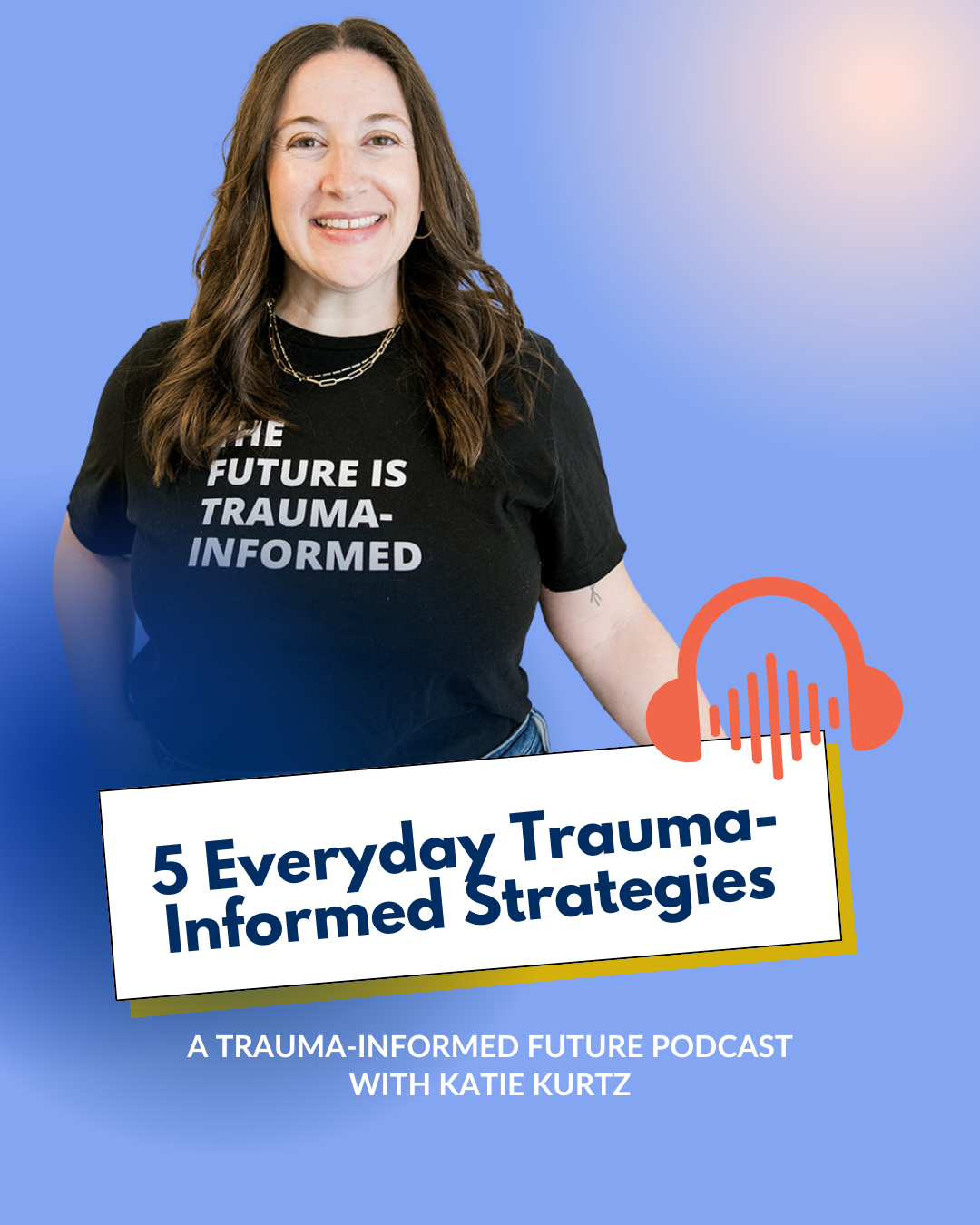
In this solo episode of A Trauma-Informed Future, Katie opens by naming what so many of us are carrying right now : the cumulative stress and collective trauma of a world that feels like it's moving too fast, too hard, and with too much at stake. She gets honest about her own nervous system responses over the past 24 hours, and uses those personal moments to ground listeners in real nervous system education. Trauma-informed is not an adjective, it's a verb. Katie walks through five trauma-informed strategies straight from the TRUST™ Model and breaks down why these aren't just soft skills, but literally what our nervous systems need to reconnect to safety during times of collective dysregulation. Short, grounding, and packed with both honesty and practical tools, this one meets you exactly where you are.
Referenced in this episode: Resmaa Menakem
Resources:
Show Transcript:
Katie Kurtz (she/her): [00:00:00] Hi everyone, and welcome back to A Trauma-Informed Future podcast. I'm your host, Katie Kurtz. I want to first just acknowledge the cumulative stress and collective trauma we're globally experiencing, both directly and indirectly. In this current time, and I think it's really important to name a thing, a thing and remembering, you know, take her or leave her.
But in Brene Brown's, Atlas of the Heart book, she says, language and naming something doesn't give it more power. It gives us more power. And I think right now, if you are a human, who gives a shit who cares who's feeling who's paying attention? Then you are likely feeling the impact again, directly or indirectly, [00:01:00] personally, professionally, individually, , collectively, culturally of what is happening right now on so many levels.
And today's episode is gonna be short and sweet, but is also going to include some co-regulation, some strategies, and some acknowledgement, and hopefully some hope.
This podcast is being recorded less than 24 hours after the president of the United States committed a war crime of global terrorism, of wanting to erase an entire civilization in Iran and that threat was, you know, taken back by a social media post. But it, it still remains a threat and we can't unsee what we saw. We can't unfeel what we felt in solidarity with people in [00:02:00] Iran and also in Lebanon and in so many places where the United States and Israel are creating global terrorism and violence.
And I don't know about you, but my nervous system felt it. I felt, I, I believe all three nervous system responses. Yesterday, I felt the nervous system response of. Flight I found myself unable to sit down and write and do you know the millions of things I have to do on my to-do list. It was really hard to concentrate. So what did I do? I started cleaning and doing things like fidgeting , and keeping really busy.
That's what my body does when my nervous system interprets a threat and activates the hyper arousal state of flight. I quickly moved [00:03:00] into fight. The rage inside of me honors the rage inside of you. My fight response is not necessarily physical aggress aggression. I think sometimes we think fight is that, that physical aggression when really the fight response is our body, perceiving a threat and then going into that hyper roused state of self-protection, armoring.
And for me, the fight response in my body. Is expressed through trolling my, you know, Democratic elected senators on threads. That always feels really good productive, I don't know, but does it feel good? Yes. For me, lately I've been noticing. The fight response coming out through like driving and road rage.
I live in Ohio and increasingly over the last few years I've noticed myself and this is like a true [00:04:00] admission. Not proud of it, but I'm human right. That like I get more irritated, impatient, and a little ragey when I'm driving because I just look around and think, wow, a lot of these people voted for and are currently supporting , this administration, this regime, and these policies and these actions and why we're here.
And so. There's a lot of that, A lot of screaming and flipping off people with supportive stickers on their car and things like that. Is it productive? Probably not. Does it feel good? Kind of, yeah. Not gonna lie. And then of course, the freeze response going from that hypo aroused state and then dropping to, that , hypo aroused, state of freeze.
I just found myself doom scrolling yesterday, constantly looking at updates, talking to friends and family, and just [00:05:00] feeling hopeless, feeling like no one's doing anything. And here we are. And yeah, the immediate threat of that tech, that social media post didn't happen.
But let's not forget that a hundred bombs were dropped in Lebanon by Israel, and we also don't know what's happening in Iran because the internet , is down and there is just so much propaganda and things happening. So as Resmaa Menakem one of my teachers says Too much, too fast, too soon, an overwhelm to our nervous system, an overwhelm to the collective nervous system.
So do it with me now. Take a deep breath in. Exhale it out. It's a lot. , It's designed to be a lot. It's designed to exhaust us and I do wanna name and acknowledge that I am , a person living in a white body. And so, yes, I am ragy and crispy and exhausted, and yet I want to just knowledge that my whiteness provides me [00:06:00] power, privilege, and positionality that I am very aware of. And, distances me from so much of the direct harm happening. From a policy level, the dehumanization, the violence, et cetera. I am indirectly impacted by that. That's why, what I mean by directly and indirectly impacting us all in some way.
So what do we do? What do we, we're we woke up today, and if you're like me still feeling , my nervous system responding in those ways and it ebbs and flows. I am a able to access regulation in my nervous system because I have the capacity to do so. So remembering resilience isn't, Marvel heroes, persevering or any of that, whitewashed capitalistic, Americanized notion of resilience. Resilience is our [00:07:00] nervous system's capacity to move through, withstand address adversity, stress, and trauma.
So if you pick up your favorite water vessel, water bottle, whatever, mine's huge. I like this analogy. So our water bottle is able to hold a lot, right? If we hold it under the faucet, it will fill up, fill up, fill up, and then it eventually reaches the top. It has no more capacity, so it overflows. Our bodies are containers and our bodies we're able to hold a lot, but we can only hold so much. And when we are experiencing.
Our lived experiences both past and present when we're experiencing the world around us, relationships, et cetera, it impacts our nervous system capacity. So if you think about a water bottle, what is your capacity right now? Now what , you can hold, but like your nervous system capacity is there room is there [00:08:00] space. And if there is, that's our resilience and we're able to utilize that capacity when the next stressor comes our way to move through it however we can.
But if we're at the very top of that water bottle, if one more thing happens, we don't have capacity, we don't have the privilege or ability to work through it, move through it, and that's where we don't have that resilience to lean on. And then it manifests into toxic stress or potentially trauma or burnout. And so when we think about where we're at right now, I want you to pause , whenever, or wherever you can to really think about what is my actual capacity, what are my resilience reserves like right now?
And when I did this mini self-assessment yesterday, and like this isn't perfect. It's so imperfect. It's so human. It was literally just like a brief check-in while I was, you know, pausing in the moment [00:09:00] to be like, okay, right now I have less stress than I did a year ago, and therefore a little more space, a little more capacity.
And I know that in this moment when I'm feeling these nervous system responses arise, I have resources to utilize. Now, this isn't like the specific wording that I had to myself yesterday. I was just like, okay, what do I need? Go? So, because I practice the trauma-informed strategy of resourcing, I know how to resource myself.
I have a resource toolkit. I lean on that. I regularly review it, and that's where I go to. Imperfectly in these times of heightened responses. So I got into my best friend group chat, was able to process had some levity, work through that. I talked to my, you know, my husband work through that.
So [00:10:00] people are our best co-regulators, right? We learn to co-regulate as infants. Because babies nervous systems aren't fully developed so we need other people to help self-soothe and regulate, but we don't stop co-regulating. We're actually co-regulating right now. We co-regulate most powerfully through people, but we can also co-regulate with. Places. So different environments and spaces, plants, nature, different types of nature. That's literally why people say go touch grass. Pets, animals and play different arts, dance, music. All of those things are co regulators. And so when you're developing your resource toolkit, think about those P's, people, places, plants, pets, and play.
What are those things you can do when you're experiencing those different nervous system responses? Remember, [00:11:00] regulation does not equal calm. There are so many, like just visualize me doing the heaviest of eye rolls right now. There are so many people on the internet who are adopting nervous system language or therapeutic language and talking about nervous system care.
It's the new trend, right? And there is this big myth going around that. The goal of a healthy nervous system is a calm one, and that's absolute trash. That's not true. The goal of a healthy nervous system is flexibility. We are regulating and dysregulating all day every day. That's literally the function of the autonomic nervous system.
Our autonomic nervous system is , automatically utilizing our available senses to perceive what is safe or unsafe, a threat, or not a threat. It doesn't care if it's literally a actual live bear or a teddy bear or whatever it may be. It's just sending signals through our [00:12:00] available senses to say, are we safe or unsafe here?
And if we're not safe, it sends that signal through every organ, every system in our body to say, Hey, we're not safe here. There's a potential threat. And then automatically, our systems, organs, everything respond to that threat. And that's externalized through social, emotional, cognitive, physical expressions.
And so take the example of you're driving down the road and a car swerves into your lane 'cause it doesn't see you. Your automatic response is to swerve away, honk your horn to make sure you don't get into a car crash. That's sudden automatic response. You might notice your heart rate pick up, , you're sweating. You might be shaky. You might be angry. That's me. Hello. But eventually , you come down from that. So that moment of dysregulation, which is good, right? Because you needed to be dysregulated so you did not hit the car. You are slowly able to recalibrate and come back to [00:13:00] neutral. That coming back to neutral is what regulation is.
It's neutrality. It's not calm or zen. That is all false . It is coming back to status quo, coming back to the baseline.
Now if you are in that car and you swerve and you get back on the road safely, but perhaps you've been in a car accident before, it may take you longer to come back to neutrality and regulate because your body remembers. The issues are in your tissues.
Your body remembers that, that experience, and so it may take longer for you to come back to neutrality, back to that state of regulation. And so as we think about our nervous system right now, we also need to be considering the nervous systems of those around us, both personally and professionally, and that every person we come in contact with has a nervous system, and their nervous system is responding in a variety of ways.
And we're never gonna really know [00:14:00] if certain external factors or triggers or whatever may impact somebody's nervous system. But what we do know is that any threat of violence, any actual violence directly or indirectly, including on the spectrum, global terrorism, active dehumanization, all of those things we know create stress and leads to trauma, both on an individual collective and cultural levels.
So what was happening right now globally at the hands of people in power, all these men in power, billionaires, all the people creating environments and imposing policies and taking actions that are threatening our livelihoods, our safety as a collective, and as individuals, , our nervous systems [00:15:00] are responding. That's the very purpose. That's what they are designed to do. Our bodies are brilliant.
They're designed to keep us safe and protect. And so that is why we're having these responses. We're having them personally, we're having them collectively, and we're having them globally. And so I really just wanna, again, reiterate that and name that. I talk about this literally and provide this kind of education literally in every keynote training workshop.
It's in TRUST Works everything because it's essential to the regulate strategy. The TRUST models regulate Strategy is how do we understand the nervous system, and then what strategies do we take to be more nervous system informed in our actions, communications, relationships, and leadership.
So what do we do?
How do what? Where do we go from here?
Trauma awareness is knowing that our nervous system is affected or impacted.
Trauma informed is [00:16:00] taking that information and informing our actions, communications, relationships, and leadership.
So let's look at five trauma informed strategies. These are five trauma in informed strategies I talk about all the time, and you're gonna understand why in just a moment.
They're embedded into everything I do. Not just talking about it in keynotes and workshops and in TRUST Works the training certification that I lead, but also how I market communicate. Write my copy and website emails, relate, lead, consult, speak, everything I do. And these five trauma-informed strategies are again part of the TRUST model.
So I'm gonna share them with you, just like high level. Again, to either affirm what you're already doing, but now you know why you're doing it, or to give you some new strategies to really hone in on. Because when there are times of heightened exposure to trauma and [00:17:00] accumulative stress. We begin to disconnect from everything and everyone, right?
Trauma thrives in isolation. It disconnects us from ourselves, our bodies, our environments, our people, our safety. And the opposite of trauma is not healing and resilience, it's safety. But we know that safety can't just happen, right? We build trust to lead to safety. And so , these specific things, these five things are so essential in helping us build trust with ourselves and others.
And when done over and over again as a practice, not a one and done, but an actual practice has tremendous social , impact for ourselves, for each other, for the people around us.
So let's dive into these five things. Our nervous system loves these five things, predictability, [00:18:00] consistency, repetition, pace, and transparency.
Why does our nervous system love these things? Because when we have predictability, consistency, repetition, pace, and transparency., we're able to reconnect. We're able to reconnect to trust. We're able to reconnect potentially to our bodies, to our environments, to relationships and potentially reconnect to safety.
Now that reconnection may take longer for for some rather than others, but it is the reconnection is again, one of the strategies of the TRUST model is how do we be a bridge to reconnect people? And so utilizing these five strategies over and over again is how we can promote reconnection in our actions, communications, relationships, and leadership, it can be applied and should be applied to literally everything.
So let's go over these five strategies, [00:19:00] predictability. Is making sure in whatever way possible you can prevent surprises. So right now, again, Resmaa Menakem says too much, too fast, too soon, and overwhelmed to our nervous system and the collective nervous system.
There's so much happening very quickly erratically. It's a poly crisis every day, so one thing we can do to help reconnect. Our nervous system to safety to promote regulation or co-regulation is to offer predictability. Let people know what to expect. Provide group agreements or space agreements. Going over expectations of, if you're, , giving someone a haircut, go over what you're gonna do if you're you're teaching a class review, , the class plan, if you're going into a meeting provide an agenda and review it.
Providing expectation helps minimize potential fear and [00:20:00] potential unknown, which helps give rise to trust and gives rise to people being able to be in a more regulated state. I get it. Life is always unpredictable, right? And we work in some places where predictability we can't control.
But I want you to pause here and think about what is within your control and how can you apply predictability, not just once, but over and over again, and here's why.
Our nervous system also loves consistency, not just something once, but over and over again. It doesn't have to be a perfect ritual or habit. Like imperfectly, consistent. , whatever, but consistency over and over again. I know that when I go to this appointment, this is what's gonna happen. So it matches predictability and consistency together. And you know, if you have an agenda and then you stick to the agenda or you tell people transparently that you're gonna change , you're able to create that [00:21:00] consistency.
The third thing our nervous system loves is transparency. So you see how these are all linked. When we experience stress or trauma, our optic nerves in our eyes begin to narrow , our optic nerves nerves narrow, literally become so hyperfocused. That's, if you've ever heard of like tunnel vision, it's so hard to see anything besides what's going on.
There's so much going on, we can only see what's in front of us, right? So we wanna be as transparent as possible, what is happening, be clear and transparent again, take her leaver, Brene Brown. Clear is kind, unclear, is unkind. Be super, super clear.
What are you doing? How are you doing it? Where are you doing it? Being very, very clear and sometimes actually whenever we're experiencing these poly crisis times of heightened stress and trauma, we need to be overly clear and [00:22:00] transparent. We can't leave this out. It is the number one way we can build trust.
Consistency helps us build reliability, which again, trust, predictability helps build that consistency and transparency. Again, trust.
The fourth thing we wanna focus on is repetition. So I know repetition and consistency can be very kind of hand in hand and similar, but I want us to think about repetition as, okay, you've shared something once or twice or maybe sent an email at the beginning of the month, and at the end you may be sick of yourself saying something or doing something, but it can take humans up to seven times to actually hear or remember something. And again, when we're in times of heightened stress and trauma, we're not able to focus. It's harder to focus, it's harder to remember. It's harder to pay attention.
And so repeat on repeat over and over again. I know you're sick of saying it and hearing it. We need it. I can't even, like, what day [00:23:00] is it? I don't even know. That's where we're at. Right? We call, in, early 2020s, we're calling it like pandemic brain. But what that really , is the impact of stress and trauma on our bodies and brains.
That's why we need predictability, consistency, transparency, and we need that repetitiously over and over again to help us build and repatternize our brains and nervous system towards safety. That reconnection.
So it's predictability, consistency, repetition, transparency. Let's talk about pace. Pace is, again, going back, I've said this three times now, right?
Funny how I am repeating myself here. Again, this is the practice. My teacher, Resmaa Menakem, he wrote the book, my Grandmother's Hands and Quaking of America says, trauma can be thought of as too much, too fast, too soon, an overwhelmed to our nervous system or the nervous system of a collective or culture. [00:24:00] So one way we can counteract collective trauma and accumulative stress is to slow things down.
I'm not saying stop or quit or go really slow. What I'm saying is how can you go a little slower? How can you pace yourself? Now, I get it. There's nuance here. Some of us are in fields where we can't spare time, we have to move fast, but there are moments where we can slow down. Having done crisis work most of my career, even in times of heightened crisis, we can still pace ourselves.
So what does pace look like? We can reconnect and repatternize towards safety through trust. By looking at how are we pacing our teams, our meetings, our communications, how are we pacing ourselves to honor our capacity? How are we honoring the pace of others? Yeah, life is gonna life. Many of us had to show up today and go to work while the [00:25:00] world is on fire.
However, how can we adapt? And be flexible and honor the pace of today so that we can honor people's capacities, right? How can we be more trauma informed and honor the realities of right now? And if we can't shift or change, how do we communicate that so that it is not ignored or unaddressed?
Let's review these five things, predictability, consistency, repetition, transparency, and pace.
Now all of these things work best in relationship in connection relationally, because trauma-informed care is relational care. We can practice co-regulation most powerfully through people, relationships, connection. So how do we build connection while we have to first honor and recognize. This is the trauma informed piece, the connection's risky, and for many people where trust doesn't exist, connection is very risky.
That's why we wanna build and focus on trust in relationships [00:26:00] so that we can connect, especially during times of dysregulation, again, dysregulation personally, collectively, globally. So we can best build trust through connection by practicing these trauma-informed strategies of predictability, consistency, repetition, transparency, and pace.
It can literally be applied to everything. You'll notice just in this podcast, the last almost 30 minutes, I have been doing those very things, those five strategies over and over again. And once you begin to practice, they become more organic and natural, it becomes just the way you do things , of course there's gonna be checks and balances and all those things, but that is part of the practice of being a trauma-informed leader.
And these are, again, exactly what we work on in the TRUST Works Training and certification and the model that I teach and talk about all day every day.
So wherever you're finding yourself, take that deep breath again. [00:27:00] I know I need it. I hope that these strategies feel supportive Again, maybe affirm what you're already doing.
Now you know why you're doing it. That's the trauma informed piece. Or give you a reminder to come back to the practice or perhaps give you something new to consider. Again, you can apply these things anywhere with anyone. It doesn't matter what your profession is. It doesn't matter if this is applied personally or professionally.
I highly recommend doing it in both areas of your life. Just start somewhere. Like I always say, it's not complicated, but it's a choice.
So where can you begin? Where can you try this on? Where can you start? The more we do this, the more we begin to counteract, and that's how we build that groundswell of this movement.
And right now we desperately need it. And you can be a mirror every time you show up and do this. You are a mirror for somebody else. Our nervous systems are mirrors. That's how we co-regulate. So how can you be a co-regulator for others by [00:28:00] practicing these strategies?
All right everyone. A reminder that trust works, training and certification.
If you want to really go deep or gain a framework that you can really focus on, that moves us from principles into practice, having tangible strategies and skills, TRUST Works certification. It's a one of a kind. It's always open enrollment. Reach out if you have any questions. It's available.
You can go to katie-kurtz.com/trust works to sign up and join us. There's a free community of practice all year long for coaching mentorships from me and to peer feedback from people around the globe.
If you're looking for just space get some feedback on maybe you have a keynote coming up or you're building out your own framework or anything related. I offer 90 minute strategy sessions. I've been loving doing these lately, working with other trauma informed leaders on helping them just getting my eyes on their work or helping support them and figuring something out. It could be client related issues, like a supervision kind of session.
Whatever you [00:29:00] need, it's 90 minutes. It's recorded so you don't have to worry about taking notes or anything. And then I provide you a summary of what we talked about and then provide you any of the resources, referrals , or anything you need feedback on frameworks or slides or whatever it may be.
You can go to katie-kurtz.com for those strategy sessions. They're one-offs, but you can schedule as many as you need. And of course, if you're looking for any speaking engagements, tailored workshops, or consulting, all of that information again can be katie-kurtz.com
In this, with you always take good care.
Let’s Connect!
Say ‘hello’ on Instagram or LinkedIn
FREE Guide: Talking Through Turbulent Times
