

Building Trauma-Informed Communities with Fihmiya Hamdan
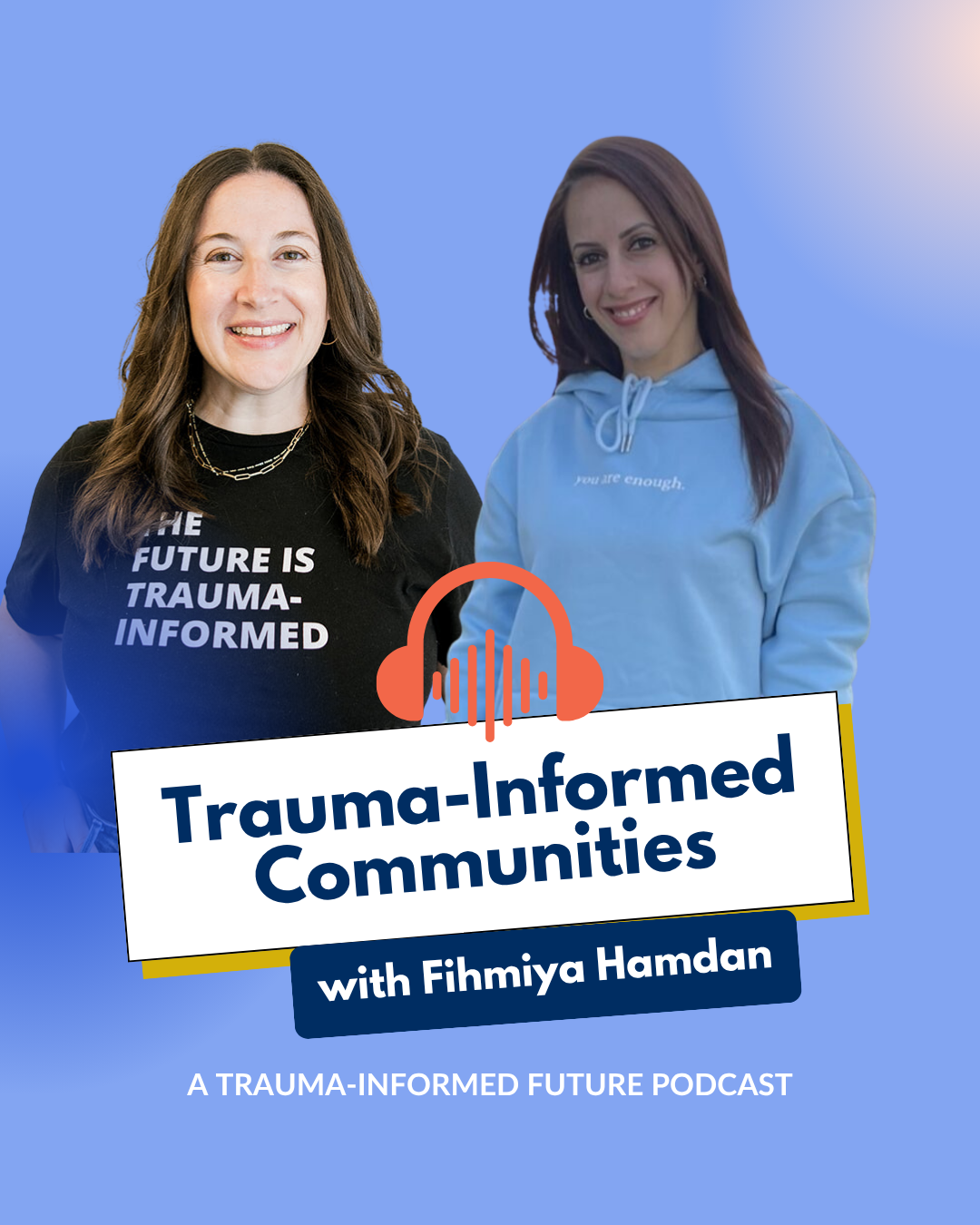
Connection and building community are vital for any team, department, and organization. It requires trust, fostering empathy, and promoting the well-being of all members. The intersection of trauma-informed care with community building is essential to effectively and inclusively connect. But you don't need to know someone's trauma story to offer them trauma-informed care. In today's episode of A Trauma-Informed Future podcast, host Katie Kurtz is in conversation with community manager and social impact advisor, Fihmiya Hamdan. Fihmiya shares her experiences and practical insights on building trust, managing group dynamics, and the transformative power of compassionate community building.
Learn more about Fihmiya Hamdan:
Fihmiya Hamdan (she/her) is a passionate baker, traveler, and adventurist. You can find her outdoors in nature's beauty and its surroundings. She a former educator and in a lot of ways, she is still educating but in different capacities. Currently, Fihmiya is a Community Manager and Social Impact Advisor who sits on the intersection of Health & Wellness, Education, and Technology. Fihmiya is fortunate to be working in Mental Health spaces where she can develop a trauma-informed lens as a Community Manager within the Integrate Network.
Connect with Fihmiya:
Docuseries: Humans of Connection
https://www.youtube.com/@HumansofConnection/featuredCommunity Management/Social Impact Portfolio to learn more: https://www.notion.so/fihmiyahamdan/Community-Management-Social-Impact-Portfolio-b234357e7a344f9fbecab8e20d94492e?pvs=4
Mentioned in this episode:
Show Transcript:
Katie Kurtz (she/her): Hi everyone and welcome back to A Trauma-Informed Future Podcast I am delighted to be here with my dear colleague and friend, Fihmiya Hamdan. Hi, Fihmiya. How are you? How are you arriving today? Thank you for being here with us.
Fihmiya Hamdan (she/her): Well, thank you, Katie. Thank you so much for having me on your lovely podcast. I am a showing up excited. Because I get to have this conversation with you and really just dive in to the topics that we have.
Katie Kurtz (she/her): So for context purposes, Fihmiya and I met through the Integrate Network, which is a trauma informed network. And it's been such a gift to get to know you and be in community with you .
You are gifted as a community builder, a community leader, somebody who cultivates community. And I know it's not just who you are and your values and your essence, but it's also what you do professionally. This is your work. And I'm curious if you can talk a little bit About that.
What is community building? Why is it integral to pretty much everything we do, whether it's in small business or in [00:01:00] corporate or in any industry? What is exactly is community building and the benefits of it?
Fihmiya Hamdan (she/her): Yeah, great question, Katie. So community is going to look and sound different to many people. And there's going to be different meetings that come to it. But for me, I would say the overarching meaning is people want to be in a space to belong, people want to come to a place where they unite, they can connect over shared experiences. Interests or goals or whatever it may be that they're coming in that space for, but for me, community is where we can really just bring and pull people together and not have those labels assumptions or Judgments that are placed on us that are labeled that society tells us that we should be a certain way or be or act, but it's rather a place to be and show fully as ourselves and people like, well, what does that mean to show fully as yourselves?
I'm like, well, just come as you are, you know, we are not here to judge you, but we're here to create a safe, [00:02:00] supportive community. an inclusive environment that you can be a part of and contribute to. And there's so many layers to it as well, Katie, but I know through the conversation, we'll dive into those as well.
Katie Kurtz (she/her): Thank you. So I'm curious if you don't mind sharing your own journey with trauma informed care and where you're at, you know, how you got introduced to the approach. How you've developed your, own skill set and your evolution as a trauma informed leader.
Fihmiya Hamdan (she/her): Yeah, so for me, when I first learned about the approach, it was about two years ago when I met Julie Johnson from Integrate.
I had originally met her in Bali, which was a space that I used to manage. She was a member in there and the more I got to know her, she started telling me a little bit about her practice and what she did as far as, you know, the trauma informed approach and how she pulls it into leadership. And then I just became more interested as time went on.
And then after that group [00:03:00] ended, I just kind of naturally and organically fell into a collaborative workspace with her. And that's where the trauma informed approach. Came to life for me. I of course know what the word trauma, but I've never implemented the approach within a community space. And when I look back at it, I was doing a lot of the underlying behaviors of a trauma informed approach is just that I didn't put a name and recognize that's what I was doing because the trauma informed approach.
And community are such an alignment with one another that it goes hand in hand with everything that I talk about when it comes to community building the true essence, the fostering connections, the supportive and collaborative environment, and then offering choices and how you want to show up as far as engagement and other things as well.
Katie Kurtz (she/her): Yeah. It's so integral to how we connect and build relationships through our communications, through our decision making, [00:04:00] through critical thinking, everything, right? How we show up, how we listen, and it, I don't know. For me I'm very much immersed in this work. Obviously, it's who I am.
It's what I do. So for me, it just automatically makes sense. Of course, this, I think this approach belongs everywhere. I think it's relatable to almost everything we see within, you know, when you go on LinkedIn, you hear about like leadership or community building or these kind of buzzy words that are in this very professional, you know, social media platform.
And every time, you know, we see emotional intelligence, appreciative inquiry, like all these things, . And I'm like, it's all, trauma informed care is like this cohesive, comprehensive thing that brings everything together with a filter. of our humanity. And I love what you said it affirmed what you were already doing, but now you know why and it also gives you the how of how to show up, how to lead, how to build [00:05:00] connection. I'm curious so if it makes so much sense, like, why are people, why is It's still such a slow roll to get this conversation into more kind of corporate leadership kind of spaces.
I think I know why, but I'm curious to hear your insights on it.
Fihmiya Hamdan (she/her): Ooh, I got so much to say on that, Katie. Well, having been in the trauma informed space and now really again recognizing that I'm using this approach from a community management lens does give me like a bird's eye view of what it could look like for a community manager to actually really implement and utilize this approach really in any space.
So if I had to put a note on it, I think it would be the fact that the word trauma. The word trauma scares people. There's still that negative connotation that is tied to it, right? Like the stigma that's tied to mental health. And when people hear the word trauma, they almost want to run away or they [00:06:00] just pause and okay, I don't know how much I can contribute to this conversation, but I don't want to share my traumatic story.
So I think the whole educational piece of what a trauma informed approach is and what it looks like. At least from a community management lens and from your lens, Katie, it's really important that we keep talking about it and having that conversation because there's this meaning that's tied to it that trauma, I need to run away.
I don't want to be in that conversation because the others like that maybe shame or blame that could be tied to it as well.
Katie Kurtz (she/her): Yeah, early on in the podcast, I did an episode around how trauma is not a bad word, yet when you say certain words, our brains can't hear them. conjure images.
If we use the term, for example, the term addict, because of the way we're culturally, programmed and because of marketing and things, we conjure up very visceral images and feelings when we hear certain [00:07:00] terms. And I use this a lot when I do education and training around language and how language matters is when I say addicts, a lot of people say what do you think of?
And people say, Ooh, dark alleys and needles and spoons and sadness. And I say, well, what do you conjure when you think of somebody, a person in recovery and people will say hope and light and possibility. And I'm like, , what if they're the same person, you know, like it's language matters.
And what if we say is instead of, some of these very stigmatizing words that perpetuate these dark images, we shift our language to help reduce stigma and humanize. our humanity. And I think the same thing happens with trauma is the reason why we still get this very crunchy kind of cringe feeling that we want to shy away from is because we're still functioning from a very old, outdated understanding and definition of trauma, which is, you know, Big events that only happen to some people, and then we other, and we create [00:08:00] distance between us and them.
That's not us. That's, ooh, that's really traumatizing. I'm good. That's them. But what we fail to understand it's not these certain experiences and events. It's our body's brilliant way to respond to when we are Sarah O'Brien, a fellow colleague of a, does a great job of explaining. It's an involuntary response to keep us safe when we are in environments or experiences that are .
dysregulating our neurobiology. And I think when we shift our understanding that trauma is our human, our neurobiological response to keep us safe, it helps expand our empathy to a little bit. And I see people when I train, I actually watch the progression of kind of expansion to see Oh, this isn't just like a, it's not a choice.
No one consents. No one wants trauma. It's just this response we have for our bodies brilliantly keeping us alive and safe. And it's not some people it's [00:09:00] all of us at this point, we know have some, some sort of nervous system dysregulation some go as far as trauma. But at least some toxic accumulative stress, depending on our individual context or our cultural or collective context.
And I get it. Like I always get I know I, people don't like the term and people ask me all the time Oh, could you use something a little nicer? Can we be more positive? Can you change a word for me, please? And I'm like, Oh yeah, no, I won't. Because words matter and like words give us context. And I think I rather invite people in.
to get curious about what is it about that word that makes you so uncomfortable, that makes you feel like it doesn't belong here? And what if we shifted our understanding and leaned into that discomfort a little bit and expand our empathy so that we can be with that word and rather learn that trauma informed care has nothing to [00:10:00] do actually with trauma informed anyone's story or addressing trauma, really it's actually none of our business.
Trauma informed care, you're probably never going to actually talk about trauma in trauma informed care. I'd be curious, like, how much have you actually talked with or to people about their trauma while leading this approach? Hardly ever. Right, right, because it's not so much about trauma. It's about knowing and understanding what trauma is and how pervasive and insidious it is and the neurobiological impact and using that to inform how we show up and build community and connect and lead and live our lives.
And in doing so, it helps resist harm and promote safety, belonging, inclusion. But typically, nothing ever has to do with getting our shovels out and start digging into people's trauma or forcing people to share their stories. I actually don't, I'm okay. If you want to share your story, I'm honored, but I don't need to know it for you to deserve this kind [00:11:00] of care.
Fihmiya Hamdan (she/her): Yeah, absolutely. And you said so many wonderful things, Katie, and some of the points I want to go back to, as you talked about humanizing that approach, right, really bringing in the educational piece. And how do we get better at things? It's the more and more we accept it and start going into it and practicing that skill set is by really stepping out of our comfort zone and really just growing and thriving in that area.
And what I've also noticed why people might just move away from the word trauma is they don't know how. To possibly help someone who's experiencing trauma, so they're just okay, I don't have experience in this area. I don't know what to do. So I'm just going to go the other way and just avoid the word, you know, and full transparency here with me before I got into integrate or started implementing the trauma informed approach.
I thought, right, because it activated some past trauma, [00:12:00] but I was like, do I have to come into this space and share my trauma stories? Like I'll share bits and pieces, but I don't really want to share my full detailed experience. I'm not comfortable doing it because there's some parts we want to keep to ourselves.
But the more and more I learned the approach. I was like, Oh, this is like the total. This is exactly what I'm doing as a community manager, but what I've been doing for years as an educator is really holding space for that diverse and inclusive population of learners that were coming in every single year.
And making sure that I gave them choices and how they wanted to show up and what that looked like. But also learning about The ways that they wanted to be a part of the community, the space. And I was like, Oh, okay. I get it now. I really get it. So it's just teaching and educating others who don't have the expertise in the air, what it looks like.
And it's [00:13:00] not what you may think it is, but it's this right here. And what I heard you saying is inviting people into that conversation and really being curious. Ask questions. We invite you to ask us. That's why we're here.
Katie Kurtz (she/her): Absolutely. I always like to lead with curiosity over judgment. And I think there's a level of readiness with this approach.
And I'm sure you see this too with within community building and management is that there's levels of readiness. We're all not just ready to jump in and build community and be best friends, right? Like some people, and I love and would love to hear your, this in your words, because I know you do a great job of kind of talking about ways people engage in community, you know, people who might be the lurkers or a little more on the outer rim.
And some people who dive right in, or some people who may sit back and absorb. Without really active participation, there's no right or wrong way to show up that we have to honor ourselves, and I think that's [00:14:00] such a beautiful way to translate what trauma informed care can look like in community spaces.
Do you mind sharing a little bit about that? Because I'm probably not saying it correctly, but I remember you sharing this and kind of these different archetypes or roles we play within community spaces.
Fihmiya Hamdan (she/her): Yeah, so when I look back to my role as an educator, whenever I would get a different round of students.
No student was ever the same. They all have their unique experiences and needs. And I really needed to tap into those areas to really help them thrive and succeed and move on and go on to their next goal. So I really had to build that level of trust. There was no way they were going to open up to me if I didn't build that foundation with them first.
So there was some level of A vulnerability that needed to come from me to really just kind of warm up what that space would look like. And I had to always keep in mind that I was [00:15:00] always going to have the active engagers. The ones that were always had their hands up for saying me. There were some that were kind of teetering on the fence that were like in between when they wanted to.
And then some that were just completely and utterly shy that never, Raised their hand, and I knew that I could not force them to raise their hand because then that's going to make them really standoffish and then never want to participate. So I knew they needed to take a longer time to really warm up to me, but I always made sure that they were always included that I always made sure that they were seen, heard and valued that even if they did not participate that day.
And by that, I mean, If they didn't raise their hand and answer a question, they were always included and made sure that they were recognized for showing up that day. So I think people need to bear in mind that there's going to be different levels of engagement. Engagement are your listeners, the ones that just want to sit back and observe.
I am one of those, depending on my mood for the day. [00:16:00] Then there's going to be other engagers who. Just want to, you know, listen and sit, maybe exchange a few words. And then there's others that are very active that want to lead their group and that's going to change. Ungiven days and moods, but it's really reminding everybody that being engaged doesn't necessarily mean that you're going to be the one raising your hand observers, listeners, readers are just as engaged and part of the community, just as the ones that are active as well.
And that's something I've noticed people keep missing. You can't force people trauma informed approach means including all. And how you want to show up in your own comfortable way until they're ready.
Katie Kurtz (she/her): I love that so much. It's such a beautiful example of self determination of allowing people to choose what's best for them in the moment, and then accepting that and not forcing or trying to center them in your experience or the experience you want for them.
And of course, being clear, I'm sure, you know, as an [00:17:00] educator, you had participation, mandates or things that like you have to do, but being clear and forthright about that and just making sure people are transparently aware is important. And then, but if not, allowing people to show up as they need to and allowing that to change, like maybe one day you're really active and the next day you're not.
I think that's such a great example of leading trauma informed care out loud. And that's what we're talking about is like something like that, which isn't a huge, complicated thing to do. It might feel a little wonky or wobbly if you're not used to it, but all in all, it's not a huge ask.
It's not a complicated thing to do. And one of the things I also, I think, stands out so much about this is that it, it integrates this ability, and this is a question I get all the time as somebody who leads and talks a lot about I do a lot around group work, facilitation, space holding with a trauma informed lens, and people always are [00:18:00] concerned well, what if, like, how do we manage everyone?
How what if somebody is talking too much or participating too much or is overly engaged? And what if people don't say anything? Like, how do we make sure everyone feels safe? Or how do we make sure? it doesn't over, get overpowering. And I'd love to hear your opinion on this because this is one I, a question I field a lot.
And it's such a common thing, not just within trauma informed approaches within kind of group spaces, but I'm sure in community management spaces as well. Kind of the dynamics. The dynamics, when you bring people together, which whenever we bring people together, conflict is natural, like rupture.
Those things are gonna happen. And also people are gonna show up differently in different kind of ways. And how do we allow balance the, and. Kind of hold the nuance of allowing people to show up as they are and also having, community or space agreements or things like that and honor the flow [00:19:00] of the space or the culture of the space.
Fihmiya Hamdan (she/her): Yeah, so if I miss anything, just jump in Katie and remind me. So community guidelines are something that's really important to have. Now when I say guidelines, I'm not talking about strict or rigid rules. They are just more overarching Practices that we talk about in regards to people are going to show up differently, but this is what we would hope to see and influence the behavior, not for someone to be a certain way, but just reminding everyone that respect, right?
Respect everyone involved. Everyone's going to come with unique skillset experience background. But to also hold space that not everybody thinks the same way people are going to have different things to say, but do it with right. Respect is the main one. And then also going into these spaces, a lot of check ins, right?
So we know that depending on the size of your community, if it's small, you're more than likely to probably hear [00:20:00] everyone share or contribute into that space. And then if it's a larger group, it's going to be harder for everybody to chime in and interact. But that's when you really have to think about, okay, well, what kind of activities can I implement within that space that would allow at least everybody the opportunity to speak and contribute so maybe whole group and then you talking if you're the one leading and then putting people into guided groups where they have that opportunity to talk with one another that way they at least have that chance to contribute and share their thoughts so And just a matter of thinking about, well, how can I involve everyone?
And then you're going to have someone that are very timid, that don't want to share. So they probably need one on one chats with you, conversations on the side, check ins, and then reminding everybody as a whole group that everybody matters, that everyone can show up, that everyone can contribute in the way that feels most comfortable for them.
And then over [00:21:00] time, you'll start to notice people, once they warm up, they start opening up to you. But you have to be the one to put as at least as a community manager, a lot of the forefront work where you have to build and initiate that space of what you want to see by modeling that behavior yourself.
It's one thing to say it, but it's another thing to do it by modeling what you would hope everybody would come in as. And then over time, when you build that trusted space, people more than likely going to open up and start talking. And I've seen this numerous times as an educator, some people take longer than others, and that's perfectly fine.
Katie Kurtz (she/her): Such a great example of how trust is not assumed, it's built over time, and we do so at the pace of our nervous systems, through that predictability, so having guidelines and things, or space agreements, whatever they're, whatever you call them, but having those things that are in place to contain, create containers.
For safety to be felt, and [00:22:00] then, those check ins, I love a check in, I love that you talk about that, I think it's a great, simple practice to utilize, and then, you know, our nervous system loves the repetition, the consistency, the predictability and that helps us build trust, and when we have trust, we can feel safe.
And I think something for people to remember, and this is where the trauma informed piece comes in. Is that people connections risky? I mean, whenever we're in community with people, it's risky because no matter what our lived experiences are, the intersection of identities we hold when we're going into a space with people, especially we don't know or parasocial relationships online.
Or in person, it, there's a lot of unknown, there's a lot of risk and the level of risk is dependent on your social positioning and your lived experiences and the identities you hold. If you're somebody walking into a space and maybe you hold an intentionally marginalized identity, or you have lived experiences [00:23:00] of trauma, relational trauma, which, Most trauma is relational.
That may make you a little more hesitant or a little more armored or guarded depending on the situation. And so you may hang back, you know, I'm an, I'm actually a very introverted person and when I'm in social situations, but I'm like a deep connector. I love connecting We can go deep right away.
I love it. But in networking, I don't do well in like professional, schmoozy kind of small talk networking because I'm so introverted. And I think even through the pandemic, I noticed myself have a little more social anxiety in public spaces. So I, it takes me a minute. I need to process and feel out my space.
I need to kind of get my senses in order and then really feel out. What's kind of going on. So I may come across as, and I've had people say Oh, like you just seem kind of intimidating or you're so quiet or like you're judging. And I'm like, no, I'm trying to get myself together [00:24:00] and regulate my nervous system for a minute.
And then see how awkward I can really be. Like, can I show up as myself? Cause I'm like a naturally awkward human and like assess it's like a threat assessment. Like how am I going to be, how can I show up in the space now? It's not all the time it's dependent on the space, but there's some things that I'm very consciously aware of.
And most people wouldn't know that about me because I can walk into a room, I can go on a stage, I can speak in front of anyone, like I'm good, but there's. There are some things that people just don't realize. You know, it's interesting, I share this a lot in my trainings is like, because of some lived experience of physical trauma that I've had in my life, I don't feel comfortable or safe having my back to a door.
So whenever I train, I'm like, okay, where am I stationed? , Where am I at so that I don't have my back to the exit? And if I do I'm fine, but I'm more conscious of it. And I like move I'm a very like moving [00:25:00] kind of speaker. So I'm like moving around, but I share this because no one would understand.
No one would know that about me. No one would know that's like what I'm doing or checking out. No one would know that's like a part of my hypervigilance. And I do that in any room I go to because That's tied to the lived experience of trauma I have, and I utilize that as an example because we just don't know what people are coming into our communities and spaces.
And so trauma informed care allows us, it takes out all the what ifs. What if this happens? What if that happens? You're using a cohesive approach. to pause and understand I don't have to caretake for this person, fix this person, solve problems. I'm here to lead with compassion, lead with curiosity.
And if something arises, which honestly, it doesn't happen as much as, as frequently as I think people think. I think it does but if something, someone has a need or they feel courageous enough to share, [00:26:00] great, like what an honor to hear someone's story and to witness, bear witness to them. And if they need something you can't provide them, great, that means you know your boundaries, and you know that you don't have to be everything to everyone and that you can.
Just tell them that and be honest and transparent. People appreciate that. They actually trust you more if you say, I don't have the answers or I don't know what to do. And then link them to resources or support them in finding it or let them figure it out. But, yeah, it's, I think we forget that connection is risky.
And even online where we're hiding behind computers and photos of ourselves, like it's still risky. So we need to allow choice and consent to when we let people show up in the way they do.
Fihmiya Hamdan (she/her): Oh my gosh. I mean, you just said, gosh, so many things that go into a community. And this is why it's aligned so well and why this approach is so important and why it can go into literally every space, every organization, every company, why people need to be [00:27:00] more informed about it is because it's You're coming into these spaces where you do need to remove the assumptions.
You need to throw out the labels, the the shame that might come in with it. And like you said, we're not there to fix people.
So in general, for me, after using this approach, because I don't just use it in professional settings too, Katie, I also use it in personal. Relationships to and how I view people and spaces way differently than I did before. Because now I have more of an empathetic and compassionate lens that I'm coming in through, but it's coming into where, okay, this person needs me right now.
How can I show up in the best way possible to help and support them? And you had touched on a really great point. I'm not there to fix that person. That person may just want me to listen to them in the moment or they do want me to offer advice or suggestions But I will ask them now more now than I did before is what do you need from me?
Do you want me to [00:28:00] listen to you or would you like me to offer? Suggestions because that will help me decide where that conversation is going in that moment is what do you need from me? Because that will help eliminate any Maybe miscommunication or resentment because I could I think it's fair to say for those that are listening as we've been in those conversations where people are not really listening to us because they're so distracted by what it is that they're doing.
Maybe their phone. But when you're using this approach, you're building more of an empathetic conversation or creating one where it involves support, inclusivity, I think that's empathy coming in to really validating that person's feelings and understanding more so what it is that they need from you in that moment.
And if you don't know how to help them, it's okay to say, Hey, I don't have the right words to help you, but just know that I'm here to support you however you need. Because I think in that moment, it just reminds [00:29:00] people that they do have a support system and that you're not there to fix them. But to let them know that it's okay with whatever it is that they're going through.
It's validating their feelings. Because I've seen it happen with a number of people who go in trying to fix someone and that person just wanted you to listen in that moment or telling somebody that it's Okay, you'll be fine. I'm like, Ooh, we don't say that it's going to be fine or get over it. No, if somebody is really going through a moment, let them move through that feeling.
Because it's a way for us to shut down what it is that person's going through. It's almost like we're dismissing what it is that they're going through and that's not fair to do.
Katie Kurtz (she/her): . I love that you said that this isn't just something you utilize in your professional world, but it also is a part of your personal life.
And this is something that, we're in professional networks together. So we're typically in professional settings. I do most of my training with professionals and typically [00:30:00] lead from that space and help talk about the myriad of benefits and connections to our professional work. But what ends up happening is.
And I know, but I just like to witness everyone else discover is that you can't, compartmentalize your humanity. We, some of us have to for basic survival and needs and safety, but the reality is our professional and personal are integrated. And trauma informed care is not just for professional settings.
It's like a leadership lens. It's almost, I think of it like glasses. It's like a lens you lead your life through. And whether that's at the work, at home, in relationships, in community, wherever you're at. And I can't tell you how many people have come up to me either after a training or later on saying, gosh, this really helped me at work, but Oh this transformed my marriage, or it's totally changed how I parent.
It's deepened my relationship with family. It's helped me leave relationships that weren't aligned. It's helped me [00:31:00] feel, , more supported because I'm using the approach for my own self care and these are such beautiful things and that's, those are the benefits we don't talk a lot about is how it really flourishes our own personal lives when we, Not just the relationships with others, but the relationships with ourselves, because this is, this approach is not meant to just live in one little space.
And that's why I think it's such a comprehensive, cohesive thing to be utilizing everywhere, because it, it touches upon and connects everything.
Fihmiya Hamdan (she/her): Yeah. And I like what you said, Katie, because I've looked at conversations a lot differently after using this approach and the way I approach it is different.
And it's a practice, right? It's a practice that I have to keep doing on the daily to keep getting better. And to continually be informed about is when I'm stepping into conversations, I'm looking at it. Okay. What type of conversation is going to happen here? What is it that person needs for me in [00:32:00] that very moment and how can I best support them to meet their need at least help them move through that feeling journey and it's helped me and it's like you said, it's not just a contained space, but it's interconnected with our personal and professional.
Spaces and our lives. And that helps me stay accountable to really tap into for me, what are you doing for yourself as well? And it's helped me become a more effective communicator because I can look at not just the words that you're saying, Katie, but now I'm really paying attention. And I've always been a very intuitive, very observant person, but now I've just become more into paying attention to the body language.
I think a lot of times we get so focused. And what people are saying, which is a great thing, but also we're missing the body cues because people communicate a lot through body language and we miss that. We're so focused on this person saying this, that, but we were like, okay, but how was that person appearing to me?
How were [00:33:00] they feeling? And they don't really, sometimes people don't have to tell you how they're feeling. You can always just kind of sense the energy. coming through. Are they engaged? Are they not engaged? Am I making this conversation all about me? Or am I really opening up space to invite Katie in to have a conversation with me?
Katie Kurtz (she/her): And nothing that you said there involved your personal history of trauma, my personal history of trauma. It had nothing to do with trauma at all, but yet everything to do with it, because it's, again, the understanding of what trauma can do neurobiologically to disconnect us from ourselves, to make relationship building really challenging or impossible.
It can be, it can impact Our nervous system responses, so it can make us hypervigilant or hype like hypo arouse, like all these things impact how we show up in community and build relationships and communicate on. And by knowing that it can better again, I just think it's it just expands our [00:34:00] empathy to show up and shift into these small shifts can make such huge differences.
I so appreciate all these examples you're giving and I'm wondering if you would, wouldn't mind sharing with us for anyone who may be hesitant, perhaps even a bit resistant or just new to this approach, new to even just saying, you know, exploring and building trauma awareness and maybe curious about becoming trauma informed or dabbling into it, , as from your perspective, somebody who. Is newer and also like really has evolved into this practice. What would you recommend for them?
Fihmiya Hamdan (she/her): Well, one thing I want to say is that we can't dislike something if we've never tried it, right? To dislike something is to say that you've actually dipped into it and actually put yourself in that situation to see, do I like it or do I not like it?
So that's a question I always throw at individuals. I'm like, you need to try it first and then decide. [00:35:00] But I would also say educate yourself right to say that you're trauma informed to want to learn about it. You need to lead with a very curious learner mindset and ask questions. If there's something you're not sure about, ask, but do the research, do your homework.
And also, Reach out to somebody that's in that area that holds a wealth of knowledge like you, Katie. It's why I already deemed you as my mentor and said, Katie, is it for me? Because you come to me and you allow me that space where I can ask you questions because I'm okay to say that I don't know everything, but I also want to learn as well.
And then finding groups peer groups that are okay to talk about shared experiences that tap into the trauma informed lens and what that looks like. But. Be open to ask questions first. Don't assume that you know what a trauma informed approach is. If you have not taken the opportunity to educate yourself, research, understand it, and ask [00:36:00] questions.
Katie Kurtz (she/her): I'm so grateful to be in this work with you. I know I'm further along in, in the process than many. And and I'm grateful that I can steward and steward this approach through education and training. But I always remind people I'm in it too, and this is, there is no arrival.
This isn't a checkbox. And I think one of the most frustrating things, People learn about this approach is that it isn't something you can just learn, Google your way to or learn in 40 minutes and then come out like good to go. It's like anything. We don't take, a cooking class and leave an iron chef or go into a yoga class and leave a yoga teacher.
Like we can't expect something to happen that quickly. It takes time and it takes effort and it takes application and being amongst peers who are also can provide feedback and can provide, examples and things like that. And so no, you, it, you may be frustrated by the pace because it does take time and effort, but so does everything else we do.
So it shouldn't [00:37:00] be like, there's no quick fix or checklist. And, , It does take time and effort, but I, I. It's worth it. It's it becomes easier the more, like anything, the more you do it, the more you practice, the more you reach another level. And you're like, oh, now this becomes a little more intuitive, a little more embodied, a little more just like the way you lead and see life.
And that I'm constantly seeing learning and going deeper into these practices and value community and peer support and mentorship so much, and watch how it just unveils itself in so many other parts of my life, especially my personal life. But it's. It's a long game and it what a beautiful evolution.
I think there's a mindset. You can look at it as something that's limiting or holding you back that you can't get there, whatever there is or you can shift and look at it as something that what a relief, a sweet relief. We don't have to worry about arriving anywhere. We just evolve and we [00:38:00] have time and we don't have to rush it.
We can take and honor our pace through it all.
Fihmiya Hamdan (she/her): Yeah, you know, and Katie, when I look at community. And I look at, the implementation of the trauma informed practice or the approach. It's consistency. It's immersing yourself in that space to practice what it is that you're learning because to really embed that practice is to actually implement those actionable steps.
And like you said, you can't go on Google and, Oh, I watched a video. I'm trauma informed. No, it doesn't work like that. It's a skill set. It's a practice that takes consistency and we're all learners here. And that was something that I accepted it too, is that I'm like, okay, I'm not far along as everyone, but I have a learner's mindset.
That's never going to change, but you have to come in with that willingness to learn and know that it is a practice that's ongoing. I'm always going to be learning. And I'm sure you can definitely relate to this too. Katie is when individuals come to me and say, Oh, We'll build this community overnight or even a week and I'm like, [00:39:00] yeah, have you tried to build a community?
This community has become another buzzword as well. I'm building community. I'm like, okay, well, what are you doing to build it? But they don't realize all the back end work that it entails. Everyone just sees the ending the final outcome and same thing with the trauma informed approach. It's a skill that has to keep going.
being used over time and really just immersing yourself in it. And keep practicing. We're all learners here. Yeah. That's how we grow and evolve.
Katie Kurtz (she/her): Exactly. Thank you so much. It's always so nourishing to be in conversation with you and you're so gifted at just kind of Going into these conversations like it can be never ending and I know you have your you're having these conversations and on your YouTube channel and so many more things.
I always like to close our time with my gentle spritz or soft spray of questions and of course, I always like to remind listeners, I provide these questions ahead of time. So people don't feel [00:40:00] like this rapid urgency to, to answer or respond, but if you could describe trauma informed care in one word, or if you have others, that's okay, what would it be?
Fihmiya Hamdan (she/her): If I had to choose one word, I would say compassion. That's the word I would use.
Katie Kurtz (she/her): Love that. What is your current go to for nervous system and self care?
Fihmiya Hamdan (she/her): Oh, it is definitely meditation. So every morning I start off with a prayer, meditation, and then throughout the day I'm also doing other mindful breathing exercises because this really grounds me and regulates my nervous system so that my stress levels don't go out of whack.
Katie Kurtz (she/her): Love that. And what does a trauma informed future look like for you?
Fihmiya Hamdan (she/her): So trauma informed future looks like what it looks like for me is again, what it goes back to everything, my mission and my purpose and my values that tie right back into community. It's a future where people do feel like they're supported, they're heard, they're validated, they're respected and they're valued and they can also live these [00:41:00] meaningful and very fulfilling lives knowing that they can come into those spaces and have that to support them along their healing journey.
Katie Kurtz (she/her): Yeah, love that. Fihmiya, anything else before we close that you want to share or ways folks can connect with you if they want to learn more or just be in your orbit?
Fihmiya Hamdan (she/her): Yeah, so I would say, lead with a very curious mind. This approach again is one that can definitely be brought into any space, but to really learn it is to dive into and immerse yourself and speak to those that are actually practicing this approach.
And feel free to ask questions. No question is ever silly. Ask away. I mean, Katie, you know, I ask so many questions that I'm like, I have more, but that's the way we learn and grow. So come in with that very curious mindset. And then to reach out to me, you can find me on LinkedIn. I'm on there. You will also see that I've started my docu series humans of connection.
And it's all there on my LinkedIn profile. So that's a, definitely, that's a great way for people to connect with me.
Katie Kurtz (she/her): , thank you so much. I am newish to [00:42:00] LinkedIn. I feel like I'm celebrating my maybe like one year anniversary of like fully immersing myself in the LinkedIn world.
And I was very resistant for a very long time. But I fully immersed myself and I got to say. Yeah, thank you It's great. I'm glad I'm late to the party, but I showed up and I love it. It's such a beautiful community. There's so many people to engage with, so many questions, like so many ways to I love when people ask me questions.
I love asking questions. So it's so great to just be in a space and be able to engage in that way. And you do such a great job of showing up in that space and inviting people in to. To connect. So thank you so much for being here. It's always such a delight to be in conversation with you.
Fihmiya Hamdan (she/her): , thank you so much for Katie. This was an amazing conversation. So I appreciate you holding space for me and, you know, allowing others to hear this conversation as well.
