

Sustaining a Business Without Compromising Mental Health with Shulamit Ber Levtov
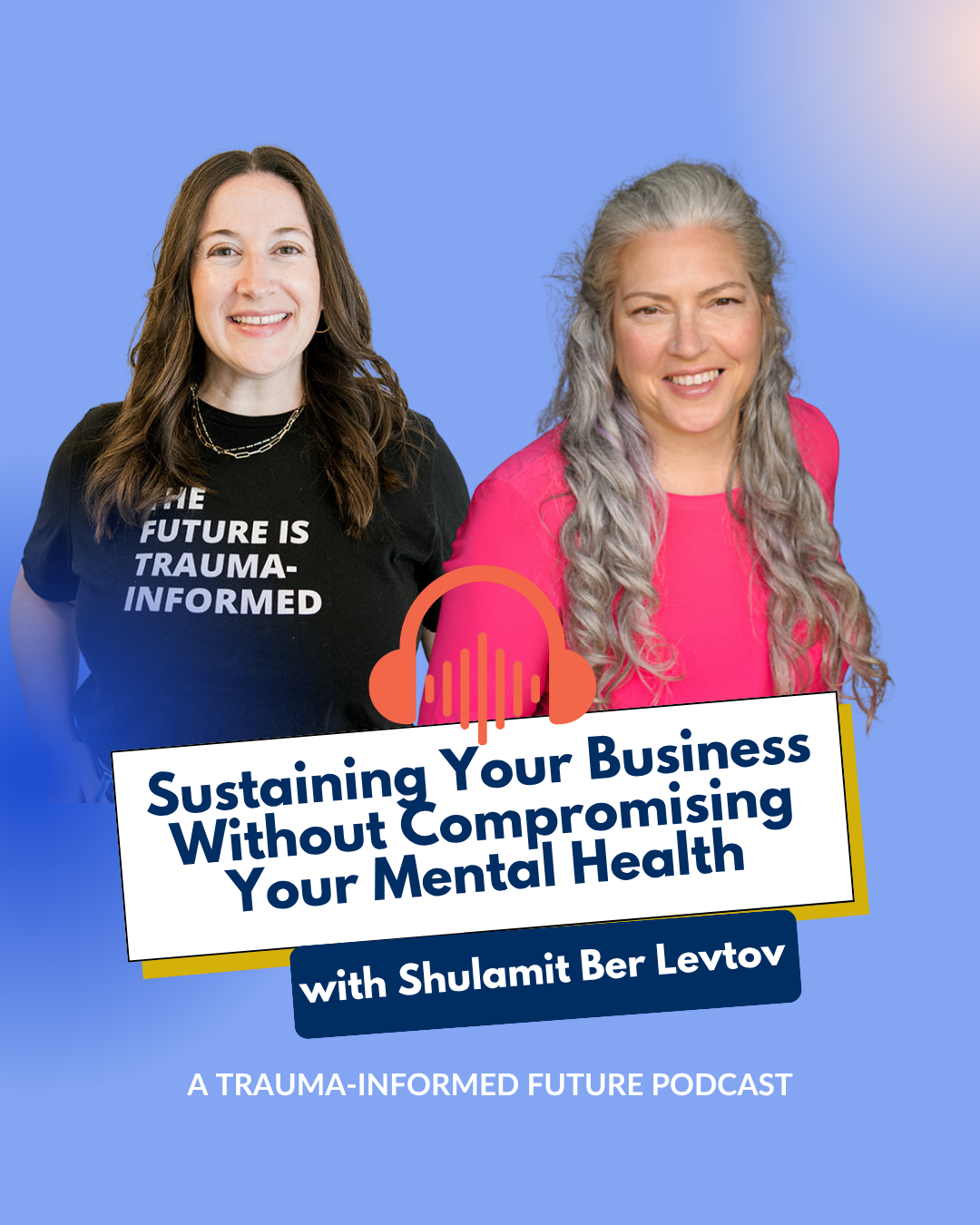
We shouldn't have to ever choose between a thriving, sustainable business and our mental health. The emotional exertion that goes into being an entrepreneur can be isolating and exhausting. In today's episode of A Trauma-Informed Future podcast, host Katie Kurtz is in conversation with the Entrepreneur's Therapist, Shulamit Ber Levtov. The discussion highlights the lack of mental health support for business owners and the intersection of emotions, finances, and stress management in entrepreneurship. Shulamit contributes insights into childhood trauma's influence on money management, emphasizing the need for trauma-informed leadership and sustainable self-care practices. The episode advocates for integrating trauma-informed approaches and mental wellness in both personal and professional spheres to support business sustainability.
Learn more about Shulamit Ber Levtov:
Shulamit (she/her) is the Entrepreneurs' Therapist. She is working passionately to mitigate the entrepreneurial mental health crisis through keynote speaking and educational workshops and by supporting women entrepreneurs 1:1 to care for their mental and emotional wellbeing and their money psychology in an era of relentless stressors that can make you want to lose your crap on the daily.
Shulamit has been an entrepreneur for over 27 years and has more than 22 years of professional experience supporting women's mental health and personal growth. In addition to working with clients 1:1, Shulamit teaches in private and university business programs and speaks locally, nationally and internationally about the intersection of mental health, trauma, financial psychology and entrepreneurship.
As an award-winning entrepreneur, masters-level, licensed trauma therapist and trauma survivor, with certifications in Dare To Lead™, Trauma of Money and Nonviolent Communication, Shula brings a unique perspective and approach to supporting women in business.
Connect with Shulamit:
Website: https://www.shula.ca
Instagram: https://www.Instagram.com/the_entrepreneurs_therapist
Subscribe to her newsletter: https://www.shula.ca/newsletter/
Mentioned in this episode:
Laura Vandernoot-Lipsky
website: https://traumastewardship.com/
video: https://www.youtube.com/watch?v=uOzDGrcvmus
book: https://traumastewardship.com/inside-the-book/
Sustainable Compassion training field of care practice
introduction to the practice (audio): https://sustainablecompassion.org/audio/field-of-care-meditation-2/
Guided field of care meditation: https://sustainablecompassion.org/audio/field-of-care-meditation-3/
Show Transcript:
Whenever we're talking about our humanity, our health, and all the dimensions of wellness that we hold, whether it's physical, mental, emotional, Spiritual. All of these different parts of our health. There's a lot of nuance. There's a lot of gray areas and there's a lot of invitations to go deeper and to be in conversation. And today I am honored and excited to be bringing you in my conversation where we kind of ease into these edges and these areas of gray and also have a really juicy conversations around the intersections of trauma and mental health, mental wellness, and healing. Today I am in conversation with Shulamit Ber Levtov. Shulamit uses thisshe/.Her pronouns and is the Entrepreneurs Therapist. She's working passionately to mitigate entrepreneurial mental health crisis through keynote speaking and educational workshops by supporting women entrepreneurs one-on-one to care for their mental and emotional wellbeing and their money psychology in an era of relentless stressors that can make you want to lose your crap on the daily.
Shulamit has been an entrepreneur for over 27 years and has more than 22 years of professional experience supporting women's mental health and personal growth. In addition to working with clients one-on-one shulamit teaches in private and university business programs. And speaks locally, nationally and internationally about the intersection of mental health, trauma, financial psychology, and entrepreneurship. As an award-winning entrepreneur master's level, licensed trauma therapist and trauma survivor with certifications in dare to lead trauma of money and nonviolent communication. Shula brings a unique perspective and approach to supporting women in business. And delighted to bring this conversation with Shula today, I admire Shula so much.
She has been a source of light and support. She has been an anchor of accountability and so today, I am eager to bring you this conversation. So let's go ahead and get started.
Katie Kurtz (she/her): Hi, everyone, and welcome back to a trauma informed future podcast. I am honored to be sharing space and conversation today with my dear colleague, Shula. Welcome, Shula. It's so good to see you. And thank you for, for coming on here and being in conversation podcast is. A semi selfish way for me to just go deeper and connect with some of my favorite people.
And I know you and I are newly connected, but someone I admire and have followed for a long time. And so it's always such a joy to be able to build relationships with folks in this work in community, in trauma informed community. So, I just wanted to name that and acknowledge that. Thank you for being here.
Shulamit Ber Levtov (she/her): Thank you, Katie. Well, it's so mutual. This is one of the beauties to me of social media is that we can find folks and connect with folks and I've been following and admiring you and your work for years. [00:01:00] And To, I responded to you in your posts. I responded directly and privately.
And social media in that way is an open door when we're respectful of one another's boundaries, we can open a dialogue just like that. And that's what I did. I just was like, I'm gonna send her a message. And so I did. And I'm really appreciative of how that led to this deeper connection.
Katie Kurtz (she/her): Yeah. Thank you. I always think of social media sometimes, although lately it's felt a little harder to describe it this way, but like, Yeah. At least through COVID, it felt like it was my front porch. we're all at home. It felt hard to know what was going on. So it was just showing up saying what's everyone doing and creating connection.
And I always acknowledge the nuance of these are parasocial relationships. Like we don't really. really know each other in, in real life. But at the same time, I have built beautiful and deep connections with people I've met online. And I'm very grateful for that. [00:02:00] And I know social media can be a place where it can be dehumanizing and disconnecting and, also can be regenerative and bring us to people we may not be able to find in our own neighborhoods or communities.
And I think for me personally, connecting with trauma informed leaders across the globe has been one of the biggest gifts social media has given me because in my community here in Cleveland, Ohio, there aren't a lot of people, like we have a little group, but It's not as common and to meet people who are in this work and co creating the trauma informed future we all need and deserve it's a long game.
Like I always say, we need community. I'm just always so delighted and grateful to be able to do that. And I always appreciate that outreach. I do the same thing. Most of the time people are, open and welcoming to that.
And I'm grateful for that. Cause it just builds, bridges to people we may never have gotten to meet in the first place.
Shulamit Ber Levtov (she/her): speaking of [00:03:00] trauma informed and bringing it home to social media, because that's what we're talking about same as any other technology. It's the tool itself is mostly neutral I would say. Yeah. And when we are aware in the case of social media, how they are constructed to exploit us, and they are not trauma informed, ultimately, but when we're aware of that, then we can make choices about how we use these tools in a supportive way, rather than a way that takes away, because typically we just sort of randomly follow whoever whatever that's interesting to us.
And then the algorithm sends us stuff that makes us feel bad about ourselves. It looks great to look at, but we feel bad about ourselves because we engage in comparison. And then it feeds us the solution to the problems it's created. But when we can curate what we're doing on social media, because when we bring in boundaries, which are as much important, I think they apply in like every aspect of life, right?
[00:04:00] That When I have my social media consumption in a container and I have boundaries around what I allow in that container and when I engage with that container, then it can be super supportive, but just used willy nilly like we're encouraged to use it. It can be extraordinarily harmful.
Katie Kurtz (she/her): Absolutely. I'm so glad you brought that up because I think it ties so much into what you do as the entrepreneur's therapist. As an entrepreneur, we rely on marketing. Gone are the days where you can say you're just an online business, whether you're online or you have a brick and mortar or a service based industry, everyone's using social media as a main method of marketing and showing up. generally in an authentic way means something different for everyone but doing so it's not just showing up and sharing who you are, especially if you're a service based provider Your service is you so you have to show up and show people who you are but you also are building connections and a brand and there's a lot of pressure.
I know for me [00:05:00] As i'm in my eighth year as an entrepreneur And I'm like business provider and everything like who the roller coaster ride it's been to be on social media and I generally speaking, have had very positive experiences for the most part. In that I choose to , like this, like finding people, building relationship, and I'm appreciative of the difference that I can be open to to learn from and expand my learning and also, especially recently, like what we're seeing with Instagram settings of kind of silencing political content I've been very grateful to have access to more points of view and people from all over the world to learn about things I typically wouldn't get in my nose feed.
And I cherish that, like that's a really important thing to have access to, but also acknowledge, and we have debates and we talk and we learn and we advocate and we protest and all these things, but at the [00:06:00] same time, how much can we actually accomplish via DMs on Instagram? Like it's the in both of things, right. Like an important vehicle, but also. It's not always a productive one.
Shulamit Ber Levtov (she/her): Well, for clarity I'm not on social media for marketing and that's not part of my marketing plan. My marketing is exclusively SEO and Google ads. so I'm on social media because this is one of the things that I learned when I learned about as a therapist, as a service provider, people are Googling especially for the entrepreneur's therapist. It's the midnight Googling. I can't sleep because I'm so stressed about my business. I need help. That they will come across me or you or whoever their whatever kind of service they're looking for. And so my goal in my marketing is to show up in the search on Google, either through my SEO or my ad or a combination of the two.
What happens though, is that people then speaking of trauma informed [00:07:00] consumers want to check us out. And that's when for me for my strategy. I need the social media presence. It's like ground cover, when you come to a house and there's you look at the house.
It's beautiful inside but the curb appeal. It's like a dirt yard and there's, the garbage hasn't been taken away yet and maybe there's a car up on jacks in the driveway versus if I had cleared out the driveway and planted a plant. Is ground cover that covers my front what used to be dirt.
Then people go, Oh, well, this is interesting. And then they look deeper. They come into the house. And so social media is not my marketing. It's actually for me, psychoeducational and then for connecting. So because of that, though, it has a very different effect on my mental and emotional wellbeing because of the way I use it.
And as you say, folks who rely on it, and you [00:08:00] must. Be there for the sustainability of their business. It makes it much more difficult to navigate because of the exposure to all the other stuff. I want a fuller picture than what I can get from the TV news or the radio news which I choose to listen to for world events. Yeah. And I value social media for that as well. And at the same time, too much consumption of any of those things, radio or TV news or the social media activism side, if I don't have good containers around these things, it's extraordinarily dysregulating
I'm acknowledging what part of me is calling hypocrisy. Because as a Jew with Israel committing genocide against the Palestinians, it's emotionally much more complex for me than say, Russia and Ukraine last year. And while people are people are people and there is no differential value on human life. [00:09:00] This particular situation has a deeper impact on me personally, not deeper, but different. And so at times when it has a personal tone to it, then of course it's much more dysregulating to be engaged in the social media world.
So it just requires I think, just like all trauma informed. If we are living trauma informed lives. It's a real practice of paying attention , how something affects us and what we want to do about it for sustainability.
Katie Kurtz (she/her): Absolutely. Yeah. Thank you for sharing and naming that and that duality and complexity of., again, the opportunity and the window social media gives us to the depth of issues, but also people and voices and representation we typically don't get seen in mainstream media. And also the dysregulating and re traumatizing nature that can be when we're not consenting in our scroll necessarily and videos pop up [00:10:00] or images or it's just.
Non stop and we don't have The break and yes, we can turn the app off, but it can get complicated and especially if we hold identities where it's directly connected to those things. It has a deeper impact and that makes showing up harder and heavier. And I feel that heaviness just generally, I've been feeling it for a long time, many years, but especially The last year and the last six months or so it's a palpable feeling. But I appreciate you naming that. I'm curious if you can first just share a little bit about what the Entrepreneur's Therapist means to you and what that means because it connects to what we've been just riffing on here about social media is We can have all the business plans and the marketing strategies and all the things, and we can apply trauma informed care to all of that, right?
But if we're not also applying it to ourselves and caring for our mental health, our emotional health, and applying trauma informed care to our lives, we're going to [00:11:00] still see a little bit of an imbalance or an impact. And I'd love to hear from you. Cause I know this is your sweet spot.
This is what you do and you come from a beautiful lens of trauma informed care. So that was like four questions in one, but just talk to us, Shula, tell us what you do just for clarity purposes. And then how we're showing up with trauma informed care within Our own personal lives.
Shulamit Ber Levtov (she/her): Sure. So I'm Shulamit Ber Levtov and I'm the Entrepreneur's Therapist and I speak and teach and consult on the intersection of mental health and entrepreneurship. And I also provide one to one emotional support for women entrepreneurs so they can preserve their mental and emotional wellbeing, preserve their peace of mind as they ride the emotional rollercoaster of running a business. And, both of us have been in business for a long time. Let's say eight and 10 years, sometimes I hear people say for a long time, and it's two. But yeah, eight years for you and 10 years for me. And I know we both have experienced [00:12:00] the demand. Demand is not bad necessarily, and it's important to recognize the impact that the nature of the demand, the extent of the demand and the impact of the demand. Because I think that's part of the sustainability equation. And I think trauma informed comes into things for me, in the context of what I'm saying right now, in the form of sustainability. Sort of as a response to the hustle and extractive cultures of business in which we live in, you're in the US, I'm in Canada, a trauma informed response to that exploitation is to say, I do not want to exploit myself. I don't want to reproduce these systems of oppression in my life or in my business to the extent possible. And so I want clear seeing about the nature of the work that I do so that I can be in choice around it. And I think choice. Autonomy is [00:13:00] another trauma informed principle. It's the opposite of trauma. Trauma is being overpowered and having no choice. And experiencing harm. That's one of the ways we can look at what trauma means. And so to flip that on its head and to say actually, yes, I am having choice about this to the extent possible, given the conditions around me.
I encourage this in my clients. This is the sustainability equation, so to speak, for clients, but it's also the equation for me as a trauma survivor who was a therapist before I started working with entrepreneurs. And I'm going on a bit, but where I first got the idea of the intersection of mental health and the work we do is when I was taking my master's and there was all this talk about self care, but no time in the master's program to do it.
It was not integrated into the program I'm sure it wasn't integrated into yours. I'm sure you heard the lip service. And there's lots of lip service to vicarious trauma as social workers, folks who are working with trauma. And [00:14:00] there's this underlying assumption that I saw that if something's the matter with you, it's because you haven't taken good enough care of yourself.
And I remember when Laura Vandernute Lipsky's work came into my awareness, she wrote the book Trauma Stewardship. She has a great YouTube video, I think it's called The Cliff. We'll get the links in the show notes because that video I It's 15 minutes of your life and it's worth every second of it, even if you don't read the book.
And when I came into relationship with that, I suddenly saw how completely flawed it was to assume that when as therapists, when you're doing work, that is going to have an impact on you. That's the nature of the work. And then to say, self care will buttress that. And if you suffer in quotation marks, the consequences of the work that you do, that's because you didn't take good enough care of yourself. blame the victim.
So I was thinking about that as a therapist in my therapy practice already. And then [00:15:00] when I started to think about mental health and entrepreneurship, and I started to have some years in as an entrepreneur and started to hear from other entrepreneurs. I was like, Hey, wait a minute.
Entrepreneurship is demanding and we will be affected by it. Just like trauma work because I was originally a trauma therapist trauma work is demanding and we will be affected by it. Because to not be affected is to not be human and as a trauma therapist, I want to be humanly present with another human in their distress.
That's the healing value of the relationship is my presence as a human being with that other person. But if I want to be humanly present, then I have to be humanly capable. So anyway, I'll stop there. I'm sure you have lots to say. I'm so curious
Katie Kurtz (she/her): so much to say. . I get a very physical cringe around the term self care, and it's not because. of self care and what it means. It's what I've been taught. It ultimately is a very beautiful and [00:16:00] necessary thing. But I remember when we really started talking about self care and this was like, 15 years ago when I started my social work practice. It felt like a new thing, and it obviously wasn't, but it felt like that, like we're finally not saying it in the shadows, but like coming out and talking about it.
But my experience is exactly that, we talk about these things, but we don't integrate and practice them, and I've shared my story before about being, a very new social worker and experiencing some significant physical trauma all at once. On the job and literally being patted on the back like You're going to be so successful because you're a real social worker now you've done it, you've taken the hit.
And I was like, what? Shouldn't I go to the hospital? I don't know. And then ushered off to run my therapy group and it was just the norm and It was ingrained in me to do that, to run into the crisis, to run [00:17:00] into a potentially unsafe situation, and walk out being like, no big deal.
And that's who I became. I became the person that ran into the fight, that ran into the street to save someone. You run into those crazy situations and I became like almost addicted to that adrenaline rush because I saw this as I'm more seen in my field when I do that.
And when I come up being like, no big deal, even if I'm hurt or putting your hands on somebody for restraints or things when I think about it now, I'm just like, oh, I can't believe I ever did that. I, ugh, no. I get it for the safety of people, but also, it's complicated.
But I disregarded the self care, because I internalized it as a sign of weakness and also a sign of somebody that Won't get ahead because I'm not deemed as somebody who can handle it, right? And thankfully, well, I burned out very quickly. Because that's not sustainable. And out of it, it [00:18:00] took many years.
And even still the physical imprints of that trauma and when something like a crisis happens in my life I feel that inclination. And that's so fucked up. What is that,? That's like a whole other thing of social work, but it's true. We feel that impact, and I think as an entrepreneur, and I've had, several conversations, and I'm always in my own healing work around it, too, is that I've noticed those things come up we're not always prepared.
There's no like entrepreneurship 101 class out there, right? If there is, it's probably gate kept behind some like 10 K price tag. But, we're not given these things. I think your work, Nicole Lewis keeper, like this even had conversations recently, like Kelly Campbell around conscious leadership.
Like everyone's talking about this in a different way. But the commonality is taking a step back and looking at entrepreneurship as a system, and are we continuing to function around these systems that weren't designed to support our mental health, our emotional health, and also how our own wellbeing.
lived experiences and [00:19:00] identities can impact that. And I find it so fascinating. And I always get so many light bulbs in my head. I'm like, of course I do this. Or in your work, like around money Oh my God. If we come from, lived experiences of poverty or near poverty or any trauma around money, like that is something that can really flare up in entrepreneurship so much.
Shulamit Ber Levtov (she/her): Well, money is a super satisfier in this culture, right? It's a strategy that meets many needs. And in particular, money is tied to worth, like self worth. And belonging and so self worth and belonging on the one hand and actual physical safety survival on the other hand. So when you have something that's connected at that level, it's under assault daily.
And so you don't even need to have had trauma around money to have. Nervous system responses to money stuff to feel shame about your money on a daily basis. [00:20:00] And if you have trauma that's not related to money, it can come up in money. So for example, this last Monday we chose to euthanize our senior dog.
And every week I have a process I go through with my money to manage the flow of money in my business so that there's money in the operating expenses account so that when the automatic bills come through, the cash balance is there. So because it's a cash flow management thing even though I took time off work, I still needed to make sure that the money was in the right place.
Well, I found out yesterday when I went to do it for this week, that last week I transferred 1, 950 from one bank to another bank of mine. I don't know why I did it. I don't know what that number was for. I keep records, but for whatever reason, I couldn't find the record I kept of it. But worse than that, worse like emotionally I miscalculated.
So the second bank to which I moved it [00:21:00] recognized that I didn't have that in the first bank, sent it back and the first bank dinged me with an NSF.
So I'm neuro diverse. I for sure have dyscalculia, which is a math related disorder. Dyslexia type learning disability is the phrase that I like to, so I have difficulty with math, but I also have some executive functioning challenges. My working memory doesn't work, I literally don't remember things. So I felt shame when I saw that. And I still can feel it. I don't know if you can see, but my lower lip is trembling a little bit and I can feel the shame kind of physiological response in my body. Okay. When I saw that yesterday, because it brings up the shame around the screaming that I experienced when I was a kid at home trying to get coached from my parents about math problems, all the times that I've gotten in trouble for forgetting things.
My frustration around trying to cope with these deficits. All that came up. And I mean, in the scheme of my business and the cash flow in my [00:22:00] business, the $50 NSF charge is not, I was like fuck 50 bucks, God dammit. But like emotionally, I had a whole reaction. But in the cashflow of my business, $50 is like, so what? Okay, so I just have to manage appropriately where I'm recognizing from a friend of mine, for example, who also has ADHD and has had a kind of a miscommunication around a bill payment that's coming out and she's got now 700 and some NSF charges, which is the what we would call the ADHD tax, right?
And so for me, the 50 bucks was the dyscalculia slash grief tax. So this is not related to money trauma, but yet here was the whole thing over what really, honestly, as far as money and emotions is concerned, this is an example of where I want to build fault tolerance, where I can say to myself, compassionately. It's okay. Nobody was a witness to this, but you. The stakes are very low. Of course you're feeling distress around this because this brings up all the emotions that I've just mentioned, and [00:23:00] it's okay, it doesn't have to take up space for me. But that's just a story. I don't share client stories because of confidentiality.
So I tell a story from my life to illustrate the kinds of things that we work on together. But that's an example of traumas that are not directly related to money that showed up in a money thing for me. So trauma, emotions, and money is a very complicated relationship because of the way money is so complicated in this culture.
Katie Kurtz (she/her): Yeah. Thanks for sharing that story. I think it's such a great. Example, and I always appreciate examples like that. And because we've all been there. I mean, who among us and you're right, it could be anything. It doesn't even have to be money. Our nervous system responds in various ways to our business.
I think of launching. Like, when you're in a launch, if you've never launched anything, like a live launch, it takes so much energy and planning and resourcing. And I was [00:24:00] joking, half heartedly with a friend recently about launching, we were talking about it. And I was reflecting, I was like, I have launched my now retired Cultivate.
It's a trauma informed space holding training that I've led for several years. It was always a live launch. I kid you not, every time I've launched, it's been a Mercury retrograde, so the technology I should have been more planful, but every time, , I'm like, this is when I'm going to do it, and then I look at the calendar, I'm like, I did it again, but I needed to launch during that time, so I was like, alright.
And, or, A major historical thing was happening. I launched during the January 6th political riots here in the United States. I launched during the election in November of 2020. I've launched during when the war broke out in Ukraine. I launched in like major, there was like a hurricane one time. I was like, I can't control these things happening in the world.
And I know I can control my launch, but when you plan for something, and I think this is where trauma [00:25:00] informed care. with yourself and in your life is so Important is I have to practice adaptability and flexibility And I had to be like, okay Of course, this is happening again. But what better time, to be launching trauma informed care training During another historical sort of trauma.
So i'm like, okay, this is okay And then also how can I be more adaptive in towards myself? How can I resource myself? Do I need to make it longer or shorter? Or just name what's kind of going on and it's been such a learning and growth edge for me to launch during those times but goodness.
It's exhausting. It brings up every story , I think I've gone through like my whole life journey in every launch because it brings stuff up, because if you have a longer launch, people might not buy till the end. And then least for me, you have all these like freak out moments.
And then, the dopamine hits when you get a set, like, it's all these things, or you tie it to Certain stuff. It's just a lot. And I just, I think [00:26:00] launching specifically is one of those things where I've learned the most. And it's been A hard learning lessons. Good, but hard,
Shulamit Ber Levtov (she/her): well, it's such a depth of vulnerability. When you're a service provider, some aspect of yourself is what you are offering. So there's visibility involved and there's survival, which visibility can feel, especially for trauma survivors who are business owners, right? As Nicole Lewis Keeber teaches, visibility can be really difficult for trauma survivors who are entrepreneurs, because for many of us whose traumas were interpersonal traumas, being seen meant we were vulnerable to harm.
And so, we can know this with our awareness and still our nervous system can have a reaction when we launch, but so can anybody because visibility, you stick your head up, you could get whacked. It's just a simple right. So there's that. And then there's the the hopes, the survival hopes, or the, just the vision. If it's not at a [00:27:00] survival level where I absolutely must make X dollars for my business to survive, which of course quite rightly evokes a survival response in your nervous system. Then there's the hopes and visions and dreams that this is your strategy for making those things come true. And if they don't, that's a loss and there's grief involved.
so, it's all this emotional labor. And every time you go through it, every time you launch, you have this whole emotional metabolization process that you have to go through. You don't have to go through it. Some people just put their head down, grit their teeth and power on.
I don't think that's sustainable. I think that's the most painful way you can go through something that's difficult. I think there are ways to go through difficult things without the added layer of suffering, right? And with potential gifts ultimately at the end of the process, instead of just marching through nothing but distress.
Katie Kurtz (she/her): Yeah. I [00:28:00] love how you've talked so much about sustainability. And I think that is a whole other immersive podcast of its own to talk about how much emphasis we place on money making things in our business, which are important because it's a business, right? However, sustainability wise, we as entrepreneurs, it's a unique career and job role because, especially for service based entrepreneurs, it's centered on us. So we're a main mechanism of the delivery of that service.
And our capacity, our season of life the happenings in our life, I'll impact how we serve and show up and sustainability wise, if we aren't aware if we don't have, attuning to that or resourcing ourselves in ways it won't be sustainable. And, I am entering my eighth year of being an entrepreneur, but I am really only in my second.
year full time. I've always had a full time job while [00:29:00] having my business for many reasons namely because of student loan forgiveness in the United States. I was tethered to a requirement to have that happen because if not, I wouldn't be able to afford them as a social worker and first financial security for personal safety purposes, for caregiving purposes, for health insurance all these reasons, right? And It's now being full time it's different. I feel the pressure a little more than I did before. And nothing's taught me more about myself or has been so instrumental in my own personal healing than being an entrepreneur.
But I'm a service provider. if I get injured, if I get sick, I can't show up and do, I mean, that's true for most jobs, but I don't have pay time off or, cushions. As a caregiver, I'm at the mercy of the ebbs and flows of two [00:30:00] people who are chronically ill and actively dying.
Which, you never know what's gonna, as we speak, my dad's in the hospital right now. I did not plan for that. I have to move on. I have to show up. It's just a part of our lives, but it's something that impacts my capacity and my time. And so you have to, again, applying trauma informed care to myself and my life is so essential because I have to practice self consent, boundaries, flexibility asking people to maybe move their schedule around so I can have a little more time, leaning on my resources, et cetera.
So I'm curious if you can talk to us a little bit about that intersection of mental health care, trauma informed care, and the sustainability. What does that look like for us as entrepreneurs? What can, folks listening who are like, yeah, I really, I see this, I get it, but like, where do I begin?
What do I do? How do I start?
Shulamit Ber Levtov (she/her): Sure. So the way I [00:31:00] teach it is using business language to talk about mental health or mental and emotional wellbeing. Maybe I should just roll it back a little bit and say there's a spectrum from mental health to mental illness and even within the domain of mental illness, there's a spectrum and even in the domain of mental health, there's a spectrum, right?
So it's a whole lot of gray. I want to be clear that when I work with entrepreneurs, I'm working with folks who for the most part. If they have a diagnosis that is cared for by someone else or they have other strategies to care for that. And where we're working is at the intersection of entrepreneurship and mental and emotional wellbeing.
That is to say how being in business affects your mental, emotional wellbeing. Dr. Michael Freeman, who could be considered the grandfather of research into mental health and entrepreneurship. He says, there are two aspects, what you bring to the party and what the party brings to you
so what you bring to the party, how [00:32:00] your care and your life outside of the business impacts the business and how the business impacts your mental and emotional wellbeing and the rest of your life. So it's in that intersection that I'm working with folks. And so I use business type language to talk about mental and emotional well being, because as a metaphor for folks who are actively engaged in business, it makes sense, because we all know that risk is inherent in business, and that the way we mitigate risk and ensure growth is by having a plan, we might the plan might be in our head and it might be an amorphous plan, but nevertheless we have a plan and we all know if you've worked in a coaching program or with a coach or whatever that it's better to have an actual plan written out. Right and you need to have a plan for your marketing plan and financial plan a cash flow forecast all those kinds of things.
So then when mental health challenges are inherent in the nature of the work we do when mental health challenges are inherent in entrepreneurship, then we also need [00:33:00] a mental health plan for the business owner as an integral part of business planning and processes. So just like you know what your KPIs are for your business, your key performance indicators, right?
What you're measuring what you're doing, the strategies you're using to get the results you want. You also need to know what your KPIs are for your mental and emotional well being. So the first step is a process of observation or inquiry or awareness around how do I know I'm doing well? And how do I know I'm doing poorly?
That's a lag indicator. That's an outcome, right? What are the signals in my life that things are going down the tubes? And what are the signals in my life that I'm actually doing well. And there's a whole inquiry process into that. Once you know what they are, then you can check in with yourself weekly. I would propose because most folks, I really liked the 12 week year, the 90 day planning process just because of the way it nests down and makes things so much more manageable.
And so on a weekly [00:34:00] basis, when you're looking at doing your weekly review, what were your, wins, what worked and what didn't work? What are the lessons from that? And what are you going to change going forward? Take five minutes out of that weekly review process to look at your lead and leg indicators for your mental and emotional wellbeing.
Am I doing well? If not, why not? If yes, why yes? What do I want to do more of? What am I going to do less of in terms of self and communal care for the week coming forward? And then I evaluate, did those things support me or not support me? Or to what degree? And what am I going to do differently? It's also important to acknowledge that there's one other aspect.
Not only your key performance indicators, not only your lag indicators for yourself, which is how you're doing, but the lead indicators, which are what you're doing to care for yourself, communally and individually, but also what are the external conditions. World events and other things. So I have a list also when we go through an inquiry process because what happens is folks [00:35:00] come to me thinking there's something wrong with them.
And when we take in the inventory of all the crap that has hit the fan in their life for that week, They go, Oh, well, no wonder I'm feeling the way I'm feeling and I'm like, yes, exactly. But it's invisible unless we check in on it. And that's the other half of the weekly check in.
Those are the lead indicators. What's going on in my life? What's going on in my business? What's going on in my world? What is the impact that it's having on me? And what am I going to do about that? So that in a nutshell, we go through that usually in a four and a half or five hour retreat setting where folks have the opportunity to really get their teeth into these concepts and develop their own process around this.
So the very first place to start is to be curious about what's going on in my world and what effect is it having on me and paying attention to that on an ongoing basis. That's the simplest way. That you can start around this equation of mental health and sustainability in my business.
Katie Kurtz (she/her): I love that I was [00:36:00] listening to you, and I was thinking about, from a trauma informed perspective, those practices that are key practices of trauma informed leadership for how we would deliver care, and then, but it's the care we give ourselves. Transparency. So, opting for curiosity over judgment. Pausing. To attune what's happening, what's going on, naming and acknowledging all of these things, creating some predictability and consistency, honoring flexibility and adaptability, like all of those things are what we would do for others.
This is why I always hone in on this by directionality of the approach, because I know I was not taught. I learned trauma informed care from the people who created it. I'm very fortunate. I was trained by SAMHSA learned from a lot of people who were leading trauma informed care before it was formalized.
But in the work setting, I was taught, again, kind of full circle to what we were talking about before. As a [00:37:00] trauma therapist, we hear, horrific stories we witness the pain, and we bear witness to people, but I don't know about you, and this may be a very American or Ohio even thing, but we're taught, you shut it down, it's boundaries, boundaries, boundaries, ethics, if you ever self disclose, if you ever show emotion, you could lose your license, a lot of fear mongering, and it never felt right to me. And I think that's why I left the therapist role, because I was like , I don't feel human here. Like, how can I not, show up, obviously beautifully boundaried and with ethics, but can I not be human too? And to deliver trauma informed care, why aren't we also delivering it to the people who are in the workforce who are offering this when we're also experiencing so much vicarious trauma, some primary trauma, and just toxic stress environments.
Things just never add it up. And that's why I teach and emphasize so much the bi directionality, because we can't be trauma informed [00:38:00] without also applying it to ourselves. And I think it can feel a little wobbly because, again, it's connected to either stories or systems that don't mirror to us how to do it.
Shulamit Ber Levtov (she/her): Yeah. My belief as originally a trauma therapist is not according to the code of ethics, but according to ethics, like small e ethics, it is unethical to be doing work with trauma survivors. When we ourselves, the three phases of trauma treatment, stabilization, memory processing, integration. If we are not caring for our own stability, holistic stability across the board, and we come in to work with trauma survivors and we are working with them on their own stability, even in the room, just on a basic level of nervous system care, which is what Stability looks like in my opinion , trauma survivors have spidey senses. Our clients will know that there is [00:39:00] something off. So that's fuckery right there. Gaslighting because there's a lack of congruence. Between what we say and what we do, and we bring that into the room and it undermines the therapeutic relationship, but it also and this is like on a very subtle level, but I believe that it's very true that it's harmful and unethical because we are by our very behavior gaslighting a person we are working with.
And for me, that was an absolute premise for me and my work, but I have to say that I've been political all my life and have had a systems point of view from my teen years. My politics are anarchist politics, and I espouse principled nonviolence, so I've studied nonviolence at length and trained in it.
I'm trained in nonviolent communication as a facilitator, and I'm also trained as a focusing teacher and [00:40:00] guide. And I had all that and in a relationship focusing is about the relationship with your inner life. And it's a somatic practice so that it's body led. So I came from, I don't know how many years of immersion and practice in those before I came to my training as a therapist. I came into my master's degree as an anarchist, a feminist. Espousing principled nonviolence, having a very deep understanding of nonviolence and of somatic, allowing the body to lead the conditions under which we live.
Anyway, don't need to go into that. So that colored my experience of my training and my practice. And right away I knew that I wanted to make my way within the institutional systems and structures. But to do that, I needed external support outside the institutions and structures to find my way through what I consider a harmful process within a process of indoctrination and gaslighting, that is the graduate level [00:41:00] training in therapeutic social worker, counseling, or psychotherapy. So I was already my own little fifth column, for myself in that environment. So I'm very grateful that I could be as much in choice as I was around how I structured my work with clients and my sense of myself as a practitioner, because I had a trusted person. deeply embedded in the European person centered tradition, which is extraordinarily political and also spiritual and is European, not U. S. American, right? Or even Canadian. And so my whole experience of that was different when I went into practice. Where had I done that when I was 25, for example, because I started my social work degree when I was 19, but I left it and then came back in my late 40s to go back to school to complete my training and become a registered social worker.
Institutions and structures are tough to navigate. They're just harmful. And if you don't come in them resisting. It's gonna [00:42:00] flavor, so that it, you get the outcomes that you're talking about, which are harmful, but they perpetuate because that's the whole point of academic training is to perpetuate the systems and structures as they exist.
So that's what we're taught to do.
Katie Kurtz (she/her): Yeah. So many thoughts. It's not uncommon for people to ask me, how can we provide trauma informed care in these systems, namely large institutional systems like government, health care, education, higher education, so the whole gamut those systems primarily when the injustice system, if you will, when they have long storied histories and also active policies and institutional.
Shulamit Ber Levtov (she/her): I'm going to interrupt to bring it back to something you said before our humanity. And transparency around that naming where we are. So, for example, I used [00:43:00] provide therapy through employee assistance programs. Clients consider themselves the clients, but the true client is the employer who pays for the therapy.
And the purpose of the therapy is to get people back to work. It's to reduce absenteeism and get them back to work. And it's limited. It's time limited. And people come into therapy expecting therapy to be this like long and caring and loving and wonderful relationship. And you're in a structure that doesn't support that.
So I would just name to folks. So listen, here's the thing. This is a bike, not a car. We can make great use of the bike. As long as we know it's a bike, as long as we both agree, yes, this is a bike. It's never going to do what a car does. And to acknowledge that there's a pain around what you really want as a car.
And that's painful and some grieving around that you don't have access to a car right now. And at the same time, we have a bike. So what can we do with the bike? How can we make this so that the bike serves your needs as best? Like it's what we have. So how can we make the best of it?
And I find that level of transparency and engagement mutual, it's not my problem to solve because I'm not a God. This is my [00:44:00] Al Anon family groups, it's not up to me. It's up to greater powers to solve this problem. And the greater powers are the powers of community, the powers of connection, the power that me and the client have together to solve our problems as much as it is.
Any divine higher power or spiritual higher power, there are many, that's why I say higher powers or deeper powers. And that we can put our heads together, the client and the therapist to navigate this together. And I think, yes, there are harmful systems and yes, it would be better if they were better or if they didn't exist at all.
And it's the bike we have at the moment and like, the emperor's new clothes, he's naked. Let's just acknowledge that. And now what do we do?
Katie Kurtz (she/her): Yeah, I love that metaphor of a bike, not a car. I might use that in the future and credit you and name you as that person because that's exactly it. And I always tell people, yeah, we have to name it. We have to name that we're in a system. [00:45:00] I've been in front of judges and said to their faces it's going to be very hard to do this approach in a system that continuously perpetuates it active harm and trauma. However, we can also integrate this approach and especially have champions and leaders within these systems who do believe in this becoming mirrors and modeling it.
And I have witnessed it and I have been that person. I have witnessed it in others and it matters. When we see people shift their language, when we see people ask questions that are different or at tables that can Model this kind of approach. Those small shifts can create a groundswell and lift, it takes a long time culture shifts.
And, I think that we shouldn't be discouraged by these systems, we just need to find a way to organize within them and adapt this approach and acknowledge a name again like I love that it's a bike, not a car, but that shouldn't limit us. Whether you're in a bike or a car, you can still get somewhere, [00:46:00] and so it shouldn't deter us from trying.
Yeah. Love that. Shula, the whole time I'm like, oh, and then we'll talk about this and that, and then it'll be seven hours and so I want us to come to a place of my gentle spritz of questions. But before we do, is there anything else you'd like to share or say before we close that maybe we didn't cover?
Shulamit Ber Levtov (she/her): No. And I want to reiterate something that has been implicit. I think we may have said it explicitly, but it's been implicit under all of this. There's just nothing wrong with you. We say in trauma treatment, we are normal human beings having normal reactions to abnormal circumstances. That's in the case of trauma.
It's hard to say that capitalism and colonialism and oppressive systems are abnormal. They are actually the norm. And humans coming into contact with these systems will experience harm. And it's difficult to be human in this world. [00:47:00] While it's painful, it's what should be happening. And there's absolutely nothing wrong with you.
If you're an entrepreneur having a hard time in business, it's because you're doing hard work. There's nothing wrong with you for having a hard time. If you're a therapist having a hard time being affected by the work that you're doing, well, of course you would, there's nothing wrong with you. If you're just a human being having a hard time in the world, especially now, of course you would be having a hard time.
That's what it is to be human now. And there's nothing wrong with you.
Katie Kurtz (she/her): Yes. Yeah, thank you. I needed to hear that today. Thank you. We need those reminders. And I think that's again how we can be mirrors to each other that whole premise of it, not what's wrong with you, but what's happening to you or what's happened to you.
I always remind people our bodies are brilliant. And of course responses are painful and life changing, but it's also our bodies brilliantly responding to keep us safe and survive. So thank [00:48:00] you so much for all of this and especially that beautiful timely reminder right now as we record this.
So I always like to wrap up with these few kind of gentle spreads. And I always say one word, but if you have more, that's fine. But if you could describe trauma informed care in one word, what would it be?
Shulamit Ber Levtov (she/her): Love. And I will refine that to say not the sentimental hallmark kind of love, but the fierce, deep, demanding practice of loving.
Katie Kurtz (she/her): Yeah. What is your current go to for nervous system care?
Shulamit Ber Levtov (she/her): This is going to make me a little teary. So I'm going to say hello to that.
So I'm training in a practice called sustainable compassion training. It's a meditation practice and the foundational practice is called field of care.
And it's a somatic meditation practice where you situate yourself somatically in the midst of this field of care.
And so there's the formal sitting practice, but then there's also the moment to moment practice during the course of the day. And certainly [00:49:00] I'm having three processes of grieving occurring at this time. So the moments of grieving come up regularly. And the practice of situating them and me in this field of care, where there is love abundantly available, warmth, kindness, openness, clarity, love,
is such a blessing. I'm so grateful. Part of me wants to say, because I don't know how I get through it without it. But as a trauma survivor, I know I can get through anything one way or another, but at the same time it would sure be so much more difficult to live these grieving processes, actually for grieving processes. Without the blessing of being held the actual somatic experience of being held in this field of care. I'm so grateful.
Katie Kurtz (she/her): I love that. That term field of care just brings a visualization of a big, beautiful meadow of wildflowers.
Shulamit Ber Levtov (she/her): Right. Yes,
Katie Kurtz (she/her): Beautiful.
Shulamit Ber Levtov (she/her): Yeah.
Katie Kurtz (she/her): And what does a trauma informed future look like for [00:50:00] you?
Shulamit Ber Levtov (she/her): Well, my vision is a world where people in distress are met with love. Again, the fierce love, not the hallmark love, not the sentimental love, but a world where people in distress are met with love.
That's to me what a trauma informed future looks like.
Katie Kurtz (she/her): Yeah. Shula, thank you so much for being in conversation and sharing space with me and everyone listening. Everything, it'll be obviously in the show notes, but is there anything else you want to share with folks or ways people connect with you, any new happenings with you or offerings that you want to share with everyone?
Shulamit Ber Levtov (she/her): First of all, if folks have appreciated the sense of validation that they got from what I said today, or if they appreciated the information that I shared, that's the kind of thing they'll get when they subscribe to my newsletter. So shula. ca slash newsletter is how you can subscribe.
And we can be in dialogue that way as well. You can respond to my newsletters, or you can just go to my website, shula. ca and send me an email [00:51:00] because I love to talk to folks. Those are my invitations.
Katie Kurtz (she/her): I love that. Your newsletters are brilliant. And going back to what you shared, I love your marketing strategy.
It feels like what a beautiful permission slip that we don't have to do it a certain way and we can find a way that feels most aligned for us and our capacity and our gifts and our energy and our brains and our bodies and all the things. Yes, I highly encourage being it. In the entrepreneur's therapist orbit of in some way thank you so much , again, for being here.
I'm so grateful. We're connected.
Shulamit Ber Levtov (she/her): Thank you, Katie.
