

Let’s Get Real About Resilience
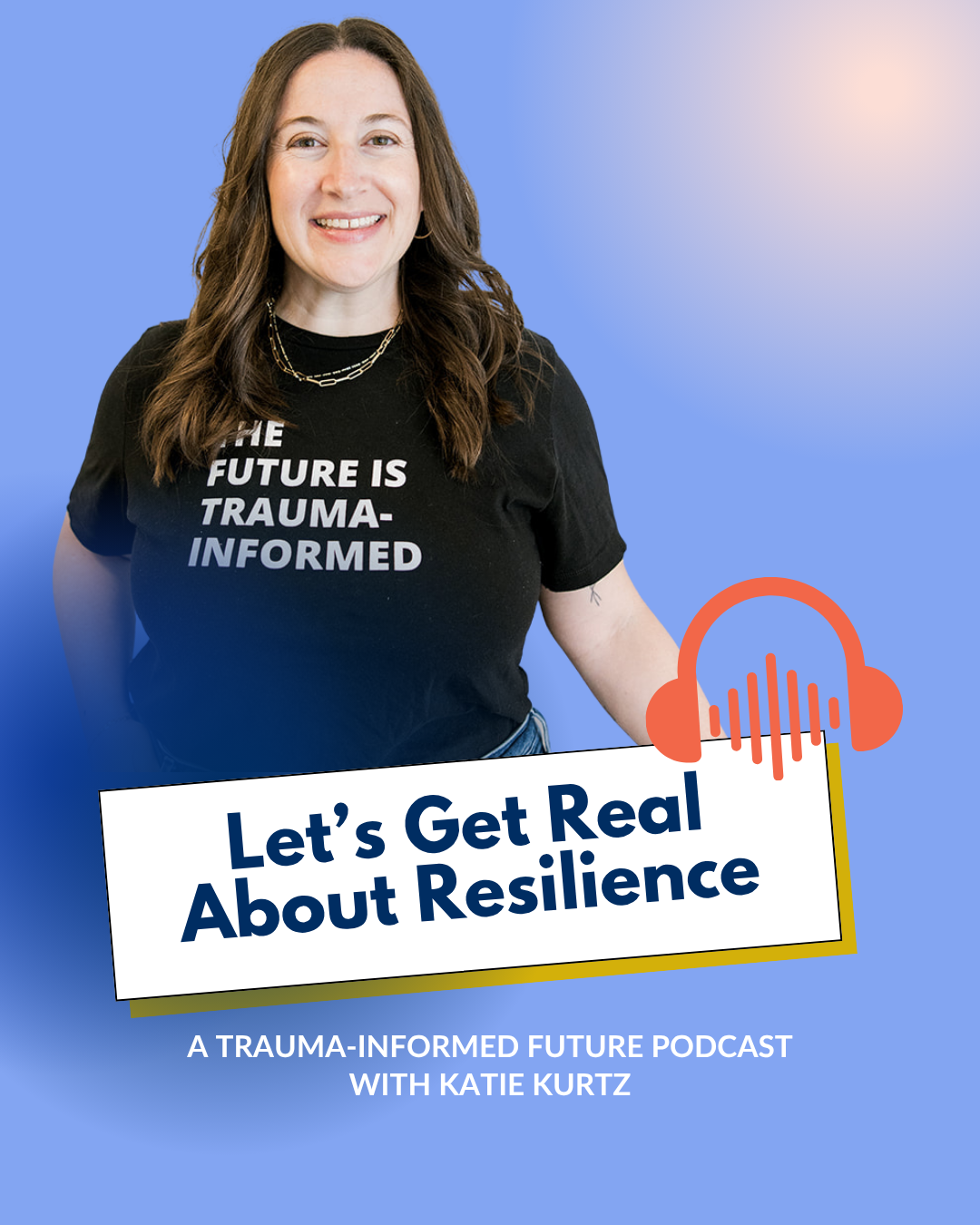
What comes to mind when you think of resilience? In this short and sweet episode of A Trauma-Informed Future podcast, host Katie Kurtz gets real about what resilience is, how we use it, and how we build it. Katie opens up about her personal journey, sharing a life update on caregiving for her parents, her dad's recent passing and the emotional toll it has taken. This poignant narrative anchors the episode’s exploration of resilience—not as "gutting it out"—but as our capacity to manage and recover from stressors.
Referenced in this episode:
Show Transcript:
Katie Kurtz (she/her): Welcome back to A Trauma-Informed Future podcast. This is the start of season five. I want to first just express my gratitude. We have had over 7,500 downloads in this first year of the podcast with so many incredible guests and. You have shared with me some beautiful testimonies of how this podcast has been an educational resource and knowing that you're not alone in this practice of trauma-informed care.
So thank you. Thank you. Welcome back. This is our final season of 2024. We have a lot of incredible guests this season, and some important topics to talk about a timely and connected to the cultural zeitgeists, especially here in the U S as we're facing a potentially life-changing election. And ongoing collective trauma and witnessing.
And so much to talk about and so much that can impact our trauma informed practice. So lots of good guests this season as well, going into really niche topics to go [00:01:00] deeper, into really understanding the application of trauma-informed care and areas in which we can apply it, that we may not traditionally think of.
So be sure to stay tuned, subscribe so you don't miss an episode. And if you find this podcast supportive please leave a rating and review it really helps. Let us know how we're doing and also but really just creates visibility of this podcast. Whether they're looking for it or they don't realize they need it.
I wanted to talk today a little bit about the topic of resilience and simultaneously talk about my own little life day update. Since we last connected a lot has happened in my personal life.
That has impacted me and my health and my capacity. And deepened my trauma-informed care practice. So I wanted to share a little bit about that. This podcast has really ways to share more depth to understanding trauma informed care as an embodied practice, how it is [00:02:00] integrative into an everyday life and how it's just applicable, how it really can be intersected into everything we do.
For those of you who don't know. In may of 20 24, my dad passed away. I have been caregiving for my parents for the last 15 years. And earlier in 2024, we hit a pivotal moment. Both of my parents entered hospice at the same time, their end of life care.
My dad was doing fairly well, although he was bedbound. A few weeks later, he passed away. And this loss is a compounded loss because of the complicated relationship I had with my dad, although he and I were able to have a really important and healing closure. Which I'm very grateful for, and I felt very at peace then, and I feel very at peace now.
But my mom, like I've mentioned before has Alzheimer's so she doesn't remember that my dad passed away. So that has been a really challenging. [00:03:00] And quite frankly, emotionally exhausting process to support her as she still is also on hospice care. His memorial was two months later, really end of June where all of my family came together and it was a really beautiful Memorial, a really important closure for me specifically. Like I said the anticipatory grief of caregiving and the complicated relationship over the years, and also supporting my mom who really had a hard time.
They've been together since they were 19 years old. And my mom's going to be 80 soon. So it was sad. And Just the emotional exertion of it all and the heaviness of having to do it, all of it by myself and the planning because my mom couldn't participate. So I was very tired and weary and grateful for a summer break.
And of course As it would happen. I got very sick with COVID and it really forced me to rest. I really needed rest. It forced me to rest. And I came out of that illness [00:04:00] really feeling okay, here we are. I'm finally able to reclaim some time reclaim some freedom. And I noticed my nervous system was really stuck in this survival state. This anxiety, this hypervigilance of that I've been so accustomed to over the years because as a primary caregiver of parents who were very sick and had in and out of the hospital for years. I was always waiting for the other shoe to drop.
I was always prepared for the next crisis. And that feeling was a residue, even though it wasn't there. Like there. The cause of it was no longer there that feeling remains, right? Because that's what happens. Our nervous systems, our bodies are brilliant and they're designed to keep us safe and to survive and protect.
And over the course of many years, my nervous system was doing that through a state of hypervigilance and that flight response. [00:05:00] And so I really recognize, I need to return to safety. Remember that safety within my body and within my environment. So I can really nurture my nervous system back to that safe response.
And so over the last few months, just re remembering, returning, doing things without urgency. Or fear. it wouldn't be taken away because I'd have to change my plans or put myself first has been a beautiful reclamation. Just like putzing around on a weekend feels luxurious even though it's very simple and I'm doing like very basic things like going to the farmer's market gardening, like listening to my audio books, walking the dogs, there's nothing huge or glamorous or big about it, but it's very simple. Ritualistic routine practices, right?
That predictability consistency, repetition pace and the reason I share this as it relates to the term resilience. You probably have been hearing a lot about the word resilience, especially over the [00:06:00] last few years related to the historical trauma of the pandemic, which we're still in, by the way. And we will have reverberating impact from it for many years to come.
I want you to pause and think when I say the word resilience, what comes to mind, who comes to mind? What images, what feelings, what sounds, what words come to mind?
For me I always thought resilience was gutting it out. My Aunt Gerry Who is like my mother figure. And she's also my care partner. Has always told me, when you get a job and you don't like it you just got it out.
And if you have to do something and it's hard or miserable, you just have to find your strength and gut it out. Which makes a lot of sense because that's what her mother taught her. And that's what her mother's mother taught her. And that's literally how those women who immigrated to this country, to survive. Just stay ahead to keep going is to gut it out. But resilience, isn't gutting it out.
It isn't pulling yourself up by [00:07:00] your bootstraps. It's not persevering despite the odds. It's not these heroes and capes that we always are seeing, in marketing or movies or whatever. Resilience is actually capacity. It's our capacity, our nervous system capacity too withstand stressors and adversities. And not to gut it out, and not to really bounce back.
I know some people. I see that. And if that's your thing fine, if that's a helpful visual, but more so this capacity, so when things do get hard or. Or unsafe or harmful or whatever. That it doesn't, you don't get stuck there that you're able, you're resourced. You have support, you have time, you have ability to get back to that neutrality. In a shorter distance, not immediately.
It's not like a bouncy ball where you bounce it, bounce rates back, but more they're shorter times. [00:08:00] Trauma happens when we don't have those resources, we don't have that pace. We don't have that capacity. If one thing happens over accumulation of stressors and adversities, and we don't have the ability to withstand it.
We get stuck because we don't have the resources, the support the safety and that's what happens. Our nervous systems don't have that space. Think of capacity is how much we can hold that space to sort things out and then get back to a space of neutrality.heal whatever ever it may be.
When we experienced trauma, there's no space left. There's no other option. We get stuck there. And so when I think about the experiences I've had over time, One thing kept happening over and after another, for many years, my parents were in and out of hospitals, very serious illnesses. We always joked because they loved each other very much. They were always together and they would always end up at the [00:09:00] hospital at the same time, which made it very hard for me. As a caregiver because I was running between two people . The last few years, especially with starting with the pandemic has been very stressful.
And one thing kept happening after another. And I wasn't finding reprieve. I wasn't finding respite. There were no breaks. It felt like a cosmic joke oh my goodness. Of course here's another thing. And. This past. Beginning of this year I hit a wall. I just I have no more space.
I had no more breathing room. I need to catch a break here. And I really had to have a family meeting and say I need help. I need people to figure things out. And we were really creating a plan. And then my dad ended up in the hospital. And that was the beginning of the end for him. But what happened from that was a gift of hospice care because it they've come in now and support my [00:10:00] mom two to three times a week, which was a huge relief and respite for me.
So with resilience I didn't have any, I couldn't find it because my capacity was limited. I had no more space left. Think of construction. With my dad passing away and things shifting. I'm not going to lie. There has been an element of relief because that demand has been lifted and I have more space. And after 15 years, it's like, what is the space?
I don't know what it is. And I'm able to really nurture my capacity more so that when, if, and when, my mom is sick. Like we don't know. She could live. A few more months, a few more years, who knows, but when the next shoe drops, the next crisis happens, I'm going to have more space, more resources, more support to face it. And not get stuck there. And that's what resilience is.
And we need, we think about resources, resourcing, ourself, those tools we use as well as resources in the [00:11:00] physical way support all of those things help nurture our capacity because they take little things off our plate to create more space. When we don't have those things, when we don't have access to them. Or we have limited access to them. Then it eats away at that capacity.
Therefore that space, that flexibility in our nervous system, that's what resilience is to move between safety and that flexibility of co-regulation dysregulation is. That's what resilience is. But if that space gets filled up by. Because there's no resources or community or support, then we're not able to move about.
We get stuck. And so that's a really important reframe to really understand resilience, especially when we call people resilient. I want us to really pause and think about. When we use that word and how we use it. Because it can feel. Like a comp of [00:12:00] course, a compliment or we're really saying like how brave, courageous, et cetera.
And again, I'm not saying that's good, bad, or wrong, but also that can feel like a lot I've talked to many people who are survivors, people who have are facing, or, really significant illnesses and them say I'm so frustrated with people saying how resilient I am or how much of A warrior.
I am like, this is hard and I want to be human. And so let's be mindful of how we use that word and really understand what it means. And. Really think about our own resilience. How are we building our capacity? So there's a few things we can think about when we build our capacity and it's really linked to our nervous system care. How are we resourcing ourselves?
So resources being things within and things. In our proximity that can help build our capacity, things like that help us regulate our nervous system so we can create that flexibility. Between regulation and dysregulation [00:13:00] joy don't discount joy. Joy is such an integral part of healing and resilience.
It's how, when we're able to really tap into small joys. Those are the things that can help build our resilience. Who's in your support system. Who can you turn to. What is your environment like? These are things that help us build that capacity. One is our ability to regulate our emotions and move through those feelings that can help build our capacity. So that when the hard things do come. We have the ability to maybe be more flexible to move back to a state of neutrality.
And the same goes, not just for individuals, but for groups, families, communities, cultures. Et cetera. So some things to think about are again, like how do we honor our own capacity? Especially as seasons change, both literal seasons and seasons of life. And when we are in a [00:14:00] season of life where maybe the accumulation of stressors or adversities are occurring. How are we taking extra time and attention to our nervous system care? Extra time and intention to community. To resources auditing what do I have available to me?
And if you don't have it, how can you find it? Or how can you communicate those needs? Or how can you adjust as needed? And be mindful of that and be mindful of that, of others. So just some things to consider when we talk about resilience and especially a lot of times in healing spaces in health, mental health care. We see a shift moving from talking about kind of trauma-informed to reslience focused care, which makes a lot of sense because we don't want to hone in just on people's trauma. Or, Quote, unquote, the bad things that happen.
We want to move towards how can we build resilience and look at the resiliency of people, which makes a lot of sense, but we also need to hold the, and both, and make sure when we're focusing on resilience, that we're really looking at capacity building from an [00:15:00] individual and collective and cultural standpoint and making sure, We hear this a lot.
Like kids are so resilient. Yeah. And also they shouldn't have to be right. We should be able to be building infrastructure in our lives and in our communities and our society and our systems so that there is capacity and flexibility is available to us through those resources. The accessibility of resources and. Of all kinds and support.
So just a little bit of things to think about when we talk about capacity building, this is a big one. Trauma informed care is capacity building work. And nervous system care is capacity. Building work resilience is our capacity to. That's where we're using that capacity. That space, how much we can hold. That's just a very quick intro life update. More to come on resilience.
There's so much to talk about so many incredible ways we can dig deeper into it. And [00:16:00] I'm going to share a resource in the show notes of one of my favorite quick videos from my friends at the Trauma Foundation Center. It's an excellent little video. It talks about our nervous system from a polyvagal theory, but it's one of my favorite things.
I utilize it in all of my trainings. I share it often if someone's I don't understand what you do sometimes. I just like here, watch this quick video because it explains what trauma is, what resilience is the nervous system, very concisely and very. Really in a helpful way, creates shared language very quickly in a way that is tangible. So I'm going to share them in the show notes. You can also find it on YouTube or their website .
All right, folks. This was a really short and sweet episode. I'm excited to bring you the next season. And hope we can come together in the space to nurture our capacity and nervous systems, especially as we near the end of the 2024.
And like I said, continuing in the ongoing collective Stress and trauma that we're [00:17:00] all experiencing worldwide and especially here in the U S facing every pivotal election. So how we can really. Nurture ourselves and our nervous systems. Let's, like all the life that's constantly lifeing.
And if you have any questions or any suggestions for the podcast, people you'd like to hear from be sure to connect with me on Instagram, LinkedIn, or email me at hello@katie-kurtz.copm if you are looking for community for people that you can find those resources to resource yourself, but also that support and people, you who get it don't forget. We have the trauma informed leadership studio. This is an online membership. It's a beautiful community where we're not just learning and sharing and practicing trauma informed care. We're also remembering how to live into it. So it's a very self paced. It's a very honoring space. We've practiced circles, a resource library, continuing education workshops. People from six different continents is a beautiful space where we're really living into [00:18:00] this practice together. So if that's something you feel called to do, you can join us at any time. It's always available to you.
Alright, everyone take good care and we'll talk soon.
