

The Power of Peer Support with Caroline Brunne
Content Warning: This podcast episode mentions the lived experiences of childhood sexual abuse and incest. Although specific details are not mentioned, please be aware and listen with care.
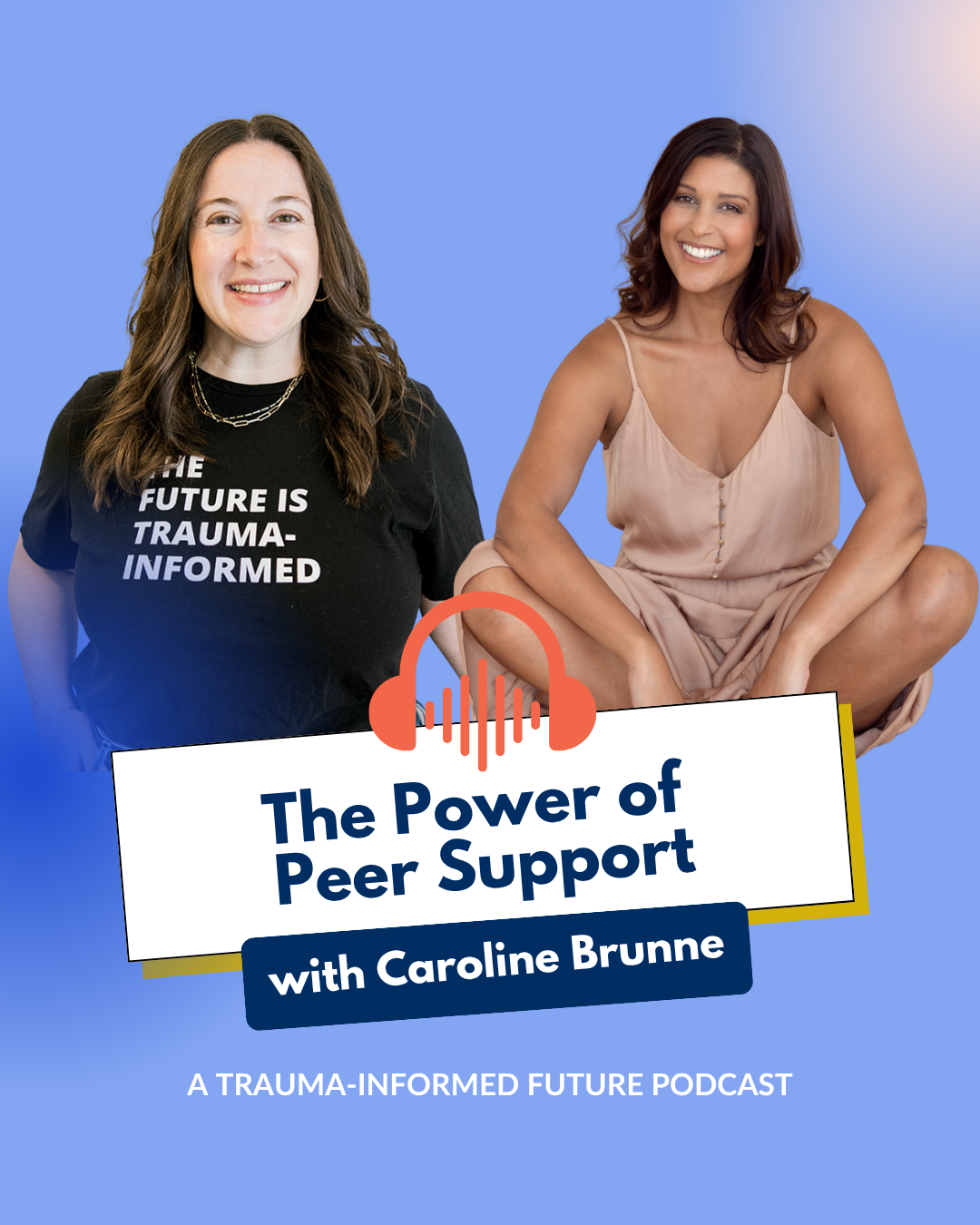
In today's episode of A Trauma-Informed Future podcast, host Katie Kurtz invites Caroline Brunne, a distinguished trauma survivor coach and breath work facilitator to discuss the powerful role of peer support. Caroline shares her compelling journey, underlining the critical role of personal lived experiences in the realm of trauma-informed care. This episode highlights how those who have navigated similar challenges bring valuable insight and a unique perspective that can bridge gaps between traditional support systems and personal recovery. Caroline, alongside her loyal therapy dog Louie, is dedicated to fostering environments of safety and growth through her initiative, In Support Community, which provides vital peer support for survivors of child sexual abuse.
Learn more about Caroline:
For over two decades, Caroline has had the privilege of supporting individuals in transforming their lives through coaching, life management, and personal growth. Her work has been featured on platforms like Channel 7’s Sunrise, Mamma Mia, Women’s Health, Channel Nine News, Body & Soul, and numerous podcasts and publications – a testament to the impact of her journey and dedication to helping others.
But beyond the accolades and appearances lies a story of resilience. As a high-functioning trauma survivor, Caroline knows the weight of building a life of accomplishments while carrying the shadow of past pain. In 2020, Caroline took her first steps toward unpacking and healing her lived experiences, confronting the trauma that had long lingered in silence. That journey led her to a place of transformation, and in 2022, she took an act of unshakable courage by self-publishing her debut book, More Than One Thing Can Be True.
This memoir is not just a story – it’s a testament to survival, healing, and hope. In it, Caroline shares her lived experience of overcoming child sexual abuse, incest, and trauma, offering a narrative of bravery and resilience. Her goal is to inspire individuals and communities to open conversations about these experiences, to replace shame with understanding, and to illuminate the path to healing.
Since releasing her book, Caroline has expanded her mission, stepping into the role of a lived experience expert and survivor advocate. She has the honor of speaking at conferences and events across Australia, contributing to media discussions, and sharing insights that empower others to embrace their healing journeys.
In 2024, Caroline combined her personal experiences with her professional expertise to create The Survivor Coach – a space where coaching and breathework come together to support transformation. Today, alongside her therapy dog Louie, Carline works with clients to move beyond trauma, reclaim their power, and step into lives of purpose and authenticity.
Connect with Caroline:
Website: https://carolinebrunne.com/
Facebook: https://www.facebook.com/cgb.mgmt#
Instagram: https://www.instagram.com/caroline_brunne/
Breathwork bookings: https://cbrunne.setmore.com/
Louie the Therapy Dog: https://carolinebrunne.com/meet-louie/
Show Transcript:
Katie Kurtz (she/her): Hi everyone and welcome back to A Trauma-Informed Future podcast. I'm thrilled to be joined by Caroline. Thank you so much for being here. It's so lovely to see you. I want to begin by just sharing, how you're arriving today and introduce yourself in a way you would just normally, we don't have to do professional bios.
We can share that all we want, right? I just like allow you to kind of come into this space and let people get to know you a little bit. So yes welcome.
Caroline Brunne (she/her): Thank you. Oh, I love that. It's so much more fun just introducing yourself with whatever comes to mind at the time. I, as you will hear by my accent, I am based in Australia, at the eastern side of the country in a place called the Gold Coast, which sounds, in theory, the way that it is described, it's golden and beautiful.
I live really close to the beach and I'm [00:01:00] showing up today quite early in the morning to navigate time zones, but with such presence as I'm so grateful for just opportunity and conversations and the way that we can show up in the world and have these kind of connections. I love the fact that you and I speak, at different points you know, throughout the month and whatever else. And that we get to do that throughout whatever's happening in our worlds. Even though we are so far away from each other. To kind of share a little bit about myself and deep in and out of that professional element I am a trauma survivor coach, a breath work facilitator.
But I think right now one of the things that people are starting to know me the most for is that I am one half of a therapy dog team. And I have technically demoted myself to being my dog's sidekick [00:02:00] because people seem to want his business cards more than mine. And that's okay. 'cause he's very cute and very lovable.
But it is a part of the work that I do that. Is technically work, but probably brings me the most joy because I get to hang out with my dog every day, and he is the best colleague ever. So I'm an absolutely obsessed mom, dog. But I'm also a mom of humans as well. So that's a little bit of a snapshot about me and where I live and who I am and for those listening to the accent trying to go, do I understand what she's saying?
Hopefully I don't use too many Aussie slang and Aussie lingo throughout our chat today.
Katie Kurtz (she/her): We're here for it. We love our Australian community. We've had folks from Australia on this podcast, so here for it. Thank you for joining us. I have to ask, is Louie joining us for the podcast? Because he's welcome to
Caroline Brunne (she/her): I would love him to [00:03:00] join, but the reality is I spend a lot of time at my desk.
And often in the coaching capacity, speaking to people so he gets kind of bored and would either be asleep, which isn't much fun for anyone. But being the time of the morning that it is with the rest of our household getting ready for the day he is probably sitting under the dining table waiting for a little corner of toast or something in hope we respect that someone will slip in a little treat or, you know, just whatever he's doing.
It's still pretty early here. Yeah.
Katie Kurtz (she/her): Yeah. We respect that. Louis maybe another time a part two. Yeah. Love it. , I'm excited to have you here and for this conversation and I'm sure Louis will come up in our conversation naturally. You know, we have known each other in so many capacities, and I think, this conversation is just a testament to something I share a lot here is that trauma-informed care is not an isolated approach to one region or [00:04:00] country or culture, that it is internationally adopted and integrated.
And I think that it's so important to highlight that and to, especially this podcast is all about really amplifying those who are integrating trauma informed leadership into their self-leadership and the leadership of whether it's their practice, their work, their business, their life. And so, I am excited to, to kind of dive in and I'm curious if you don't mind, just start telling us a little bit about your journey with Trauma-Informed Care and you know, where it's led you to.
Caroline Brunne (she/her): I think for me, my journey of trauma informed care starts with me. I have lived experience of trauma and though I didn't have that exact language, I have known for a very long time how [00:05:00] important trauma-informed care is to my existence and my survival and navigation of this world and my existence in it.
And that as the foundation of understanding trauma informed care to me has been so incredibly important. Though I understand many of us come from, you know, may think about this work or. Explore this work or research or, you know, come to understand it from different perspectives. It may be from a professional setting, it may be as an ally or a support to someone else.
When we think about how we learn things, it often makes more sense when it's related back to us, when we kind of see where we fit into it. So for me not even knowing that trauma informed care was the thing that I was doing for so [00:06:00] long in lots of different ways when I eventually came across the concept, but more specifically your work, because I think the language itself came through the work that you do and how it was presented to me through the coaching academy we met through and things like that helped to provide language.
And when you can name a thing. It gives it so much more substance and power, but not necessarily power in a way that it changed my own understanding and lived experience of trauma-informed care. So what's been really beautiful is having that personal foundation, but then being able to then dive into the greater, broader understanding of trauma-informed care and continuing to e evolve my understanding so I can then apply that to the work that I do, support others and further [00:07:00] understanding and really just deepening that, deepening my understanding and therefore deepening my trauma informed care, which is really beautiful.
Katie Kurtz (she/her): I want to focus a little bit on your specific work, which is as a one of the many titles you hold as a trauma survivor coach and what that means. I think a lot of times on this podcast, but just generally, you know, we're both in the coaching world. You know, there's always the, in the delineation of counseling and coaching, obviously, especially when it comes to trauma.
But we're seeing more use of coaching in trauma recovery and trauma support, which I love to see as long as we, I know we're on the same page as long as it's ethical and like really stays in that lane, right? so we don't cause further hurt or harm. But for those who may not be familiar with the practice can you share a little bit about what your coaching [00:08:00] practice is, who you work with?
Caroline Brunne (she/her): Yeah, definitely. And I love. But you have, again, emphasized the differentiator between therapy or counseling, psychology and coaching. It is different, and that's a really important part of the process. Even in, in working with me, I'm very clear from the get go that I am not a psychologist or therapist, so on and so forth.
And one of the key differences, and one of, not to say that therapists or psychologists don't do this as well, but I'm very clear that I work with trauma survivors and that title in itself is really broad. Because trauma is individual in many ways and how we experience it. But I work with people in a coaching capacity to focus on what's happening in the present.
So if someone needs support to process things that have happened in the past. [00:09:00] If they want to do that style of talk therapy where they're talking through moments of the past that isn't what I do. That's a very clear line from the get go. And so bringing that person and holding them in that stillness of the present, and then we work towards what they would like to be working on as they move forward into the future.
There are three key pillars that I focus on in my coaching model, which are values, boundaries, and communication, which I think all humans need and need an understanding of. And that becomes really clear to most of my clients when they then interact with other humans during the process of our coaching.
But so they can work towards their goals and work towards what they want in the future. We look at those three elements of values, boundaries, and communication. [00:10:00] It then supports them in working out. How things are going. Like, you know, do they understand what their values are? Are their values potentially skewed due to some behaviors or some unlearning that needs to happen?
How can they deepen their understanding of what they truly want and need based on their values? Once that step has happened, it helps them understand what boundaries may need to be put in place, and that can be incredibly challenging. I often start with clients as we focus on boundaries, self boundaries.
I think when we hear the word boundaries, especially in today's society, we think of a big hard line that we are putting up between us and another person. And sometimes that is the case, but. When we truly understand, I believe when we truly understand [00:11:00] boundaries and we practice them well, we often have to start with ourselves.
And we have to be better at how we support ourselves and the boundaries we put up to support ourselves. 'cause that's essentially what we're doing right across the scope of boundaries. So supporting them to work through that and then piecing it all together with communication. And that sometimes is practicing how conversations could go.
And though some of that is hypothetical because we can't plan for what others will say and do in circumstances, it's about supporting the client in working through what that could look like, how they can lean back into their values as certain circumstances come up. Now as I've shared all of that, you can hear why I say that all of this could apply to just anyone because these are just things we navigate in life as human beings.
The complexity then comes when someone identifies as a trauma [00:12:00] survivor. And I have had people work with me that have struggled to come on board initially because they've felt that their trauma hasn't been big enough. That maybe I only work with people that have been through certain types of trauma.
And that in itself is part of that trauma-informed self-care of understanding that our lived experiences are important and they have had impact, and therefore what we need for ourselves is just as important regardless of some imaginary scale that we might have or might perceive to be more important than.
Like that. We sit in a more important space than another role, not as important. So I feel like I've kind of gone a bit roundabout in answering your question, but hopefully that gives people an understanding of what I do as a trauma survivor coach and the foundations of how I work, [00:13:00] and that regardless of what the trauma is or where it sits on that imaginary scale if client is ready and wants support from me, then I'm there to hold space.
Katie Kurtz (she/her): I love that how you shared that and something that just always comes to mind whenever I'm talking about the difference between coaching and counseling or therapy. And I wish I could remember who said this to me, but. I always say, you know, counseling gets you through something, coaching gets you to something.
And I loved how you talked about how like, values, boundaries, communications, like these are life skills, right? To function as a human and would be applicable to all of us. But I think in through the context of a trauma-informed lens or a survivor informed lens, when we're working with folks who have complex trauma or trauma of any kind, right?
I agree with you. I'm not here to, , I don't do the big [00:14:00] T, little t, hierarchy of trauma or competition, like nobody wins at the trauma Olympics. Like it's a continuum or a spectrum for sure. But, you know, trauma's trauma and when someone either self-identifies as a survivor or has complex trauma but trauma of any kind, it's.
When we're looking at values, we may be have a hard time doing that because we never had that model in or mirrored, or our values were violated through a events or environments or actions by others or relationships. Our boundaries, I mean, any type you know of trauma we experiences because of some sort of boundary violation of some kind, right?
Whether that is a safety boundary, a security boundary, any type of relational or even cultural where it impacts our safety and survival. And then communications like none of us consent to these events, [00:15:00] environments, relationships, right? That happen to us. We don't say like, yes. We're gonna have this trauma, it's our body's brilliantly responding because we do not consent to, or we don't have the ability to consent to whatever is happening.
And that's why we say so often in the trauma world, like it's not what's wrong with you, it's what happened to you as a result of, you know, something or someone else. And so I think when we're, I appreciate that context because I think it's so important to note that when we do these typical life skill things like values, boundaries, communications, a trauma informed approaches, so key when working with people with, you know, who are survivors or have complex trauma.
'cause there's a little more need attunement focus and support and skill from you a coach to hold space for those folks. Because traditional coaching, traditional mainstream, whatever, often doesn't take into account [00:16:00] our lived experiences, our ident identities or social locations. I am curious if we can unpack some of these terms a little bit.
You know, I'm a big fan of shared language and understanding, like there's so many buzzwords, so much jargon, and we both have used the term survivor a lot. And I'm, I am curious if you can share a little bit about like what does that word mean to you? What does that identifier mean? What does it mean to the folks you work with?
And it's kind of intersection with trauma-informed care.
Caroline Brunne (she/her): So for me personally, I have definitely had my own struggles with that word. There were times where. I have moved from victim to victim, survivor to survivor. Often when I write I do a lot of blog writing and I self-published my memoir a few years ago.
I will use the [00:17:00] term victim survivor as I feel that it will capture more will open space for more people to identify with what I'm trying to say because I know it's a very complex word or title, it feels like a title. And that in itself is the com part of the complex part. And so that push pull of.
I don't want this title. I don't, I didn't choose this. I didn't choose for this to happen and therefore I don't want it to be a part of my identity or or how I'm known versus I have lived experience of this and have worked so hard for what has happened to me to not be something that continues to happen to me that continues to impact me.
So for me, the word survivor [00:18:00] has formed a really beautiful part of me acknowledging my lived experience and acknowledging that I have overcome and in many ways purely survived. So in, for me, in the context of when I experienced a. The abuse that I experienced that caused the trauma that I still carry, I that was survival.
Like I can't describe it in any other way. And I think if I was to choose one word that's the word. So to me that kind of goes hand in hand. Now, when I think about my clients, they sit in this really similar space. So, because I'm very clear that we're not talking about the past now, I'm not to say that sometimes the past comes up.
Of course it does. Like we're talking about ourselves and our lives and our future and our goals and whatever else. And if things are [00:19:00] coming up that remind us of this moment or that we don't want to repeat said moment, of course that's gonna come up. So please don't think that if you are halfway through a conversation with me and you mentioned something from yesterday, I'm like, Nope, we can't talk about that.
That's not how it works. But. I think one of the things when people come to work with me and they see the word survivor, some do really struggle with that that hierarchy or that scale we were talking about before. But as they deepen their understanding of how they carry their lived experience and how we all carry it with us, they often will sit with the understanding that they have survived some form of trauma or abuse or whatever the case may be.
And that is the context of how I'm supporting them, that I'm not ignoring [00:20:00] that we are not ignoring, that it's not an elephant in the room that we're pretending isn't there. We're acknowledging it from the beginning. It's in the title of the work that we do now, we may never actually talk about any of it, and in most cases we don't.
We just don't like, we know that it's there and we carry it within the process of our work together. But if the focus is I wanna run a marathon, and I've never been able to do that because of these limiting beliefs and whatever else that we can see where they may come from. But we don't need to, we don't need to talk about 'em because we know that they're there and we're acknowledged.
We've already acknowledged them in the titles. So I think I've only worked with one client who really struggled with the concept. Of survivors and the title, and I was really clear with her. I'm like, I don't expect you [00:21:00] to jump on every call and say, hi, my name's Caroline. I'm a trauma survivor, and today we're gonna work on this.
Like, that's just not our conversations work. So once we moved past that I found that she really deepened into the work and was clear that it didn't need to have a title for her. It was just about what she wanted to work on and the importance of dedicating this time to her personal development and growth.
So, yeah I think the other part that's really important to acknowledge is that we don't need titles and labels to know that our experiences are ours and that's why I really respect anyone that will say, I don't resonate with that word, or I don't like it, or I don't use it, or any of the other words that are used [00:22:00] because I completely understand that like our lived experiences don't need titles.
And we know what they are and however we decide to show up in the world from that point on is how we choose to show up. So I think there's definitely room for both. But the, I guess the second part of that is, for me, the other part of claiming my space as a survivor has meant that I've been able to find other survivors and that peer support component, because I'm very clear on who I am and what I've experienced.
And I don't even need to go into detail because that the title says it all means that other people who may or may not use the title can then resonate with who I am and seek support from me as a peer or know that they can offer support [00:23:00] and community to me as a peer, which is also a beautiful part of the process.
Katie Kurtz (she/her): I love that distinction and then how you emphasize the peer support, which traditionally, peer support is one of the original principles of trauma-informed care from the model developed here in the us. And right before we hit record, you and I were kind of talking, I had asked the question, I'm like, I.
You know, the term survivor and what it means and the evolution of that word here in the United States has I know that, but I don't wanna assume it's the same in other countries or cultures. And I always say like, trauma informed care, survivor informed care, because it's the same, it's the same thing, right?
To be able, if you know what, who a survivor is and what that means, the history of that word, then that is trauma-informed care and I can't, I always nerd out on , the history of trauma-informed care. Again, I'm speaking from the lens of [00:24:00] being an, you know, an American, but you know, for those who don't know, and please chime in.
If I'm missing or especially missing I. Any origins or history from, Australia or whatnot. But, the term victim is a very utilized word within criminal justice like police, right? Like there's a perpetrator of victim that's used in courts and police work. And in the rape crisis movement, which is one of the founding origins of trauma-informed care here in the United States, which is happening at the same time around the late 1960s, early seventies we were starting to hear and advocates shift from victim to survivor.
And there's been an evolution of that word that I've witnessed in working in survivor related services. But those, the origins of those words are really rooted in you know, interpersonal violence and sexual violence [00:25:00] spaces. And. Because we used to have such a narrow definition of trauma. We always associated trauma with abuse, neglect, sexual violence, interpersonal, or what used to be called domestic violence et cetera.
And so that's why as we kind of move along, people still think, well, I didn't, I, it wasn't that bad, or it wasn't necessarily, it didn't constitute ab abuse. So I, that wasn't trauma. And it's not being, we're not out here like being, like, that's trauma. You know, we're not, I think some people think that we're just like out here pointing out people things for fun.
Like it's not what we do. Yeah. It's just that we're helping people expand their lens of empathy to realize like there is no need to judge or hierarchy or, no gold medals here. However, it is good to honor. You know, if people want to self-identify and we know the term survivors used in other contexts, but the history, the lineage of those words specifically in this [00:26:00] context are linked to those movements.
And a shift in our language, especially in those movements to survivor rather than victim to. Give back agency control and autonomy. And I think that's the point. What you said is like, just because you identify as a trauma survivor coach doesn't mean you are out here telling your clients you have to identify as a trauma survivor, right?
Because in pure essence of trauma-informed care, we're giving you the option, we're giving you complete autonomy to choose how you identify, but the re services you're receiving are through that lens. And I think that's such an important, I'm gonna get off my history, you know, soapbox here, but like, I think that's so important.
We're, because kind of what we were talking about before we hit record was this mentality that not all people with trauma are going to identify as survivors. And that's kind of where, at least again, from the US stand like history of. Of our [00:27:00] origins of those words, where that relates. And I know so much of what happens here gets mirrored in other places, but I don't think it def, it's defining, I want us to think outside of just this very western culture that it, it means other things in other places too.
Caroline Brunne (she/her): It's so true. And I think even, I was speaking with someone, this was a few years ago, a woman came to one of my workshops and the workshop was designed to support people in being better allies to survivors and a little bit of a what to do, what not to do type scenario, utilizing my own lived experience.
And this woman had come from the criminal justice system and we were talking about language and she said, how do I navigate? Having to use certain titles whilst knowing that really [00:28:00] dehumanizes and often triggers and un upsets said person. And I was like, what? What term do you mean? I haven't been through the criminal justice system, so I've never been through that process.
And she said, we don't, like the media tends to use the word victim when they were reporting on cases, but in the legal system, in her role, she has to use the word complainant. And that I had a visceral reaction to the word 'cause. It just infuriated me, but also broke my heart to, from the perspective of lived ex, my own lived experience to, to imagine myself sitting in a room, having to go through my case.
And being referred to as the complainant. It doesn't even come near the word victim or survivor. It's, [00:29:00] when I hear, when I think of the word complaining, it creates a whole different set of emotions and reactions for me. So it's, so, I like, language is so important. And even as you were sharing that history around the shift from victim to survivor and even in a lot of the memoirs and the, you know, survivor led stories that I've read, they're such a, and I share it even in my own, there's such a transformation that comes from feeling like you claim this transformation from victim to survivor and whatever else That, to think that.
Our legal system, I don't know if it's the same in yours, but to think that there are trauma survivors and abuse survivors that are sitting in courtrooms or legal rooms having to be referred to as complainant with a [00:30:00] few amazing people like this woman who was like, how do I navigate that? And I, we workshopped it and I said, if it was me, I would want you to be really clear from the get go to say, I have to refer to you in this way, but please know that is not my personal choice of how I have to refer to you.
It's a legal requirement. And I know that it can be upsetting to be referred to in this way and just humanize the moment and then do your job because you're there to do your job. And we respect that everyone is there to do their job and just that. Almost that moment of consent. Though it's not seeking consent because you don't get a choice of the language that's used in the legal system, but it's a moment of humanity of saying, this is just what I'm working with and I know that this could be really upsetting for you.
So yeah, it's e even as you were talking about that, I was thinking about [00:31:00] this example that I had in this discussion. And again, when I hope that the trauma informed response I had to this woman who was looking to make change in the way she interacts with clients or people in her space then went on to create more trauma informed.
Space for whoever she was gonna be working with. And it's those moments, it's those little moments that make the difference.
Katie Kurtz (she/her): Yeah, absolutely. I think that's such a great example of what happens because oftentimes with trauma-informed care we know most people who are at least like, have heard of it, are like, okay, consent and choice.
Like that's important. That's important. And then we get, as trauma-informed leaders, we get stuck 'cause we're human and we swing to this extremes and we get stuck in this. And I see this with thousands of people I [00:32:00] work with. Oh, I'm not offering enough choice. What if there is no choice? And I like to help people pause and come back to neutral that sometimes there's just not gonna be choices.
That's just life. Right. And this is a great example of like, there is no choice in this system we have to deal with. This word, we don't have to agree with it, but what you utilize or what you demonstrated was transparency. And although we couldn't this, we couldn't offer choice to this person to pick another word or whatever, there was a power sharing moment to say like, this is what it is.
How can I support you with that? Or how, you know, do you need to tell yourself something else even though we can't change the legal system's word? You know, what would you prefer to be called? And I think that's such a great example of when there is no choice, how we can still insert trauma-informed principles and strategies.
And it also highlights that [00:33:00] there is so much power with the word survivor. I mean that there is an incredible survivor movement across the globe and. You know, and studies and its relation to like post-traumatic growth and some people do still identify as victim and that is an identifier for them.
And I think coming back to trauma informed principles of autonomy, like letting people self-identify with whatever they identify with and let that be okay. And also checking in. I notice you're, you self-identify as a survivor. Is that something you're okay with? Me Also using as an identifier and having that conversation.
Similarly, what we do in the recovery world, once people self-identify as alcoholics or addicts that may, that is a very typical self identifier in recovery spaces, but they're highly stigmatized words elsewhere. And so checking in, I noticed [00:34:00] you self identify. Are you okay with that? Or, you know, curious.
Can you tell me more? Rather than a person centered alternative, which we're seeing a shift towards, was like a person in active addiction, a person in recovery. And I think, again, it's simple, but we're human, so we gotta check our humanity that we just have to ask, rather than assume, just do a simple check-in.
Like, tell me more about that word. I notice you say that. Like, what does that mean to you? And most people are be glad, gladly to be able to share or they might honor their boundaries and not, and we have to practice that acceptance.
Caroline Brunne (she/her): Yeah, definitely.
Katie Kurtz (she/her): I want to talk about another word or concept, which I love and I know you do too, which is peer support.
And I'm, I want, would love to shift gears a little bit and talk about your in support community and the role of peer support and how that is also, you know, when we're talking about lanes, it's a little different than coaching but is more similar. [00:35:00] And just the power. I love peer support. I'm a firm believer in that and you know that about me.
And just the power of it, especially when we are holding space for people and their humanity and their lived experiences.
Caroline Brunne (she/her): Yeah, I wouldn't be here without peer support. My survivor peers have just been incredible and most, what's what I find really interesting, even in saying that, I don't think any of us actually, and I say any of us, because I know that I provide similar to support to survivors, I don't think any of us actually know what we've done or how we do what we do in a similar way to how friendships can evolve and just connections can evolve.
I didn't know what I didn't know and I didn't know how much I needed to speak with and [00:36:00] be in connection and community with people that understood my lived experience. Now, my survivor peer support community, my own, and I'll talk about in support community in a moment but me personally has just evolved over time by connecting with different survivor advocates.
That's, in most cases how I've connected with people. The reality is the majority of our survivors are just doing life and doing our thing, and we're not talking about any of our lived experiences publicly. There are a handful of us that are on the front line sharing the big hard things. And that in itself is a completely different style of.
Survival and how we do what we do. And so being able to connect with others and also being able to understand more of my own story through the lens of other people's stories. For me, one [00:37:00] of the most powerful moments from a peer perspective, not necessarily peer support, but peer connection is when I was, I think it was even prior to writing my memoir, I came across a woman based in the US who had a very similar story to mine.
I had never heard anyone speak of lived experience of this particular type of abuse slash trauma and the way that her timeline had flowed. And I was like, ah, I thought I was the only one genuinely thought, like, knew that. Really, I couldn't have been, but I didn't have, there was no one else to reference.
And I can't even remember how I came across this woman and thought, wow. So I, you know, reached out to her and thanked her for sharing her story. And that was [00:38:00] probably the first time that I had reached out to the, essentially a complete stranger, someone I would never meet and most likely may never meet in person.
But it showed me the power of that peer connection and the power about stories and my storytelling and sharing is important, and that I've gone on to seek peer support from other survivors in lots of different ways. And we support each other in lots of different ways, often with funny memes and just silly reels and things that keep us afloat at times.
Now in knowing that, and I guess it's really similar to the first thing I shared about understanding trauma-informed self-care and trauma-informed practices through my own understanding and my own kind of fumbling my way through it, and then doing the same in this space of peer support I have in support [00:39:00] community is very specific.
The peer support or the peers that we support are survivors of child sexual abuse. So I am a survivor and wanted to be very clear who that particular community was going to support. Even as I say that out loud, it's still kind of, I still get nervous when I, I. Get so specific for a few different reasons.
My coaching work is so much broader that the thought of excluding people is hard for me because there are people that really needs peer support that maybe don't fit in this particular category. But I know that there are other ways that I can support them and that's okay. I think the other part of it that still makes me nervous is knowing how challenging and [00:40:00] how challenging it has been to create in support community.
I had looked at other peer support models, and though I had never really assumed that it was easier, in some ways it has seemed a lot easier. So to identify as. A cancer survivor for like, not to trivialize cancer, but as something easier. I think the thought of cancer being something that, obviously similar to other, to abuse, you don't choose it, but there's no one to blame and there's no other human involved.
And you do what you need in regards to, you get the treatment you need and you keep going through that. You survive in whatever way you get the support that you need, and that's where [00:41:00] the peer support component comes in. But because it's something that doesn't involve another human as to the cause of the trauma.
The peer support models that I've looked at in that area, they've been really successful and really easy to lean into. And one of the biggest challenges that I've found in launching in support community is that similar to identifying as a survivor and choosing the title, when you add the byline of Survivor of Child sexual Abuse it's almost like there's a line of people standing there and I say, please step forward if this is and I, no one moves or that you can see [00:42:00] by the body language or whatever that's the thing.
But claiming that title for lack of a better way of phrasing that. Is incredibly challenging. Now, behind that more direct way of being a part of in support community, what I have found is when people come to me one-on-one and they say, Hey, I noticed that you have this peer support community, and I would really love to be able to be a part of this in an anonymous capacity.
I really need more people in my life, but I'm not ready. And I just, how can we do this? And so I've really had to adapt what I thought was going to be the model and the layout based on my own peer support experiences and [00:43:00] adjust to create opportunities for safety and opportunities for presence.
And I. And connection in a way that still allows people that choice and the way of being able to opt in and out. So what I found to be really beautiful is that once we navigate what that entry point looks like and that attendance or participation looks like once people are in the benefits of being with others who understand and have similarities to their stories and may also even understand the challenges of even being in the room in the first place.
That is really powerful and really beautiful and.
I think one of the things that was really important to [00:44:00] me as opposed to, you know, therapy, counseling, or even coaching,
there isn't a huge, like, structured framework. It's simply about being in presence with others, in community, with others, and often that's all we do. And I love that because I can do the coach thing and sometimes I need to, sometimes I need to create a bit of structure or we have an activity or whatever else.
But the majority of the time it's just about knowing that you're not alone and that you've got others to be in space with, which is really beautiful.
Katie Kurtz (she/her): I love how you spoke of peer support as that. Reflection, being able to see yourself in other people and know you're not alone. And that's, that power, like I say, trauma [00:45:00] thrives in isolation and it's that it disconnects us from everything.
And so many people, the shame and the guilt and all the feelings that fester, that trauma thrives on isolates us so much that it can feel like something's broken, like something's wrong with us, that we're alone. And peer support is this beautiful, powerful thing that is so simple and so accessible, but is often hard to access because of the stigma and the way we con construe trauma as a bad thing.
And we think of it in such binary terms, and I've seen so many. Transformative life shaping moments for myself, for my family, for people in my life through peer support. And it's that ability to just witness [00:46:00] and see and hear other people and be seen and valued and around a shared lived experience or something shared.
And I think I appreciate you also kind of creating that distinction because that term survivor is utilized in other spaces, especially in health, healthcare, you know, cancer survivor and there. And I think that's again, why it's so important to highlight that term and that lineage, because we would never say a, typically say like a cancer victim.
Some people may use that language, but we don't because it was not a crime to, that was. That was done. Like you said, it was, there was not someone giving this person cancer. Right? Yeah. And not to create minimization to that, it is creating a delineation that we often celebrate the survivorship of cancer patients, which I've, you know, I've worked in healthcare and oncology and that's ver it's very celebratory, yet we don't often celebrate, [00:47:00] the survivors of sexual abuse or violence or whatever.
And and sadly, we've often even seen the exploitation of survivors to just share their stories for clickbait or money or funding or whatever. And. Oh, goodness. I could go on a whole rant about that. I'm gonna stop myself
Caroline Brunne (she/her): as you were talking, I was like,
Katie Kurtz (she/her): Yeah. Okay. I'm going to pause. Because I think what you highlighted here goes back to what you originally said about coaching, which you mentioned. It's like being in the present with somebody and supporting them in the now. And I think peer support is that beautiful bridge between the two. But you also do so much, you offer so many additional tools and resources for people in your coaching practice, in your community to help people be in the present and build that nervous system capacity.
Which brings us to Louis and your breath work and how we, it's like that coming back, that [00:48:00] reclamation, that coming back to self, that coming back to presence using these tools, which again, I'd love for you. I want you to talk about it and also maybe talk about how. Imperative it is for that to be led through a trauma-informed lens.
Caroline Brunne (she/her): Yeah. For me, what's really beautiful about breath work, which is something that I brought into my work last year in 2024, I, once I had finished my qualification and decided to bring it into the umbrella, that is all the things Caroline does. That is when the concept of in support community came to me.
I found it really beautiful that I had a tool that I could share with my peers that didn't require any talking at all. And so it [00:49:00] was really deepening that I. Coach element of all that differentiate between therapy and coaching. And initially when I launched in support community, I was like, we're just gonna do breath work.
Like people are just gonna come. We can do breath work, we can do it online. We and that has been a part of the process, but these practices and now bringing Louis in, and I'll talk about him more in a moment, but breath work has been such a beautiful practice. And again, like I, I often say to people like they're like, how do we know what it's like to work with you as a coach?
And I'm like, 'cause I practice what I preach. Like I don't talk about anything. That I feel that I either don't have an understanding of because I have researched it to the ends of the earth because I need to do that for my own understanding. But most of the time it's because I either have a lived experience and then have added my research, my understanding, my training, whatever else, and why I [00:50:00] have breath work in my spaces because I breathe every morning.
I, it's part of my own daily rituals and self-care practices, and it's how I look after myself. So having that as a tool that I can weave into my coaching that has a standalone and also provides people an opportunity to work with me that don't ever have to claim anything to do with trauma or survivors or anything like that.
So, I have a breathwork studio here on the Gold Coast where I live, and people have the opportunity to come in and just come to a class. They don't need to know. Sometimes they actually don't know anything about the other work that I do because they just get to have me hold space for them in the way that I would for absolutely everyone.
And I do find that people will come in, especially if they don't dunno much about me. And they're like, what is this? Like, how did you, [00:51:00] and then when I share more of what I do, they're like, oh, that was amazing. I'm like, yeah, that's called trauma informed care. You don't need to have had like, the hardest life ever to appreciate what it feels like to be held in space and then to do something really beautiful and somatic, like breath work to feel better in your nervous system.
It's just gorgeous and they're just like, oh, this is amazing. So it's really beautiful to be able to use all of those skills and practices. And so end of last year I brought Louis into that. Now, similar to what a lot of people do and there's definitely the theme of our discussion today, Louis is definitely my therapy dog.
Like he has been, he has consoled me at many times. He's four now. So he was at my feet every day while I wrote my memoir. He's just [00:52:00] one of those dogs. He's like, and if I could just have him all to myself, I probably would. But that felt a little bit selfish 'cause he's pretty special and I thought it would be great to share him with the world.
So. I formalized that idea by doing some formal studies of therapy dog training and animal assisted therapy. Louis slept while I did all the theory and all the exams and submitted all the things,
Katie Kurtz (she/her): what a life
Caroline Brunne (she/her): I know, right? Like he gets all the glory. All the glory. So before, when we were doing our testing and stuff, we're like, how are you going?
How's it going? How's Louie doing? I'm like, Louie mate. He's not doing anything. It did have to do obedience testing and where there were quite a lot of dog parts of the training, but I will say that the majority of it is the human part of the training. So, we got our qualification in late 2024 and it's been [00:53:00] really beautiful to, to weave him into my work, so into my coaching and definitely into breath work.
Where he's definitely become the star of the show. And in a similar way to what I was saying before, when people come through the space and they feel that feeling of being held and being supported by me, what Louis does is just this kind of magic that you can't really, you can't really understand until you experience it.
And even if you're not really a dog person, it's just a way of, he holds space for people in a way that I have never really seen before. So, he does his beautiful, goofy, normal dog thing where he just goes up and wants snuggles from everyone and whatever else. As we begin, and then as people are experiencing the breath work and.
What is the obvious one, which is like, if someone gets emotional, they might shed some tears, he'll go he'll be asleep on his bed and he'll know and he'll go [00:54:00] and he'll kind of snuggle up next to them and support them in that release. Or sometimes when people get quite agitated and their nervous system is really fighting that feeling of sinking into the stillness he'll again go and sit with them and that creates a level of calm and there's a whole he of science behind it as well.
And we could nerd out on that for hours, but we won't get into that. But one of the things that I'm really excited about is the work that we're now doing with other organizations. So. Funnily enough, today is our first day with the Gold Coast Center against Sexual Violence, and we are doing a meet and greet with them, with their therapist.
And so a handful of their clients who have opted into the session where we will be meeting with their clients who will then get to choose if they want Louie and I to be in their [00:55:00] sessions. We'll be working in what's called a Diamond model. So where there's the therapist, the client, myself as Louis's Handler and Louie.
And that again, is a completely different role for me where I step back even further and I don't say or do a thing in regards to the human. My role is to be Louise sidekick and supporter in him doing his job as the, you know, the nervous system regulator that he is in that role. So all of those beautiful things.
You can hear the theme, you can hear the way that breath work, that the classes, that the interactions with Louis in lots of different ways, all form part of this greater container. That is the work that we do. And there are a handful of clients that I've worked with that have experienced all levels of that.
And [00:56:00] the way that they get to move through their journey, knowing that they have these interactions, and also now the skills to take breath work with them. You know, you don't need to take anything, like, you don't need bits and pieces. You've got it with you every day, sort of things. So teaching them those skills as well is really beautiful.
Katie Kurtz (she/her): I always say that my dogs are my favorite co-regulation. Now they're not therapy dogs, although they're very therapeutic. They would definitely fail the obedience part. But yeah, like that power of co-regulation, which again is the thread, common thread of everything you're doing Right.
Coaching, co-regulation, peer support, co-regulation, even breath work, that is such a powerful somatic way to co-regulate with other breaths, like when we can't find our own. And I think I love what you said that, and it's so validating. It's so validating to hear other people say exactly [00:57:00] what you said.
It's like people come in, they're like, what is that? And it's like, it's because people so often don't know what it's like to be. To feel trauma-informed care. And when they do, they realize it's just for everyone. And I think that's such, the common theme of this podcast is like we, the goal is to , not even need that term because it just is, it's just how we interact.
It's how we people, it's how we relate. And it isn't just for certain people. It is for all of us. We all benefit, we're all breathing, we all benefit from all of these things. It's just how we deliver it and how we receive it is in a way that just honors that virtually all of us have or will have an experience of trauma.
And using that umbrella of, which includes stress, which we all have burnout, moral injury, like all these things. And so the more we can kind of expand that understanding, my hope is we shift the culture that it is just like [00:58:00] this is the norm. This of course, like of course you would. Feel that way when you come into a breath or class or, you know, and I'm very, I'm so excited about your big day today.
I had no idea. I love that. For you and for Louis, like that's a big I love to hear that and also I know that's a big step for you, just like to shift into that role. Yeah, very different one. I'm eager to hear how it goes for you.
Caroline Brunne (she/her): Yeah, and I guess I'm gonna put a little, like, extra cherry on the top of this because it is very special.
What I really love about this work that we are doing today, and we don't know where it's gonna go, like today is a bit of a trial and a meet and greet, but I think the part that like, and I can even feel the bubble bubbles of emotion as I go to say this out loud, is I used this service 20 years ago and they are a not-for-profit.
They provide free counseling and therapy to survivors. And have done so for over 20 [00:59:00] years. And so to be able to volunteer for them and give back in this really unique way I've ever had a therapy dog in the center before. We've had a meet with all of the therapists. We did a meeting where Lou had literally went from therapist.
The therapist had just got belly scrap scratches and just did just, he has the best job. I keep saying to him, I'm like, you could be on a muddy farm herding sheep, which he'd probably actually really love. But you get to just like, hang out with people and their job or your job is to let them pat you.
That's your whole job. So it's really beautiful to have this full circle moment and to support the center, but, and the work that they do and to support their clients and know, again, from a peer support perspective, I know exactly how they feel because I have been. In that exact space. And and I'm so grateful for the work that the Center [01:00:00] does.
And the fact that we get to gift then this beautiful moment and hopefully continued moment will be really lovely.
Katie Kurtz (she/her): Yeah. Oh, I love that. What a incredible full circle. Moment and be able to have that as a part of your ongoing story too, to in this way. It's so beautiful. Yeah. I am so grateful for you and this conversation, and that your work, you know, your work exists in this world and your spaces that you're creating, especially in person, because I think, I, obviously virtual is how we're connected, but there is something to be said about the in-person.
Ability just to breathe with people and be with people is so special. Is there anything you wanna share with those listening about, you know, anything you do or anything else before we jump into our gentle spritz of questions?
Caroline Brunne (she/her): I would say yeah, for anyone that's listening who isn't based in Queensland in [01:01:00] Australia, there are definitely ways to connect with me.
So coaching is definitely one of those ways. And if breath work is something that you're interested in it, it can be weaved into the process, which is a beautiful way. Louie might be in the background of the shot, but that's kind of all you're gonna get in regards to the loneliness of it all. I do host a monthly online breathwork, but the timing is very much catered to Australian timing.
So I know we're on completely different time zones, but if that works for you or you can stay up later or however the time zone works all of that information can be found on my website if anyone's interested in working with me. And as I said, if you're based here in Queensland, in Australia, you're welcome to come and interact with us in person.
That's probably it. There's workshops and other things that I do, but a lot of the things I do are in person. I think I've spent a lot of my time online and do so from a coaching capacity. So when I can be in presence, in person, in community with people it's what I love to do.
Katie Kurtz (she/her): And [01:02:00] a big celebration for you.
You just won a big coaching award, so celebrating you and all you've done in that space. And we especially need more trauma-informed coaches in the world. And just honored to be a witness to you and your journey and to call you a colleague in this work too. And to be able to say, you know, you are part of that groundswell of people leading in this profession with this lens.
And I think it's so needed. And, what a great model you are to other people learning in this way. So congrats celebrating you always. Are you ready for our gentle spritz, which is our anti rapid fire?
Caroline Brunne (she/her): I love that so much. It's, yes, I'm ready.
Katie Kurtz (she/her): I always say I say one word, but if you have more than one, that's totally fine.
So, if you could describe trauma-informed care in one word, what would it be?
Caroline Brunne (she/her): Transparent. [01:03:00]
Katie Kurtz (she/her): What is your current go-to for nervous system care or trauma-informed self-care,
Caroline Brunne (she/her): Louie.
Katie Kurtz (she/her): And what does a trauma-informed future look like for you?
Caroline Brunne (she/her): Home? Just being home in my body and knowing that this is not one word, the word is home. The meaning is. When I can feel at home in myself, that is when I know that I'm living in a trauma informed present and future.
Katie Kurtz (she/her): Oh, I love that so much.
Thank you so much for joining us today. Everything is linked in the show notes for folks to connect with you, be in your orbit and join anything anything you're offering.
And also, you know, can follow Louie in his journey. And I know he has his own little Instagram and does Avatar and all the things, so we're definitely, you know, we'll fan him for sure. [01:04:00] Any and just thank you so much for joining us today.
Caroline Brunne (she/her): It's my absolute pleasure. Thank you so much for having me.
Let’s Connect!
