

The Business of Trauma-Informed Care with Angela Johnson
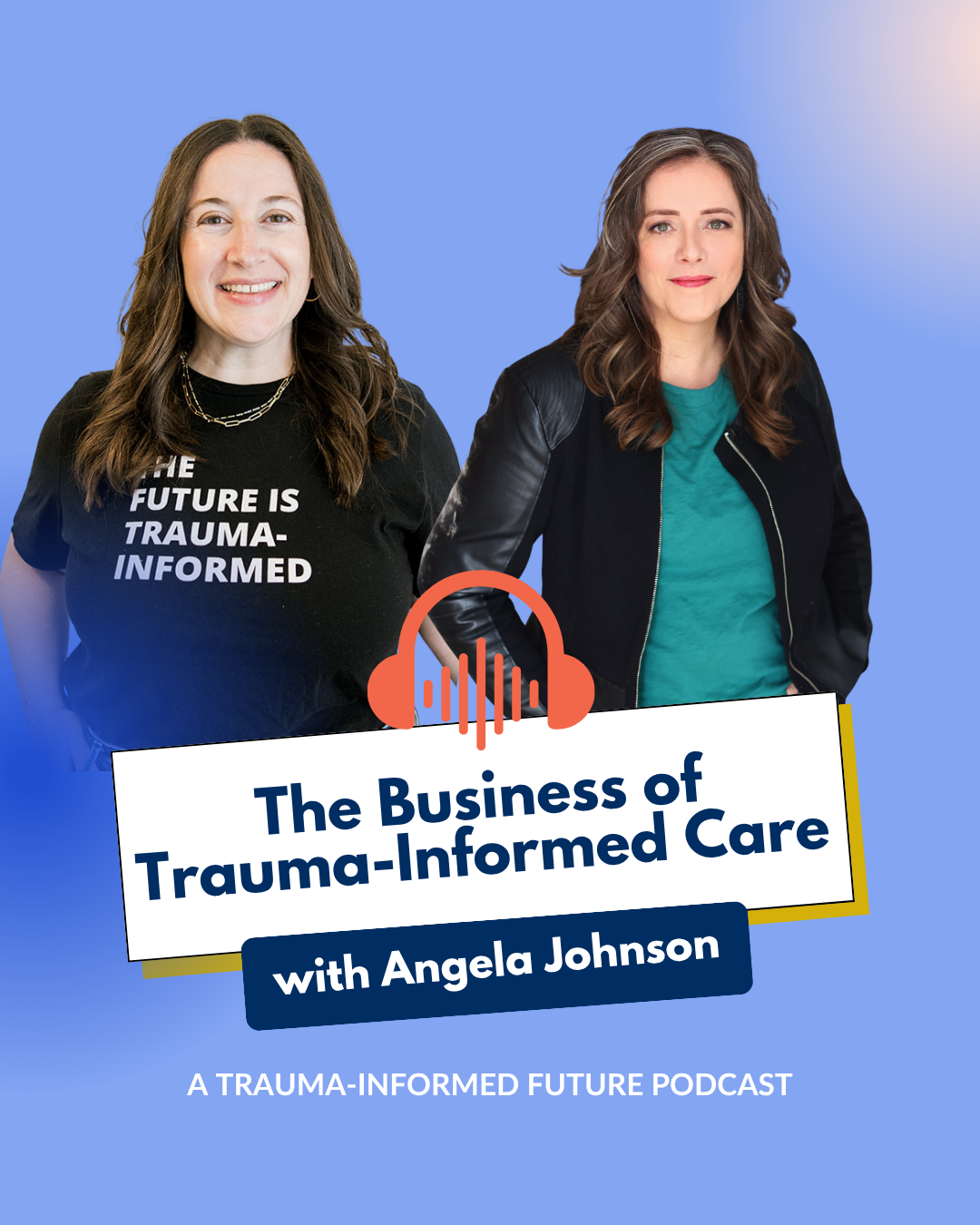
What if the traditional way of doing business is no longer the way forward? What if people and profit could coexist without extraction or harm? Today's guest, Angela Johnson had these questions and set out on a journey to research how this could be possible using trauma-informed care. In today's episode of A Trauma-Informed Future podcast, host Katie Kurtz is in conversation with business strategist Angela Johnson discussing the critical role of integrating trauma-informed care into business practices. She underscores the importance of viewing trauma as a fundamental component of human interaction and how it influences business strategies, marketing, and communication. This episode offers resources to help businesses incorporate trauma-informed approaches, highlighting the transformative potential for both business success and personal fulfillment.
Learn more about Angela:
Angela Johnson spent decades searching for the answer to one question: Why do people sabotage themselves? Angela discovered that no matter how hard she worked or how much she changed her mindset, she couldn’t outrun her traumatized nervous system, which was perplexing at first because she never considered herself to have trauma.
This wake-up call led her to conduct IRB-approved qualitative research in a Master’s program on how trauma impacts small-business owners. This research was the catalyst for integrating trauma-informed practices and somatic parts-work coaching to support her clients beyond messaging and marketing strategy.
Angela is a trauma-informed coach and strategist who helps multi-passionate rebel entrepreneurs and DEI-focused organizations craft their unique message and implement their marketing without using pain points, complicated funnels, or other gimmicky strategies.
Since 2008, she has helped hundreds of private clients and over 3,000 students in her courses and events ditch one-size-fits-all formulas and lead their businesses with their values. She is best known for her simple 1-page marketing plans and keen ability to help her clients craft compelling messaging while prioritizing their nervous systems.
Angela has shared the stage with renowned thought leaders like Liz Gilbert, Lynn Twyst, and Lisa Nichols. Her work focuses on guiding business owners and organizations to integrate trauma-informed marketing and communication so that collectively, we dismantle systemic oppression and co-create a world that prioritizes equity and compassion.
Angela lives on the unceded territory of the Goshute Nation, now known as Ogden, Utah, with her partner and rescue dog. She’s an amateur gardener, plant and dog mom, and artist who loves any project that allows her to create beauty and kindness in the world.
Connect with Angela:
Website: www.angelamjohnson.com
Instagram: www.instagram.com/angelajohnsonbiz/
Free Trauma-informed Business Guide: https://tools.angelamjohnson.com/free-trauma-guide
Show Transcript:
Katie Kurtz (she/her): Hi everyone. Welcome back to A Trauma-Informed Future podcast. I am excited to be joined by Angela. Angela, welcome. Thank you for being here. I'm excited for this conversation, selfishly, as a trauma-informed business owner and also just to be in conversation with you about so many different topics.
So I wanna dive in, but at first can you just, we. You shared your formal bio, but curious if you could just introduce yourself in your own words today.
Angela Johnson (she/her): Well first, thank you so much. I am so excited to be here. I love the work you're doing. I am a big fan, so it's a real honor for me to be on your podcast.
So yeah, Angela Johnson pronouns, she her. I'm a pro for marketing and messaging strategist. I work with a lot of solo entrepreneurs and social impact organizations around their communication marketing. I've been doing this since 2008, so I've seen a lot of, a lot of, trends come and go in the online business world and the coaching world.
And then [00:01:00] about five years ago really took my focus into a more trauma-informed focus. I know we'll talk about my trauma-informed journey here in a bit. Yeah, that's me in a nutshell.
Katie Kurtz (she/her): Let's dive into your trauma informed journey. I always love to start here just to see how people became aware of this approach.
Although it has such strong origins rooted in, our history, especially here in the us it's still such a new and. A new concept. It's still new. I mean, it wasn't formally published only 10 years ago. Like, that's fresh. Yeah. And there's so many interpretations and variables that come into play with the adoption of this approach, because that was.
Purposeful, right? Like left to our interpretation. So I'm always curious like how people find it, how do people grow? What does it look like for you? So yeah, if you could just kind of share your journey with us yeah, that would be awesome.
Angela Johnson (she/her): Well, things started opening up in about 2018 and I had an I.
Experience that I would not had the time of classified as a traumatic experience. But what I started noticing, and this was about, a year and a half, almost years, [00:02:00] until right before 2020, and we know all the things that happened in 2020, but during that time, I noticed, and this is what got my attention, so I had this experience, I thought I was fine, no big deal.
And. My business was ever so slightly declining month after month, and I could not understand why. And that was the thing that got my attention. And so when I really started taking a look at that, and then I zoomed out and I thought, well wait. Actually, this is not just happening in my business, this decline, this lack.
Of joy, like something is off and I can't put my finger on it. And it was incredibly frustrating 'cause I had, spent a ton of money on coaches, all the high ticket programs, personal development programs for decades. And none of my tools, my go-to tools were working. And I just could not shake this feeling that something was off.
Long story short 2020 with the height of the pandemic, I thought my mental health is not. What I would like it to be. I started seeing a therapist and their focus was parts [00:03:00] work and trauma informed. And so as we started talking about some of these things that occurred in 2018, what was unbeknownst to me was like, oh, that's trauma.
I had no idea that trauma was not just catastrophic experiences, and so my mind was blown and something just clicked and I thought, I have been seeking for a solution for decades about why, like, why can't I stop sabotaging myself or. What, like what is really happening beyond just more mindset work? Like how do I really create sustainable change?
So these are some of the questions that drove me my entire life. So everything started clicking and falling into place and grew my neurodivergent nature. I, just clinged onto it, did a deep dive into all things trauma. Understanding it, understanding myself. 'cause it was really from that perspective of I wanna understand what's happening.
Why, like why this off feeling like I just can't quite get it together. Like things are just not flowing [00:04:00] in my life the way I would like and the way I'm used to. What changed? So that was really the catalyst. And so 2022 did a master's program focused all my projects around trauma informed communication, did IRB approved qualitative research about the impact of trauma on small business owners, which that was another mind blowing moment of.
Oh, these patterns that people are talking about. This is what I've noticed and witnessed and observed for years in all of my clients, and my only approach that I had, my only solution was, well, just more mindset work. Let me help you with another marketing strategy. Let's just try harder. Let's push yourself a little more.
Like I was regurgitating all of the stuff that my coaches had told me. Not once did I know that, oh, wait a minute. My nervous system is actually what's running my business. Not the slickest trendiest marketing strategy. So present day, that's, that was the big catalyst to bring my focus [00:05:00] to all my work now is trauma informed.
And I love it. Like, I love it. And just like what you were saying, it's often very misunderstood. People don't quite get it. I've been told, well, trauma's such a negative word. I don't, I had a professor tell me this, my whole, thesis and project is around trauma informed communication.
Is there another word you can use other than trauma? 'cause that's really negative. And I was like, oh, okay, let's, oh, I don't even know how to reply to that, so anyway, yeah, it was a big journey, one that was necessary, and it's one of those things that's like once you see it, you cannot unsee it.
It's everywhere.
Katie Kurtz (she/her): I love that you highlighted your introduction to this approach because I think it's how most people become introduced is from their own lived experience and that shift from that. Narrow definition, we're taught that trauma is this bad word [00:06:00] that it, oh, it's, I mean, I get that all the time.
Yeah. Ev like maybe twice already today and or it's this, like you said, this catastrophic event. And so when we think of it that way, because that's such an old updated definition, but it's because we don't talk about it. Right. We're still functioning from that. And I mean, I thought that too. I didn't realize that I experienced trauma.
Throughout my life until my early twenties when I realized trauma, isn't this like three different things, right? Like war, violence, injury, which I was always raised and taught to believe that. And then when I entered grad school and started to learn about trauma and trauma informed care, I was like, oh.
And it even took me a little while because I almost was like, I, my, my experiences aren't bad enough to be that and. Again, this emphasis on the event when we know that's not the case. And but it's so often that we [00:07:00] become trauma aware from our own lived experience. 'cause we learn and we learn, we unpack it in therapy, we learn from our own research.
And then it kind of begins to inform our worldview and then that trauma-informed lens into skill development. I think it's so interesting when people. Say like, oh, can you just be like, more positive? And we're recording this in April of 2025 and I'm at the point now, like, I am, I just like, you, like get this all the time and people will, I. Asked me to use, like, can you just, could you focus on like, resilience or even mental health, which I think is really funny because as like a mental health advocate and professional for most of my career, I'm like, remember when you didn't like that word? Like, remember that, that stigma? Yeah. Now it's like, no, we only wanna talk about mental health.
I'm like, okay. But it's like, well, if we're not, if you're not okay with talking about it. And like [00:08:00] now it's like really like. Okay. But then that's an invitation to all of us to say, well, clearly there's some strong held stigma Yep. Around this. That means we need to be talking about it. Yes, I understand you.
You have those feelings. But we're still gonna use the word and let me help you understand. What that means. And so help us Angela, understand what trauma-informed business, trauma-informed marketing, trauma-informed communications, all of these things that all are one and of itself.
So interconnected. What does that really mean? Yeah. Because I know probably not people listening to this, but I think a lot of people are just like, what is that? Is it mental health? Are you a therapist? And we're like, no, we're not therapists. Right, right. So like, let's break it down. I always, you know me, I love shared language and understanding.
Angela Johnson (she/her): So let's start there to just help break down. What this means when we apply this approach to business marketing communications?
Yeah. [00:09:00] Well, I think the first thing, the first step is let's define what marketing is, because that's another word that it's like, well, I know it's this thing I'm supposed to do in my business, but what does it mean really, a simplest way is it's how you sell your services and products.
More specifically, it's inviting and sharing people to change something specific in their life through your products and services. And so when we know that like this is the vehicle, whether it's social media or networking or speaking, it's like the vehicle and how you're selling your services, but trauma informed are the principles that it's rooted in.
And so I have and it's interesting 'cause in the research I did, there were. What I call the sixes of trauma-informed business, which very much overlap with the six principles of samhsa trauma-informed care. But these words kept coming up over and over again. And so when we think about marketing through this lens, and I'm gonna read some notes here 'cause in the moment, I will forget.
And but choice, consent, clear communication, transparency, collaboration. And I wanna circle back to that in a [00:10:00] moment. Curiosity and compassion. I. But these were the words that were used over and over again. In addition to when I. I did a first round of interviews with small business owners, and then I did another round of interviews with mental health professionals.
Said, here's the, here's what the data's showing. Here's what I've noticed, but is this what you're seeing with your clients from that trauma informed, mental health professional lens? And they were, a hundred percent. It's like, yes, these are all the things that I see, but when I was asking.
Folks of what would you love to experience in your business? What would trauma-informed care look like? What are some of these things? These were the words, but I wanna circle back to that collaboration piece because when we think about trauma-informed marketing, trauma-informed business, a lot of times traditional marketing tells us it's this hierarchy.
It's this power structure. I'm the expert, you're the client. You pay me, I will give you something in order, in exchange for that payment. But collaboration is a powering with dynamic. Rather than empowering over dynamic. And so that [00:11:00] trauma-informed perspective is acknowledging that your audience, whether they're a client or not paying client or not, but the people that you're marketing to have incredible wisdom, they know what they want.
And they can make decisions based on what they want. They don't need to be coerced. Convinced. Manipulated. And so again, it's that powering with someone, recognizing that couple of things, like not everyone has starts from the same place. Not everyone has the same access to resources. Not everyone's brains think similarly to my own.
So it's acknowledging a person's humanity and how they're making decisions. And so this translates to specifically things like. Payment plans or communicating, in detail what someone is going to get with whatever the offer is, whether it's a product or a service, but being explicitly clear about what the deliverable is and not just assuming that people know.
And so it, it's touches every aspect of business from our contracts, our pricing [00:12:00] structures, the way that we're marketing even, in. We're thinking about having a sales conversation, whether you're in a proposal phase or you're having a conversation and it's just a, the individual making that buying decision.
Giving someone time to actually make the decision. I. Even asking them like, so are you the kind of person you need to think about this for a few days? Would you like me to follow up with you? What would support you to make the best decision? Rather than, the way I was taught to have a sales conversation is you spend no more than 20 minutes, you get the person's credit card before they hang up and it's all this, it's very extractive in nature.
Like, what can I get from this person rather than what can we co-create together? So I could go on and on about all the things but I mean, it's very similar to when you say, a trauma informed lens. Is it start, it touches every decision you make. It shifts the way that you see the. A simple decision of how am I even [00:13:00] wording a buy button on a sales page?
How am I communicating with a client that there is some sort of an upset that we need to come together and have a conversation? Everything is done through that lens.
Katie Kurtz (she/her): Okay. Two questions. I'm gonna start with this one. Okay. With the research you did, maybe you can share a little more detail and clarity around what that means.
And I will and perhaps you can shed more light on this, but I will say in my tenure of doing this work, there's very little research done on trauma-informed care. Most people think it's a clinical intervention and it's not. So it's often mislabeled as an evidence-based, practice or treatment.
It's actually not, typically we hear that term like evidence-based, which is a very social work term. It's very much about the evidence to repeat something and.
Typically a treatment, an intervention, et cetera. This is not that, it's an [00:14:00] approach and really should be housed under what we think of other types of approaches more in like the leadership world. Which we're most familiar with, at least in my perspective. But I'm curious if you can share a little about the research and how that is, has sort of backed up this need for trauma, not just need for trauma and from business, but just like.
Like you said earlier, it makes sense, right? Because I do think I witness, I have witnessed an evolution in the last five years of people starting to kind of awaken to that very traditional marketing that extractive non-consensual marketing into what we now typically hear as like ethical.
Marketing or ethical business. And I know what ethical means to me. Right? Like I, I know what that means, but I don't ever really know what that means to other people. And what I've seen is people saying, well, I, I don't take [00:15:00] credit cards over the phone. I don't pressure people. So that's ethical marketing.
And I'm like. Good start, but do you know? Yeah. You don't do that. Like it's, that's the trauma informed piece is , you don't just do the thing, make the choice, behave in a certain way. You're informed by reasons why, and the understanding and the rootedness to a principle. Yeah. That guides that behavior.
And that's like the informed piece. Yeah. So , yes to we're almost there, but maybe you can highlight your research and how that kind of ties to , this isn't just like good business, quote, business quote unquote ethical business decisions or making Yeah.
Angela Johnson (she/her): Well, two, two angles here. I wanna talk about the, just what you were saying of like, when we know why we're doing something, then we can intentionally duplicate it. But if we're just checking a list and that's, and I get it, it's like we all want the checklist. We just want the like, just tell me the things to do and I'll to get this result. But trauma informed [00:16:00] as, I mean, you're very well aware of just.
It's deeper than that. We have to understand why. And it's not this cookie cutter, well, I'm gonna do this in every single situation. There's a lot more nuance and a lot more context because we're dealing with human beings who have vast different lived experiences. And and it's also yeah, I could go on and on about that, but it's, yeah, it's, why are we doing this?
Why am I offering payment plans? Why don't I get a credit card on the phone just so I can have that, it is sometimes almost performative of like see how good of a person I am rather than, but is there a depth of understanding what these things actually. Help people be able to choose the impact of giving them these choices, giving people these choices.
And are we really doing it from a place of honoring our own nervous system as well, in addition to that human first or people first approach in all these aspects of business? So I just wanted to reiterate [00:17:00] that and I'm with you on board with, when people say ethical business, the same thing with when people say, oh, I'm trauma informed.
Okay, what does that mean to you? Because I have a different definition and everyone you talk to is going to have a slightly different definition. But I so the research. So what I noticed, so let me back up. So IRB, qualitative research, I conducted a lot of interviews. When I say a lot in qualitative research, you reach a point what's called reach reaching saturation, which is you don't start getting any new themes.
But it's really important to make sure that the people that you're talking to have diversity. So you're not just, I'm not just talking to other cis, hetero, or white women. Like that was really important to me because I knew that if I only talked to people who looked like me, I would just be getting, I would be talking into an echo chamber.
So choosing my pool sample was really important to make sure there was as much diversity as. Possible. And so the questions that I asked were simply 'cause they were also, they recognized that they experienced [00:18:00] trauma. They were very aware of trauma informed. So they already had a heightened awareness of what their experiences and how they directly, and especially this high stress and traumatic experiences, how that impacted their business.
So there was already, a baseline sense of knowledge around trauma and trauma-informed practices. So I wanted, I think that's an important thing to mention. These are not just people who've never heard of trauma and I'm asking them questions and trying to connect dots. It's, they've already made these connections for themselves.
And so I'm gonna just, I'm gonna reference a note here. But what was interesting to me is that there were four main categories of when I ba you know the question was, how has this been in act, been impacting your business? There were four main categories, perfectionism, self-worth and value. Fear of rejection, and fear of visibility.
And this translated to things like. I just can't quite seem to raise my rates. It feels [00:19:00] so scary. Like my nervous system has goes into a trauma response every time I think about raising my rates or, and there's this difference between, okay, I'm stressed, I'm nervous, but there was some something that was shutting down in their nervous system when they were about to make different decisions.
And so what I saw when I. Kept seeing the same thing over and over again. There was also this overlap that I think is really important that a lot of the people that I interviewed were also neurodivergent. And so when I say things like perfectionism, self-worth, fear of rejection, fear of visibility, I'm not saying that, oh, if you have those things happen and show up in your business, then you must have trauma.
There are other reasons why those things can happen. Neurodivergence is a strong case for that. So there's a lot of, coexisting possibilities. So I think the question that we, that I encourage people to ask is instead of, oh, well this is happening because of trauma, that might very well be, but it's about approaching it with [00:20:00] curiosity of, huh, I wonder if there's something else happening with my pricing decision or with how I'm able to manage a conflict.
With a client or with a coach or with a collaborator. I wonder if there's something else happening other than just a strategy, than just a, I need to work harder. But from a nervous system perspective, what are some of those default patterns, behaviors, beliefs, that are influencing this based on my past experiences?
So if we take that general approach, then I think that can create some healthier. Well, a lot more self-compassion, and then the deeper layer is recognizing the impacts of trauma to our brain and nervous system or trauma responses. Then there can be an additional layer that just give us some information of how am I approaching my own business, but also how are my clients coming into work with me?
What are their lived experiences? Where is their [00:21:00] nervous system at? I don't need to know their background and all their trauma experiences, but having that understanding of this is a human being with a nervous system who's doing the very best they can, as am I, that's a very different kind of relationship than I need this person to pay me so I can meet my sales goal.
Katie Kurtz (she/her): I love the way,
Angela Johnson (she/her): I dunno if I answered your question. So you did tell me if I know.
Katie Kurtz (she/her): No, and I love the way you answered that because I think it perfectly depicts this fine line that we tend to edge up against when we talk about trauma informed anything. And it's a, it's this line of understanding. Trauma, and I always tell people when I say trauma, I'm talking about an umbrella here.
That includes stress, all forms of stress, which include positive stress. I'm talking about [00:22:00] burnout, moral injury, resilience. All under, we're just use trauma as the umbrella term. Not to minimize or depict, but like trauma, grief. All the things, right? Yeah. Yeah. And in order to be trauma informed, we have to understand what trauma is, what these things are, the continuum that they exist upon.
Now, I personally teach a stress resilience continuum. So there's, one type of trauma experience is different than another, not hierarchically hierarchy. Hierarchy. I don't know what word I'm trying to say right now, you know what I'm saying? But like that Big T, little T trauma, which is always very popular, right?
Like small T trauma is this, like these small insidious things. Big T is bigger. I don't do this. I do like this spectrum, this continuum. And I should say that's not how everyone. Believes or interprets trauma. But it's understanding like what it is, why it's pervasive, what impact does it have, and then it leads us into [00:23:00] that nervous system understanding, because what we're really talking about is the health of our nervous system and our nervous system's.
Brilliant ability to keep us alive, which is what trauma is. I'm not saying that trauma is good, bad, right or wrong, but it is the response we have to survive and protect. Yeah. And that's brilliant. And I think where people get close to the edge is they misunderstand that we can all have an understanding of how our bodies work.
Yeah. An understanding of the complexities of the brain body. Connection and how we as humans, existence systems and contacts that impact our relationship between what's happening inside of us and what's happening outside of us. And without it becoming this tipping point of addressing that.
Right. There's an, there's a difference between being aware and [00:24:00] informed about what that means, and then using that information. To guide our decisions, to guide our behaviors, to guide how we run our business versus addressing. The trauma someone may have when you're doing business coaching. And I think that's where I spend a lot of time that I don't wanna be spending explaining to people that trauma informed anything is not trauma responsive trauma therapy.
Right. Like you as a trauma, not trauma resolution. Exactly. Like you as a trauma informed business coach, consultant are not in there digging into people's trauma. You can understand when a client might be. Having a nervous system response and how it's manifested within our business. Like I've had a few people on this podcast and I talk about often like Nicole Lewis, Keber, Shula, ma, like all these people like.
Nothing has prepared me for deeper healing than being an entrepreneur. Right. Oh yes. It brings up your shit. Right, right. Amen. Yes. So like you need to know your [00:25:00] nervous. I need to know when I'm being reactive versus responsive, or I'm changing prices or doing things and like, what is that? Yeah. So it's like good to have that mirror from a coach, consultant, mentor perspective.
But that doesn't mean we're like, now let's process that. Let's dig into it. Right. Right. There's that line that I really want people to understand is when we say trauma informed, that's not what we're talking about. Yeah. And that ironically is the conversation or the. Pressure point that hits hardest with therapists.
When I talk to therapists, they're really against, that's the resistance I get from a lot of people in mental health professions. They're like, well, you're teaching people to be. Coaches to be therapists. I'm like, hell no. Like absolutely not. Yep. But if anything, they're having even stronger boundaries when they leave the trainings I leave because they know they're not.
And they want to be clearly communicative to their clients that this is not [00:26:00] it. So that's my rate rampage of just saying like, there is such a close line because of our universal. Infancy of this approach and the lack of universal shared language and understanding that is a pretty constant conversation I would say and I'm sure you're having too, is this delineation between helping people understand trauma without getting too deep into it.
Angela Johnson (she/her): Absolutely. And 'cause I've experienced similar resistance. I get a I think the most resistance I receive is from mental health professionals. You have no business talking about trauma and trauma informed.
And I appreciate that because there is such a. A sacredness to the work, so it's not just cheapening the work. So I appreciate that, and I'm like there's room for all of us from that perspective of I understand what my scope of practice is. It took me a hot minute to really like.[00:27:00]
Get in into that, like to know exactly what my lane is. But that was part of the trauma informed journey, was what is my scope of practice, what is my lane, and making sure I have referrals. Because the second I start talking about trauma informed, it almost acts as this permission slip of like. Oh, I can just be human with you.
I don't have to pretend that I have it all together and all the things, and because we live in a culture where we're not heard, we're constantly gaslit. When there's that space as judgment free space to just be heard. It can feel really awesome to just be like, I can just. Be who I am and I'm always the first to go.
And if this starts getting into trauma resolution, like there are some things that are coming up frequently, then this is where I have some referrals. And you do need to work with a trauma trained professional. Not, 'cause there are a lot of great marketers out there on TikTok are like, I can help [00:28:00] you heal your trauma in one session.
It's like. What's your training like? What are, how are you really equipped to do this? So understanding your scope of practice but also recognizing that because we're working with humans, trauma is always gonna be in the room with us. I may have even heard that from one of your courses or programs, but.
Knowing what that scope of practice is and then clearly communicating what if we're approaching that line. I actually just had this conversation with a client a couple weeks ago. I'm like, we're approaching this line that I am not comfortable going here, but this is what we can talk about.
And it really is, that foundational difference of coaching versus therapy. Not that there are verses and against each other, but they have different purposes. Coaching is always addressing the healthy adult self. I'm focusing on what your goals are and then understanding that you have this humanity, these lived experiences that are influencing your ability to take action, make decisions, be confident, like I under, I have that understanding, and when someone wants to [00:29:00] process that trauma, then that's where a referral comes into place.
So I think there is sometimes a fine line because again. We're humans and we're complex and there's a lot of nuance and we wanna be supportive of people, but I think it's a really healthy thing for anyone who's saying that there's, they're trauma informed is to keep reassessing. What is my scope of practice?
Where's that line so I can clearly define it for myself and my client and have resources for an individual if they need support beyond what I can provide.
Katie Kurtz (she/her): Yeah. Yeah, and you mentioned something that kind of goes back to the second question I had a while ago and I told you like this, podcast, we can go. We have so many things to talk about, but you know, I think that what you said was like, we're human and no matter if we're in construction or in healthcare or in business or sales or marketing, we're dealing with humans.
Our jobs are relational. Some of our jobs are social focus, where we're, we [00:30:00] are in sales, we are in direct social engagements for the purpose of the job. Some of them are more relational. They're care driven, service driven, right? It's, there are very few jobs where we're not interacting with other humans and.
So if we're working with humans in any capacity, like you said, we as humans are complex beings, right? We have a myriad of things that develop our lens of what, of influence, and we need to be considering that when a person shows up to a job or to a contract or any, or to buy something from us, they are not these like one dimensional.
People with flat surfaces that have nothing going on in their lives. Right. There's trauma will always be present. As long as humans are present. So back to what we said before, like, oh, don't use trauma informed. Why wouldn't we? Right. Because it's always gonna be there. So like it's what I explained [00:31:00] to people was like, I'm gonna teach you this training.
Like, come and talk to me for 30 minutes, gimme 30 minutes, and I will guarantee you're gonna better understand what I mean. Yep. Before you judge it, because what we're really, you'll notice that in the hours of training we do, and I'm sure the same for you, is that like we spend the first 15 minutes talking about trauma of itself, and then we really don't talk about it again because we're focusing on how that understanding informs our communications, our relationship building skills, our critical thinking skills, decision making, conflict management.
All the things we need to be a person. That's everything in between. Absolutely. So it's a and I, I've taken all the trainees, emotional intelligence, motivational, everything, all the things, right? All the. Disc and all that stuff and no shade to any of that. Like you do you, but like wouldn't it be easier [00:32:00] instead of taking a million trainings and getting different colored belts and whatever, that you just had one cohesive approach.
Yeah. And then it, like everyone had it and then it became the culture. That's what trauma informed, right. Leadership is like, that's what it is. So anyways, again, I can go off, but if we look at it from that, like every. This impacts all of us. So how, for whether somebody is an entrepreneur, if they're in business, if they work in some sort of business, whether it's for-profit, nonprofit let's talk about like what that looks like, what it sounds like, what we're really talking about.
Because I know you shared like how it, IM it impacts certain things, but. I really am in this kick of like, how can we get people to understand the relativity of all of this? Yeah. And I'd love to hear your perspective on that.
Angela Johnson (she/her): And I think an important layer to this is looking at this also through the lens of capitalism, because capitalism [00:33:00] is treating human beings like production units.
Like if I have this many people, how much work can I extract from them and make the biggest profit possible? And so right away we're stripping people of human people's humanity, and we're buying into those systems. When I'm climbing the career ladder, when I'm, trying to reach that seven figures, whatever the new trend is in the online world, right?
I. So I think that's another important aspect here because trauma informed and capitalism, and maybe this is too strong of a statement, but are in direct opposition of capitalism, is telling us to be more productive. Just suck it up buttercup and just keep working hard. And trauma informed is a people first approach, and so it makes sense with all of the gestures broadly to the world.
All the things like, no, you're not even allowed to use the word trauma. You can't even talk about trauma informed, like there's a reason for this because if we actually bring humanity into this world of capitalism cannot [00:34:00] exist. With all of this undercurrent of, wait a minute, we're people, I. We have a whole, there's so much more to a human than just what we can produce for a company.
I kind of lost track of your question but I wanted to bring that perspective in. Yes, thank you. But lemme circle back to like, if we really talk about what does this actually look like? The first question I always ask people is we wanna question everything. Why is this a strategy? Whether it's a payment plan, whether it is how I'm communicating to clients, whether it's how I'm hosting a, an all hands meeting with my team.
Why are we doing it this way? Because chances are, the way we've been taught have been directly born out of that capitalistic structure and not a people first approach. Going back to the example of I have to get the person's credit card number before I hang up the phone, on the sales call, why?
Who someone made that up? Enough people bought into that, that just became the norm. At least in, the training, sales training that I [00:35:00] had many years ago, that was just the norm. But when we start asking the question why, it's like, oh, wait a minute. We can start poking holes in this. Like this is not the standard that we should all be adhering to.
And so I think one of the reasons that people resist trauma informed is because. It starts shaking up and breaking up the things that we've always done just because we've always done them, because we haven't had enough critical thinking. We haven't known that there are other ways that I can get what I need and want, and the person I'm working with can also get what they need and want.
Like everybody can win in these situations is not just about a one-sided win, which is, when I think about capitalism. So I think it's important to bring in, when we are talking about trauma-informed care. We're doing so within very imperfect and oppressive systems. And it will feel complicated because it hasn't been the norm, it hasn't been modeled.
So I always start with that question going back to why is the strategy, [00:36:00] in the online business world, why have a webinar that's really a sales pitch? Let's use some critical thinking here. Do I really have to manipulate and convince people and use all these over the top promises and all this FOMO in order to get someone to buy, like, wait a second, let's really take a critical, thinking lens to this.
So that's one aspect. And then we wanna really start looking at. How, like what are the policies, what are the principles that my business is rooted in, whether that's my sales, my marketing, my client care, even my onboarding process to a client. One of the things that I think just as another simple example is we get so used to our own business well, I know what happens when a client comes in.
Comes into my world, I do this, I do that. But if we're not communicating that of, okay, the first step is you're going to sign the contract and then you're gonna book your session. And then on our first session it's gonna be this, just as an example, like [00:37:00] walk people through the map of what's happening.
And not only is it just a kind practice, but when we think about a trauma-informed practice, it's because a person's nervous system. Can take a breath because they know where they're going with this. They're not gonna be caught off guard, they're not gonna be surprised. They were taking care of we're providing structure so that person's nervous system can actually receive from us.
So it's not just a cool thing to do, it just makes sense. But when we, but that's that trauma-informed angle of like when we understand why, then it makes so much more sense and we can intentionally duplicate that instead of just accidentally having it work out like, well, yeah, I think that was good. I think the client was happy.
What did I do to create a client experience that they are seen, heard, valued, they have a sense of belonging. They created some results, like what were the specific things that I did to create [00:38:00] that entire customer journey? That is what trauma informed and just that aspect of an onboarding process as an example, that's what it can do.
And I wish, I just wanna acknowledge like, I wish I had more succinct ways to explain this. And I think that's sometimes the challenge part of just the way my brain works. But because there isn't this universal shared language of this is what trauma informed sales means, this is what trauma informed marketing means, this is what trauma informed communication means.
There is a lot of nuance within each of these lanes. So I just wanna acknowledge, I know I'm using a lot of words and I'm. Hoping to even be more concise the more I talk about this.
Katie Kurtz (she/her): I think you've done a beautiful job and I think that's kind of back to your point on capitalism. It is this, we have to think of trauma-informed care as a bit of reverse engineering.
So capitalism teaches us that we need to produce to market sell. Right. It be out there. Influencer culture, all these [00:39:00] things and. That's when we take a trauma and informed approach, I always tell people like, I'm not adding another, I'm not telling you to do marketing sales differently.
Right? Like you can't change the definition of marketing and sales. And they're not inherently bad or wrong, like, we live in a capitalist society and so we have to play. Into those things to have our needs and safety needs met. Right? So there's a component of that. What I'm telling you to do is how can you reverse engineer it to look at the why behind it and make different decisions to sell market?
And honestly, I think that sometimes businesses, the e like easiest way for me to give tangible examples of trauma-informed leadership because they're just a little more. Because I do them every day. It's like, this is like who I like how I run my business. So it's how I can just give really quick examples.
But I work in every, I'm speaking at a pharmacy. Convention this [00:40:00] weekend. Like, okay. I don't know much about pharmacists, but I can certainly give you a lot of examples of how to be trauma-informed in the pharmacy world. We just need to Yep. Get back to the why. Right. But that's not like, I'm not a pharmacist, but Yeah.
Like, it can still happen. And I think too, it's, it feels so good as the person. Delivering trauma informed business practices. Like I ran my business, I'm in my eighth year. I ran my business for a few years in the beginning with these. Traditional business practices. And I tried really hard and I kept thinking I was failing because I'm not a business quote unquote business person, right?
And I realized when I started to apply trauma informed practices, I didn't think to apply them to the things in my business. But when I did, it felt like such a [00:41:00] relief. I was like, oh, this feels so authentic. Yes, I'm human too, like and and now it just feels, it just makes sense and it feels so good.
Yeah. And this leads me t kind of to my next question of just meeting ourselves in the moment. We're existing in a world right now of kind of cumulative stress, collective trauma, and we still need to pair our bills. We still need to, pursue our goals and passions and purpose. And for many people listening, we, our business owners, we're contractors, we're freelancers, we're creatives.
And so I'm curious if you can speak a little to how are we, how are you showing up? How can we show up right now during these, the times, right? Yeah. As you said, gestures to all the things, tariffs and all the stuff like how, how are we showing up as trauma informed business owners when the trauma is trauma, pretty heavy.
Angela Johnson (she/her): Yeah. It's very present. It is a day by day journey. [00:42:00] And I in fact, I think he's talked about this in the town hall you held. I was like, this is what we've been trained for. It's like good news, bad news situation. Like this is what this is. I'm prepped for this and I also know the importance of doubling down on the things to keep myself in a good place, mental health wise, physical as much as possible.
And so really making sure that I'm focusing on that and, transparently i'll, share I've used, 'cause I have this rebellious nature and I've actually been tapping into this a bit more and in a good way. And I'm like, Ooh, is this kind of like maybe a fight trauma response maybe? I don't know. But it's more of a like, I am not going to back down.
I am not going to shut up. I am not stopping my work because of terrible administration and decisions. No, because if I do that, you win. I can't do my work. I can't contribute to my [00:43:00] community if I am in such a scarce place because I'm not able to pay my bills. Like, no. And so I've had this like rebellious nature of like f you, I'm not backing down.
I'm not shutting up. And again, I don't know if this is healthy or not, but it's helping me because I've been more consistent in my marketing. I've been more present, I've been more, it's like. This is not an option. I cannot collapse my life. My business, I've been at this for 17 years. I'm not letting them win.
My work matters. I deeply care about people, and so I'm going to keep going. And I also acknowledge that requires a certain level of privilege, a lot of privilege, because I do have the ability to speak up without direct harm. In the spaces that I'm speaking up in. So I wanna acknowledge like this is not just go, shout your message from the rooftops and just go do all the things.
It's, I also acknowledge not everyone has safety or environments of safety that they can be fully expressed. So I [00:44:00] think there's some nuance there that's important to note. But very specifically, you can see like my plants in the background, I'm the childless plant lady, and so that's been one of my latest obsessions of just, I'm doing that.
I move my body, I make sure I'm drinking water. Like some on some days it's like, okay, let's get back to basics. Have I had water today? Have I had food? Have I stopped looking at a screen for more than five minutes? Have I felt the sun on my face if that's available to me? And so going back to those basics, Sharon McMahon is a government teacher.
She's a nonpartisan, a government teacher. I don't know if you follow her on Instagram, but she says this. She said, I. People can't stop you from doing your work. They'll try to make it as joyless as possible. They'll try to take the joy out of it. And I think about that a lot too. And so I and a lot of people talk about that, of joy is the resistance.
And so it's knowing what I can control, which is not a whole lot. Where can I show up? And when I am showing up in those spaces, am I [00:45:00] doing that from as regulated of a state as possible? 'cause I don't think the point of life is to just have this regulated nervous system. That's where humans, it's gonna go up and down all around.
But when I am contributing to community or showing up in community spaces, can I actually be a contribution rather than centering my privilege? In those spaces. So I just said, 20 different things. But it's a very day to day journey that includes all of those components.
Katie Kurtz (she/her): Yeah, I have that fight. Me too. This like, oh, you're gonna traumatize all purposely traumatize everybody. And then you're gonna tell me not to say the word trauma. No. And it's like, it is like this little like rebellion and I. I definitely am human, so I've definitely been riding the waves of the last few months of like, noticing people back outta contracts or people, I have to change all my language and my trainings to meet the [00:46:00] needs of clients and like rolling with it and trying to plan the future and like seeing things shift and it that I notice my trauma response of like poverty, trauma come out pretty strong and then coming back to being like, no, like this is.
This, the, we, I share this today, but like millions of people are finally standing vol, being vocal and standing out in their town, squares all over the country to say they care. And we need to capitalize that care, not in the capitalist, extractive, productivity way, but people don't know what to do with their care.
Yeah. Yeah. When people, when and I'm sure you see this when you talk to people who are business orders, whatever their business is, whether it's cupcakes or fly fishing or whatever, they care about whatever it is, they hold [00:47:00] values and it's like that's what trauma-informed care is. It's you care, and then you use these principles.
To guide your behaviors in whatever you do. It doesn't change what you're doing. It enhances it and makes it better. Yeah. Like it makes everything better. The experience will be better for your clients and customers and consumers. Their engagement will be better, whether that's, they come back to you, they buy more from you, they tell your friends, they stay working with you, and then their outcomes will approve.
Like, it's not that complicated. But the human complexity makes, it, makes people overthink it. Yeah. And yeah. Oh, I could talk forever, but yeah, I, it's I hope people listening are, even no matter where you're at in this moment of time, and as these horrors kind of persist and we get, we're just exhausted pur, they're purposely exhausting us.
To remember that [00:48:00] this approach is available and the more we show up in it, we're, and we let other people feel it. Yeah, they're not gonna know until they know. And so we have to demonstrate it through mirroring and modeling it for others to invite people in. And that's how we create that shift.
You're sig you're using it not as a virtue signal, but as a possibility signal to others that like this, there is actually a solution. I, I don't use that term lightly, but like, there is a solution to so many of these things, and we can do it in a human or people first way.
Angela Johnson (she/her): Yeah. Well, and I always think about, I, it's just am my, it's just baffling to me when people are opposed to empathy, trauma-informed care, DEI like this doesn't take anything away from anyone.
Like doing these practices, it doesn't take anything away. It actually adds to, but it does [00:49:00] require a loss of identity and control. And again, that capitalistic nature that is running everything. So it makes sense why there's a conflict, but when we really look at the heart of it is like this actually helps everyone.
And why is that a bad thing? Like I, I explain this to me. It just makes zero sense. It just makes zero sense. So yeah, I'll just I'll keep, alongside you and many others keep speaking up and and I think, one other thing that just occurred to me is when we recognize that the systems are doing exactly the way I.
What they're designed to do. This administration is doing exactly like it's all on purpose. I think that actually helps because it helps normalize our reactions instead of like, why am I having such a reaction? I just can't seem to think positive today. Or, whatever is it is. It's like, oh, this is all by design, which adds to that little rebellion, middle finger that I'm like.
Oh, okay. You have underestimated me. That [00:50:00] never goes well for people who underestimate me. Okay, got it. And so it just adds this oomph, this fire to I am not shutting up, I'm not shutting down because this is too important. I care too much about seeing all of us get through this. Like we, we've gotta link arms.
We've gotta keep standing up and linking arms so we can find each other in these crowds of chaos. And just like, Hey, we've got each other when you need to rest. I've got you vice versa. Like, this is a long-term game, but understanding this is all by design I think helps normalize our feelings and go, okay, yeah, I'm not backing down.
Katie Kurtz (she/her): And look what change has happened in such a short period of time. I mean, let's look at Target. The fact that they pulled their DEI and now there has been [00:51:00] significant impact by people not shopping at Target in the us and that is. A mirror for us to, yes, that's corporate America, but that's a mirror for everyone else that people are paying attention to where they're putting their money.
Absolutely. People are paying attention to whose values align with theirs. People are going to your website and looking for who you are, what you stand for, who you follow, who you know what your statements are about the world, and they're making their choice to follow. Sign up for your email, purchase your products to, to work with you based on those things.
So we're seeing a great shift in consumerism, and I'd be curious, maybe we should reconnect like in the fall or some another time to see where we're at. To see those shifts because this. Like I said, like we're ready because we have those things. You can go to our website right now for and see [00:52:00] all of those things to see who we are and what we stand for because we're leading our values out loud.
That's what trauma-informed care is in its essence. And so we're, I know people are going to come to this approach eventually. It's just taking a little longer than I'd like. I'm impatient. I know it's going to be the. The expectation, not the exception because unfortunately capitalism is going to drive people that way.
People are going to choose, and we're seeing that already happening. And so I'm just sort of sitting and waiting and like, and I know a lot of people choose to work with me and others because of the values alignment, and I think that's important. People are paying attention. Absolutely.
Absolutely. Thanks Angela so much. This is such a great conversation. Before we get into our gentle spritz of questions, is there anything else you wanna share? How people can, connect with you or learn more about. Maybe if they're [00:53:00] curious about trauma-informed business practices or ways that they can integrate trauma-informed marketing into their existing plans and strategies.
Angela Johnson (she/her): Yeah, so you can find on my website is angela m johnson.com. An Instagram, I'm Angela Johnson biz and I have a free trauma-informed business guide. It's a beautiful PDF that explains what is trauma informed care giving some examples. It's a really great starter kit for someone to look at, okay, we've taken this.
Pretty broad concept, but what does it actually look like in my business? What are some things that I can start thinking about? So that's a really great place to start. So it's a, link in my bio and on Instagram as well as on my website. So you can definitely check that out.
Katie Kurtz (she/her): Awesome. Love that.
Definitely check that out. That's such a great way to help kinda take what we've talked about into some tangible next steps. Okay. Are you ready for the gentle spritz?
Angela Johnson (she/her): Yes.
Katie Kurtz (she/her): Alright.
Angela Johnson (she/her): And I love the gentle spritz rather than the rapid fire.
Katie Kurtz (she/her): You talk about plants. I'm I, I'm growing my indoor seeds.
It's so cold in Cleveland right now. My poor seed babies, I'm just like [00:54:00] coaching. I'm like, you can make it through. The sun is coming and I'm spritzing them with their little, my little spray bottle. So that's how I feel. I'm just like gently spritzing. Yes. So if you could describe trauma-informed care in one word, and if you have more than one, that's okay too.
What would it be?
Angela Johnson (she/her): Regenerative.
Katie Kurtz (she/her): What is your current go-to for Durva System Care?
Angela Johnson (she/her): I mentioned some of it before my plants. I'm pla planning my Dahlia and peony and Flower Garden. Moving my body Pilates is a gentle movement that I love and connecting with people who bring me joy, like really putting friendships and, intentional connections.
So I have that social connection with people.
Katie Kurtz (she/her): And what does a trauma-informed future look like for you?
Angela Johnson (she/her): Well, I would love it to look like everyone has the resources to live a very whole and well-lived life. Like everyone has resources to thrive, not just the 1% of people .
Katie Kurtz (she/her): thanks so much, Angela.
We'll include all of the links to connect with you in the [00:55:00] show notes. And thank you so much for this conversation today. Thank you so
Angela Johnson (she/her): much for having me. It was been an honor. I loved, I could, we could talk for hours. You're right. So thank you so much.
