

Solidarity & Entrepreneurship with Tristan Katz
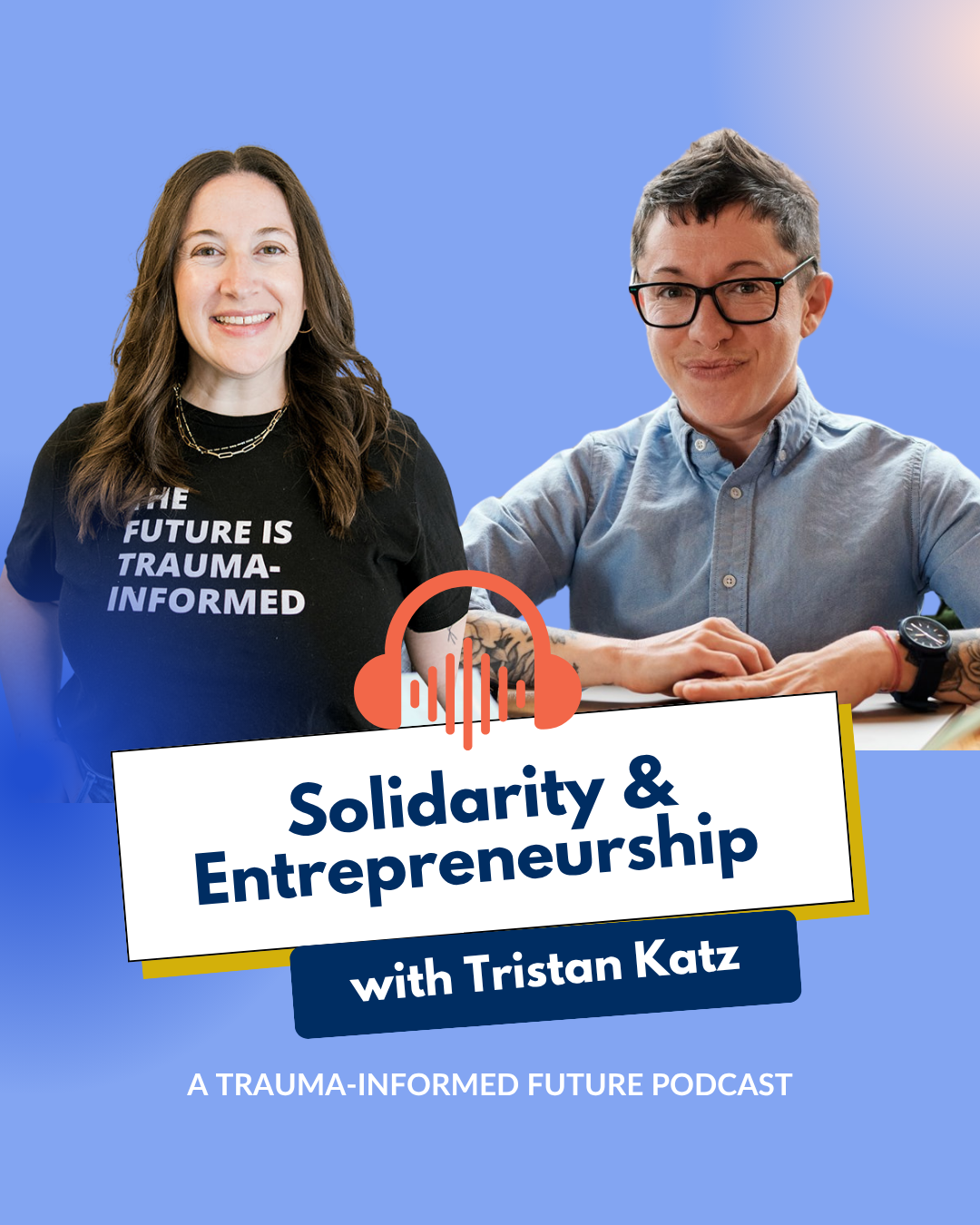
How do we meet the moment while also running a business? In this episode of A Trauma-Informed Future Podcast, host Katie Kurtz explores the intersection of trauma-informed care, LGBTQIA+ inclusion, and effective marketing and business practices with Tristan Katz. An LGBTQIA+ DEI facilitator and consultant, Tristan shares their profound insights on creating meaningful change and fostering supportive environments for entrepreneurs. By highlighting the interconnectedness of solidarity and entrepreneurship, this is a compelling call to action for reflection and sustained efforts towards an inclusive future.
Learn more about Tristan:
Tristan Katz (they/he) is a business consultant and equity-inclusion facilitator specializing in culturally competent marketing strategies and LGBTQ+ Diversity, Equity, Inclusion, & Belonging (DEIB). Tristan currently serves as COO and Director of Programming for Fruition Growth Network, a platform designed to support entrepreneurs with affordable programming, free trainings, coaching, and community. His clients are at the forefront of creating more access and inclusion in the yoga industry and beyond, with social media audiences of 20k and above; many of them have been featured in NPR, the New York Times, NBC, and USA Today, and have worked with companies like Google, the Met, and TikTok. As a longtime student of social movements and social justice, Tristan’s work centers on values-focused marketing, the exploration of power and privilege, and the intersection between solidarity and entrepreneurship.
Connect with Tristan:
Website: www.katz-creative.com
Instagram: @tristankatzcreative
Mentioned in this episode:
Show Transcript:
Katie Kurtz (she/her): 00:00:00] Hi everyone, and welcome back to a Trauma-Informed Future podcast. I am very excited to be in conversation today with Tristan Katz. Welcome. So happy you're here.
Tristan Katz (they/he): Thank you, Katie, for having me. I'm really happy to be in conversation with you.
Katie Kurtz (she/her): Me too. And I'm so eager and I'm like holding myself. I'm like, let's go into it.
But I would love for you just to introduce yourself in your own words to everyone listening today.
Tristan Katz (they/he): Cool. Thank you. My name is Tristan Katz. I use they and he pronouns interchangeably. I am currently, I mean, my work in the world is, is essentially it's, it's LGBTQIA plus DEI facilitation and consulting.
And I, I bring that lens into marketing and business coaching and consulting as well. But I, you know, I do a lot of different things under those two umbrellas. And really my, I think my main goal is to, like, in my work is to contribute to [00:01:00] meaningful change. And to support entrepreneurs who also want to contribute to meaningful change in the world.
Like really that's my goal. And, and from starting my business, I started my business officially in 2018. But have been doing this work even before that. I've always just been like, I wanna support folks who are leading change. I wanna support folks who are working in social justice and social movements and human rights movements.
And I have a lot of different ways to do that. And I wanna call people in, you know, and I wanna educate. And so that's kind of just like, it's all become like this mishmash soup. That makes sense to me. Like, yes, of course I do marketing from an anti-oppression and trauma informed lens. And I also do DEI work from a anti-oppression and trauma informed lens.
Like, it makes so much sense to me. And I understand that it can see a little confusing or like odds, you know? Yeah. But that's, that's the work I do in the world.
Katie Kurtz (she/her): Well, I love that we need it and [00:02:00] also makes total sense to me. I'm like, of course. Why, why wouldn't we? It's all intersected. It's, it's all very much needed.
Yep. And I don't know about you, but I just get. So annoyed with myself to the point of nauseam when I have to say now more than ever, it's like, oh my God, how many more times can I say that? But I don't know what else to say because the times, you know, but, so if you have any examples, like please share because I, yeah, in my eyes, at myself, at the amount of times I say,
Tristan Katz (they/he): oh my God.
I mean now more than ever we need to, I think we really need to understand trauma now more than ever. I think we really need to understand how to care for people. And not just, I mean, this goes so deep. Like we need to, we need to be learning about care, I think culturally, in a whole new way at this moment in time.
And I [00:03:00] think that looks a lot of different ways and. And one of those ways is also understanding how to care for people in our marketing and in the work that we do. Like, I don't think marketing is just a conversation of transaction. Transaction can be a component of that process, but it, it isn't always.
And I think that there's really something to be said about understanding the impact of growing our work in the world in these times. If we're not being sensitive to the way in which people's nervous systems are particularly out of, I mean, I'm gonna say quote out of whack, but that's not even the right way to say it.
It's, we're not out of whack. Our nervous systems are operating just as they should in response to what is happening. And that means we have to meet people where they are and not pretend as if things are normal. But how do we do that when everything, when the [00:04:00] violence is being normalized, you know?
Anyways, these are some of the conversations I wanna have, but definitely I wanna be having them now more than ever.
Katie Kurtz (she/her): Yeah, me too. Absolutely. You know, I always say that we build trust at the pace of our nervous system. And, you know, my background's not in business. I'm a social worker by trade. And when I first entered my business eight years ago, I just was like, well, where do I learn about it?
And that's, you know, you have to, you know, , like trust or whatever, whatever. Bro said that. But I came into business with doing this work, trauma-informed work, not thinking at the time of applying it to business. Right? Because what a , why would you do that? Why wouldn't I? But it always felt so I could not, I had such a hard time with it, and I tried all the things Yep.
And listened to the, the bros and then the girl bosses. Yep. And then all the things, and I hated it. Yep. And I was like, well, maybe I'm just [00:05:00] bad at business. And that's just like me, because I didn't, I was like, how can I have anyone? Trust me if there's no relational dynamic or care. Yeah. And when I started to deconstruct that and really begin to apply trauma-informed care to my business, it felt so natural.
And I mean it definitely is a rubs up against the, the traditional culture and it's very countercultural. But I was like, we build trust at the pace of our nervous system. So like how can you know, how can I do that through especially marketing, communications and sales so that it truly is meeting people where they're at, which right now.
Of course we're just all dysregulated, rightfully so. Our bodies are brilliant. Yep. That's exactly a normal response to extraordinarily abnormal times.
Tristan Katz (they/he): Yes, yes. And I [00:06:00] also immersed myself in studying, let's just say the dominant narratives in business and marketing for a long time. I have also heard from so many people who, like you heard all of the stuff and felt like, I guess I'm can't do this, or I guess this isn't for me, or, because they didn't see themselves reflected back in the me in what was underneath all the things being taught.
Right. And. I found very quickly in studying marketing and business and, and doing it for other people and then doing it for myself. It was like I just kept brushing up against things that felt icky and wrong, and I don't like doing things that feel icky and wrong. I don't like doing things that feel icky and wrong.
Anytime in my life, and there's a reason I'm running my own business, it's so that I can make choices in accordance with what feels icky and wrong for myself, right? Yeah. There's nobody telling me no, but you have to do it this way [00:07:00] though. There are messages out there saying, you gotta do it this way, right?
You set up the email funnel and the sales funnel, and the lead magnet, and the freebie and the news, blah, blah, blah, blah, blah, blah, blah, and I just felt like, no, no, no. That is not how I'm going to build the quote, know, like, and trust factor that feels manipulative and insensitive and disingenuine. I. I love hate the sales funnel emails that I get today.
Like in these times, my goodness, can we please pause any sort of lead magnet or sales sequence and reevaluate Like, what does it feel like? I wrote, what if you wrote this thing in 2020 or 2021? Go revisit it because you've got it coming out on some sort of schedule right now. It's really feels poorly done and poorly timed.
You know my point, I could ramble on and on and yell for so long about all the things I see us as entrepreneurs missing [00:08:00] because systems like capitalism and white supremacy are moving through us and because they're moving through the conversations about how to market yourself. And it can seem like there's only one way.
And I really want to talk about quote building the know, like, and trust factor. 'cause that is an a core part of. That is a core part of building relationships with people, to your point, but I wanna do it genuinely. So what does that look like from a marketing perspective? And, and how do we do it in a way that feels genuine, authentic, and care focused, you know, care for ourselves, care for the world.
We want to see for, for the world. We wanna be a part of creating care for the ideal people. We're trying to meet and serve care for people we may never meet and serve, but we want our message to be so much bigger than just the, you know, anyways. To me this is, I actually think that social media in this way has allowed us to get [00:09:00] bigger with what marketing is.
And now I think that you can create. Like thought leadership. Mm-hmm. And it not necessarily, I don't know. It's just like there's something else going on now because of social media that is like, kind of beautiful. That makes marketing so much bigger than just sales. You know? And don't get me wrong, social media is not beautiful.
It's a shit show.
Katie Kurtz (she/her): The same say the least. Yeah.
Tristan Katz (they/he): Yes. Anyways, I know there was a lot in there that I said, Katie, oh no.
Katie Kurtz (she/her): Oh no, I am, I'm ready. So, right. Something you said that made me think of like when I really was like, oh, I really, really want to have Tristan on this podcast because you and I have. Not even knowingly, like not even knowing each other, posted almost exact same things near the same week or day.
Yes. About safe spaces. Yes. And I wanna talk about it. 'cause I think it goes back to exactly what you were saying was this [00:10:00] assumption of safety, right? We, we generally, if you're like a quote unquote good empathetic person, which like most people listening to this are, and I'm not going to say most people are generally in the public because member empathy is a, it's a learned skill and we're sorely lacking it these days.
But generally speaking, most people want people to feel safe Yes. In their space program service presence. But you and I both know, you can't assume that, and I've said this in nauseam on this podcast, right? Safety is not assumed. It's, you know, it's an individual sense of felt sense. Like we can't actually create a safe space.
'cause like you and I, we have totally different measurements of safety based on our. Lived experiences. Yes. Intersection of identities, positionality, et cetera. Right. So let's talk about safety, especially now when people are starting, we're starting to see some movement of people realizing, oh, I need to be a safe space, right?
Mm-hmm. So we get the, we get the [00:11:00] emojis out that indicate safety or whatever, and like the posters and the things, or we say it, and I get it. It's a really good intention. Mm-hmm. Right? And yeah, like we, I feel like sometimes we're out here and we're like, especially where I live, I'm like, who's, who's, who is safe?
Who's safe
around here? Yeah. No, we need
like a little signal or, or handshake. Secret. Handshake or something. Yes. But at the same time, even just saying you're safe doesn't make people safe. So like how does that translate? This isn't even a formed question, but like, let's talk about the translation of safety and marketing and how it's all intersected to with.
The, the intersections of inclusion. We're saying it folks, all the words. Oh yeah. Oh yeah. I'm just, yeah. One podcast where I just say all the words and that's it. That's the podcast. But like, intersection of business, intersection of just our lived experience and identities. It's all together.
Tristan Katz (they/he): Yes, we can, that [00:12:00] wasn't a
Katie Kurtz (she/her): question, but if Okay, cool.
Tristan Katz (they/he): But I love what you're saying and I love it because so when I started my, my work I was mainly working with yoga teachers because I was trained as a yoga teacher and I was I've been a student for 25 years now, more than half of my life. And I mean, I was all in on yoga. It was a huge part of my life.
It still is. But what I was seeing in yoga spaces that were liberal and well-meaning and quote inclusive in Portland, Oregon, you know, queer friendly. What I was seeing was a lot of othering and a lot of dynamics about relating to power and privilege that happen outside of the yoga space are happening inside the yoga space.
And we didn't wanna acknowledge it or talk about it because in that space at that time, what it felt like was we were all going to transcend it by practicing this thing [00:13:00] together, you know? And meanwhile, as a queer person who was at the time coming into my transness, I was like, wait a minute. I don't feel welcome here.
I feel like I have to advocate for myself and other people, and that means I have to educate And wait a minute, this isn't a safe space. There's a lot of people missing from this space who's not in this space. Why are all the same types of people in this space, right? Who is the safe space for safety?
For who? And so then I thought, well, if that's, and, and by the way, I just, it wasn't just like, oh, I had these realizations. I just wanna say that I would not be doing the work and having this conversation with you if it weren't for this book and the work of Michelle Cassandra Johnson and Skill in Action, radicalizing Your Yoga Practice to create a just World Michelle's book changed everything for me and things started coming together.
And then I thought, okay, [00:14:00] I want to, I wanna make this change in the world. How do I do this in marketing though? Yeah. And then it was like, oh, same thing. Power and privilege is happening whether we are going to recognize it or not. Right. We can tend to that or we can ignore it. And when we ignore it, we're more likely to cause harm while trying to create something meaningful that has well, good intentions in theory.
You know what I mean? Mm-hmm. And so I just, I, I think the, what I always say and what I said recently is that I am learning, it's almost like there is no such thing as a safe space. And in fact, who is safe, right? Some of us are safer than others, and I think there's a lot of people in this country and beyond who've never known safety.[00:15:00]
When I sit with that I feel like if we are well intentioned and empathetic human beings who wanna create safe spaces and be safe people, then we have to reckon with that, right? With the fact that like, safe directly correlates to privilege, which means we also have a responsibility to recognize that we're all capable of hurting one another.
We're all capable of harming, we're all capable of reacting and being defensive or saying the quote wrong thing because we're s we just don't know any better. Right? I wanna talk about that and how it, it doesn't just play out in the spaces we hold or the relationships we engage in, but also in our marketing.
Right. And, and to me I don't know, it's just, it's, it's so nuanced I and so [00:16:00] tender it feels like for me in part because I've heard so many people who have more power and privilege than myself insist on safe spaces for them at my expense as a trans person. And I'm white. I'm able bodied, I'm small and and thin as the culture would call it.
I'm middle class. I own a car, I own a home. I have a lot of privilege. I have a master's degree. And my transness is something I have to defend and protect and advocate for. And I need other people to do that with me. You know, and if they're, if other people who hold more privilege and whose identities are more normalized than mine in relationship to gender, for example, or sexuality, if they're the ones who are insisting that safety is for them, what does that mean for me?
So that's not a safe space. Anyways, I could keep going on and on. And then it gets me into a conversation [00:17:00] about like, what language are we using in our marketing? But how does language, to your point, we have to signal, we have to do a secret handshake. We have to say, I see you, I'm one of. The people who wants to be in a relationship with you and see your humanity.
And we have to do so much more than just the handshake, right? And we also have to recognize like, okay, I, I got the handshake down. What else am I missing? Like, what comes next after the handshake? What do I not see? Or what am I mistaken about? Because I was taught something that's actually not true, you know?
It's not a bad thing to have been taught something that's not true. I mean, it is a bad thing, but it's a reality. So let's reckon with it rather than pretend it's not a reality. You know?
Katie Kurtz (she/her): Absolutely. I I love that question and use it often too. Is safe for who you know, and, and tell folks all the time when we're thinking about safety, because it is, when we think of trauma-informed care, safety is the [00:18:00] number one principle, right?
And I I honor the origins of this approach, but. To usher it into a future where safety isn't a principle, it's not just a good thing. We want, safety is the essence of why trauma-informed care exists. And so I don't deem safety as a principle. I deem it as the, the sole purpose of why we have an approach.
But the principles are autonomy. 'cause what generates safety, autonomy, collaboration, accessibility, and inclusion, which hmm, hopefully generates belonging. If belonging is what the person wants.
Tristan Katz (they/he): Yes.
Katie Kurtz (she/her): Or needs. And, you know, power sharing and trust and transparency, the, those are the things that generate safety eventually, hopefully.
And not just safety physically, but psychologically, socially, morally, culturally. And I think like that these. Especially during these, these times, [00:19:00] I keep coming back to these conversations with folks in, in the trauma-informed world of like, we cannot keep saying safety. Like we, we, it's not dismissing the importance.
It's almost holding it with like this sacred thing that like we, just because we have that intention or principle means nothing if we have no actions going into Absolutely promoting it.
Tristan Katz (they/he): Absolutely. Absolutely.
Katie Kurtz (she/her): Yeah. And I am curious if you see this in your work. 'cause I see this a lot as we have these great conversations, right?
And like we get it, but then we're like, shoot, what do we, how do we, yes. Where do we begin? And then well-intentioned people, probably fellow Virgos like me, who overthink everything, get stuck and we freeze because we swing to these extremes of, well now like if I can't signal, like what, how do I let people know, like I believe on this, I care, I'm involved.
But like all I, I am an online business or social media is like my [00:20:00] front porch. Like how do I even just like let people know or we free swing to the other extreme of being so terrified Yeah. Of causing harm, saying the wrong thing. Yep. Either way, we're stuck and we freeze. Yep. Yeah. And there's no, like, it's like how do we get back to neutral?
So we're actually doing the work that we are meant to do because we need trauma-informed, DI lgbtqia plus inclusive folks in every little nook and cranny of every field. Right. But yeah, it's like that signal and intention and like, I don't know, do you see that, that ex, those swinging of two extremes?
Tristan Katz (they/he): I see it all the time.
All the time. I was thinking about a training space that I just facilitated over the course of a couple months with a small group of, spiritual practitioners like this was a spiritual group, a spiritual community, a sangha and their values are, you know, compassion [00:21:00] for all. And and yet homophobia and transphobia, or maybe I should say cis heteronormativity is playing out in the space and it's impacting people.
And then the people in the space who are being impacted are having to do more labor to educate and call people in. So this is not a safe space. And I said that on day one. I bring that in as one of the things we talk about from the get go. And we repeat it every time we come back together. We are creating a safer space, but we can't guarantee that this is a safe space.
But over the course of several weeks, what I realized was that even saying, and I've been saying that for years again based on the work of Michelle Cassandra Johnson, that is something she teaches, is this is a safer space. We cannot guarantee safety. But we can create safer spaces. And what does that look like?
Well, here's how we do it. Like, here are some of the ways we'll be in practice with one another and be in a relationship and listen and ask questions. And you know, like, here are the, the practices for the space. [00:22:00] The, the thing that I'm realizing is that when we say, well, this is a safer space, it, it's almost like we need to get rid of the whole phrase altogether for a while.
You know, because it's, it's, it's almost, it's the mantra, the power of the repetition of safe space, safe space throughout so much of our culture, I think has, has still, it's like we have to challenge that over and over and over again. And challenging that over and over again is really, really hard. So what I walk happen is, to your point freezing.
Or a lot of times fight flight comes up. Like if you feel that you are being somehow overlooked in your identity. Maybe I, I just, I've seen, I've seen us get triggered around, but is this space safe for me when we've already said it's not safe for any of us here? You know what I'm saying? Like, that's the point we're trying to make.
Yeah. Is like, no, [00:23:00] we're trying to talk about creating something else. So like get rid of the word altogether. This is, and I'm hearing Prentice Hemphill now, who I'm sure you are a fan of. I'm hearing them in their book and, and their work. I've learned so much studying their work, particularly in relationship to understanding that our nervous systems aren't meant to be in homeostasis all the time.
To your point, which we said at the beginning of the conversation we are going to get activated. The point isn't to avoid the activation. The point is to learn how to care for ourselves and one another when we do so that we can be, I'll just say in caring relationship with ourselves and with one another, you know, and experience more healing, right?
And less pain. To me that means we have to accept that things are gonna be uncomfortable, right? We have to accept that. Like we might not know the quote right? Way forward. We might not have the answer to the question in this moment. We [00:24:00] might not have the quote right? Language. What, but what do we have?
You know? Is it education that you recognize you need? Well, we've got that. Go find it. Right? Is it a book? Is it a podcast? Like where can we engage? To me, if we are going to counteract the narratives of our dominant culture, such as like maybe the idea that everybody is a girl or a boy based on genitalia and assigned at birth, if that's the, the, the, the truth that we need to reckon with because it's actually not true to the human experience, then we, I think need to show ourselves what is true over and over and over.
It's like building a new muscle. It's like practicing a new skill. It it, it is, it's the quote, unlearning, you know? I want us to just familiarize ourselves to immerse [00:25:00] ourselves in that, unlearning in whatever way feels accessible and remind ourselves too that learning things, new things or unlearning things takes time and it's not easy and that doesn't mean we're bad.
People, right? Like we've, many of us, most of us in the United States particularly those of us in white bodies, have been taught a lot of false truths. Let's reckon with it and, and, and expose ourselves to, so that we can awaken more and learn how to say the thing when we're afraid to say the thing. You know what I mean?
The only way to create the space that is more inclusive is to expose ourselves to stories and experiences and language that counteracts the thing that's not true.
Mm-hmm. Exactly. [00:26:00] Yeah. Yes to all of that. I, you know, I think this comes back to why, how intersectional everything is.
Yes. Just
Katie Kurtz (she/her): like I.
It's funny, I start every training or keynote I do the same way you do. And I just like, and we didn't know that. Right? And I always say like, I start, I'm like, Hey, I'm Katie, blah, blah, blah. Here's my intro. This is not a safe space. And the faces I get, people are like, what? And I'm like, that's because, and then I do my show.
I'm like, because I don't know you. We have no relationship. How could you possibly feel safe? And then people are like, oh, that's a good point. And then some people shut down. 'cause you know, like some people are just not ready. Ready. I mean, I honor that, right? But it starts to get people thinking about safety Yes.
In a different way. And I also just say like, how are we burning the binary like this good, bad, right or wrong? Like, I get it [00:27:00] that that's literally how we survive every day. Like our brains are either or left, right? Like yeah. However, humanity is not. Like, and both and everything in between. And so how are we getting better at nuance and critical thinking?
And especially now because we are seeing, yes, we're inundated with media and messaging and marketing and even, you know, our government systems. The White House is marketing
Tristan Katz (they/he): just
Katie Kurtz (she/her): egregious, horrific things. And we have to discern, is this real? Is this real or is this not? And a myriad of other things, but it, when we start to really think about.
What we're consuming and how we're faced with it. Like, and we start to think of safety. I feel like it's one of the entry points into trauma informed anything [00:28:00] for people, at least in the work I do. Because then I start, and then I bring in my like, and don't you see how we can't separate this from anything else?
Exactly. Like, I'm like, don't you see how we can't separate anything related to oppressive systems? Because we are the oppressive, like systems are made of people, and that's us, mainly people who look like me, like, and you know, DEI. Yeah. What, you know, you know, even like Ju Jedi, anti-oppressive, anti-racist, all connected, neurodiversity affirming care.
Yeah. All connected like, you know, trans rights all connected. Yeah. Like, and you can't say. Like, then it starts to help build people. Then they start to see the world's, the everything turning. And there's a lot there, right? We're not going to, you know, dismantle oppressive systems and thinking and being in 45 minutes or however long they give me.
But [00:29:00] it starts to create the new neural pathways. Yes. That like this is all connected. We have a choice and here are the choices that we can make. And we don't know what we don't know till we know it. Yep. But I truly believe people, there's power in changing our minds and our beliefs, and especially when we have ingrained messaging that is so deeply a part of our culture.
And reinforced. It's gonna take a while, but it's happening. Its, it's happening.
Tristan Katz (they/he): Happening. It's happening.
Katie Kurtz (she/her): I'm not one for silver linings, but No.
Tristan Katz (they/he): Yeah, no, I'm not either. Especially in these times. And it is happening. I mean, look, there's a reason we're fighting for rights to gender affirming care for trans people is because there are more trans people who know they need that care.
And ever before Yeah. Because of the conversations we're having about gender, how could trans people possibly know ourselves if we're [00:30:00] not talking about these things? Right. Yes. And it, and to me it's very similar. I always say it's like, and there's a lot of resistance in the conversation about gender. So much resistance.
Not as, not to say that there isn't in other conversations about other identities but what I do notice is somehow, the, the, the story of gender is like so deeply personal for so many of us in a different way than for many white, cis hetero people. The story about quote Thanksgiving is a little different.
And, and what I mean by that is for most white people I know at this point in time, they were raised with the idea that quote, Thanksgiving was a, a celebratory event of breaking bread, you know, between the people who lived here and the people who came to reside here. End of story. And that's the way I was raised.
And I was raised to create [00:31:00] turkeys on paper out of my hand. You know what I mean? Oh yeah. I was raised to take holidays every year and do it a certain way with family traditions and blah, blah, blah, blah, blah. And then I learned that that wasn't true. That it was actually an incredibly horrifically violent event, not celebratory for everybody there, celebratory maybe for the conquerors, you know?
And the people committing genocide and forcing assimilation. But if we can reckon with that as a country, which I think we are starting to, like, we're seeing the conversation happening, right? Like, let's not call this Thanksgiving anymore. Let's call it a national day of mourning. You know, let's start talking about what it really was, what really happened at the beginning of this, the quote founding of this country.
If we can, if I can get folks to embrace that conversation, then I feel like the gender conversation is the, is the next one over where it's [00:32:00] like, okay, the other truth I was raised with is this one I. But if we don't talk about the fact that's not true, how are people gonna free themselves and heal from the wounds of the gender binary?
Right. As a system that we all have been indoctrinated into. The healing comes, I think, from many things. One of which is having the conversations, and I know we're having them, which is why trans people are being targeted in such unprecedented ways. It's because the conversation is getting louder in some way.
Yeah. And that is more threatening, you know? Yeah. So, yeah, I don't feel any silver lining, but I do feel like, damn, when I look back at history and I think about Nazis burning books from the Sexual, the Institute of Sexual Research that existed, and that being a pivotal moment where trans people were literally being erased.
Well, I don't know what's gonna happen in the coming years, [00:33:00] but I do not foresee our erasure. And to me that means we have to keep fighting for change. Yeah. And I mean, we've kind of wound all around in this conversation and now suddenly we're here. I'm like, and I want every single human being to understand their role in that fight because I think we all have one.
Katie Kurtz (she/her): Yeah, yeah, absolutely. I think anyone listening to this, me included, we have a role in that. And I think that it's just like any movement we have to really, you know, rumble with our own, like exploring our own self-reflection of gender Yes. And sexuality and look at, you know, around in our lives [00:34:00] and. F use the tools we have already to be a part of that.
And you know, I think this goes back to what I was asking was like, what can we do? Well, that that's it. Yep. That's it. It always starts within self of that building, that attunement. And then if that means, you know, shifting some language I am a, I've talked about this on the podcast before and I am a big fan of having like an inclusion statement.
I know, I mean, it, I, I don't say just throw, slap something on your website, but like having some sort of statement, whether it's an anti-oppression statement, inclusion statement that makes people aware. That's a part of every contract, it's a part of every agreement. I'm not going to work with you if it doesn't align.
Right. Doing those values, checks and values alignments like. Because it's met with action because we know you're not just slapping things to virtual signal or be performative. There's action behind [00:35:00] it. Things like that. Yes. Being in conversation, there's so many different ways we can be in action and not minimize small shifts make big impact.
Yes, because we have to sit as a non-trans person. I have to sit with the fact, like the reality is there are attempts of erasure and what does that mean for me? Yes. What does that mean for the world I am trying to create and be a part of and exist in because I don't want that world. I don't want be a part of that.
So I am going to show up and do my part and listen and learn from people leading and who have always led in these spaces. And I wanna come back to something you shared. And I don't, I share this comparison not to minimize how you were talking about like. More trans people are talking and, and, and sharing stories and, and having the courage and ability to do that.
And I, I'm not minimizing that or comparing this to this, but it's similar to how trauma is still considered a bad [00:36:00] word, right? Yes. And people are still, you know, it's on the list, whatever are still like hesitant or want us to not use that word. And it has for the entire time we've had that, right?
Including trauma-informed care. And the reason, you know, I get asked a lot like, why is everyone talking about trauma all of a sudden? Why is it such a buzzword? I'm like, 'cause people are talking about it. We have language. And people are finding spaces to have conversations. And then they're finding, they're realizing, oh, there's therapists for that.
Or like, you've gone through that, or what's a narcissist like? And now look at it. It's not a buzzword, it's just people are finally having language. To name their experiences. And I think that it goes to the fact that how powerful language is that when we have words, when we have the ability and social media is for better or worse, a conduit to
Tristan Katz (they/he): Yeah.
Katie Kurtz (she/her): Visibility and being able just to [00:37:00] learn about other people or just not feel alone. Mm-hmm. And it's, it's different, but it's similar in that there's so much power to showing up. Yes. And, and sharing. And that our language and our presentation and representation, it all is inter, it's, again, it's all intersected.
Tristan Katz (they/he): I love that you're saying that because I'm realizing I'm like, how much backstory do I give for this? But I'm realizing that s. My father has reflected back to me that he, well, let's just say this. He has I'll just be, be real. He's accused me of being obsessed with trauma. He's very confused about my quote, obsession with trauma.
Because I don't think I'm obsessed with trauma. I think I'm obsessed with healing, for lack of a better word. And to me that means understanding the nervous system and the [00:38:00] brain and the way we get stuck in patterns. And to me that means understanding trauma and somatics and, you know, like all of these things are about, I, I think freeing ourselves.
And the reason I love that you're bringing this up is because. I am similarly, quote unquote, one might accuse me of being obsessed about gender. And I am, I am. I think about gender and I think about trauma, and I think about sexuality, and I think about identity and power and privilege all the time. So yeah, I am obsessed with these things.
And in my quote, obsession. I have also discovered the most freedom and the most healing, you know, and the most liberation [00:39:00] that I've experienced in my lifetime. And I'm 42, I'm gonna be 43, which I know isn't that old. And yet also feels significant, you know, to know myself in my transness, to have the language.
There is a parallel in knowing my own trauma and having the language. Both things allow me to move forward in my life with greater clarity and greater ease and less pain and suffering. So, yeah. You know? Yeah. I think trauma's a, a, a beautiful buzzword for us to have. I think trans is a, you know, and I think we need to keep reckoning with our cultural reactivity to change.
Yeah. Because that's what it feels like. It feels like we are culturally just like, oh no, that's too big. Too big change. That change is too big, too uncomfortable. Nope. [00:40:00] Let's not talk about trauma, let's not talk about gender. Let's not talk about DEI. Let's not talk about freaking reproductive rights. And next thing you know, we've got this list, you know?
So yeah, we need to keep having these conversations. And I think social media, to your point too, gives us a platform to have them. In a whole new way. And for better or worse, to me, if you're gonna take up space on social media to grow your work in the world, you gotta be sensitive to that platform and the fact that it's not just about selling your work in the world.
Yeah. What are you doing on that platform beyond you and your work and your sales? You know, how are you contributing to something bigger? To me, that is a big part of what I want to have when we talk about marketing is like, it's so much bigger than just the, the come to my workshop or come buy the service from me.
I want us to contribute to something bigger in our marketing that has nothing to do with the sale. I'm not minimizing the fact that we need money to [00:41:00] exist and pay our bills, you know? But I want us to understand marketing in a much more expansive perspective because to me it can be about having these conversations and, and being in dialogue and making change and being a part of change.
And, and, and, yeah.
Katie Kurtz (she/her): Yeah. It, I think the, the other piece of that is having spaces to co-regulate in.
Tristan Katz (they/he): Yes. You
Katie Kurtz (she/her): know, like having those mirrors, and I, I tell folks all the time when I train, I'm like, your nervous system's a mirror. So if you're showing up reactive or the other person is, yeah, we're just gonna be reacting.
That's, it's the auto, the autonomic nervousness. That's that automatic part. But if we can show up responsive, you're inviting other people to be responsive too. And I wanna be mindful of time, but I have a quick story if you don't mind, please, of a really I am also often told that I'm obsessed with trauma or referred to as that the, the trauma [00:42:00] lady, which I don't love, but also like.
Where's the lie? I was recently with family over the holidays and my partner's, two aunts, older aunts, very small town in Illinois. We were visiting and it was my partner a cousin who's our, you know, our age and the two aunts, and we were talking, it was lovely. And then all of a sudden one of the ants was like, I need, I would like to talk to you about something.
Like, sure, what is gender affirming care? And I was like, we were all just like not thinking he was gonna go there. And we're like, well, let's talk about it. And we had a great conversation. They were both able to have their questions answered. They talked about how they knew a trans person in their community.
No one would talk. They, they unfortunately, you know, died by suicide. There was a, but they kept it hushed in the church and the whole thing. Oh. And we were able to have a conversation. It was. Possible [00:43:00] because we were all regulated. Yes. I mean, we were, there was no reactivity. And after, and like sharing some things and like encouraging, you know, additional education and just really grateful we could have a conversation like this.
Especially just in December they left and they said, you know, I, I'm gonna go back and share that with my friend at church. And I'm like, please do. Like, oh my god. Yeah. Like great. And I know she is going to talk to people. S and, and she's going to do it with Yes. And not back down. And like that's, you know, I'm so guilty of just getting so fired up and like, not being able to like even handle people with empathy, without empathy and like diversity of thought.
Like I can't like it's so it, I know that about me and I get very reactive. That fight too comes out. And I know that the only way for change is to find spaces, to have conversations. I'm not personally there yet. [00:44:00] I hope to be, and in those moments I am. But those are the, like the example of how powerful it is though when we're not in reactive states.
Yes. And we were actually co-regulating. I mean, obviously trust was there. They trusted us enough to come and like clearly planning on to talk about it. We didn't know, like we were talking about like. I don't know, recipes. It was such a beautiful conversation and powerful. And it gave us the three of us, like so much hope.
'cause it was so, it was such a dark time. Yeah. Who knew? It was only December. Remember Dad was such a, we were so young and naive then. And I share that just because how important it is that we often miss that on social media too, right? Yeah. Anything online is like, we can't, we're just assuming someone's state because through their, we're interpreting what people are saying from a post.
We don't always know the tone. We don't always know what it is. And I see so [00:45:00] much harm happen because people are uncomfortable and they're misconstruing discomfort, which is actually
Tristan Katz (they/he): mm-hmm. Very
Katie Kurtz (she/her): normal feeling when we don't know something. Mm-hmm. That can also be very healthy or destructive. And when it's destructive, it becomes harmful and like.
I mean, exhibit A uhhuh our country. So, you know, I always tell people like trauma informed care, anti impression work, this is all uncomfortable. It's countercultural, it's reckoning with our own identities. It's reckoning with the identities of others that maybe we don't understand. It's positionality and sort of like nothing revs someone up.
Then privilege.
Tristan Katz (they/he): Oh my God.
Katie Kurtz (she/her): And so when we can build our capacity for discomfort, we're going to be building our capacity to be more resilient in situations when we are uncomfortable. But you know, yes, here we are.
Tristan Katz (they/he): Yeah. And I know, yeah. I'm like, I know it. [00:46:00] It requires so much of us in some ways lately I find myself saying, I really wish that, you know, instead of chemistry in high school and junior high or whatever, that I was taught, like I.
What a nervous system is and how it works so that I could start to learn to notice mine and, and care for myself. You know, like if we were just give, but why would we be given these tools? They, the tools that, these are tools that that are celebrated in the systems we live in. But they are tools that I think we need in order to fight these systems and challenge these systems in ourselves and in our relationships and in our actions and in our larger communities.
And it is about I learn this all the time, both in my work when I'm facilitating groups and we're in sticky moments. And I, my responsibility is to stay, my responsibility is to stay in [00:47:00] the space and hold it. So what does that look like when my body is lit up on fire and hot or whatever because of something that's happening in the space that's directly impacting me, you know?
And my job is to stay, whereas if I'm in a conversation, I'll bring my father back in. If I'm in a conversation with him and I'm activated, it's a different situation and I have had to learn how to care for myself differently. My nervous system needs different things in that situation, but I won't learn.
How to respond to my experience with care and literally like, take care of my wellbeing. 'cause nobody else is gonna do it in that moment. Unless I ask for support, which means I have to know that I need the support. In order for me to care myself, I have to go through those experiences of learning.
This is uncomfortable, I'm not feeling [00:48:00] safe. Is it really a lack of safety? Am I like, can I feel my feet? Do I have water? Is there a roof over my head? What kind of safety are we talking? And, and, and really like learning in real time through practice, how to be with the dysregulation. Yeah. I want us all to learn that
Katie Kurtz (she/her): it's such a beautiful example of trauma-informed self-care.
Like, when I first learned this approach, I was taught it's, it's really only the care we give to others. It doesn't include us, the givers. And it felt so unnatural to me. I was like, I don't get it. Like, I just feel like, why are we, I was a very young social worker at the time, being traumatized at work, and I'm like, this doesn't make sense.
Like, shouldn't it be both ways? And over the years as I like learned and grew in the practice, I was like, oh, this is bidirectional. Like it has to be, we have to give the same care to ourselves [00:49:00] and to your point, like it, everything you described there is resourcing and that's a trauma informed strategy of like, how do we resource ourselves so that we can be more attuned?
And then therefore attuned to others. I mean, that's the essence of group facilitation, right? Is like facilitation of any kind is like, if we're attuned to ourselves, we're better attuned to other people. Yes. And then we can really hold that space. And I think we often miss the, the self attunement. And some of us are really into it, right?
Like I always say like, I'm a little too self-aware. Probably at most times I'd like to give that up. 'cause it's like too focused on it. But though even just noticing those sensations and like, what does safety, like, what does that mean for you? Yeah. Like, what is that? How do I know that? What does that feel like in my body?
What does trust, what, what is my pa my process of trusting people? And what is that based off of? And yeah, it's, it's usually intersected with healing work and liberation work. It's all again. It's connected, but [00:50:00] it helps us then better understand and attune to other people, which just rich, you know, makes this such a richer practice for both you as the provider and the people receiving.
Yes.
Tristan Katz (they/he): Yeah. I always, I keep thinking too about my friends who are parents and how they're having to face on some level parenting their inner children while also parenting the child that's out in front of them, you know? Yeah. And I'm like, yeah, that's healing work. You know, like same in trauma-informed care.
If I can orient towards being receptive to your nervous system and what you are needing and meet you where you are, and be a, a consistent nervous system support for you, that's also going to support me too. Because, again, co-regulation, it's all interconnected, et cetera, et cetera. We don't live in isolation.
You know, our nervous systems don't function in isolation. And our, our dominant culture would have us believe otherwise that we could just like
Katie Kurtz (she/her): absolutely
Tristan Katz (they/he): hide ourselves away and protect our [00:51:00] sense of safety. But that's not. Possible.
Katie Kurtz (she/her): Yeah. Yeah. So Tristan, we've talked about so many good things, right? So many things, part two.
Okay. But the reality of these practices are so countercultural, right? DEI clearly is like now the scarlet letter. Like we, like everything is just now labeled bad, wrong, flagged, you know? Yeah. But it's also in essence counter-cultural because we are deconstructing the culture while using the practice, right?
Yes. So even if we didn't have what we have, it's still a long game because it's, it takes time to unlearn and then rebuild.
Tristan Katz (they/he): Yes.
Katie Kurtz (she/her): So for those of us in it, and noticing or knowing these intersectionalities what, and, and the times, because it's making it a little harder, what can we do? Like, you have incredible, you, you do such incredible work.
You [00:52:00] have lots of workshops and I know fruition and like all these things. Like, do you mind sharing with us like a few things that like Yeah, if you were talking to someone today, what can we do with what we have just right now? Right. We're not gonna change the culture by, you know, April 5th, right? So like, you know, even four years, like a lot, you know, there's a lot to happen and I, I always say that not to be like, like, oh God.
'cause I know that can feel daunting like a lifetime in our lifetime. But it's like, no. For me, as somebody who tends to lean on the perfectionism and overthinking it almost feels like a relief. Like, okay, good. I don't have to have this figured out by May. I can I have some time. You know, we have time, but also it's like, oh my God, how much more time do we need?
So it's just always this fun contraction between the two. But with what we have right now, especially with the too much, too fast, too soon, nature of our culture right now, which has always been that way, but it's so intensified. Yeah. Right. Yeah. Yeah. You know, [00:53:00] not to put you on the spot, but like, no, what are some things we can consider considering?
Even just things to be more mindful of. Yeah. Or consider, especially as we, we think about business perspectives. Yeah.
Tristan Katz (they/he): Cool. I actually kind of love this prompt. There was a time where I would've been like, oh, you just want a bullet list? I'll give you a checklist, you know, but now I'm like, no, no, this is exactly what I wanna be talking about.
Because there, I feel like there are a few things I, I want folks to know, and I'm going to speak specifically to cisgender folks in this moment. Mm-hmm. From what I know of most trans people right now, it feels as though we are being. Abandoned to be erased. It feels like, and I know the circumstances, man, we have been watching the genocide in Gaza for so long now on our phones.
I know that [00:54:00] those of us who have social justice values, for lack of a better phrase, are many of us are burnt out and overwhelmed and tired and just barely holding it together. And it just feels like there's a lot of silence in the ally community. It feels like there's a lot of insensitivity to what pe trans people are going through.
For example, most trans people I know kind of feel like at this point they might never be able to leave the country again. Most trans people I know are afraid that if things get more dangerous and violent here, that we're really gonna be in trouble if we can't leave the country. But even just taking a trip to visit a family member right now is really scary.
We're afraid of being detained and disappeared 'cause that feels like it's [00:55:00] actually potentially around the corner. So, given that reality and the fact that it's, it's what, whatever anti-trans legislation is being passed or not being passed either way, it has such a significant impact on the mental health of this community.
I want us to understand that trans people are not just some, like small fringe of the population. I think we all have to reckon with gender norms and the way it's been constructed, and the larger nuances of the human experience, and understand that trans people are a natural part of being human.
In fact, what might not be natural is understanding people only in terms of man and woman. So if that's the case, then I want us to speak up more. And it feels like even now, more than ever before, it's like, now's the time to do those little things that [00:56:00] aren't little at all. Like, put your pronouns in your Zoom name or your email signature and talk to your coworkers about why you're doing it.
Call your workplace in, you know, have conversations with people in your spheres of influence and community, because that's part. Of something that I don't wanna keep doing. It's really hard not just to keep having them, but people mostly don't wanna listen to trans people because they have bias against trans people, which means we need cis folks to steward some of this work with us, you know?
So these quotes, small things, and I'm, you, you followed me long enough on social media. You know, I'm yelling about the word women and gender inclusive language all the time. It's gonna be like the hill I die on, I swear. And not because I love talking about it, but because I'm so tired of being erased and I'm so tired of entrepreneurs and solopreneurs thinking that they need to specify the gender of the people they work with in [00:57:00] order to reach their ideal client.
I don't think that that's true. I don't care what kind of work you do. I think it's the easy answer and easy isn't always right or inclusive. And I don't care. Even if you work with women, your marketing has an impact beyond just the messaging of the, of the, of getting people into the space with you.
You're, you're putting that out there into the conversation in the ether, you're reinforcing something. So I. There's so many things that entrepreneurs can do. Write the equity statement on your website. Put that into your contracts. Put that into your marketing, right? Be vocal about why you have one. Share it over and over again on your social media.
Understand too that maybe you're not in a position to hold space for trans people right now because you have more learning to do or whatever. You do not have to be for everyone, but you at least need to say that you recognize that trans people exist and stop pretending that we don't, you know? [00:58:00] And I regularly teach on this, as you said.
I love holding people in this learning, even though it's really hard and sometimes really triggering and activating and sad. It's also like I wanna have this conversation over and over and over and over and over and over and over again, as long as we need to have it. And to your point, the change may not happen in my lifetime, but I'm gonna keep working towards it either way, because I know that what is happening is so I wouldn't be here, you know, I would not be here in this moment if it weren't for trans people coming before me and, and doing this work and telling their stories.
And I wanna see trans kids. Have a life that is authentic and affirming, and there's no reason for them not to. And so I think we all have a role to play in that. And I could keep, come learn with me if you wanna learn more. That's all I'm gonna say. Yeah. Yeah.
Katie Kurtz (she/her): Please do. Thank you so much for that. [00:59:00] I think it's, those are the things we can be doing and if we're doing it to keep doing it and having those conversations and keep showing up even, you know, and, and leaning on the practice of resourcing or if you're burning out time to resource.
Yes. Time to recalibrate. Because we need to sustain in this practice and showing up for, for whatever comes. And I think, you know, there's so many what ifs right now. Yeah. You know, there's so many what ifs for the trans community. For so many communities, right? There's just like, this could happen.
And some of it's like, wait, it's that hypervigilant state of waiting for the shoe to drop.
Tristan Katz (they/he): Yes.
Katie Kurtz (she/her): And in our case, like in the middle of the night by some weird whatever. And that is a, that's intentional. I mean, they're doing that intentionally. That's intentional. Weaponization of, they've stated they're intentionally traumatizing us.
And so [01:00:00] that's one thing, a whole other podcast. But this is about,
you know, whether it happens or it doesn't, whether it succeeds yes or fails. The fact that it's happening is problems.
Tristan Katz (they/he): Yes. Give
Katie Kurtz (she/her): shit about people. Yep. If your values are compassion and empathy and kindness, you know, all that be kind bullshit that sprung up during, during covid, which I just can't, if you care if you're telling everyone you care, that you just want love and all this great, this is love.
Yeah. This is love. Making sure trans people are not erased or disappear or anything. This is what,
Tristan Katz (they/he): yeah, yeah. Like, like
Katie Kurtz (she/her): you find whatever word value, whatever thing you can grip on and hold tight to and see the humanity of what the humanitarian [01:01:00] crisis is happening and that, you know, that needs to, you just need to start where you're at.
Tristan Katz (they/he): Yeah. And
Katie Kurtz (she/her): this is a great place to start. People can share this podcast. Your following you on social media alone is like your everything. You post all of your workshops. Follow Tristan Learn. Remember that social media is not the end all, be all. That there has to be actually things happening in your community.
If you say your community's rural or small or Midwest or red, it doesn't matter. Correct. Find there are people there, right? Like yes, there is somebody and it's possible. So yeah. Thank you so much for sharing so much with us. Yeah, thank you. Thank you. And generously giving us so many calls to hope in action.
And I will also list the books you shared and all of your links in our show notes so folks can connect with you. Cool. Is there anything else you wanna share before we go into our slow spritz? Gentle [01:02:00] spritz, if you will.
Tristan Katz (they/he): No, I'm ready for the spritz. Spritz me. Spritz me. Here we
Katie Kurtz (she/her): go. If you could describe trauma-informed care in what word, what would it be?
And if you have more than one, that's okay too.
Tristan Katz (they/he): P.
Katie Kurtz (she/her): Yes. Yeah. Yeah. What is your current go-to for nervous system care
Tristan Katz (they/he): drawing? I draw really intricate and color the drawings and it's like a whole thing and it'll go on for hours and it's like really just grounding to my nervous system. Yeah.
Katie Kurtz (she/her): Love that.
I'm really into art right now. Yeah. More art, the better I see it. Yeah. I need to sit with it. I need Yes. Yeah. Yes to that.
Tristan Katz (they/he): Yeah.
Katie Kurtz (she/her): Such a good co-regulation too. And what does a trauma-informed future look like for you?
Tristan Katz (they/he): One where we are equipped to hear each other's truths, you know? One where we are [01:03:00] better equipped to really. Be in relationship with one another. I feel like we're so poorly equipped with relationship skills. So many of us the trauma-informed future would be one in which relationships are something about the way.
I mean, and I know this directly connects to, you know, individualism and capitalism and all the things, but I think there's something so important about learning how to be with one another in relationship when trauma is going to be present. You know? So I want us to learn how to do that. Yeah,
Katie Kurtz (she/her): yeah. Yeah.
Trauma-informed care is relational care.
Tristan Katz (they/he): Yeah,
Katie Kurtz (she/her): for sure. Yeah. Well, thank you so much for joining us today. Such a great conversation. I'm sure many more to come. Thank you. And I hope folks check out you and your work and really reflect and think about those calls to action.
Tristan Katz (they/he): Thank you, Katie. I really appreciate it.
