

Who Cares?
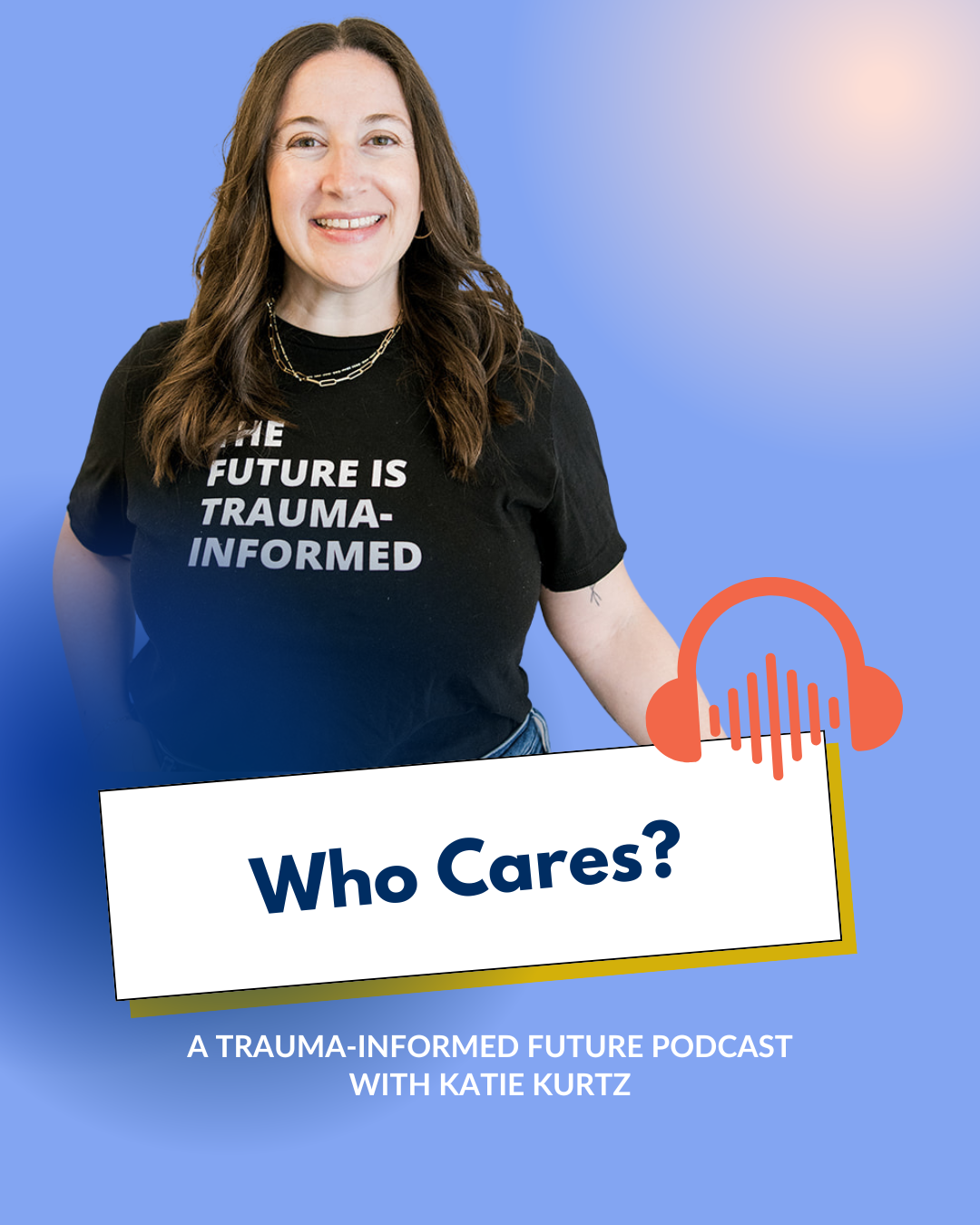
Welcome back to a new season of A Trauma-Informed Future! After a restorative pause, Katie is offering transparent updates about the behind-the-scenes shifts that have unfolded since the last episode. Acknowledging the deep distrust shaping our world-from politics to community safety to information itself-Katie reminds us that trust is built slowly, at the pace of the nervous system, through aligned intentions and actions. She reflects on the collective trauma of the current moment, the exhaustion and hopelessness that doom-scrolling can amplify, and the grounded hope that trauma-informed practice continues to offer as people make daily choices toward humanity, safety, and care. Katie shares the evolution of her work, including the emergence of TRUST™ (Trauma-Informed Relational Upskilling and Systems Transformation) as the aligned home for her methodology, the beta launch of TRUST Works, and the growing community of trusted partners. Centering the power of caring as courageous rather than “soft,” Katie calls listeners into mindful action, inviting them to reflect on where their care lives, how they can use their power within their spheres of influence, and how choosing trauma-informed care in small everyday moments contributes to a broader trust swell.
Resources mentioned:
Show Transcript:
Katie Kurtz (she/her): [00:00:00] Hi everyone and welcome back to a Trauma-Informed Future podcast. I'm your host, Katie Kurtz, and this episode I wanted to welcome you into a new season. There has been a bit of a pause for restoration for time behind the scenes work. And so I wanted to practice what I teach and offer some transparency, some updates, and a look ahead of what to expect from this season because it's full of incredible guests really helpful tools. Some education calls to action and is always incredible people who are demonstrating what it looks like to live and lead this approach out loud.
If you are new here, welcome. If you are returning, welcome to, I wanted to be sure. It's been a minute since we have had the last season, and although sometimes we don't listen in seasons or maybe you do , a lot has happened behind the scenes and a lot has been happening in the world around us.
Let's not gloss over and practice [00:01:00] some transparency because we know transparency supports our nervous system and it helps build trust. And that is the reason for the season, right? It's, we are living in such distrustful times. We are living in a trust deficit everywhere we turn from AI to government policies.
To communities, to business, everything is feeling like shaky ground when it comes to trust. We don't know who to trust, what to trust, whether it's news or information, or a post, is it real? Is it ai, et cetera. And so we know as trauma-informed, as people who use a trauma informed practice, that trust is not assumed.
It's built over time and trust creates conditions for safety. But we build trust at the pace of our nervous system. So each and every time we are in relationship with people at work, at home, in our communities, [00:02:00] we have to remember that trust is. Something that is almost like a currency. It needs to be earned, it needs to be built over time.
And we do that through our communications and our in aligning our intentions with actions. So let's practice trust together here since the last time you heard from me and this podcast we've gone through a season the summer season here in the Northern Hemisphere. We are in. Late fall and this year of 2025 has felt like 10 years.
As I record this in the Midwest of the United States, and so much has happened within the political collapse and the just onslaught of violence from iCE raids to ripping families apart to [00:03:00] transphobic policies, to now seeing SNAP benefits be paused and taken away. There's just so much happening and.
It can be so easy to get stuck in the doom scrolling. I'm very guilty of it and feel that sense of hopelessness. And at the same time, this podcast demonstrate the hope, demonstrates the hope and the long game of this approach to show how people when faced with the choice or choosing humanity, they're choosing trust.
They're choosing to promote safety by choosing a trauma-informed approach. And so I hope wherever you're at that this podcast can be a space of hope for you and not like a Pollyanna toxic positivity kind of hope, but a real grounded strategic kind of hope that. It gives us glimmers that restores our faith in humanity, even a little that gives us mirrors to [00:04:00] model from that calls us into action and gives us a sense of community.
No matter where you're at, that you are a part of a groundswell of people choosing to show up. As I always say, trauma informed care is not complicated, but it is a choice. And when we are more mindful. In the moment, no matter who we're with, we have the opportunity to choose. And a lot of people are choosing this approach.
So that's my moment of hope for us all. Since this podcast, a few things have happened. Actually a lot of things have happened behind the scenes and I wanted to share it , transparently because we have to keep it human. And again, that's an element of trust building.
I did our beta launch of Trust Works, which if you haven't listened to previous episode, trust capital T-R-U-S-T stands for Trauma-Informed Relational Upskilling and Systems Transformation.
I know it's an acronym. It's a mouthful. Katie. Why would you do that? [00:05:00] Because I realized over the years as I have been studying and practicing and formulating a methodology and model of trauma-informed care that honors the origins of the approach, but ushers it into a future that is inclusive for all fields where people can see this as relatable and doable through practical everyday strategies.
The term trauma-informed care is loaded. A lot of people are just completely turned off by it, and I have been very vocal in saying, I will not stop using the term trauma-informed care. And I implore that neither should you. But we still also need to meet people where they're at and honor the levels of readiness.
And so I switched to trauma-informed leadership and I was using this term a lot. I noticed that it was shutting even more people down. What's so interesting is because they don't see themselves as leaders or we've connotated leadership as this very specific hierarchal thing, and that's not what I ever meant by it.
Leadership is we all have a choice to lead our lives out loud [00:06:00] and what choice will we make and can it be a trauma-informed choice? And it wasn't landing for people and it wasn't landing for me, even though that's what all this is. And so I had some support and I sat down and realized, what can I do?
Where can I move this body of work? Nothing's changing about the body of work, but it felt like it needed something. And someone who I was seeking support from asked me what exactly does it focus on? Your specific methodology, your interpretation of trauma-informed care, your body of work?
What in essence are you doing? And I was like, oh, do you have the time? Like, how do I sum up something that can be so nuanced and so vast into a few words? So I said if I had to simplify it. I would say it's all about learning how to use strategies and skills that are trust points that lead to safety within relationships, environments, services, [00:07:00] business, et cetera.
And the other person just immediately clicked and said, oh, so you specialize in trust and this is why the power of having space held for you, coaching, consulting, like it's so powerful because I was like, oh yeah, that's exactly what I do.
Everything I teach from every trauma informed principle, strategy and skill is a trust point that builds towards safety. And like I said just a few minutes ago, we build trust at the pace of our nervous system and we build it over time. And so each and every word we use, way we listen. The way we build relationships, collaborate critically, think, adapt, all of these things are trust points towards safety.
And not just physical safety, but psychological, social, moral, financial and cultural safety, the kind of safety we know and we promote through this approach. So things just began to really click. And since then I had this really beautiful, creative [00:08:00] surge and realigned everything under the term TRUST. But for me, I needed it to mean something more than just.
Trust lowercase t this value, this essence of what this approach is about. And so trust capital T-R-U-S-T, the trauma informed relational upskilling and systems transformation came to be to really have something that was aligned that felt really embodied and aligned for me, that really encapsulates everything about this specific interpretation and body of work I have developed over the years.
So trust. Is the new name. It's kind of everything. Everything is the same, but everything is now funneled through this. So it makes it more engaging and relatable because when you use the term trauma informed, it's going to shut people down because they get hung up on the term trauma. Again, we're still using it, but everybody knows what trust is.
Trust is the essence of every relationship, both [00:09:00] personally and professionally. And so you can't argue that when trust is present, so much is possible. When trust is ruptured or broken, it can also create a lot of hindrances and hurt and harm. And also trust is the essence of, we think of marketing and business.
No, like trust. You need trust to maintain clientele. So even from that business perspective, it's relatable. We need it from a patient experience, a client experience, student experience, and of course in personal relationships. So TRUST it is the name that really encompasses everything of what this advanced trauma-informed care model I have developed and have taught and have spoken on over many years is now under that umbrella.
And you'll hear me talk more about trust because it's relatable and especially now in the times we're living in, it's undoubtedly ever present. And [00:10:00] I have seen such a shift in speaking specifically to trust, and I joke like I have created this non-manipulative Trojan horse, right?
That like when we start to talk about trust, then we can under start to understand the neuroscience behind trust. If you've listened to the last episode, the neuroscience of trust is why we have trauma-informed care, and then we can invite people into this approach, how it is neuroscience based, that it is evidence led, that it is tangible and practical and applicable to every single person as long as we choose it.
So from that I launched the beta of TRUST works, which is a three-part advanced training. This is the training I've been, using over the years. I formalized it to make it accessible to individuals who wanna move through this path. There's three parts, TRUST Yourself, which really fo focuses on the TRUST principles.
TRUST the process, which is the the trauma-informed [00:11:00] strategies, and then TRUST in action, which are the skills or the upskilling, right? 'cause we already know how to communicate and build relationships and collaborate, but how do we upskill it through a trauma-informed , trust centered lens. And so , we had the beta launch and we also are moving almost 40 trusted partners through the program who are becoming collaborative partners to help share and lead this approach out loud and have, become and will continue to be guest faculty for our community of practice, which is part of this training as well as the work I do within organizations and companies.
So a lot of wonderful things that are happening. It feels so good. It feels so good to me, for me. To have this alignment it makes sense. And it's really it's just overall has felt so aligned and that's so important to me. That's an important, a value to me alignment to have that alignment.
And , I think, really [00:12:00] captures the work we're doing here. So with that being said, the beta went well and then I've been gearing up to do the full launch, but, life's a lot of lifeing is always happening and some really great things started happening that have continuously held me back from that that launch date.
So a lot of the things are just, I've been doing a ton of keynote , speaking conferences throughout the year. So I had several between the end of the last season and now and , a lot of the work I do behind the scenes is with companies that hire me to license that TRUST works training or other workshops bring me in for consulting to build out communities of practice for sustainability.
And so that's the bulk of the work I do behind the scenes. And I work across industries from hospitals and healthcare systems to corporate, to small businesses, to universities government agencies, you name it, all over the country and the world. I do a love working with [00:13:00] my international clients. And that takes time, right?
It takes time to , onboard new clients, get them set up work within their learning management systems and their IT really understand and meet their needs and build trust with them. And so that's been really exciting to onboard several new clients and be in communications about new projects and other things that have opportunities have come my way, which inherently as a small but mighty business, it takes, that takes time and priority.
And so that has been part of the prolonged , full launch of trust works and why not? Did a little bit of a tech audit because if you're in the small business world or online business world, prices have been going up for online platforms and my businesses primarily online and relies heavily on online platforms.
And so I realized that some of my platforms that I've been using just weren't meeting my needs and prices were being raised. And I wanted to really align myself with, companies [00:14:00] that fit me and my values and my business needs. And so we did a little bit of a tech audit and in true Virgo fashion blew up everything.
Decided to rework all my tech support, which is actually really awesome and I'm excited to bring you a whole new kind of learning management platform and community practice platform, which more on that soon. But that takes time and energy and like , integrating everything over.
And so that's been a fun thing. I've joked about this, but every time I launch something it's during a Mercury retrograde. And so I really planned y'all to not have anything like have this all done and not have anything launched during this next marker retrograde.
But when you know it, I am. And I was talking to my OBM, my operations business manager, Jenny, who's amazing. She's a trauma-informed OBM for neurodivergent business owners. And she's maybe this is just your thing. And I laughed and I was like, yeah, I think I just need to embrace market retrograde.
I'm a [00:15:00] Virgo. It was. I wasn't born in a Mercury retrograde, but every launch I ever had has happened during some unprecedented historical traumatic event and a Mercury retrograde. So now I'm just assuming this is my thing. And so we're finalizing these platform stuff so that we can get ongoing access for you if you are an individual who wishes to get trained and certified and join community of Practice, which is going to be part of that. We would love to, we welcome you in. This is especially great for people who are just like maybe you're a small business owner or creative contractor, whatever, and you really wanna lead this approach. You wanna strengthen it. Maybe you've taken trauma informed trainings before, but they've left you feeling now what, how do I do this?
I know what it is. I know it's important, but how do I do it? I specialize in the how. I specialize in how do we make this so that it becomes a part of our everyday life. So that eventually we start to become more mindful so that in that mindfulness, we choose this approach and then we begin to choose it over and over again.
It becomes embodied and intuitive. [00:16:00] This is also a really a great opportunity if you work for a company or an organization or an agency where maybe you really value this maybe some people on your team do, but your company isn't at a level of readiness for them to maybe take the leap or the next step to, , integrating this into an organizational level.
So perhaps you wanna take it so you can begin to model and mirror this for others. Or you have a small group of people that wanna really take this together and model and mirror this. So it creates that groundswell or what I've been calling a trust swell where it "forces" leadership and organization to make that change, to make that choice.
But a lot of the opposite end. I am working and here's some more glimmers of hope with organizations who have leadership that are like, yes, this is important to us. How can we begin to embed this? And not as a quick checklist, but how do we really dedicate a commitment to sustainability?
And that's where TRUST works. The certification, the community of practice, [00:17:00] and. One-on-one leadership coaching and consulting is available. So Trust Works can be licensed to companies to embed into their existing learning management systems, or we can host it as well so that everyone can get access to that training.
There's overall shared language and understanding, and then we commit to sustainability through ongoing practice, whether I host that for you or we do a Train the Trainer program where we help companies build their own communities of practice to sustain. So it becomes the culture of the business, the organization, the agency.
The bulk of what I do is that organizational work. But I really want to have that top down, bottom up approach to have it offered to a lot of you who are. You are the models, the mirrors in your field, in your sectors, in your businesses, your organizations. So you have that access. And for people who maybe do similar work or who really wanna have a body of work that they can eventually lead and teach, [00:18:00] this is a great opportunity.
I can't give you a date because i, every time I do life lives and things happen. And so I like to be transparent. And that, as an entrepreneur I'm going into my 10th year, which is , so wild that I've had to learn just to be adaptable. And that has really been a lesson, an ongoing lesson.
But I believe that being transparent and just also like sharing behind the scenes, 'cause there's so much that I do that I realize I don't have time to share on social media or always on the podcast. I'm gonna be more deliberate about sharing that because I think it's important again, to build trust with you, who's listening, but also to share like what's actually happening 'cause there's a lot of really incredible movement happening, which again, creates , that kind of groundswell of hope that we need right now.
And to encourage you to stay in it. That we know this is a long game, but to stay in it, , we are gonna outpace the current that is moving this like [00:19:00] undercurrent of divisiveness and hate and oppression.
Like when we stay this long game, when we have this swell, we are going to outpace that. And so that is a little bit of an update. I am excited to bring you this season of the podcast. There are so many incredible guests really sharing how they learned about trauma informed care, and then in the moment made this choice.
And now that they lead this approach and embed it and integrate it through everything they do, from storytelling, to pharmacy, to coaching to business operations we're gonna have some episodes on resilience and somatics. And gun violence prevention, just all sorts of incredible people doing and leading this work out loud.
So I'm excited to bring that to you. There's also gonna be episodes for me to talk more about the current times we're living in and actions we can take together. [00:20:00] And that's where I really wanna start today and just name and acknowledge where we're at. We are seeing and feeling the collective trauma of the accumulation of stress.
And violence that is happening here in the US and also globally. From, war and genocide to political unrest and , inhumane policies to so many different things happening. And a reminder that we have this power. We talk about trauma informed care. We talk a lot about power dynamics, and so often we want to avoid power over which we're seeing play out on every level, and we want to move towards power sharing, but we often forget that we actually have power, that we all have power within, and we can use that power within to bring power to our voice to our communities, to our neighborhoods, to our neighbors, [00:21:00] to the work we do.
So I really want a call to action to remember our power and not in like a sticker, we slap on the side of our water bottle call to action. But the thing is, we need people who care and I. I keep asking myself, every time I see another news headline or Aaron Parnas update or whatever, it's like this deep, wrenching, volatile scream.
I want to yell into the void of who cares? Not ugh, who cares, but who cares? Who is out here caring? Who cares about all of this? Am I the only one who cares? I can't be. I know I'm not. But when you're alone in your phone and you're doom scrolling for hours three on TikTok, it can feel that way.
And I keep thinking about this question. Who cares? Who cares? [00:22:00] And it's us. We're the ones that care, right? And enough of this bullshit of, oh, caring is a soft skill, or trauma informed is a soft skill. Caring feels edgy. Caring feels hard and challenging.
It can feel really sticky. It can feel like boundaries. It can feel like gut wrenching love and loyalty.. I just can't stand this like soft skill because there's nothing soft about caring. You have to be strong. You have to be resilient and compassionate and resourced to care.
You have give a shit, and right now we need people to give a shit. We need people to care because there are more of us who care than people who don't. And we need to show up and demonstrate that care through our actions. We need to get clear on what our intentions and our values and principles are, and find [00:23:00] the actions to demonstrate them in everyday life.
So when I think about the question, who cares? I think it's us. We're the ones who care. We need to demonstrate that care. And we are. We are, I'm not saying like we need to do more, we do, but also acknowledging how much we're doing. But one thing we can do is just to keep caring.
To not let that care go away and to know how strong and powerful caring is that it's not a soft skill. It's not this thing that's only meant for certain, genders or certain people or certain professions that caring. Is the courageous thing to do right now. Caring is the most daring thing to do right now in a world that cares so less or that is careless towards others.
So we need to give rise to care, and we can do that through this proven evidence, neuroscience backed approach. Everything we need is here. All the strategies and skills we need are right [00:24:00] here before us. And so when I say who cares I say we care. And one thing we can do within our power and this podcast can support you in is helping raise trauma awareness.
Trauma awareness is simply how do we help people to understand, give them the information, to raise their awareness, to understand that what we are experiencing is traumatic. That when our safety is threatened that the natural automated response our bodies are going to have is dysregulation.
And that dysregulation can put us into that survival mode. And that is where trauma lies, right? And obviously many of us are far more advantage or resource than others and are far more impacted than others. And so we have to be mindful of , what is my lens of influence? Who is in my lens of influence, , what people do I touch, whether it's personally and professionally, [00:25:00] and what are my advantages and where can I use that power to, in those spaces?
Not power over, but power with to really utilize and put care into action. And so I encourage you to sit with. This question of who cares? Why do you care? What do you care about? What is the essence of your care? Get clear on it. Sit with it.
Where do you feel it? I feel like my care sits deep in the well of my middle, and it feels innate and fiery and purposeful. And. It's been there a very long time, and when I'm stoking that fire to keep it sustaining and it's rejuvenating and restorative and changing because I evolve in change and learn and unlearn as I go, [00:26:00] but I know that when we get clear on that care and then we put that care into action, it's the most powerful and transformative thing we can do.
And it all comes down to small, everyday conscious choices. And whenever we can be more present and mindful in the moment, we have a choice and we can choose trauma-informed care in that moment, and that brings us closer to trust, closer to safety.
Closer to the possibilities that come with that. So the season is really about demonstrating how powerful care is by showing you through the actions of others who we can mirror and model through tools and education in ways we can really put humanity first and to create a connection and a common [00:27:00] thread through all of us listening around the globe, that we are choosing this together.
And that is the trust swell. While we're creating that, we are amending that trust deficit by each trust point. 'cause each trust point leads to safety.
Goodness. Alright. That is a wrap on this. I am excited to bring you future episodes. Please be sure to if you can just give us a quick subscribe and rating.
It really helps with visibility and availability of this podcast. I'd love for you to share it with people.
We have so many podcast episodes that is just a treasure trove of education and tools and resources, so please feel free to share it with your people in your personal or professional lives go back and listen.
There's some great episodes if you are looking for something specific and I'm eager to share and hear from you on these future episodes. And I'm always open to feedback. So if there's [00:28:00] something you really wanna hear or something you wanna hear from, let me know and you can get all the updates, free resources, and learn more about TRUST Works and any other way to work with me at my website, katie -kurtz.com.
Alright, until next time, take good care.
