The Neuroscience of Trust
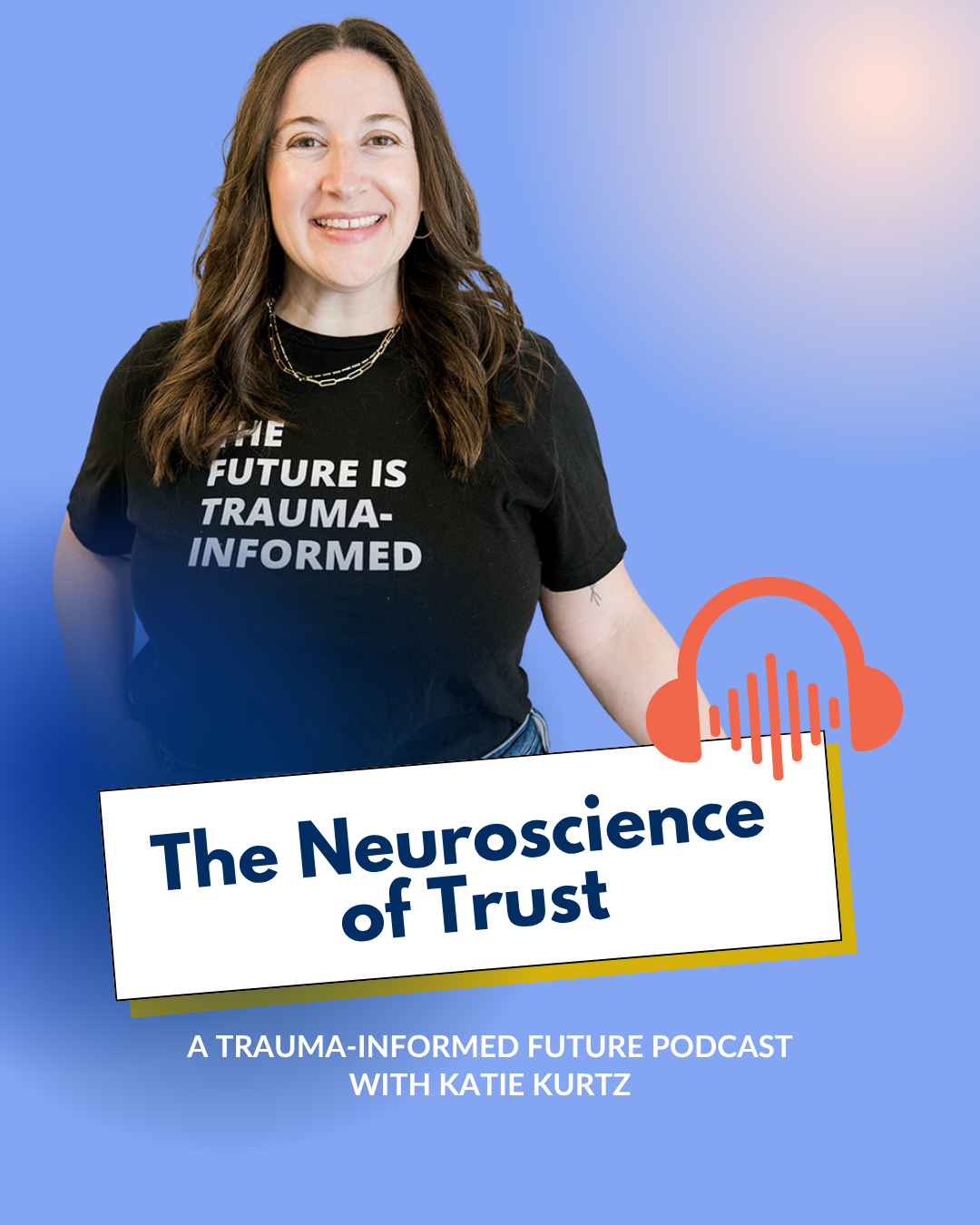
When people feel truly seen, heard, and valued, their nervous systems shift from protection to connection. As humans, our deepest drive is to feel safe-and that sense of safety is shaped by our internal physiological state, governed by the autonomic nervous system. We’re navigating a world marked by uncertainty and disconnection-at work, at home, and in our communities. Trust is in short supply, yet it’s the very thing we need most. In low trust times, trust becomes the glue of what holds us together when everything else feels unstable. In this timely and hopeful conversation, host Katie Kurtz explores the neuroscience of trust and why it matters now more than ever. You'll discover how each of us carries the power to build, repair, and sustain trust: one relationship, one choice, one nervous system at a time.
Resources mentioned:
Show Transcript:
Katie Kurtz (she/her): Hi everyone and welcome back to A Trauma-Informed Future podcast. I'm your host, Katie Kurtz, and today I wanna talk about the neuroscience of trust. It's pretty clear that, we are living during low trust times, at work, at home, in the world around us, and in times of uncertainty, disconnection. And social fragmentation trust becomes even more valuable because it's what holds everything together when everything else is shifting .
So I wanted to spend today to talk a little bit about trust, not just as a value or a good intention, or something that we think is important or know is important, but really understand a little bit of the neuroscience behind why trust is so essential to everything we do everything we are.
Now a little disclaimer. I'm not a neuroscientist. I'm not a neurobiologist. I'm not gonna get into the deep. You know, scientific realms , [00:01:00] of trust and there's plenty of people and research out there that does. But I wanted to give us a little bit of an overview just to create the connection between our nervous system and trust and why it's so essential right now that we need to , become trust builders.
We know that feelings of safety emerge from internal physiological states that are regulated by our autonomic nervous system . There are tons of studies that look at the neurobiology of trust and especially, focusing on the biological neurochemical and neuro processing foundations.
A lot of studies around the neurochemical, oxytocin and its connection to our behaviors and how we build trust, how we learn, et cetera. And a lot of the findings of research, which , I'll include in the show notes, reveal that trust is rooted in biology and it's shaped by social context. And we can learn [00:02:00] through self-awareness and through the systems we exist in and through repeated interaction.
That's how we build trust. It's not an assumption, it's something that's built over time. You probably have heard me say that quite a bit, right? Trust is not assumed. It's built over time.
And I want to take a moment to talk about systems because what we're seeing right now is the lack of, , and quite frankly, the crisis of trust in systems.
oftentimes when we think of systems , we tend to just think of either business systems, corporate systems, or government systems. But as humans, we are hardwired for connection. We have social brains. We are meant to be in relationship and in social settings. And as humans, we created systems.
We exist in systems, social systems, . Educational system, healthcare system, community systems. Family systems, friend systems. When we bring people together and we're sharing and we're [00:03:00] connecting, that is how we create systems. And so when we think about building trust, we need to be looking at both , how we individually build trust, but also how we're building trust in systems we exist in.
When we look at trust building efforts in neuroscience,, we're able to have a little more depth, , definitely validity and some more precision, both in understanding how personal and systemic trust is developed. Now, obviously, I always hold the nuance that, you know, we need to be mindful, , and use critical thinking when it comes to research, , and the gaps, , and limitations that occur, especially when looking at the lack of representation, , diversity, et cetera, , and the purpose and how , that research is utilized.
What I really wanna hone in on is. This understanding that, again, trust is not a value we list on a website and we can all feel it is [00:04:00] palpable the trust crisis we're existing in right now, we're not trusting the systems, , which quite frankly we may never have.
They were not designed to build trust. They were not designed for human humanity, right? Even though they many systems have programs and things and services that may support us, a lot of main systems like government systems, healthcare, education, et cetera, weren't always designed for that with that intention.
But if we're just looking at our personal systems, , we're seeing a trust deficit with, . Because of the , inhumane policies and politics and political unrest, we are seeing a critical thinking crisis, a trust crisis, and it's hard to navigate who can we trust, , what can we trust and the fractures and fragmentations of it in our social systems.
If we think from a polyvagal theory, polyvagal theory points out that approximately [00:05:00] 80% of nerve signals are sent from our body to the brain, and only 20% from our brain to the body. This means that our bodily signals, meaning sensations, emotions, physiological changes, provide most of the information that drives our nervous system responses.
As people, we want to feel genuinely seen and valued. When we feel seen and valued, our nervous system shifts from survival mode to connection mode, or safety mode. As humans, we are on a lifelong quest to feel safe, and those feelings of safety, remember not just physical safety, but psychological safety, social safety, moral safety, financial safety, cultural safety, those feelings of safety emerge from those internal 80% physiological states that are regulated by our autonomic nervous system.
So this is why we say we build [00:06:00] trust at the pace of our nervous system. We can't just assume it. We need to take our time to build it. We know that many, modern strategies for health, wellbeing, wellness,, really fail to look at these biological needs.
By not acknowledging that feelings of safety emerge from these internal physiological states regulated by our autonomic nervous system. So. Think about a job. Any team building retreat. Remember, trust falls. This is why team building exercises and trust falls don't do anything. They don't create change. And especially if they drop you, it could create some lasting, you know, trauma.
But the reality is these types of exercises that are typically done in corporate America at our jobs, et cetera, they don't create lasting change. Because they're not addressing the nervous system and the neurological reality of how we as humans experience safety.
Because [00:07:00] those neurological shifts unlock creativity, collaboration, and resilience. Those are the things typically in work, using work as the example and context here, we're striving for, that's why we have those retreats.
That's why we do those activities, why we have team building, all those things. Because we wanna unlock creativity, collaboration, and resilience. But if we're just doing these surface level activities without building the foundation of trust through a nervous system perspective, then. it's always gonna fall flat be, and it's a shame because organizations, whether it's nonprofit, corporate government, these systems we work in desperately need that, and we can't demand trust through policies and procedure procedures.
We cannot generate creativity, collaboration, and resilience through policies and procedures. These results can only happen when trust is built authentically and not performed right. We cannot AI our way through trust. [00:08:00] We cannot hack it. We cannot buy it. It has to be built through authentic, meaningful connection.
Because surface level trust initiatives fail. They don't address underlying relational dynamics that are rooted in our nervous system responses.
So with that being said, how do we actually build trust? Trust is transformational because it's how we move from intention to action, performance to presence, and from disconnected cultures to cultures of trust and without trust, we resort to control coercion and performance. Look around right when trust doesn't exist there is heightened survival mode of protection and armoring. But when trust does exist, we have a sense of connection and safety. Therefore, we have more ability to tap into our creativity, collaboration, and innovation.
But again, we have to redefine what trust building is because [00:09:00] so often trust is looked at as a one part path, but really we know it takes a whole system of intentions and actions to generate that impact of trust.
Again, it's undeniable that we're living during low trust times at work, at home, and in the world. As humans, we have this lifelong quest to feel safe, but safety doesn't happen automatically. Safety is felt through trust points.
You hear me say this all the time, this is not a safe space because I can't assume what safety means to you because if we aren't in relationship, if we are not connected, then how will I know that trust is there for safety to be felt.
If we wanna focus on building safer spaces, safer environments, safer workplaces, safer homes, safer community, safer worlds, then we need to focus on trust points.
Let's go back to the neuro science of trust. We build trust at the pace of our nervous system, and if our nervous system is dysregulated, if our [00:10:00] nervous system is in consistent survival mode or protection mode, then it may be harder for us to build trust if we are in a workplace where trust is ruptured where we are unsure of who to trust or , how to show up authentically, then it's going to be hard to build it. ,
This is where a trauma-informed approach is the most effective way we can make trust happen. There's tons of theories and concepts out there of how to build trust and how to build high trust in workplaces, et cetera, and a lot of them cover the different elements that a trauma-informed approach has.
However, it lacks the cohesion and again, the aligned action to generate trust sustainably. A trauma-informed approach is the most effective way to make trust happen when there is low trust it can lead to stress, burnout, moral injury, and trauma. That makes sense, right? Because when we experience stress, when we [00:11:00] experience extreme or chronic stress, it disconnects us from trust. Trust of self, trust of others, trust of culture, trust of systems.
High trust leads to safety. The more trust we have and build those trust points lead to the different types of safety, which can also promote resilience. 'cause we know resilience is relational it's built through trusting relationships and you know, every other possible outcome you could think of.
Because when we feel trust and safety, what is possible,? Pause here and think about a relationship you have that has high trust. Think about how you show up, how do you communicate, how do you feel? What are your bodily sensations? What do you share? What do you do? How do you express yourself?
When I think of the relationships I have high trust in, I am at ease. There's less tension in my body. I am more [00:12:00] present. I feel like my most authentic version of myself. I feel free to express myself without judgment. I am able to take risks.
I am able to speak my mind. I am able to laugh and cry and feel because those people I trust will hold me in that. When high trust exists, safety, resilience, and every possible positive outcome is possible.
So we build high trust in relationships and environments, both personally and professionally through aligned strategic and intentional actions, right? Because that person you have high trust with isn't something that just happened. It took time, it took effort. There probably was, , missteps , and ruptures that needed repair, and you come back in time and time again. Trust is not assumed. It's built over time, and when real trust exists in our relationships, something transformative happens.
[00:13:00] Authenticity replaces performance. Creativity flourishes where fear may be once lived, deep connections form naturally. Vulnerability is seen as a strength and focus replaces distraction.
I know I keep saying this, but it's so important to acknowledge that we're living through a trust deficit unlike anything we've ever seen in our lifetime because of collective stress, trauma, and disconnection has eroded every foundation of human connection.
But here's the thing that gives me so much hope, is that those of us who practice a trauma-informed approach know exactly how to build trust back up. , We know how to create a trust surplus. And it's not through hacking trust or automating it or AIing our way through it, because we know trust requires intentional, purposeful action.
And if you're listening to this, I bet you that you value trust deeply. You want you, your [00:14:00] relationships, your clients, your workplace - people to trust you. You want people to trust what you say. That you have integrity and you ultimately want people to trust themselves too. You wanna be a part of the solution in a world that desperately needs more connection and less suspicion.
You wanna be a trust builder. And this opportunity is in front of all of us right now. We are being faced with a moral, ethical, and human dilemma. , Are we a part of contributing to a trust deficit, or can we be an active trust builder in our lives personally and professionally?
Every time we choose a trauma-informed practice, we're choosing to create a ripple effect Every time we choose this approach to lead with understanding rather than assumption, we're depositing trust into our world's account.
I have been teaching an advanced interpretation of trauma-informed care for years with [00:15:00] thousands of people globally focusing on aligned trust points through our self-awareness, our capacity building, our communications, our relationship building, our critical thinking, restorative practices, adaptability and collaboration.
Utilizing specific trauma-informed strategies and upskilling, those specific things to focus on trust point with the mindset of understanding the neuroscience of trust. And I have spent so much time really developing this training system to equip people all over the world to be trust builders.
You have heard me on this podcast talk about trauma informed leadership and the importance of trauma-informed leadership, and none of that has changed. That's what this is. But what I have found, especially since the start of 2025, is when I use the term leadership, [00:16:00] there is a hesitancy. There is a lack of trust.
People are not trusting in leadership of all kinds, and people are lacking trust in themselves as leaders. There's a delineation of, oh, that's not me. I am not a leader, and we're not recognizing the lens of influence each of us has and the impact we have.
And so I've been really sitting with. How can I shift away from the term leader, even though that's so aligned with what I do and who I work with.
But it's just feeling a little misaligned. And so I sat with this. I sat with the content of the work and I used some peer support and someone reflected back to me, Katie, what you do is you build high trust using these trust points with the trauma-informed approach you've developed, and that is where TRUST , came from the same trauma-informed training system I've been using for years with companies and organizations and all [00:17:00] the different programs, everything I talk about on this podcast, but now with a new name and a new lens through which we are going to create a trust swell, globally.
TRUST is an acronym that stands for Trauma-Informed Relational Upskilling and Systems Transformation, and it's a comprehensive trauma-informed approach to building trust from the inside out. Through trauma-informed insights, relational skill building and systems level transformation.
So unlike trauma-informed care, TRUST advances the approach to be integrated into our mindset using strategies and skills to create a trust swell, that shifts culture towards safety. Same thing I've always been doing, just with more focus, and I don't know if you can tell this, but this urgency not of a unnecessary urgency, but this urgency of the world and the times we're living in. We desperately need to build trust from the inside out and find those people that we can create trusting connections with. [00:18:00] Because we need to trust swell.
As trust continues to erode, we need to build it back. And so TRUST Works™ The trauma-informed training system that I have,, follows A natural order of sustainable change by focusing on three parts, trusting yourself, so personal alignment with purposeful principles because we can't give what you don't have, trusting the process, which is really looking at relational strategies to build trust between people. Because we know trust is built between people, not through systems, and then trust in action, which is how we create sustainable change and scale through culture.
Upskilling the skills we have, right? You know how to communicate, you know how to build relationships, but let's upskill, let's enhance them through a trauma-informed approach and know how to implement these through everyday actions to transform from the [00:19:00] inside out.
Right. I work with a lot of organizations and companies who are at a level of readiness where we can change culture from the top down. But the reality is, most of us exist in systems, in workplaces and cultures and communities that are not at that level of readiness or benefit from distrust. And so we have to equip ourselves and , go from the inside out to create that swell of trust so that it forces the culture to be trauma-informed, to focus on human first approach.
Intentions alone don't yield impact. We need to take aligned action. And what's so important here is that you don't have to choose between being authentic or being effective. We don't have to choose between burning out or trying to fix broken systems. We don't have to choose between performing versus actually relating. TRUST helps us build the relational confidence to create trust where it's been [00:20:00] missing, repair it, where it's been , ruptured, and practice it daily in our work and life.
I am very excited to finally be ready to share the beta launch of TRUST Works, which is the three part comprehensive training system to become a trust builder with an optional certification of competency.
Again, TRUST stands for trauma informed relational upskilling and systems transformation. The training is three parts. TRUST yourself, so building unshakeable personal alignment with. Trauma-informed principles so that you can lead from the inside out. TRUST the process, which goes over six trauma-informed strategies that are proven to build trust, especially in low trust environments. And TRUST in action how to upskill everyday actions so that you can create sustainable change because this isn't just a professional development or another course or program. This is culture healing [00:21:00] at scale.
I am opening the beta launch of TRUST Works in the coming weeks. And I'm only opening it up to those of you who receive emails from me to honor my capacity and just allow those of you who have been sitting here ready to join me, it'll be at a discounted rate.
This is an on-demand self-paced training that everything is designed from a trauma-informed approach. It has gone through rigorous , peer review, looking at user experience, user design,. It has gone through feedback loops to develop a really comprehensive training that you complete that doesn't sit in your inbox.
This isn't another course or program. This is a way of living and leading your life and becoming a trust builder . For those of you listening, I know that you're ready and this is that opportunity , to start now with what we have and to help start integrating this right away. Everything you learn can be immediately [00:22:00] integrated, implemented.
There are scenario and vignette videos to help you look at what looks and sounds like in real life. There's companion workbooks for you to practice and, you can receive a certification of competency to say, I am trained in TRUST Works™ . I am committed to leading this imperfectly, but with integrity and reliability. So if you are interested or curious or ready, I know many of you are so eager and ready, make sure you're receiving emails from me. Go to the show notes and sign up. I'll be sharing all the information and registration. Very soon through my email so that you can have first access, the full launch. It will be available in the fall. So this is just for those who are ready and. , It's a beta offering, so it doesn't have the full, bonuses that will be included in , the full fall launch, and it's at a discounted rate.
So if that feels aligned for you, be sure you're on the list to get an information. I can't wait to share it with [00:23:00] you.
Remember that every time we choose this approach, we are building trust. You are a trust builder and we need you and we need TRUST right now. So in this with you always and take good care.
