

Trauma-Informed Marketing with Theo Nash & Stephanie Bilinsky
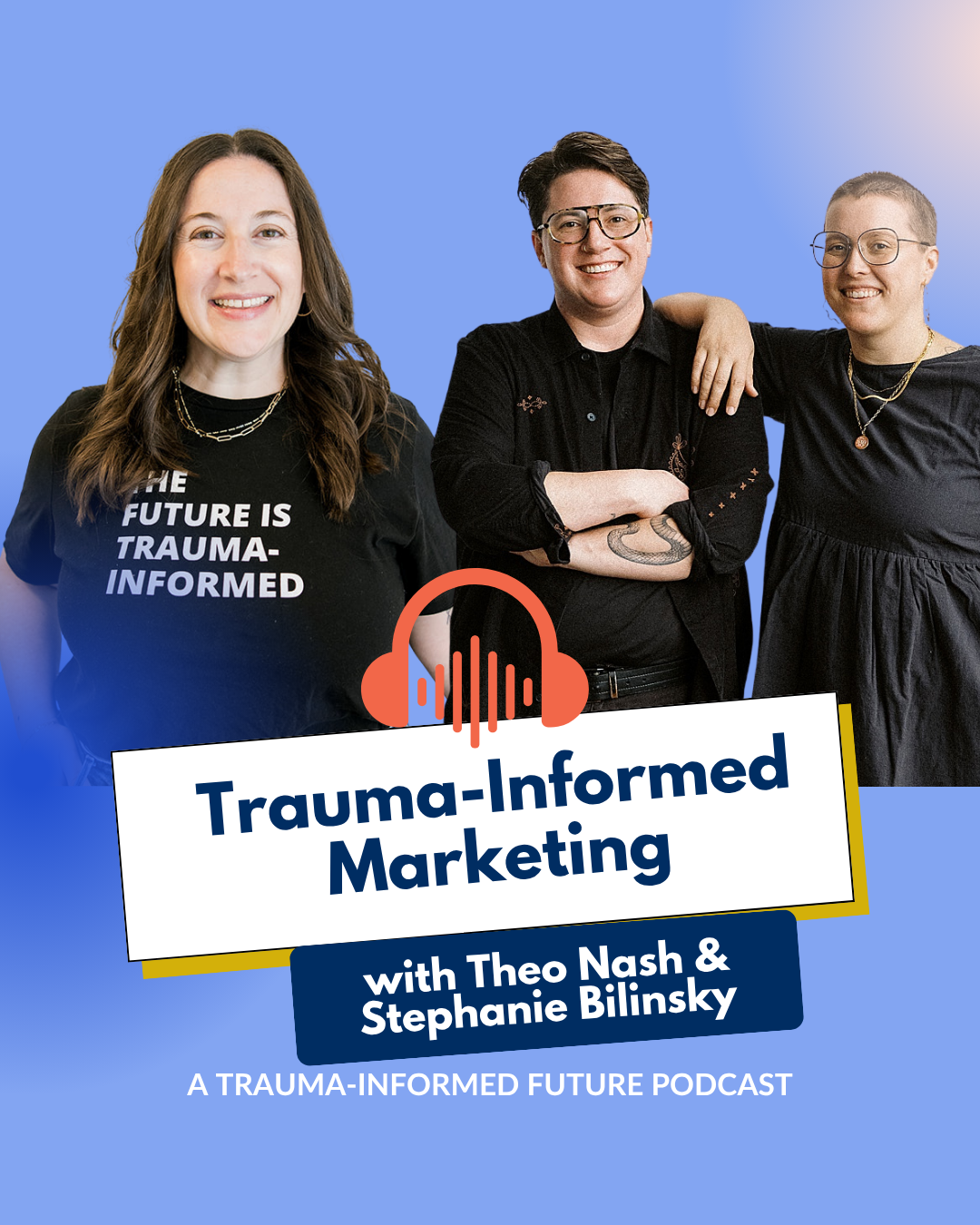
Don't underestimate the benefits of applying trauma-informed care to your business. Embracing a trauma-informed approach can significantly enhance a business's client experience. In today's episode of A Trauma-Informed Future podcast, host Katie Kurtz is in conversation with Theo Nash and Stephanie Bilinsky, trauma-informed entrepreneurs who are sharing how their focus on trauma-informed care has shaped their business approach. Theo and Stephanie delve into the significance of transparency in business practices, particularly around marketing, pricing and communications, and how trauma-informed approaches can lead to both success for their clients and themselves.
Learn more about Theo & Stephanie:
Stephanie and Theo left their 9 to 5s in education to build businesses that allowed them to thrive as neurodivergent, nonbinary people. Along the way, they discovered a passion for helping other entrepreneurs thrive with trauma-informed marketing and business strategy. Now Stephanie supports business owners with copywriting and SEO. Theo runs a photography business and coaches other entrepreneurs.
Connect with Theo:
Website: https://theonash.com/
Instagram: @theonash
TikTok: @photographerdad
Connect with Stephanie
Website: https://brandcendent.com/
Instagram: @brandcendent
TikTok: @brandcendant
Show Transcript:
Katie Kurtz (she/her): Hi everyone and welcome back to A Trauma-Informed Future podcast. Welcome, welcome Theo and Stephanie to the podcast. So happy to have you here.
Stephanie Bilinsky (she/they): Hi, we're excited to be here.
Theo Nash (they/them): We're happy to be here.
Katie Kurtz (she/her): I'm excited to be in conversation with you. I think you both bring a breadth of experience, both individually and collectively, when it comes to running a small business, being an entrepreneur, but not just any old entrepreneur, but socially conscious, trauma informed entrepreneurs.
And I would first just like to start by hearing from you both, , how did you come to trauma informed care? How did you come into this practice, and not just come into it, but actively choose it for yourselves?
Theo Nash (they/them): I feel like we both came about it, not from an entrepreneurship lens, but both of us taught in high school, both of us taught in like pretty high needs, high schools, like I don't know, there's, they, lots of different descriptors for the types of schools that we taught in.
But Steph taught special education students, I [00:01:00] taught in like the alternative high school where kids would go when they were expelled from everywhere else, so we just inherently by the population that we were working with, we're working with populations with large amounts of trauma, adding to the fact that we were teaching in New Orleans in a post Katrina world, so they're just like, there wasn't a single child that we taught that wasn't high on the ACES score and like just was bringing a lot with them.
And so with that, I feel like we did a lot of training and that was just it wasn't necessarily like a conscious choice we made. It was just like the only way to move forward in that environment.
Stephanie Bilinsky (she/they): At least from our perspective. We certainly saw people try to move forward in that environment without understanding trauma and the way it affects people's brains but I think to us as people, it was the thing that aligned with our values and the thing that we felt like aligned with our identities , in the sense that we try to be like compassionate people who are oriented towards like justice and [00:02:00] understanding and it was the thing that made the most sense to us, for sure. It seemed intuitive to us, although we recognize it's not to everyone.
Katie Kurtz (she/her): Yeah. So I'm curious, how did that transfer into your creative entrepreneurship? With photography, with branding, business, how did that begin to bridge over?
Theo Nash (they/them): That's a good question.
Stephanie Bilinsky (she/they): I think that Theo had been a little in the entrepreneur space a little bit before me and saw pretty quickly that it is a space that a lot of people try to cut and paste strategies from one business to another without any real consideration of different people's neurotypes and brains and however we want to think of that.
And We saw it just wasn't working for people. And I also was like, wrapping up my time in education working with students with 504 [00:03:00] plans and IEPs and seeing that, we were trying to get them these supports in schools and then realizing that, They were being put in these spaces if they wanted to be entrepreneurs where nobody was taking into account The things that hopefully their teachers were taking into account in school.
You know what I mean? It's like there should be these built in supports in schools and then suddenly people don't have them . It just didn't make sense to me that there was no accounting for people's different neurotypes and needs in the services that I provide, for example, in copywriting.
It's like I have this skill set with special education and everything where I can like building different supports for entrepreneurs and in terms of like communication styles and things like this. It's like, why wouldn't I do that? Why would I just put everybody through the same? Factory line,
Theo Nash (they/them): yeah, and if I think about my photography business the, one of the reasons that I specifically got into working weddings and got into photographing weddings [00:04:00] was one of my friends got married and I remember that friend got the photos back from that wedding and they talked about different moments during the day where the photographer made them feel not great on their wedding day.
And I remember thinking like, that is bananas to me. Like, why would someone make someone not feel good on their wedding day? And a lot of it was about like, Communication and giving clear directions and having a very human centered approach, and a lot of it was trauma informed care.
And I remember seeing that person, and I knew that I liked photography, and I always wanted to do photography, but I didn't really know how to make a living off of it. And then when my friend had that kind of not great experience with their photographer, I remember them saying oh and like we paid them, I think it was like 1, 200 for five hours.
And I was like, I can make 1, 200 in five hours. I was like, I'm going to be rich. I just remember being like, I could have made her feel better on her wedding day and I could make other people like, [00:05:00] feel, it's I never say that I make that my space is like a safe space, but I can do what I can do in order to make it a more comfortable space for more people, especially people who hold one or multiple or many marginalized identities.
And myself being a trans person who's been in queer relationships, obviously, for a long time and just seen the dynamic, there's just a lot that the wedding industry kind of pushes on people that I don't think they need to push on people. And just seeing that there was a gap in the market.
For someone taking a more compassionate approach. It was like, part, it aligned with my values to do trauma informed, and then part, That there was a gap in the market that could be filled and like people were looking for my services and it was like beneficial for my business too.
Stephanie Bilinsky (she/they): Yeah. I think there's this idea that if you're doing trauma informed business, that you're somehow not going to make as much money cause you're too busy, like being nice, but actually people crave trauma informed business practices and services, and I [00:06:00] have only found it to be a huge benefit to my business.
Katie Kurtz (she/her): Thank you for naming that. I love this common theme that you've both kind of mentioned is that it, it aligns with your existing values your existing vision. And so it's not like this extra thing, and it just makes sense, and I resonate with that because for me to obviously this is what I do, but it just makes sense like why wouldn't we see a person before us, not as somebody who needs a product or a thing, but as a full human being, and that their humanity influences and informs how they show up.
And making small shifts with a trauma informed approach actually enhances the copywriting, literally anything. And we know, and I share this a lot in trainings and I hate like minimizing it so much, but like sometimes we have to it's like if people have better Experiences then they're gonna be more engaged and they're gonna keep [00:07:00] showing up. So like how is that not good for business ?
I don't know. It just makes sense So I'm really glad you named that and I'm curious if you can Maybe share, because I know you, you do a lot of like B2B, you're working with other , businesses or entrepreneurs. And I'm curious, like, how, what have you seen as you've integrated trauma informed care into your business practices and your service delivery? Like, how, what are some important things you've seen or noticed or how, some of those enhancements of utilizing this approach?
Stephanie Bilinsky (she/they): , I would say from the copywriting end, there are a lot of times where my conversations with clients at the start of a project are really just me asking some open ended questions and doing a lot of deep listening. Which I very much consider part of the trauma informed approach of not making assumptions and like really trying to understand where somebody is coming from so that you don't project things onto them or their [00:08:00] brand or whatever.
And I've had a lot of clients Say that almost felt like therapy when I was like that's not what I was trying to do, but I'm glad that you felt like you were really accessing something that was authentic. Because that is how I am able to also produce brand messaging that stands out from the crowd, right?
Is like waiting for them to say something. I haven't heard a million other photographers say. And there's always something, people just don't always have the tools to work through it by themselves to figure out what that is. But I have found that it is, I don't know, I find it very fulfilling to work through all of that and support people and just hold space for them to talk through the different pieces of why they're doing what they're doing and what, where they want to go.
Theo Nash (they/them): I think about integrating a trauma informed approach to my business. One of the biggest benefits [00:09:00] has been that when I first was starting my business, I was reading a lot of literature and blogs about like, how to do sales and how to do this and how to do that. I just remember. Trying a bunch of these things and being like, okay, this is how I'm supposed to do sales.
And so this is how I'm supposed to do this and this is how I can maximize my profit. And yeah, some of it worked, some of it really worked, but , it would work. And then I would feel like a sleazy, like I would just feel like not good. And then I wouldn't want to do it anymore. And then I would find myself retreating from my business, which then in turn made it so that I was not profiting as much because I didn't feel like doing the sales process, so I just didn't do it. And when I shifted my perspective and did a more trauma informed approach at least within like the photography side of things, then it no longer felt bad to do sales. And it just felt if I am a good fit for people, I'm going to be clear about what I can offer and how much that's going to cost.
And if that aligns with them, then that's great. And if it doesn't, that's fine. There were moments where I was like, , [00:10:00] am I really going to be booking things? Am I going to be like making my minimums? And like I always have, so it's been good so far. And I haven't needed to retreat from my business as much.
I'm definitely someone who like needs to take time for rest because I just, I can burn myself out no matter what. But the need for rest. It's much like shorter duration. So for us, I'm able to come back to my business with more speed than I could before.
Katie Kurtz (she/her): I want to bookmark that because I want, I have questions and I want to come back to that importance of applying trauma informed self care to our business.
Because if we're going to show up and run a trauma informed business, we also need to make sure it's bi directional and applying to us. Yeah. And integrating throughout some of those client relationships, but I have worked with you on some like SEO stuff and then also just a, an admirer of your photography, Theo, like When you photograph a wedding it's exquisite.
I, sometimes it pops up and I'm like, Oh my gosh it's [00:11:00] art. It's pure art. And the reason why it stands out so much than other things I've seen Not just because I know you, but you can tell people feel comfortable in your photos. And I think having had a wedding, having been photographed before , it makes all the difference.
When you can feel comfortable, or you can feel trust, or you can feel safe. So much is possible and I think that's transferable even to branding and copywriting like that's a vulnerable process to have to get everything that's in your head and heart on to a website or on to an email or something like and it can feel really overwhelming and to have somebody who can hold that space and really utilize and finesse Skills in a way that can help generate authenticity, like we, we throw on like authentic, be your authentic self all the time, but what does that actually mean if trust and safety aren't present . I always say like when we can feel safe or safer, so much as [00:12:00] possible, and especially, From the, from a creative standpoint we can be, when we can be ourselves and our full expression the possibilities are endless, and I think it shows that's one of these inadvertent benefits that just blossoms and flourishes from trauma informed care that, again, isn't that complicated little things, like not assuming asking open ended questions, getting people to really Practice self consent like what feels good for you.
These things aren't complicated, but yet they have tremendous impact that can really, flourish into a lot of different things. So I think that's something to really note, right? It's not just Being nice, although like trauma informed care is not about being nice. It's it is about being a good human, whatever, good as like having big empathy energy, but it is a really boundary practice.
And this kind of, segues into my wanting to talk about like, how do we practice these skills also towards ourselves, because it is so [00:13:00] easy. As an entrepreneur, as a small business owner to burn out, especially because we exist in these systems that are telling us to do business one way. But if we have values that don't align, it can feel like we're rubbing it just like rubbing against this bird, this edge that just like it.
I've been there. It's oh, this feels awful. Am I doing? And then you like, internalize oh, it's me. I can't, I'm clearly not good at this or something like that. But really it's oh no, there's just another way of doing business.
Theo Nash (they/them): Yeah, definitely. And when I think about caring for ourselves within a trauma informed business and like that client experience I've recently had some tensions with a contractor that I had to part ways with who I'd been working with for over four years I've been working with this individual, and in the end, in separating our businesses and going our own separate ways, there was some tensions of things that I assumed were being done that weren't being done.
And then things that they weren't doing because it [00:14:00] wasn't like explicitly outlined in our contract, but it was like work that we had always done together. And so I had a hard time understanding what was like included in the contract and what wasn't. And so then I was left feeling like a bit Bamboozles , a bit, caught off guard for what was being done and versus what wasn't being done.
And I, I can very much understand that the contractor, the other person that I was working with was like coming in from it from a perspective of oh, I'm just gonna say yes to everything. I'm just going to do everything that they like ask in the beginning. Because they were just like trying to be nice.
They were trying to go above and beyond, but going above and beyond. The contract, and then suddenly stopping going above and beyond ended up being, feeling very like, unethical to me, with, because there was no like, communication. And so that really taught me a lesson about how, when we do want to go above and beyond our contract the communication is such a key thing.
And we, it's also okay to say yes, we can do that, but it is an additional fee. It is this. Communicating our boundaries is It can feel like, oh, I'm being mean, or I'm like, [00:15:00] enforcing things too much, but, and honestly I just would have so much preferred the communication to be clear and transparent.
Stephanie Bilinsky (she/they): And to pay the additional charge to ensure what we thought was being done.
Theo Nash (they/them): Yeah I would have been happy to do that. Because I never want to exploit people, and I, it was like, really minutiae language within the contract to this versus that was included.
And it's just it ends up. Getting all kind of messy and lost in the sauce and if It just really taught me that going forward when I have contracts with people and when I am going above and beyond, I need to be clear like, yes, we can definitely do that. This is beyond the scope of the contract and I'm happy to do that for you this one time.
Or like once place that I see it a lot not a lot, but once in a while I'll have clients come back after a wedding and be like, could you Photoshop X, Y, Z. And sometimes people will ask me to alter their bodies. And I'm very much never do that. Without I would never do that to someone's body without consent.
I would never just go ahead and slim something here. Like absolutely not. But when I have a client who like [00:16:00] really wants something different, I will say that's not really something that I do, I am happy to do three images free of charge, and I don't actually do it myself, I contract it out, but I'm happy to like, facilitate that for you.
This is not something that I can do within my business, but it's something that like, I can connect you to, and I'm happy to like, cover the cost for three of these to be charged, anything in addition is an additional fee of X, Y, and Z. And it's we can go above and beyond, be like, yes, this, I can do this for you, complimentary, but, Then outlining like what it looks like going further, like beyond the scope of the contract.
I just feel like I've learned that lesson and how important it is to like, not only on our own boundaries, but then communicate what it is within our business and like being nice is often not nice in the long term.
Katie Kurtz (she/her): I resonate with that. I really appreciate your candidness in sharing , that specific incident because I think, I know I resonate with it and I know many people listening may resonate with that too because there's a few things from that are really important to note.[00:17:00]
It can be really easy to become very friendly and have, become develop connection and relationship with people we work with. Yeah. And I don't think there's any I have beautiful relationships with people I have hired and worked with and vice versa. But in order to protect the connection and relationship, I have learned the hard way there has to be agreements and contracts in place with clear and transparent expectations.
Because when there isn't, and we just rely on the relationship, it doesn't work. And I can share from experience like a really unfortunate situation where I was really pushing to have agreements and contracts in place not to be rigid or, create, any, divisiveness, but or like harshness, but to say this is to protect the relationship and the other parties did not believe in that.
And then there was a huge rupture and an exit from that partnership. And it was really hard, but now I know I will never go into [00:18:00] anything without really clear contracts and agreements and over communication, and I'm really grateful I have a trauma informed lawyer and will have to have her on the podcast, because it, it makes, because it can also get really scary because agreements and contracts, that language is not my first language sometimes it's hard to translate, and To really understand what is in the agreements I'm sending out or signing is really important because of the second point is that I have learned the hard way when I root down to why sometimes contracts or like agreements have been sticky for me.
It's because it's rooted. in my conflict averse childhood trauma. I don't want to make people upset. So I fawn and say, Oh, it's okay. I trust you. It'll be okay. We can just have this verbal agreement. And then when it doesn't work, the conflict arises and then you freeze. And I know that about myself.
And I've had, unfortunately, several incidents where I've had to work through that to now [00:19:00] know, okay, I know this about myself. And so I have to have these certain things in place to work with me. Or collaborate even if it's like a good friend collaboration I value the relationship, therefore they have to be, there has to be clear communication and agreements, and that boundary has to be made, not only to protect each of us individually, but to protect the work and the relationship, and that's, that has been so much more important Helpful and nourishing and also like freeing in a way to know that's there and okay, now that's done and we don't have to worry about it.
We can just continue the work. And when it's done. Or if we have, like you said, if you have to exceed it, then we just talk about it. But yeah, unfortunately, I've learned the hard way.
Theo Nash (they/them): Yeah, I feel like it's one of those lessons that sometimes you need to learn a few times for it to really stick. And I feel like I'm at the point where I'm like, Oh, okay I really understand now how important that clear communication is and like how it is not mean to say, Hey, yeah, I'd love to do that.
But that's what that, that's like beyond our scope of our contract. [00:20:00] Let's like, figure out like what this could look like doing this work together. I look forward to running into those situations in the future and just having this perspective and, you live and you learn.
Stephanie Bilinsky (she/they): Another chapter in the memoir.
Theo Nash (they/them): Another chapter in the memoir. .
Every time we hit a hard spot in our business, I always just say, ah, a chapter for the memoir.
Katie Kurtz (she/her): I think it goes back to what you were saying, Steph, about it's not just about being nice. Because I think where we falter or we misconstrue trauma informed care or find ourselves swinging to these extremes is that like we have to be overly compassionate, overly accommodating, overly giving.
And it's no, you just swung to an extreme. We need to come back to neutral. Remember, this is a boundary practice that we can be kind and clear that we can be compassionate and structured. We can have structure, we can have boundaries, and still be human and compassionate, but if there's no boundaries, if there, if everything is, just acting from a place of niceness, is it not actually nice?
Or are we fawning? Or are [00:21:00] we like, coming from a place of fear that we're going to hurt feelings and things like that? Whereas maybe a structure or boundary would actually amplify the compassion. Between the parties. So I always like to reiterate that this is a boundary practice. We love a boundary in any way possible that we can be both compassionate and boundary.
Stephanie Bilinsky (she/they): Yeah, and I would say to one thing that I've found in, taking a trauma informed approach to business and having clear boundaries paired with clear communication is that when something comes up, people are very compassionate about it. So if our kid gets sick and I have to push back, a deliverable to the next day or the next my clients are really chill about it.
They're so compassionate because I have established a clear timeline, communicated clearly, and then communicated the change, and I've never had an issue with pushing back things a day or two here [00:22:00] or there to take care of the family. And also people understand, I think, that our family is our priority and people who are drawn to trauma informed business tend to hold more space for that.
Theo Nash (they/them): Yeah. I also think that there's this kind of obsession within business of constantly the upset, like, how can you maximize how much money you're making off of an individual? And I almost think that having these boundaries and being willing to go above a contract and then talking about how much.
The fee associated with it makes it also not only a better place. But it makes it when you create a system for people to ask for more work beyond the contract creates a pathway for people to do that. Because I know that if I I never want to impose or ask too much of someone or assume that someone's going to be doing it.
If that person who I'm working with is Has a system for me to ask this information, or has a path for me to get services beyond what we're doing, and me compensate them for those services that is a way of upselling [00:23:00] without being like, I just need to upsell, I need to upsell, it's it creates a path that makes it, the door is open for people to ask for more when they need more, instead of just forcing more on people before they need it.
Katie Kurtz (she/her): I think that one of the underlying things here too is just like clear expectations, right? And that's what a contracting agreement is. Like, how do we have clear expectations? I know what's expected of you. Here's what's expected of me. Here's what's expected of the project or the deliverable or whatever it is.
Do we both understand? Do we both agree? Great. Sign here. And I think that is a transferable thing to a very common trauma informed practice of like space agreements or group agreements or client agreements. It's here's what the expectation is and are we agreeing to it and how do we keep coming back to it?
How do we remind each other? That like this is what we talked about like referring back to it if you oh, that's great I'd love to help you but just remember it's not in that contract or agreement We can [00:24:00] add it or amend it or maybe phase two. We can create a new one, and I think You As much as we take, we think about this trauma informed tool of space agreements or whatever term you're using, whatever agreement of talking about agreements, we also are putting them in writing like on your membership or your course or whatever, contracts are also a part of that and it's so important and it's not something to you gloss over, and I think that again, just from that experience specifically, I've learned, and some other ones, just because, yeah, added to the memoir. I I will not ever not have contracts, especially with projects or especially with people that I have existing relationships with because it's so important.
And. I, there's no charge anymore for me. Like I was saying in the past I like, felt bad or there was like, oh I don't want to ask or assume we should just have trust and it's no, but trust, this is trust. This is compassion, this boundaries these agreements and contract [00:25:00] isn't, it's not taking away It's buffering.
It's amplifying. So when this exists, it's it's now it feels really good for me and aligned for me to have these because then there's no extra concern. It takes out that what if, which space agreements do too. It takes out the what what if someone does this or what if someone does this in our, membership or whatever.
It's oh, we have it. We don't have to worry. takes out the guesswork and that's what contracts do too.
Stephanie Bilinsky (she/they): Yeah, and to me, taking out the guesswork is what builds trust. It's like consistency and Knowing what to expect. And that's what makes a lot of people feel safe. That's what made our students feel safe in our classrooms or safer, and that's what makes people feel safer investing with service providers.
It's you know what to expect. And it sounds so I don't want to say almost like simplistic when it's boiled down that way, but It really is important that people know what to expect from a client experience. That's why I always like [00:26:00] emphasize that with my website copy clients is like your services page isn't just about what's in your packages.
It's about what the client should expect out of their experience of working with you and you don't have to tell them every Step of your client experience, but like they need to know what kind of communication to expect like what kind of experience they're gonna have Because you're asking a lot when you're asking someone to invest You know to trust you with their wedding day or to trust you with their business so That what to expect piece is huge.
Katie Kurtz (she/her): I'm curious, just going back to that question of trauma informed self care, like practicing this. Do you notice any other components or things that you've done to really infuse some of these principles or skills into your own just day to day, business, whether it's behind the scenes or client experiences or interactions, marketing, things like that?
Theo Nash (they/them): I feel like a huge one that I have done for myself is just giving myself permission to [00:27:00] use autoresponders. I feel like there's this that autoresponders are like bad or I should be able to just keep up with my emails quicker but now like anytime someone inquires with me I have an autoresponder and that was something that like so many kind of business mentor y, business coach y people told me it was, like, not the right move.
Instead, I should just be, like, responding right away. Personally responding from my phone or wherever. But I can't tell you what a positive response I've had from the autoresponder. And the autoresponder, like, when someone inquires with me for wedding photography services, they get the autoresponse.
It's hey yes, this is an autoresponse. You can probably tell. But then I also send them a full gallery. And I tell them that client what package they booked and how much they paid me for it. And just and then also what to expect next, like how long you can wait to hear from me personally but if you want to go ahead and schedule a call, like here's the link, you can do that right away, and it's just people, I've had such a good response to it, and it's interesting because it's just awesome.
Was really like one of the biggest things that people told me never to do within my business to have that [00:28:00] like auto responder. Cause it's like too cold or too unpersonal. And I think if you just say thank you for reaching out to my business, we'll be back to you. We're excited to get to your inquiry.
We'll get back to you in three to five business days. Yeah, that does feel really like cold and probably does turn people off, but like that, it's just like a little thing that was like self care for myself because it gave me permission to like, Put my phone down at the end of the day and not worry about responding or put my phone away on the weekends.
And it just made my clients feel more cared for because there was, like, clear expectations. They knew what to expect. They had the bit of information that they were looking for.
Katie Kurtz (she/her): A trauma informed life hack? No. I hate life hacks, but I'm also just I can't believe the bros didn't love an autoresponder.
What can you get done with all your time now?
Theo Nash (they/them): Oh, rest.
Katie Kurtz (she/her): Rest and rest. Yes. I love that
Theo Nash (they/them): Hang out with my kid.
Katie Kurtz (she/her): Tend to your life. I also think that this message that I know we all have heard at nauseam is like, put up This persona or don't give too much [00:29:00] information. And when I first started my business eight years ago, that felt so weird to me.
And, I was like, okay, I guess I'll like, play this game. And I felt terrible. And then I started being. Really transparent, especially as a caregiver, I have no idea what the day will bring. I can make all the plans and those plans get completely ruined.
I just was like, you know what? Honesty and transparency need to be at the forefront for me, and like you said too if life comes up, life is lifing, and I'm honest, people are so responsive, because I think it also mirrors to them because they have a lot of life too, and it's okay if you need time, or you need to adjust, or you need to honor your capacity people are craving that right now, and I see that a lot in the Trauma-Informed leadership studio, like the space, like there's this expectation. We're so used to like in a membership or in a course, like you have to get everything done. And it's just no, you can come and go as you please. You can take your time. And it's what? And it's a culture shift of being able to like, oh, [00:30:00] I don't have to be on.
I don't have to be doing something. And just that transparency of being like, yeah, we'll get, We're, this is what's happening. It's almost that inadvertent permission slip to others to say yeah, we're all human ing, we're all doing our best, in life, but then also like the context culturally of what's happening.
There's a lot going on. And like, why would we ignore that? Can we just not, can we just like name, name a thing and be like, a lot's happening. The horrors persist. Maybe you need another day or another week. I do too. Let's catch up then. Transparency always. works and even makes things even better.
Stephanie Bilinsky (she/they): And I would say that just like that whole principle of just like slowing down for a second is so huge for that bi directional care. That you were talking about. I know for me, I've been really being intentional about slowing down in the morning and not as soon as I drop our kid off and I don't just run straight to my desk.
I usually sit and pull [00:31:00] a card lately. It's been from the contain. Oh, nice. Been loving it. And read or do something, even if it's just for 10, 15 minutes. To start my day a little more regulated. And I also have been, reminding clients that like SEO is great for like long term marketing.
The copywriting projects we're doing are good for like long term marketing strategy. It is not urgent. If this does not get done today, that's okay. That's the beauty of the marketing channels that I help people with. The whole point is to take off the pressure of the hustle culture and like more anti hustle and just slow down a little bit.
Katie Kurtz (she/her): It's like when your shoulders are in your ears, like just to be like, Oh, that so nice. Like slow marketing, intentional marketing cause that's such a huge, as as entrepreneurs, like we have, we wear all the hats. So when you have to jump from the [00:32:00] marketing and the sales and the bookkeeping and this and this, and then also the work that you're delivering can be really, like, all over the place.
And, I agree. For me, I. Thought oh structure like I don't want structure. I need this is why I became my own boss is to have freedom and then I tried that and it was not good. And I was like, oh, I really need structure I need things like it doesn't have to be like rigid but I need some things in place because I feel more supported and I can actually support my brain and like how I function and my capacity levels when there's a little You Bit of a little bit of boundaries, right?
I always say it evolves as we evolve, but yeah, these are really great examples of like how we can apply it, not just to ourselves and our, like our behind the scenes business, but like to our human, our humanness too. Yeah. Awesome. I'm curious. As we kind of wrap things up, is there anything you would share with folks who are really intrigued with [00:33:00] working, either working with a trauma informed, like an identified trauma informed business owner like what you would, be discerning about, or how would what would you be looking for when you say, you advertise, I know, as like a trauma informed marketing company, or like trauma informed marketing, which I love and it's real, and it's true you're not just like slapping an adjective above, above a different thing but like you feel it you can actually, Feel it.
But I'm curious as you navigate, as we see more and more people adopting trauma informed care, any takeaways or feedback for folks when they're navigating the trauma informed business world to look out for or be discerning on?
Theo Nash (they/them): I think if a business won't, if you reach out to a business and the only way to get pricing or information is like a call or some like additional step, that's like an immediate red flag for me.
Maybe there are trauma informed ways to do it where you don't give any information until you're like on a phone call. But I just, I [00:34:00] think that if a business isn't open about like sharing, or if a business isn't transparent about their pricing that's just a big problem. Red flag for me.
And it's someone that like, I wouldn't want to work with. I never want to be put in the position where I need to like live react to pricing with the person who's pricing it is, or like live react to something like on a phone call, because then I just know that like my own people pleasing tendencies are going to slip in and I'm going to be like, Oh yeah, that sounds great, even if it like doesn't because I can't say no myself.
Yeah, for me, the willingness for a business to give you information without jumping through hoops. It's like a big plague for me, green or red.
Katie Kurtz (she/her): And also I don't have the energy anymore. Can you just tell me what it is? If I don't see prices, I just move on immediately. Cause I don't have the capacity or energy.
To schedule a call and make another meeting like can you like I'm in the information gathering phase. Can you just tell me and I know it's really hard [00:35:00] because I have to do that too with like projects like if a company is coming and they want a specific thing like I can't tell you the price of it till I actually know the scope of work like that's one thing and that like you have to have a conversation and feel out what it is but if it's like a specific product that like You do a lot.
Yeah. And there's not much tailoring. Like just tell us what it is. Tell us, please. .
Theo Nash (they/them): And tell me like a clear what I can actually expect and not just My prices start at, or payment plans start at, and it turns out that payment plan goes far beyond the time frame. I'm, I, payment plans can be great, and offering a payment plan that goes far beyond the timeline for, like, when the scope of work is to be completed is totally fine.
But if You are like, if the advertised price is just, this is starting at, payment plan starting at 2. 99, but really, that's a 2. 99 payment plan over two years, then it's then that's not a realistic starting price. Like I, I want, I just crave some transparency there. So I just know what to expect because it, then I can make my [00:36:00] informed decision whether or not it actually makes sense for me.
Katie Kurtz (she/her): If I have to see another trauma informed care training or business, hide their prices. Come on, y'all. No, come on. If you're teaching trauma informed care, offering a trauma informed care service or product, and you're hiding your prices, all right, just can't. I'm at the end there.
Yeah, it's a good one.
Stephanie Bilinsky (she/they): Yeah, I would say from a marketing perspective, any marketing that relies on shame or like making you feel like you're doing something wrong in order to sell to you is a red flag for me as well. The, we've all seen the Instagram posts that are like 10 mistakes you're making.
Or five things that are stopping you from selling, or my favorite, this is why your business is failing, just like all of that stuff. Like those are really, they, unfortunately, I see those all the time. They feel really hyperbolic to me because I'm like, chill out y'all. But it's also aside from like the [00:37:00] initial oh, there's there's just so much of that.
That is not trauma informed. That is not. It's just clickbaity. It's so clickbaity and not in alignment with any sort of trauma informed principles. So when people do things like that and say they're trauma informed, it raises some red flags for me and I have questions at the very least. But probably will click away before I ask.
Katie Kurtz (she/her): I don't know if it's just like my curation Of social media these days, but I don't see it as much, but I also will refuse to like I've curated a feed where I don't I think I'm on the right side of something, but it is sometimes boggling, to see that still happening. And I'm like, really?
We're still here. Okay. It's also can feel like a culture shock when you enter a trauma informed business or service, because it's not that way. And it can feel like I've had people like, feel a little wobbly at first because oh, [00:38:00] it's like, This is what it can feel like and there can be a little bit of that tremor of oh, and then the awakening of this can be something a little different.
And it's not complicated. It's not overly. A lot of times affirming what you're doing is just now you know why and then you can feel more. A little more courage or a little more empowered to use it.
Awesome. Anything else before we head into our gentle spritz of questions to end our time together?
Stephanie Bilinsky (she/they): No, I don't think so. Let's bring on the spritz.
Katie Kurtz (she/her): All right. Let's spritz away. Feel free to use more than one word if you feel called to but if you could describe trauma informed care in one word, what would it be?
Theo Nash (they/them): Communication.
Stephanie Bilinsky (she/they): Space.
Katie Kurtz (she/her): Love that. Love space. What is your current go to for nervous system care?
Theo Nash (they/them): Walking my dog.
Stephanie Bilinsky (she/they): Sitting on our deck. Yeah.
Theo Nash (they/them): It's nice out there.
Stephanie Bilinsky (she/they): It is nice out there. And we worked really hard on that deck. Oh yeah.
Katie Kurtz (she/her): Yes. I feel like I saw the beginning and it's, I love when people share [00:39:00] projects like that. I look for it. And what does a trauma informed future look like for you?
Stephanie Bilinsky (she/they): Oh, Theo and I were talking about this a while ago and we, this is a big question, which is probably why you ask it. But Theo had said a world in which more businesses make it past the first year. And I thought that was really compelling.
Theo Nash (they/them): That'd be nice.
Stephanie Bilinsky (she/they): Do you want to speak more to that or,
Theo Nash (they/them): I think like less, just not just like any business, I would say like a world in which more businesses of more people that hold more marginalized identities are making it past the first year, making it into your five, six, seven, eight, nine, 10 plus.
Because the current system of like marketing and sales works really well for a certain demographic that tends to be like. very privileged already and like come in with that innate privilege. And some of those sales tactics I think are easiest for people who come into them with the most privilege because you have to have some like assumptions to make more traditional marketing and more traditional sales work.
[00:40:00] And then they don't feel good to people who have lived experiences or might hold identities that like sometimes come with more trauma. And so a trauma informed future, I could see more businesses with more identities, making it further into their careers.
Katie Kurtz (she/her): Here for that. Yeah. Thank you both so much.
Such a great conversation. So many little Inlets and rivers, we could float down on it. So more to come I'm sure. And I'm curious if you don't mind sharing, like how people can connect with you or learn more about the work you're doing.
Theo Nash (they/them): Yeah, sure. I am Theo Nash on Instagram. I'm photographer dad on Tik TOK and that's where I am the most.
Stephanie Bilinsky (she/they): Love it. I am Brandcendent on Tik Tok and Instagram but honestly, I think my best content goes to my email list. So that would be a good place for connect people to connect. I always enjoy your emails. Because I can take my time. There's space to go slowly.
Katie Kurtz (she/her): I save a lot of your [00:41:00] emails.
You're one of the top few people that I'm just like, I'm like, oh, I need, this is a good little nugget. And I like put it in a folder. So yeah. That's so nice. I mean your content everywhere is lovely, but it's. It I do enjoy your emails. So yeah, thank you both so much. Everything will be linked in the show notes.
Highly recommend connecting and exploring and just seeing what it feels like to be in a receiving, trauma informed care within a business. And, service delivery. So thank you both so much.
Theo Nash (they/them): Thank you. Thanks for having us.
