

Valuing Inclusion with Crystal Whiteaker
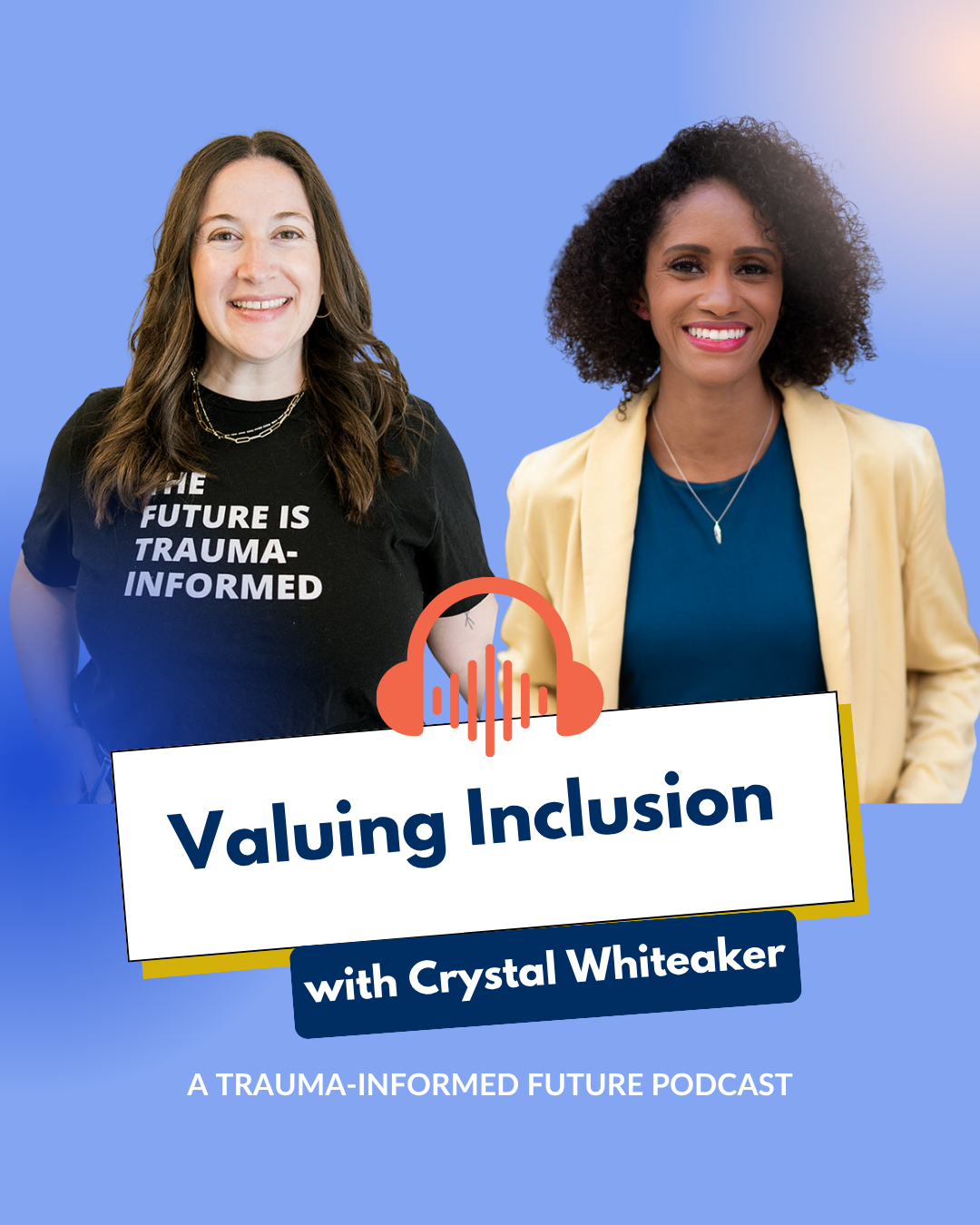
In today’s episode, host Katie Kurtz speaks with guest Crystal Whiteaker about the inextricable connection between inclusion and trauma informed care. They discuss the impact of trauma on individuals and organizations, the need for brave leadership, and the power of aligning core values in creating a trauma-informed future.
Meet Crystal Whiteaker:
Crystal Whiteaker (she/her) is the Founder and CEO of Crystal Lily Creative, and author of Brave Leadership is a Choice: An Inclusive Guide to Creating Belonging. Crystal is an Inclusive Branding and Leadership Development Consultant who helps mission driven brands and leaders create human-focused messaging and environments rooted in core values. Crystal brings over 15 years of creative, relational, process driven experience across multiple industries. She is a self-described "corporate trained, creative hippie” who puts a strong focus on core values to help people connect, communicate and lead with belonging in mind. Crystal cares deeply about diversity, equity, inclusion, and belonging and is an advocate for leaders and organizations that provide resources and support for healing. Beyond her work, Crystal enjoys spending time at the beach, connecting with people, and exploring new places.
Connect with Crystal Whiteaker:
Show Transcript:
You've heard a lot of people talk about your core values, but how often are you taking your core values and putting them into everyday action? It's one thing to value something, but are you living those values out loud? And especially if you have values like inclusion, belonging. Trust, safety, diversity, any of these types of values.
Then you also need to have actions in which you are demonstrating those values out through your messaging, your branding and leadership. Okay, today we have guest Crystal Whitaker. Crystal is the founder and CEO of Crystal Lilly Creative and author of Brave Leadership is A Choice, an Inclusive Guide to Creating Belonging.
Crystal is an inclusive branding and leadership development consultant who helps mission-driven brands and leaders create human-focused messaging and environments rooted in core values. Crystal brings over 15 years of creative, relational, process driven experience across multiple industries. She is a self-described corporate trained creative hippie who puts a strong focus on core values to help people connect, communicate, and lead with belonging in mind.
Crystal cares deeply about diversity, equity, inclusion, and belonging, and as an advocate for leaders in organizations that provide resources and support for healing. I am so delighted to welcome Crystal as a guest on today's podcast. But before we get started, I wanna be sure I share with you a content and trigger warning for today's episode.
In our conversation, crystal does share her personal story of trauma and lived experiences, and in it she does mention. Sexual assault, sexual violence, and interpersonal violence. So please be cautious, honor your capacity, and if you need to skip today's episode or pause, do whatever you need to do to honor yourself.
Let's go ahead and get started. I can't wait to share this conversation with you with Crystal Whitaker.
Hi everyone, and welcome to a Trauma-Informed Future podcast. I'm your host, Katie Kurtz, a subject matter expert and trainer. I'm making trauma-informed, care inclusive and adaptable for all spaces. I am so excited and truly delighted to have today's episode guest, crystal Whitaker here with us today.
Crystal and I, I think, connected a few years ago and have. Stayed in each other's orbits in a variety of ways, and I'm just really excited for this conversation to see where it takes us and to talk about how we can look at trauma-informed care through the lens of values work and inclusion and belonging and so much more.
So welcome Crystal.
Crystal Whiteaker:
Hi, Katie. Thank you for having me.
Katie Kurtz:
Yeah, welcome, welcome. I know I gave a, a really formal introduction of who you are to everyone, but I would love you to just introduce yourself in your own words and how you're arriving today. Of course.
Crystal Whiteaker:
So I, I'm working on not leading with what I do for work these days.
But I am, uh, the, the best way that I can describe myself is kind of like a flower child. I'm very much, I, I tend to wanna lead with love and harmony, and I'm a plant mom. I'm a daughter. I. Live, I move through the world as a queer woman of color, so there's also that identity that informs a lot of how I show up and interact in the world.
And I would say I'm very. Tend to be really joyful and bubbly, but also grounded. I'm a nature lover and all of those things. A little bit woo woo, which I know that you can get on board with
Katie Kurtz:
Absolutely. Here for all of that.
Crystal Whiteaker:
Yeah. And then with the work stuff, I, I operate as an inclusive branding and leadership development consultant, and all of my work is rooted in core values with that inclusive lens, which I know we'll talk about.
And I get a lot of. Fulfillment out of being able to work with people on their own leadership journeys and kind of guiding them through how they can embody their own values in a way that feels genuine to them, so that they can show up how they wanna show up.
Katie Kurtz:
Love it. I am so delighted you're here, and we crossed paths initially because you join, cultivate, the trauma-informed space holding training I lead and have. We've reconnected again through it actually. And so, I, I'm eager for this conversation because I, I know that, you know, so much nuance lies in this work. And so when we can be in conversation, I. In our humanity, first and foremost, it allows us to go deeper and really explore and get curious about all the, the other layers that come with, with this work and all the other hard work we do related to leadership and of our lives and of our businesses.
So I wanted to start first and foremost with, you know, what drew you to trauma-informed care and adopting this approach. Yeah.
Crystal Whiteaker:
So, one of the things I like, like many people, I think once you reach, reach a certain point in adulthood, everybody has trauma, right? And I've always carried a lot of trauma.
I've had a therapist on and off to help me navigate things throughout my adult life. But the catalyst for me, Was, uh, in 2019 and I experienced several major life events that included a sexual assault that occurred while I was working through healing from a toxic marriage that had led to a divorce. And during that time, there were.
There were people in my life, both personally and professionally, on, on a personal side, and then on the professional side. I was a part of a, a couple of groups that people were just really insensitive. Whether or not they knew what I had going on, I just noticed a lot of insensitivity in general. And I remember realizing how little people knew or understood about trauma and what it does to people, the person who's impacted, and then subsequently the people around them because of, you know, how about the person who's dealing with their trauma?
We're not dealing with their trauma, depending on where you're at, how, how they're showing up. And um, I. I was learning in real time. I, I knew that I had a lot of trauma, but I was also in a space where I was actually learning in real time What. Was happening in my body and, uh, having a therapist who could help me put language around my experiences and subsequent behaviors because of those experiences really helped me make sense of what I needed.
And it also made me really consider how I could show up better for other people regardless of how much or how little I knew of their own experience. Um, And one of the things that I found in, in a lot of ways, I was kind of already naturally practicing elements of trauma-informed care. In part, probably because of my own experience being a woman of color who understands how important consent is and having a sense of safety.
Right? But ultimately, going through that healing journey really made me wanna be intentional about how I occupied space and also held it for other people.
Katie Kurtz:
Yeah. Thank you first and foremost for sharing that with us and your personal experiences. And I, I wish we didn't have to have lived our own personal experiences of trauma in all its forms to become informed about what trauma is. So often it's very common for us to have our own lived experiences of trauma and that is kind of where. We first learn what trauma is and, and what the components of trauma-informed care are from that lived experience. And it's also not uncommon for people to learn about trauma-informed care first and then also realize they have experienced trauma.
It's a really. Interesting phenomena for me personally to witness people come into these spaces and I, I think you are not alone, that so many people often are drawn to the approach because of their own lived experience and simultaneously going through their own healing process. And I think that's such a testament that we don't have to, you know, have all our shit together or be healed, whatever, you know.
Like, show me a healed person. I, I mean, healing is so nonlinear and so evolutionary and that we can be in our own process while also holding incredible space for people in, in various forms. And that those, those truths can be simultaneous at, you know, ha simultaneously happening at the same time. So I really appreciate you sharing that.
Crystal Whiteaker:
Thank you for listening. I mean, I, one thing that I will, I would also just like to share with anybody tuning in is something that was really recognizable for me in navigating that was recognizing familiar feelings. Like, oh, I felt this before and this is what's happened. And the last time I felt this way.
These things were happening and being able to connect those dots and be like, oh, that's trauma and this is what I need to move through it. And gosh, I don't ever wanna put anybody in a position where they're than having to navigate some harm that perhaps I caused. How can I be better? How can I do better?
Katie Kurtz:
Yeah. Such a great point too, because so much of. Our own histories of trauma or toxic stress, uh, Can impact our behaviors and how we show up. And I always, you know, I always share the, the quote from Resum that says, trauma decontextualize in a person can look like personality. And so how often are we with people like, oh, that's just how they are.
And it's like, is it, or what's underneath? What are those root causes? It definitely doesn't leave anyone off the hook of responsibility or accountability, but it allows us to expand our understanding of. The reason why someone may be or do or say the way, the way they are. Um, I'd be curious if you feel comfortable sharing after really learning about trauma-informed care and starting to integrate the approach.
How has that impacted you personally as a space holder, as a leader, as a business owner, as a human, uh, how has the approach benefited you or impacted
Crystal Whiteaker:
The number one thing is that it has helped me slow down. I moved through basically all of my twenties and in a blur of, you know, doing the, the next thing you know, you're, you're taught, you go to college, you, you just do the things.
You're always doing the things. And I, I have really slowed down and I, I. I am intentional. I, I try to practice and model, taking time and space to just pause and be as mindful as I possibly can. Remembering to check in with how I'm feeling and communicate it when necessary. I'm definitely, I. Still working on it.
I'm a recovering people pleaser, but I am better about honoring my own boundaries than I used to be. Um, and this is what's really interesting about being a recovering people pleaser. I'm better about my boundaries, but I'm even better about honoring other people's boundaries.
Katie Kurtz:
Yes. Very much relate to that. Yeah.
Crystal Whiteaker:
Yeah. And I, and I think also it's, it's made me a really good facilitator. And that's not just my own ego or opinion because people who have come to classes of mine or who have worked with me in a coaching relationship often tell me how much they appreciate just the way that I set up and hold space.
Some things that I, that I learned from you and integrated, which I'm very appreciative for. Um, and it's just, it's led to even more aligned relationships. Two, and just how I'm showing up, whether it's with clients or business partners, uh, and I'm able be, because of that alignment, I actually feel a lot more peace and harmony within my business because I'm not dealing with putting out fires because the people that I'm attracting are, they're more mindful, they're thoughtful, and they care about prioritizing people's wellbeing.
Nobody's mad if a meeting gets pushed or canceled. It's, it's lovely. Yeah, there's just a lot more peace.
Katie Kurtz:
I love, I love that aligned relationships. That's so true. And I think we often skip over that relational piece, which is so funny 'cause trauma informed care is relational work. But I. How once we feel alignment within us and we align the approach to how we show up, it then attracts those aligned clients or relationships or projects or whatever it may be.
So that, and it's not just aligned with the approach, but I would, I would venture and I know, we'll, we'll get into it, your values, which are so interconnected to a trauma-informed approach. And I, before we go into that, although I'm sure it's probably. Very much intertwined. I love how you shared how this approach impacts you and how you show up.
And I'm curious how, and you've touched upon some of the feedback, and I, I will attest, I've been in some of your, your webinars and, uh, in, in the spaces you held and it's, it's apparent, it, it's a very visceral feeling to be held in a space, in your space because you can feel that alignment. It's just like an energetic.
Exchange, if you will, and I, I think when you're in a trauma-informed space, you can feel that difference, whether you, it may be subtle, but I think once you know the approach, you can probably feel that difference of being held in that, with that intention, with that clarity, with that presence and that groundedness that, uh, We don't often have, because we're all moving about so fast.
I still, even though I teach the circ, I still am functioning at that very ingrained like fast pace. Um, and I have to remind myself constantly to slow down. Yeah. Yeah. I, I'm curious then how you see that personal impact, but then how have you noticed as you integrate trauma-informed care into your business, how has your business been impacted by this approach?
Crystal Whiteaker:
I, how has my business been impacted? How do I answer this question?
I would say, I mean, my business has grown. If we're, if we're talking about financial impact, weirdly, I. Or maybe not, weirdly, because I'm aligned and I'm drawing in those relationships, uh, financially, my, my business revenue has grown. And I think it's because of the way that I've slowed down and been really intentional about who I'm connecting with and how I'm connecting with them and the, the way that I am extending invitations to people as well.
Uh, you know, even things as simple as being on a clarity call where you're connecting with people in, in my experience, I don't go into it with this, you know, goal of I have to sell to this person. I go into it with. We're gonna have a conversation and learn a little bit about each other and see if we're aligned and if there's this connection.
And if there is, then I can ask for permission to extend that invitation. People love that. And I know that you wanna talk about the the values component as well. On almost every call. Every now and then I forget 'cause I'm a human. But it is a part of my practice to also ask people about their values as well.
Apparently people aren't asking people about their values on discovery or clarity calls because nine times outta 10 people are like, wow, nobody's ever asked me that in a conversation like this. Thank you. Lemme think about. And it even that opens up opportunity for more connection. So I think. The, the short, simple answer to your question and how it's impacted my business is that I am making more meaningful, valuable connections, not just in a monetary way, but in, in a way that the people that are choosing to engage with me and you know, whether it's a partnership or a client relationship, There is actual connection there.
And connection is what leads to longevity. And longevity is really what you want. If you're gonna be in business, you don't always wanna be scrapping and scraping. So absolutely there are benefits to being trauma-informed. And I will give this caveat, do not go through a trauma-informed training just for the financial benefits.
Do it because you genuinely care about humans.
Katie Kurtz:
Yes. Yeah. No, that's, I am thrilled that you've seen that abundance and that growth, and I think you're right in that it's not it, it's just a. I don't know, a benef an an extra benefit that I, I think many people, and I've heard many people state because of those extra shifts that they've made because of the approach, whether that's, you know, slowing down, doing things in a way, practicing self consent, which is such a, I think for people who are raised and socialized as women who are maybe who, who are.
People pleasers, I mean hand raised to recovering people pleasers for a variety of reasons. We may always override our own needs, or al always over accommodate to others or lack those boundaries or I. Gray them out or step over them just to make something happen. And so the, the practice of self consent of saying, does this actually, is this something I actually wanna do?
Is this something I want to do or can do? And which, which one is it? And, and really tuning in that personal attunement practice, all of those things. Can also shift how we show up, which gives us, you know, regenerates our capacity, which then allows us, again, that longevity for aligned connection, which can only in turn, grow, you know, your efforts, your business, et cetera.
So I really, yeah, I'm so glad you touched upon that because there's so, I think there are so many benefits we don't consider to applying this approach because so often we're taught that this is a very clinical, or it's just about trauma. And it's, it's not, it's so much more.
Crystal Whiteaker:
Yeah. I see it as a way of being.
It's, it's something that has just become a part of how I operate even outside of my business. It's just once I, once I learned from you, there were things that were affirming that I was already doing, and then there were things that were illuminating that I latched onto because it made so much sense to me and.
I, I honor that in, in all areas of my life. I, it is just, it's become a part of how I operate and it also helped me divest from ways of being that I had learned as a means of survival, you know, survival in corporate. Yeah. Survival in familial and, you know, relational dynamics. And once I was divested from that and realized, oh, I'm actually a.
Sensitive person and I don't like sarcasm. And you know, there, there are just certain, uh, things that were normalized for me that I'm like, actually no, this isn't how I wanna be and this isn't the kind of world that I wanna exist in. Yeah.
Katie Kurtz:
Yeah. And that's such a good point to that we can't compartmentalize this approach.
It's not something, you know, I am typically interacting with people. I would venture to guess too with values work, like we can have business values or, you know, most people I work with are coming to me for professional development, but what they learn is that this isn't something you can just keep and compartmentalize in your professional world.
You can try really hard. I know I tried for years, but it ends up seeping into your personal life and your own relationships and your own way of showing up when you're not, you know, working. And that can feel a little. Harder even because it's more vulnerable and it's, it's where we're usually are most ourselves, but it, it kind of impacts.
It's not uncommon for people to come to me and say like, I came for professional development, but it's, this has impacted my marriage and how I parent and my partnership and my friendships and all these things, or how I relate to nature and all, all of the stuff. So it's, it is, it's sort of that bidirectionality is in, in so many ways.
Crystal Whiteaker: Yeah. Yeah. I can relate to a lot of that through the, the core values work that I do. People tell me the same thing. Uh, we thought this was just gonna be about business and leadership, but it's. Applicable in so many other ways.
Katie Kurtz:
Right? Right. If you value trust in your leadership, I am gonna venture to guess.
You also value trust at home and in your community and all those other things. Yeah, absolutely. I love that. I'm curious if you wouldn't mind sharing, you know, ways that you utilize and even just like a few ways you're utilizing trauma-informed care practices like in your everyday life.
Wherever you are on your trauma competency journey, we could all use some extra tools to ensure we are leading with both competence and confidence. The trauma mindful toolkits are four different interactive guides to begin or deepen your ability to integrate trauma competent care. You can choose from nervous system care, knowing your scope, consensual communications or humanizing harm toolkits.
The toolkits are accessible on demand guides to ease the overwhelm and help you actively apply and integrate essential trauma-informed practices. To celebrate the launch of this podcast, you can receive $10 off each of the toolkits. By using the discount code, a trauma-informed future, this limited time only discount is available now through the end of July.
So head on over to katie kurtz.com/toolkits to get your toolkit and use the discount code, a trauma-informed future. That's katie-kurtz.com/toolkits.
Crystal Whiteaker:
It is so integrated. I'm like, how do I parse it out? Uh, well, starting with myself, one of the first thing, literally almost every single day, the first thing that I do when I wake up in the morning is tell myself to unclench my jaw and just do a body scan. Yes. Uh, how am I starting as I am waking up today?
Um, and, you know, not, I, I try to not schedule things before 10:00 AM because it allows me to kind of ease into the day a luxury that I did not have in corporate and not overload my schedule. Don't get me wrong, there are days where. It happens, but I try to limit the amount of, you know, calls and meetings and things like that because I know that if I'm too stacked, at a certain point I'm gonna be showing up, you know, with, with a half empty or, you know, three quarters of the way full cup and.
I won't be able to serve people as well. So being mindful about how I am being and feeling and giving myself that space. And then also being really mindful in my interactions. I, one, one thing that I do, I. On a consistent basis is really like that, slowing down and paying attention to my language. Uh, when I'm speaking with people or even creating content, I'm really mindful about language and how the words that I say or write could potentially impact people knowing that there might still be some impact and I've gotta clean it up.
But there's that and. Practicing the pause. I know I'd mentioned that earlier, but really practicing the pause and giving space so that I have that time to assess whether it's for myself or other people, what's happening, what might be helpful or supportive around what's happening. Um, uh, how, how can I honor myself and if I'm in relation to other people, how can I honor them?
And really just. Giving grace. I, I think that those are the key things is just, you know, doing that assessment, not overloading, giving grace and just being, being mindful with people and knowing that usually if somebody's coming in a way that might be negatively impacting me, it's not necessarily about me, it's probably something they've got going on.
Yeah.
Katie Kurtz:
I love that this, everything you shared here is so, Much about personal attunement and personal attunement is a core practice I teach, uh, as a part of trauma-informed care, which I didn't learn when I learned about trauma-informed care because it was so much about what I give to others and I. Why I, I make it such a core component of the way I teach trauma-informed care is I can't be present or attuned to other people.
If I am not present and attuned to myself, and if I am aware and I'm checking in or I'm able to pause and regulate or just notice the sensations, like all of those things, then I'm more able to then help. Not only extend that to other people, but help attune to what's going on in with the group I'm facilitating, or the client I'm working with.
And I think we, it's so easy to bypass our ourselves. It's so easy to just be like, okay, I gotta move on to the next thing. Whether that's because of the culture of a necessary urgency or because we are more aptt to bypass our needs, whatever it may be, that. That pausing, that attuning. Is one of the most crucial things we can do because it expands again, that regenerates that capacity to sustainably show up in all areas of our life.
And if we don't, if we keep going and going, that's how we burn out. Yeah. And. Those simple pauses, like I ventured to guess. You're not like going on having some, you know, picture perfect morning routine. I mean, maybe you are, and if you are like props to you or like, you know, Bali retreats, like, and, and that's great if people do that, but.
Those small intentional moments every day are what adds up. Mm-hmm. And I think that even the small pauses of just checking in, breathing, you know, am I clenching my jaw? Yes, I usually am. So maybe just like remind myself, uh, post-it note, say Unc Unclenched jaw. I'm gonna put that up in my, my office. Uh, definitely later today.
Are, are those ways to come back to self? And I, I love that you shared that because I think. One of the biggest myths with trauma-informed care is that we're always talking about trauma and we're, it's trauma. Trauma and like what you just shared there has nothing to do with trauma, not even your, your own or others.
And I'm sure a lot of what you're doing is integrative to your own healing work and, and your own self-care practices, but you'll notice. Nothing we've said here is about anybody's trauma and I think that's, it's unfortunate that the approach is called trauma-informed care. 'cause I think people mis misconstrue it.
But that's okay. That's why we're reclaiming it. That's why we're here is to show like it's, it's not actually about people's trauma, it's about expanding our awareness and understanding and empathy that. Trauma impacts every aspect of our lives, whether we realize it or not. And I think these, these tools help us resist and, and heal in all its forms.
So, yeah, I, that's, I love that. I love that you have all these practices that I'm sure greatly impact how you show up and, and lead your life and your business.
Crystal Whiteaker:
Yeah, yeah, there. There are other practices that I lean on, but those are the things that I know I do consistently, and it's just automatic. Yeah,
Katie Kurtz:
and that's a key, right?
That when we're consistent, when we repeat those things, our nervous system love it, does it auto, it becomes automatic, it becomes habitual, it becomes integrative and embodied where we are just sensing and we're doing, and I think that's part of. What I always say, like we can't say we're trauma informed.
We have to be it, but the practice is how we be it. That's how, it just becomes second nature, right? And I, it's not uncommon for people to be like, well, how do I get there? Like, how do I just like automatically know how to do all these things? I'm like, you will, you just have to show up and choose it and practice it and then like, I think you're a great testament of showing how that consistency really ends up just becoming who you are and how you, how you show up.
Crystal Whiteaker:
Yeah. Yeah, I definitely feel more grounded. Yeah.
Katie Kurtz:
Yeah. And that it's not perfect, right? Like you never know how you're gonna wake up or how your day will be. And I think that's, that's the beauty of grace and I love that you use that term because it's so much about giving ourselves grace and others and that permission to show up and, and allow.
That's where that flexibility and adaptability come in of the approach is allowing for that, that space to move so we don't get so structured or, or rigid and stuck. Yeah. Mm-hmm. Yeah. Yeah. So I'm wondering if we can talk finally, I know we've, we've kind of danced around it, but why? Trauma-informed care is so important when it comes to knowing our core values, uh, and not just like developing our core values, but leading our values out loud.
Crystal Whiteaker: Well, so when I think about trauma-informed care and coupling it with core values, I, I literally cannot compute or begin the conversation without integrating inclusion. Yes, because I believe that if you are trauma-informed, you must also be inclusive and vice versa. I personally do not believe you can have one without the other if you're genuinely.
Hundred percent agree.
Katie Kurtz: Yes.
Crystal Whiteaker:
So with that in mind, when you consider that being inclusive also requires honoring people's diverse lived experiences and creating space to understand them, you, you've also gotta account for the fact that. Marginalized people have trauma. I mean, I, I know every, most people have trauma.
I know that. Uh, I also know that, um, when you are considering inclusive values, I. You, you've gotta be trauma informed because you have to be able to lead through multiple lenses of intersectional identities and experiences. So if you are someone who you know, you're really connected to your values and you really want to be trauma informed as as a leader, you, you have to understand that all of these things intertwine and overlap and.
I, I see it as something that requires you to, if, if you're gonna really embody your core values. This is stuff that I do with my clients where if you're really embodying your core values, whatever they are, even if you don't have inclusion or trauma informed, as listed as a value, you still need to be able to work through your own shit.
Including unpacking your own biases, your own traumas, any challenges, and that's not easy work to do.
Katie Kurtz: No. So it's, it's not, most people quit. They're like, you know what? Yep. But
Crystal Whiteaker:
It's, it can be really hard and scary to, to bring up all of the, that discomfort. But if you can't work through those things with yourself, you're gonna have a really hard time embodying and modeling that for other people.
So if you are striving to be trauma informed, I think that it's important for you to be really rooted in your values and understand, uh, how trauma, like how you can speak to trump, being trauma informed through the lens of your values, as well as how your commitments to inclusion look through the lens of your values.
If you can't connect those dots together. Then I personally don't think that you are ready yet to be leading people in that way. You've gotta be really comfortable being uncomfortable and like you're saying, checking in with that personal attunement. Where am I? How am I showing up? What am I feeling right now?
And how might this impact people? Uh, Where am I in, in alignment to my values and my commitments to hold space to people? Can I actually be trauma informed in this moment? What? What does all of that look like? I think they're all intertwined.
Katie Kurtz:
Absolutely. A hundred percent agree, and I think that's such an important.
Thing to emphasize is we can't have one without the other, and everything is so interconnected and it. When we bring everything together, it just amplifies our ability to show up and lead our, our values out loud. And I always, when I think about values work, I am, I always think about, show me, don't tell me, like, show me that you value inclusion.
Show me value. Diversity, show me you value. I think about all these, uh, corporations and all these people showing me their values and their missions, and I'm like, that's great. I love your website. That looks beautiful, but like, if you value accountability and integrity and trust, show me. Don't tell me. I wanna see it in your actions and your copy and your products and your sales and your team and leadership and, and who you're supporting and what you're supporting.
And, and are you quiet or are you vocal? All of those things. Uh, and, and yeah. I, you know, the, the original trauma-informed care model has in one of the main elements is cultural considerations, and that includes understanding, you know, the, the intersection of identities. But I think it doesn't go deep enough into really, Boldly stating that you have to acknowledge inclusion and belonging and looking at systemic trauma and oppression as a part of this approach.
And if you aren't willing to look at your personal, uh, You know, investment and attachment to systems and also, you know, your, how you have benefited or been complacent, as well as just how we exist in these systems that are continuing to perpetuate harm and trauma. Then, then you're not, then the approach is incomplete because we have to, it's not one or the other.
It's tandem work. Uh, and I know. You know, for myself and the identities I hold as a white woman, like I, I have to show up consistently in this work on my own and take responsibility for that because it's so integral to trauma-informed care. And it's not easy and it takes time. And just like trauma-informed care, it's an evolution and it's, it's lifelong, a lifelong practice of divestment and, and, you know, untangling and healing.
Uh, and I think I. That's why knowing all this work is relational too, is and knowing that there's spaces and people to unlearn and learn with, um, and be, find community care. Uh, but I, yeah. I love that you talked about the interconnection because it's so important and it's, it's so necessary. I mean, Sometimes I'm like, of course.
But I have, I have to remember like for those of us who do this work so often, it's not coming to that point of clarity so quickly for people. And so understanding the importance of inclusion and values and trauma-informed care that overlap and, and impact one another is so, so key.
Crystal Whiteaker:
Yeah. Yeah. Everything is connected. I talk to my therapist about this stuff all the time.
Katie Kurtz:
Yes. Love it. Oh my goodness. I, I have one other question for you and I'm curious. So you have your new book, uh, and it's about brave leadership and so much of, so many of these topics, and I would love to hear from you, um, you know, what does brave leadership mean for you?
What does it mean to hold space as a brave leader? Like, can you share with us. Just a little bit about that and of course about your book. 'cause I want to amplify your work, um, because it's so incredible.
Crystal Whiteaker:
Thank you, and thank you for reminding me that I'm an author because you're probably the third or fourth podcast interview that I've had since the book was published.
I mean, you've had more, but where people are like, oh, tell me about you and what you do. And I keep forgetting that I wrote a book because I was in it for so long.
Katie Kurtz:
Sure. Right. And there's so many things to talk about that it's like, oh wait, I also do this. And I did that. Yeah. I was like,
Crystal Whiteaker:
Wow, okay. It was a busy year.
Uh, but to answer your question, um, so for me, brave, brave Leaders are people who they, they are inclusive leaders. They are practicing trauma-informed care. They believe in really reimagining. Business and, and how we can do things. And of course this also extends beyond business, but they are people who they're, they're not afraid to disrupt the status quo.
They're not afraid to name things what they are, and really lead. Through the lens of their values and, and be in integrity with that. And I, I see brave leaders as people who are, they are comfortable getting uncomfortable. They understand how important it is to be able to hold space for people in all of their humanity and how, how they're showing up and how their lived experience might be impacting how.
How they are in relation to other people. Uh, brave leaders are the ones that are doing things that. Are, they're, they're the ones who do things before they're considered, quote unquote, trendy, right? Mm-hmm. We're, we're seeing a lot of uptick in conversations about trauma-informed care and business and leadership.
We're seeing a lot of conversations about inclusive values, but there are people who have been bravely doing this work for years before it became. The, the trendy thing to do to keep the younger generations engaged. It's, they embody who they are and what they believe unapologetically, and they use their power and positions and influence and platforms.
What whatever I. Privilege. They have to support and uplift those who don't have the same advantages as them. And those are also, those are brave acts. So that's just kind of my general synopsis of what it means to be a brave leader. You sometimes you're gonna be the first to do or say something, and people are gonna think that you are a little out there for wanting to do it, but you're probably right.
Katie Kurtz:
Well, I appreciate that because I think when we. Envision a trauma-informed future. We have to include brave leadership, and I think the term leadership can be, it can shut people down. It can energize people. It's, it's a very, Dynamic word that, you know, take it or leave it, but it's a thing. And we're all leading lives, and I believe therefore we're all leaders.
And I think brave leadership and everything you've described here and in your book is, is nec a necessary part if we want to create and envision a trauma-informed future? So I will, uh, all of Crystal's information are in the show notes, but including, including your book, your wonderful book, Crystal, this has been such a great conversation.
I feel like we could talk for hours, uh, and, you know, probably we'll have you back on the pod. So, uh, I wanted us to sort of close our space together with, I am still working on my, my language here, but instead of like a rapid fire, 'cause that feels like a little too much, too fast, too soon for this space.
You know, I'm, I'm playing with like gentle spritz, a slow clap. I don't know, a leisurely walk. I, i something that's just so a little more gentle to close our space together. Uh, so I'm curious if you could describe trauma-informed care in one word, what would it be? Compassionate. Yeah. What is your current go-to?
Nervous system care tool or practice
Crystal Whiteaker:
Breathing and meditation.
Katie Kurtz:
Hmm. Yeah. And what does a trauma-informed future look like for you?
Crystal Whiteaker:
Definitely, I'm thinking back definitely one where people consider how their decisions and behaviors could impact people before they act. Mm. Like practicing that pause and where environments, whether they're professional or not, are human focused. They're values-driven spaces were. Ideally, I, I would love to be in a world where people have to spend less time and energy wondering about the safety or assessing the safety of a space for themselves so that they can focus on the purpose of why they're in this space.
Whether it's for business or pleasure or personal development. You know, I, I would love to be able to move through the world. Without wondering, oh my gosh, am I gonna be safe here? Yes.
Katie Kurtz:
Yeah. Oh, so much. Yes. Thank you so much, crystal, for joining us today and being in conversation and sharing so many amazing insights and things that I know are really gonna help.
People visualize what trauma-informed care looks like in everyday practice and also the importance of including inclusion and values into, into their work. Before we go, um, is there anything you're working on or anywhere folks can connect with you that you'd like to share here before we close? Yeah,
Crystal Whiteaker:
I mean, the best way to connect with me right now because everything is linked there, including the book is my website, crystal lilly.co, which I know you'll put in the show notes.
Yes. And all this stuff is there. You can connect with me on social media. You can access the book if you are looking to bring inclusive core values aligned, uh, education and leadership development to your organization or whatever it's that you're doing. I offer speaking engagements and facilitation, and I also offer coaching as well.
Katie Kurtz:
Awesome. Well, thank you so much Crystal, so appreciate you being here.
Crystal Whiteaker:
Thank you so much, Katie.
