

How I Reclaimed Trauma-Informed Care
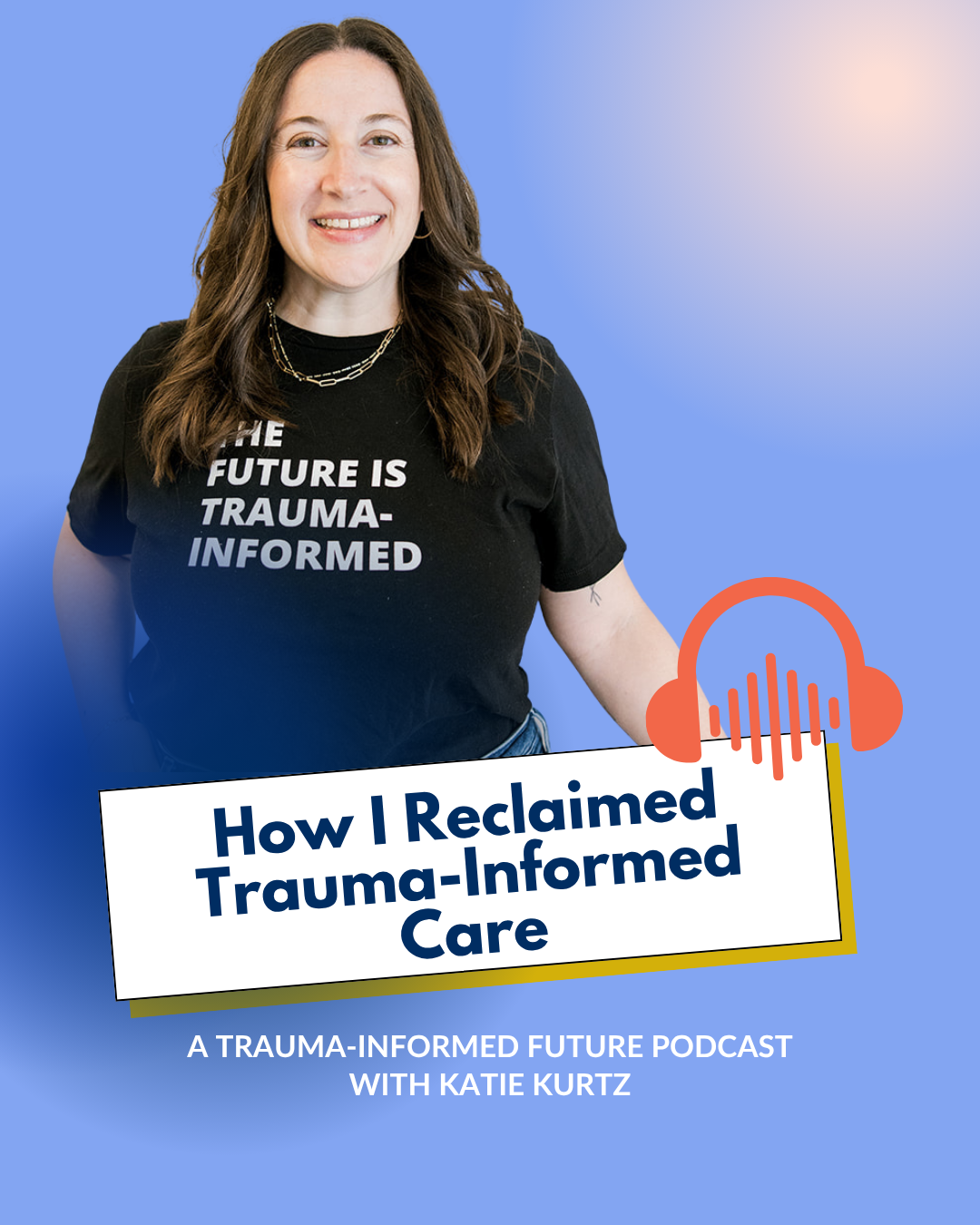
In this episode, Katie shares her personal journey of reclaiming trauma-informed care. From her own healing journey to becoming a coach and launching her business, she discusses the impact of adverse childhood experiences, burnout, and the importance of creating safe spaces for healing.
Resources Mentioned In This Episode:
Show Transcript:
Hi everyone, and welcome to a Trauma-Informed Future podcast. I'm your host, Katie Kurtz, subject matter expert and trainer, specializing in making trauma-informed care inclusive and adaptable for us all. I'm so delighted you're here, and today I'm excited to shift a bit and share a little more about me, my why and how I reclaim this approach after almost giving up on it, if you haven't already, I hope you listened to the first few episodes where we started by creating shared language and understanding, which will help us get on the same page as we move through this podcast together.
A content warning for this episode. Today, I will be sharing some personal stories that include the mention of mental illness, houselessness, assault, and suicide. If you need to honor yourself and your capacity, please feel free to skip this episode. So how did I get here? I had no intention of becoming a social worker, and I didn't know what trauma was.
Well, until my graduate school program. My life and journey of where I am today involves many different experiences, many of which I'm not going to cover today. But I do wanna share a little bit about some of my relationships in my life that have impacted me as well as my own trauma that led me to where I am today.
I was born in Cleveland, Ohio, here in the United States, two uninsured parents living on the edges of poverty. I have been surrounded by pervasive mental illness all my life. When I look back at the people and experiences I've encountered in my life, there are three distinctive relationships that I can point out that have lingering connections from my childhood to where I'm at today.
When I was a kid, my parents were very involved in their church and community center. It was there that they befriended a man named Frank. Frank had a variety of health challenges as well as mental illness, and Frank was houseless Frank became good friends with my dad, and he would frequently sleep on our couch in the winter, in our porch in the summer.
That was all his choice and he meandered in and out of our lives until he passed away. When I was in college. Although Frank was sometimes scary only because he kept dead birds in his pockets, he was harmless and witnessing my parents treat him with friendship and dignity and respect was a really important thing for me to experience at Witness, which led me to generate a great deal of empathy at a young age that only grew as I grew up.
Although as a kid I didn't really fully understand what was going on with Frank, and sometimes I found him annoying because I was a kid or a teenager. When I look back, Frank was a really instrumental relationship and person in my life, and that demonstration of empathy, really it is connected to where I'm at today.
Another extremely instrumental person in my life has been the relationship I've had with my mom's twin sister Joyce. My Aunt Joyce has been an incredible role model throughout my entire life. My Aunt Joyce would pick me up from school. She would try to teach me math or anything she could possibly do.
She loved Star Trek and Star Wars, and she was always anxious and worried, but we always just thought that Joyce was just being Joyce. My Aunt Joyce is a brilliant woman. She was a teacher throughout her entire career. She loved the environment and was an activist in trying to protect the environment as it we founded in crisis.
She even was tutoring up until a few days before she passed away a few years ago. Joyce also lived with severe paranoid schizophrenia. She was the strongest woman I've ever known, but she shouldn't have had to be. We never talked about my Aunt Joyce's schizophrenia. I always knew that something was a little different, but it wasn't until I was in my adulthood that I really understood the scope of what was happening with her and her story.
She never once let that impede her work, her desire to teach and educate or to love her family. I was with my Aunt Joyce up until her final hours before she died a few years ago. One of our last conversations was her asking me if anyone will remember her when she's gone. I took a deep breath and I told her we would never forget her because she taught us all so much about being a good and caring person.
She showed us through her actions, she showed us how to use her voice and how to stand up for yourself for what you believe in, and she showed us by fiercely loving everyone, even when she struggled. My Aunt Joyce lived despite her diagnosis. I aim to live my life every day holding onto the legacy of my Aunt Joyce.
I also grew up seeing and feeling the impact of living with someone who didn't participate in their own healing or care. My dad is a Vietnam War veteran with a mental health disability. He was in and out of psych hospitals my entire life up until my mid twenties when his mental health turned into major physical health issues and thus began my caregiving for him.
The impact of my dad's mental health and the associated struggles that came with it greatly impacted my ability to regulate my own anxiety, no trust, and it led me to have to parent myself at a young age. My mom always did her best to shield me from what was happening, but despite her good intentions, her actions of telling me everything was fine, when clearly it wasn't led to me to believe I was the problem.
If everything was fine, but I didn't feel it was fine, then clearly something was wrong that led me down a long road of struggles with self-worth, self abandonment, relational issues with my peers, and drinking at a young age. Living with a caregiver who has a mental illness is what we call an adverse childhood experience, or an ace living in poverty or near poverty is what we call an adverse community environment.
Together it is what Dr. Wendy Ellis calls a pair of ACEs. We can't talk about trauma without talking about one of the most instrumental studies that have occurred in our lifetime, the Adverse Childhood Experiences or ACEs study. In the early nineties, Kaiser Permanente and the Center for Disease Control, or the C D C here in the United States did a groundbreaking study with over 17,000 individuals.
They utilized a 10 question survey that asked these adults, have you experienced a certain number of things before the age of 18? Things like, did you have a caregiver with a mental illness? Did your caregiver deal with substance abuse? Did you experience physical emotional neglect? Did you experience houselessness divorce, et cetera?
17,000 individuals filled out the survey and what came from this is the most instrumental body of research we have that had, has also been replicated over time. In that study, 61% of adults said they had at least one ace and 16 had four or more types of ACEs. It's an extremely strong body of research that shows a strong connection between adverse childhood experiences and health outcomes later in life.
Experiencing these things in childhood could lead to later health outcomes that can impact so much, so many different things, including heart disease, diabetes, chronic illness, mental illness, substance abuse, and even premature death. However, after 20 plus years of this study being in existence, it's still not even universally discussed, adapted, or harnessed as a tool of prevention.
I don't believe we can talk about adverse childhood experiences without also talking about adverse community and environments. This is the work from Dr. Wendy Ellis. I'll include in the show notes. She depicts it almost like a tree. If you think of a tree that has leaves and fruit, And then you go down the trunk, it has roots.
So if we think of a tree and if adverse childhood experiences exist in those leaves and branches, but they don't just bloom and flower out of nowhere because that tree is rooted and the roots are those causes of adverse community environments. Root causes such as racism, discrimination, poor access to housing, or quality housing, poverty, violence, community disruption, lack of social mobility.
When we don't have these things in the roots, then we're likely to experience all of the symptoms, which are those adverse childhood experiences. Now, let's talk a little bit about the discrepancies of this research. There were 17,000 participants. However, the majority of those participants were white male, college educated, and they all had health insurance.
So out of those 17,000, we saw this huge impact in linkage of childhood trauma and stress to poor health outcomes. This was just a sample. It's not a representation of our full communities at large. So, again, keep this in mind when you think of the ACEs study and the pair of ACEs and how if we continue to function from this narrow definition of trauma, we aren't seeing the full picture.
So, It's so important for us to discuss ACEs and we will spend future episodes go talking about it further, but I wanted to be sure to mention it here. Please take extra note that if adverse childhood experiences or this study is new to you, please take extra care if you decide to Google or learn more about the ACEs study.
Just remember, this survey is not a Buzzfeed quiz. I do not recommend taking it without somebody who's professionally trained to deliver this survey. Yeah, because when you start to learn about ACEs, you yourself may realize that you have experienced some of these things, so please be sure to take extra care with yourself.
I took that little segue to mention ACEs and the pair of ACEs because I didn't know that existed when I was growing up. I didn't learn about the adverse childhood experiences, study well into graduate school when I was getting my Master's in social work. So now that I knew the context of the pair of ACEs, I realized that what occurred in my childhood left me with trauma.
It felt normal and I didn't have the language or the ability to witness other people's stories to know that what I experienced was not in fact normal. And to be honest, I didn't, again realize this was trauma until well into my career as a trauma specialist. I was still functioning from that very narrow definition of that trauma just occurred with some people in extreme situations that it wasn't me.
When I was able to really have the language and understanding of what had happened to me, then I was able to find a pathway of support and healing. And that also came with the acceptance of the reality that healing is not linear and that it takes a lot of time and effort, and when you open up and peel back one layer of the onion, it just opens up another one.
I've always been surrounded by humanity in both its most glorious and heartbreaking forms. Something my mom taught me from an early age was empathy, not just what it is, but she mirrored it through action and how to be it. My mom has and continues to be, even as she fades away from Alzheimer's, a fierce mental health advocate.
She raised me understanding that mental health is health, that we need parity for our care, and that we need multiple pathways of access to the healing and care that is best for us. I've never been a bleeding heart. A lot of times people assume I'm a social worker, so I must have a bleeding heart, and that I love helping people and I can't help myself.
And of course I have a lot of feelings and I get super fired up about injustice and I have a great deal of empathy. But the desire to become a helping professional wasn't to help or fix or solve people. It has always been to hold space for their humanity, for their process, for their being. Because I've seen what humanity has been like again in its most glorious and heartbreaking forms, and the need to have spaces for, for people to be held in my career has led me to various jobs and roles, all I'm grateful for because they led me to some incredible people and mentors, and they taught me about what I want and don't want, and help me find my voice and use it.
Okay. During my first field placement, which is a professional internship you have in graduate school to become a social worker, I quickly learned the realities of working within systems that state they exist to help people, but really continue to oppress and marginalize 'em. It was during my second field placement, I began to feel burnout, moral injury, and experienced trauma.
I'm very fortunate that I have never experienced physical assault in my life up until that job. And when I did, it was significant and traumatizing, and instead of my supervisor sending me to the hospital to get checked out, he laughed and told me, now you're a real social worker. And made me go back and run a three hour therapy group.
Having this lived experience changed the way I related to myself, to others, and to my body. It changed the way I showed up. I had a heightened hypervigilance I never had before. I was jumpy and anxious. I had a hard time sleeping, and I had a hard time accessing safety in certain spaces. This led me to burnout quick.
Not to mention that when I graduated grad school and began this job, I didn't only begin my social work career, but I also began my caregiving career for both of my parents because of their chronic health issues. I kept finding myself from job to job system to system were things kept feeling perpetually toxic systems designed to be broken systems that treated myself and others like cheap labor because they chose to cheapen it and extract us until we burned out.
About halfway through my career, I found myself at a brink of wanting to quit everything, but unable to because I was tethered to a hefty amount of student loans. Financially supporting my parents and being underpaid and overworked, I found myself feeling overwhelmed by the work I was leading and becoming jaded by trauma-informed care, and even wanting to distance myself away from it and giving it all up and asking myself time after time, what's the point of all this?
It felt like an impossible trap. A lot happened in those several years. But one thing that was really starting to happen was I was starting to my own healing journey and self exploration, and through this, I began working with my own coach. This experience was transformational for me, and it led me to finally take the courageous leap and pursue my co-owned coaching certification.
Six months later, I launched my business. All while working full-time. As a clinical director of a large city outside Cleveland,
wherever you are on your trauma competency journey, we could all use some extra tools to ensure we are leading with both competence and confidence. The trauma mindful toolkits are four different interactive guides to begin or deepen your ability to integrate trauma competent care. You can choose from nervous system care, knowing your scope, consensual communications or humanizing harm toolkits.
The toolkits are accessible on demand guides to ease the overwhelm and help you actively apply and integrate essential trauma-informed practices. To celebrate the launch of this podcast, you can receive $10 off each of the toolkits. By using the discount code, a trauma-informed future, this limited time only discount is available now through the end of July.
So head on over to katie kurtz.com/toolkits to get your toolkit and use the discount code, a trauma-informed future. That's katie-kurtz.com/toolkits.
I kept my social work and coaching lives very separate. So separate that people in my social work life had no idea. I had a business and no one in my business world knew I was working full-time. I did this for a lot of reasons because I didn't wanna blur my scopes of practice, but also because I needed that boundary.
I wanted to be able to exist in those two worlds very separately. And to be real, I needed to protect the safety of my job because I needed the financial stability. I needed the health insurance, and I needed the caregiving leave. Okay. I chose to launch my own business because it allowed me to express myself.
It allowed me to hone my creativity. It gave me autonomy, and it gave me freedom to harness my share and share my gifts in a way that social work never did. Then on one December evening after tireless calling, years, after years, faxing them, losing the papers, faxing again, all this advocacy to the point where I almost testified at Congress, I receive student loan forgiveness.
For the people in my life who witnessed and saw me worked tirelessly for this, they were also, I'm sure, very relieved because it created so much stress for me. It's what kept me in so many jobs that I wanted to leave, and it may seem like a very simple thing for some people, but for me it was huge. It felt like I was finally free and I had this ability after I triple checked it a million times, because I don't trust the US government sometimes.
I had to really. Settle into the reality that I had choice, and I've heard so many stories in my time of owning a business about leaving your nine to five job and becoming, you know, seven figure coaching business owner. I. And if that's your reality, then that's amazing. But for me, it definitely wasn't. I worked really hard at my coaching business, but I was limited because I was also working full-time.
I had to work in the tiniest of moments, whether it was at my lunch hour or after work. I sacrificed a lot of weekends just to build websites and my marketing and to grow and see clients. It always felt like there was a catch, like how did people actually do all of that? What piece was I not being told?
I. When I got that student loan forgiveness, I really wanted to quit my job, but I didn't. I shifted my business and I finally started to merge my worlds together. I've always specialized in trauma and trauma-informed care throughout my social work career and in holding space for others in my coaching world.
So I decided after a lot of overthinking to merge them together. And what came from that was a surge of fear and then a great release, a relief of not having to maintain the boundary of two worlds that I could show up fully myself. And to be honest, my business grew more than it has ever grown before.
When I did that because I was allowing myself to show up fully me, but I still didn't quit my job. I haven't really talked about my backstory a lot because I was working in jobs and with people and systems that I didn't feel safe with or I couldn't trust. I needed to maintain a full-time job for many reasons, which included a steady paycheck, health insurance, and the ability to caregiver my parents who had increasingly more needs.
So I needed to protect myself until I could choose when it was time for me to leave on my own terms. When I finally did decide to leave my job about a year ago, it was not in a way I thought it would be. I knew I needed to leave. I was breaking under a considerable amount of burnout, both professionally and personally, and I found myself at a precipice with an option to leave that I didn't realize or think I would have again.
At the same time, my parents' health issues were becoming increasingly more challenging. I had to make a very rapid decision last year for the sake of my mom's health to move them both out of their home after 25 years into an assisted living. I had an opportunity last year to leave my full-time job, and so I took the risk and seized it in order to find space and time to reset.
I wanna acknowledge that I wouldn't have not been able to do this or take this risk if I didn't have the supportive in infrastructure behind me. It's a privilege I don't take lightly, and to be able to quit my stable job and pursue my social impact entrepreneurial path is something I'm very grateful for.
And I know that could go away at any moment. This past year has been nothing short of a rollercoaster, and it's been both scary and exhilarating, amazing and hard, but it's a choice. A choice. I continue to choose a choice. I have the privilege of choosing, and I'm committed to showing up in that choice, despite the good, bad, and everything in between.
Because I really love this work and to be able to express myself through this work has been such a gift. I've never felt more aligned, more centered, more on purpose than when I lead this work in this way. There's obviously so much about my me and my story that aren't being shared here, and that's not because I am trying to hide something.
It's just we only have so much time, and as we get to know each other through this podcast and build trust over time, I will continue to share parts of who I am and my story with you. But why I really wanted to come onto this episode today and share is that so much of my life and my identity has been defined by being a social worker.
And although I'm so grateful for many aspects of that, I don't wanna be defined as a social worker because I'm so much more than that. Yes, I have letters after my name, and again, I have the student loans to prove it. And I worked really hard for that, and I continue to utilize my license in ways that may not, you may not see, but I utilize them in different ways to support other people.
So I still have that identifier with me, but I share this story today because it's not a story of overnight success or seven figure day daydream realities. This is a story of someone who felt the fear, but also felt unknowing that there was something more. And I gave myself permission to keep going.
Over and over again. I tried and I failed. I failed so many times, but yet I kept going. I've worked tirelessly to figure it out, and I hold a level of values and commitment for this greater shared vision. I don't believe my way is the one way or that I have all the answers. By any means. I have more questions than answers on any given day, and I have an incredible support system that believes in me, which allows me to believe in myself.
But like I said, I actively make this choice every single day, and by making this choice, I'm able to feel more me and more free throughout the years of starting my coaching practice. What, and while working full-time, which now is almost seven years ago, during all this time, I was holding space every month within my community to gather, connect, and create real authentic relationships with others.
These gatherings were held in different spaces within my city every single month for seven years. These gatherings utilize what is now known as the Trauma-Informed Space Holding Blueprint, which is a variety of methods to hold space so people can feel brave enough to access safety for themselves and be themselves and connect.
I was hosting these gatherings as well as retreats and workshops, and becoming really well known for my ability to create spaces for people to feel seen and heard in. Spaces unlike anything else that existed in the city I lived in. And I loved holding space in this way, and I gradually found that I wanted to see more of this, not just me holding it, but I wanted to exist in those spaces too.
I saw how beneficial it was to have these spaces held for other people, and I knew that at the time, although I wasn't calling it a trauma-informed space. It truly was. And so this is where I started to shift gears a bit. I. I launched Cultivate, which is my, I guess quote unquote signature training. It's a trauma-informed space holding training.
And in that training I teach people these different methods of the trauma-informed space holding blueprint so that they can become trauma-informed space holders so people can feel seen and heard and honored in their full humanity. And then my life changed and my why changed forever. On March 30th, 2021, I received a call while driving home from dinner with my partner.
In that call, we were notified that my mother-in-law Barb, died by suicide. It was a shocking and traumatic loss for us to watch your partner grieve while you two are also grieving is complex and devastating. Barb was a trauma survivor. She endured both acute and chronic trauma since childhood and was often silenced and told by family, community, society to keep quiet.
Trauma thrives in isolation. It disconnects us from everything, our selves, our trust, our voice, our choice, our relationships, all of it. That isolation killed Barb when we lost her. I felt alongside my complex grief, a renewed sense of purpose. I do this work for Barb. I show up with a passion and a knowing of how powerful it can be when we create spaces to feel seen and heard in, and that we feel belonging.
I know that trauma-informed care is suicide prevention, and I know that when people are given the opportunity to access a felt sense of safety, they are able to be more themselves. I've always done this work with a lot of fire and passion, but when we lost Barb, everything changed for me. It became personal.
It became something that I knew I wanted to really devote my time and energy towards. So where am I now and where am I going instead of giving up on this approach that I wanted to so many times? Instead, I reclaimed it. I honor the inaugural models and frameworks and all the people that brought it to where we are today.
But I also decided that in order for it to be relatable, inclusive, and doable for all of us and something we can actually integrate into our everyday lives, I had to adapt it to work for me and the people I work with. So that's why I created the Trauma Competency Framework and the Trauma-Informed Space Holding Blueprint, and it's now how I'm known as a subject matter expert who specializes in offering dynamic and experiential trainings and consultation to make this approach doable for all people and professions.
My superpower is that I can hold space for the expansiveness of our humanity and do so in a way where you feel fully seen, heard, and honored. I know what it feels like to not feel seen and heard and honored, and so that's why I'm so passionate about expanding spaces for that to exist. My other superpower is that I can make anything trauma informed, and by holding space for individuals, groups, and companies, I can help them not just learn, but actively and practically apply it into action.
If you haven't noticed, I'm extremely passionate about this work. I live and breathe it. It's not just the work I do professionally, but it's how I live my life out loud in every context in which I live. But I want you to know I'm not just talking about trauma all day, every day, although I do a lot because that's just the nature of my work.
I want you to also know I don't take my life too seriously. I am more than just this work. I'm a very full human, first and foremost always, but. Other things I like to do with my time is you'll find me spending time with my partner who I get to marry this November, and with our two puppies, Trudy and Mabel, who you may occasionally hear in the background.
I love being with people who could have deep heart-to-heart conversations. I love to introvert, and you can find me in nature, especially at Lake Erie. I love spending time writing in local coffee shops or cozying up and watching something funny at home. You can find me dancing in my kitchen pretty much every day.
And I am exploring every handmade ice cream shop because ice cream is my absolute favorite. I'm also still a full-time caregiver for both of my parents. There's so much about me that you'll learn throughout this podcast, and I'm excited to learn about you so that we together can co-create this shared vision of a trauma-informed future.
Because we need trauma-informed leaders in spaces, it's time to reclaim this approach and to make it inclusive and doable for all people in all spaces. I'll never bypass the reality of challenges and nuance that come with working in the trauma field, but I always have the same answer when it comes to what continues to propel me to showing up in this work.
And that's the four letter word of hope. And not in like this rose colored glasses, bleeding, heart toxic positivity, or that forced gratitude kind of hope. What you'll learn about me is that's not who I am. I'm hopeful, but I'm also realistic and I can hold that and both. The kind of hope I'm talking about is the fact that I'm seeing more people, more leaders, more spaces, more industries, start to open up and learn and adapt this approach.
The systems are starting to shift because we're having individuals like you starting to adopt this approach and push those systems into change. Those systems that I worked in, that burned me out, those systems that failed Barb, The hope I carry is that we will have more brave spaces for people to show up in exactly as they are.
The hope that I carry is that we're expanding our empathy in ways that bring us closer to collective healing. The hope I hold is that as much as trauma can change our lives, so can healing. Whenever someone asks me what I do for a living and I try to explain it to them, it's not uncommon for someone to have a sad look on their face because so often when we think of trauma, it can generate so many negative or heavy connotations, and I totally get that and I hold that because I live it too, and both I cannot.
Show up and continue to do this work without this relinquishing type of hope. Because if there's one thing I know for sure it's that being trauma informed is possible for everyone. I see the impact of it every single day. We are all deserving of this approach. It's not transactional, it's transformational, and this is why I do this work.
So thank you so much for sharing the space with me today. That's all for today's episode. Until next time, take good care.
