

Trauma Is Everywhere: What Do We Do?
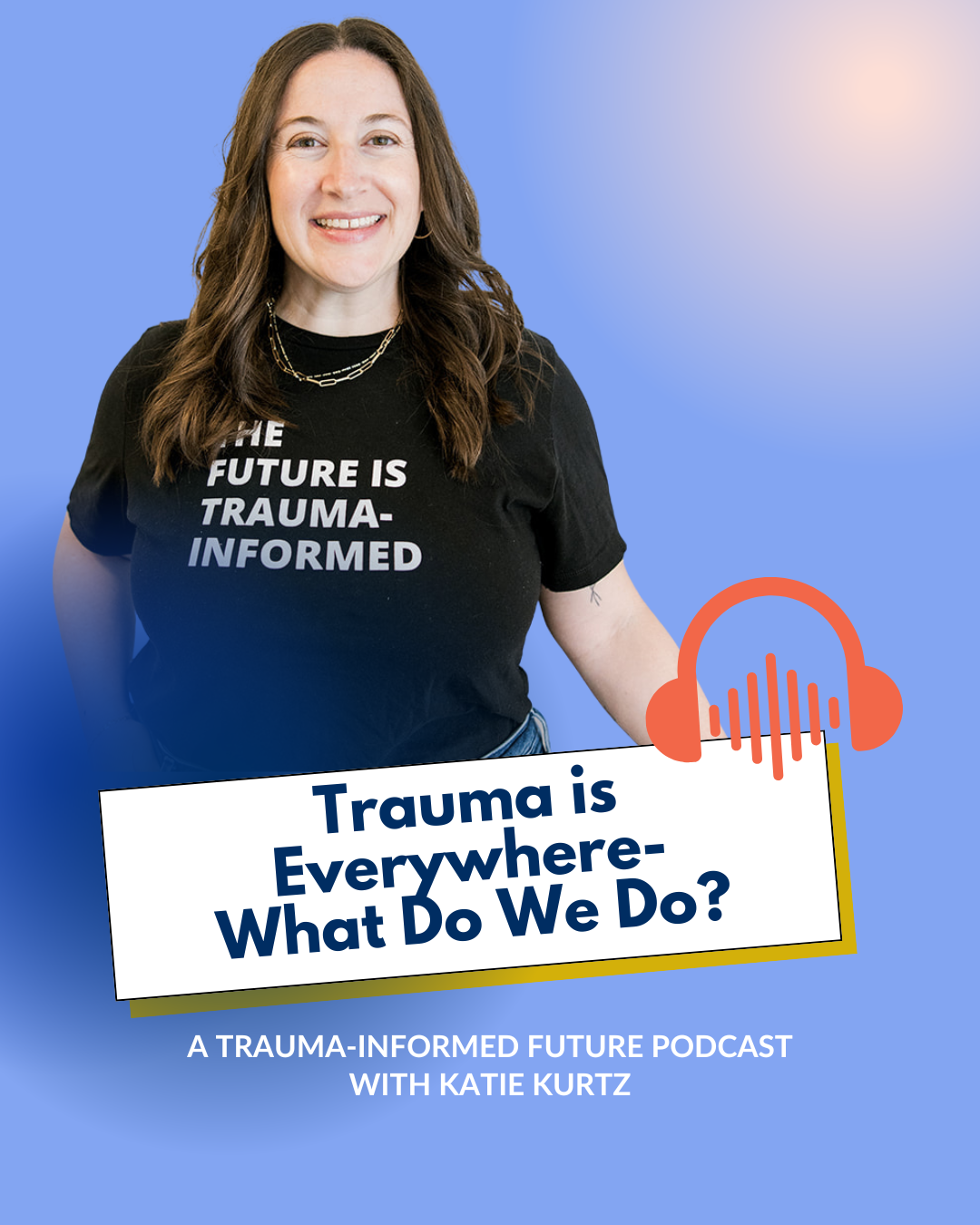
In today’s episode, Katie discusses the ubiquity of trauma and the need for trauma-informed care in various professions and industries. She emphasizes the importance of adopting trauma-informed approaches, promoting safety, trust-building, and honoring the humanity of individuals, to create a future that prioritizes healing and resilience for all.
Resources Mentioned In This Episode:
My Grandmother's Hands by Resmaa Menakem
Show Transcript:
Hi everyone, and welcome to a Trauma-Informed Future podcast. I'm your host, Katie Kurtz, a subject matter expert and trainer, specializing in making trauma-informed care inclusive and adaptable for us all. I am so happy you're here, and today I'm excited to talk about this question and you might think this is not something to be excited about, but for me it definitely gets me excited.
So over the last few podcasts, we've talked a lot about trauma and understanding the pervasive nature of trauma. And so often that leads us with this question of, so what do we do? So today I really wanna focus on. What do we do? How do we find hope? And my hope is that we can ease any overwhelm you may feel and find ways to seek out hope together If you haven't already, I hope you listen to episode one where we started by creating shared language and understanding, which will help us get on the same page as we move through this podcast together.
So there's never going to be a time in our lives in which we won't need trauma-informed care. In episode one, I shared a quote from one of my teachers, res mechem, and I use this quote a lot whenever I talk or train people. He says, trauma decontextualize in a person can look like personality trauma.
Decontextualize in a family can look like family traits and trauma decontextualize in a people can look like culture. If you pause to really think about this, it may start to feel like trauma is everything everywhere, all at once. Trauma has and is and will be a part of our human experience. It's a response in our bodies that is there to protect us and aid in our survival.
And I will never get over how brilliant our bodies are. They're doing exactly what they're designed to do, but this of course doesn't mean that trauma's necessary inevitable or good. It's simply stating the reality of this complex and very human experience. We may not be able to eradicate trauma, but there is something that we can do to prevent, mitigate, and heal it.
Research has shown us that having relationships with people where we can feel a felt sense of safety, trust, and belonging can prevent, mitigate and heal trauma. It doesn't just impact us as we grow up. It impacts all of us across the lifespan, not just people who live on the margins of life because of systemic oppression that is designed to hold people there, not just people who experience abuse or neglect all of us.
As professionals and leaders, we can cohesively ensure not just us, but our teams and our spaces, and the culture in which we're working are promoting this kind of connection by adopting a trauma-informed lens. Trauma-informed care has nothing to do with knowing people's trauma. But it does have everything to do with understanding the existence of it, the insidious nature of it, and the impact of trauma to help inform how you show up, how you create, how you interact, and how you lead.
Because once you do, it widens your lens of empathy. It expands your understanding of humanity. It creates more clarity around our nature and the social context we exist in. It allows for us to stop othering and thinking it's just those people, and creates a pathway for a collective and shared human experience.
If we know that most, if not all people, including ourselves, have experienced trauma or toxic stress, then why wouldn't we want to ensure we're cultivating a lens to better inform the work we're doing and the spaces we're holding to honor those lived experiences that are very much a part of our everyday humanity.
Even if it's not relative to your specific service or product or line of work, trauma is a reality of our humanity in everyday lives. I know it's not fluffy or cute or whatever, but it is something that we can recognize and then actively and intentionally insert that recognition into how we show up and lead our businesses, our leadership, our life.
Holding an understanding of trauma and toxic stress, and then using that to inform how you hold space and your lead, your business is how you can honor this reality of our shared humanity. I believe very strongly that trauma-informed care is non-negotiable. Every day, we are waking up to a mirage of heavy global news, of war oppression, human rights violations, violence, climate change, economic uncertainty.
And dehumanization on so many different levels, and that's just what we see in here from the collective world around us. It doesn't even touch about what's happening in our own backyard. When our eyes land on those stories or our ears listened to those accounts, our bodies are imprinted by them. As someone who works at the intersection of almost every industry, I can safely and emphatically state that this is necessary and no longer optional.
I train thousands. Yes, you heard that right? Thousands of people. Each year across almost every industry, and it's not uncommon for me to state this, what I just stated about trauma-informed care being non-negotiable, and then here replies like, oh, it's just so much work. Or we would have to change everything I.
Or it doesn't seem like it really applies to us or that's nice, but is it even possible? What's the point? I can't help but laugh a little bit. Not at them or to make just at any of this, but because these are such common misconceptions I hear on the daily. Trauma-informed care isn't a lot of work. Unless you find being compassionate or empathetic hard work, then I don't know what to tell you.
Most people I work with end up realizing they're already doing a lot of the things they're learning. It's just simply shifting the perspective of understanding the intention of why they're doing it. Trauma-Informed care applies to everyone. Even if you haven't experienced trauma yourself, you still will greatly benefit from trauma-informed care.
Expand and empathy sounds so nice, but what does that actually really mean? And if you ca are caring and kind, isn't that enough? Yes and no because nuance always. Caring and kindness, empathy, they're all the same, in the same wheelhouse, but empathy is more of an active mindfulness of intentionally pausing to listen, to understand, and to move from that understanding.
It's essential in holding space for people, and it increases our capacity to hold complexity and nuance, and then in turn, it deepens our understanding of our clients, our customers needs and desires from the lens of their lived experiences. Expanded empathy is key in trauma-informed care. That's why you hear me talking about it so much because it helps us understand one of the most important aspects of this approach.
Safety is not guaranteed or assumed just because we say it is. So what does expanded empathy look like in real life, in real time?
Wherever you are on your trauma competency journey, we could all use some extra tools to ensure we are leading with both competence and confidence. The trauma mindful toolkits are four different interactive guides to begin or deepen your ability to integrate trauma competent care. You can choose from nervous system care, knowing your scope.
Consensual communications or humanizing harm toolkits. The toolkits are accessible on-demand guides to ease the overwhelm and help you actively apply and integrate essential trauma-informed practices. To celebrate the launch of this podcast, you can receive $10 off each of the toolkits by using the discount code, a trauma-informed future.
This limited time only discount is available now through the end of July. So head on over to katie kurtz.com. Slash toolkits to get your toolkit and use the discount code, a trauma-informed future. That's katie kurtz.com/toolkits.
So when you expand your empathy, you're expanding your capacity to ensure your clients, your customers, your colleagues, feel more seen. Heard, understood. It allows you to build trust and it gives them the ability to access safety in your presence, all of which, by the way, inadvertently resist the likelihood of harm.
When we feel a felt sense of safety and safety is accessible to us in our spaces, in the presence of others, then we have the ability to. Explore more to discover, to create, to be ourselves, to express ourselves. The possibilities are boundless. So when people then have that ability to access safety and to safely explore, create, discover, et cetera, then they are more likely and able to express themselves, gain clarity on their goals, be more open, to have more creative freedom.
So, so much. If you haven't noticed, there are no losers in trauma-informed care. When applied, everyone benefits both the person receiving and the person offering this approach. It's bidirectional. And the benefits from offering trauma-informed care are honestly endless because when you apply it not only to how you're holding space, but how you teach or lead, run your business in your relationships, in your communications, you are reaping the benefits of what could be possible when we're able to honor our full humanity.
When you're holding space for other humans in any capacity, that means you're holding space for their identities and lived experiences, which include trauma. We are seeing a growing need for trauma-informed practices in new professions and industries where it previously did not exist. Not to be hyperbolic, but now more than ever, professional space holders need to be equipped with actionable and sustainable ways to hold space that honors the realities of our humanity, which includes stress and trauma and adversity, and also healing and mutual care and liberation.
So yes, trauma is a part of our reality as humans. However, so is healing and liberation. We have the power to shift systems and cultures and change the healing trajectory. Trauma-informed care does not fix or solve. It does, however, enhance and promote the likelihood of this to become our reality. We just have to choose it.
A trauma-informed future is possible when we come together to choose and create it. Okay. Every day I see how non-negotiable trauma-informed care is. I hold space and guide people in adopting or strengthening this approach because I hold tightly to the hope that comes from knowing we are co-creating spaces for our full humanity to exist.
I witnessed the energy shift when we begin to acknowledge the realities of our humanity, especially within the last few years, eye witnessed, shoulders relax and jaws unclench when we acknowledge our nervous systems need care and tending just as much as everyone else is eye witnessed, the exhales of relief.
When we acknowledge that there are ways to bring our humanity forward in the like work we lead. And I witnessed the sparks of hope that are generated when we feel more confident in promoting safety in the spaces we exist in. I believe everyone can be trauma-informed. I don't think it's reserved for some, but rather meant for us all.
I don't think this is a trend or a buzzword. I think it's best practice. I don't think that by increasing the amount of people who adopt this lens will diminish the practice, but only strengthen it. I believe trauma-informed care should be the standard of care, especially for industries like healthcare, mental health care, wellness coaching, yoga and fitness nonprofits and funding, and so many more.
When we think about the realities of trauma and how trauma can impact our bodies and our brains, how it disconnects us from who we are, the relationships we have, and our meaning within the communities we live in, it can change our ability to exist within cultures and spaces. When we think about how trauma can literally change ourselves on the molecular DNA level, and then that can then be passed down from generation to generation, it is impossible to not feel the heaviness of that, to not feel the weight of that and to not feel hopeless.
But what I wanna infuse here together is that, is that despite how hard. How tragic and how hopeless trauma can feel for so many people. For so many cultures, healing is possible and that we know and we see it every single day, that resilience is not built by persevering or gutting it out, but rather by expanding our capacity to have nurturing and healthy and.
Safe relationships and spaces that we can exist in that that all contributes to building our capacity so that when additional stressors come, when things like pandemics happen, when adversity or stress arises, we have more of ability to withstand that and get back to a place of neutrality. All of that is accessible to us, and we can even.
Create more access to that by choosing to show up and adopt some sort of trauma competent care lens. Wherever work centers on humans shouldn't the baseline approach be to honor those people's full humanity. If you go into a hospital or a doctor's office, we are often at our most vulnerable states, so shouldn't the baseline be to have our full humanity honored in those spaces so that we are not.
Added additional stress that additional anxiety or additional harm is not created there. If we walk into our therapist's office that we can be met with where we're at and not given or led down a pathway that could cause us to not feel seen and heard. If we go into a yoga class or a fitness studio, shouldn't we be able to exist in the bodies we belong in?
If we are GE getting funding for our nonprofits or to have community centers or community programs, shouldn't that funding be met with the realities of what those programs are and not. To intentionally continue to marginalize or create more barriers or gate keep. I believe a trauma-informed future is possible, and I'm witnessing its possibility every single day.
It's slow, but sure, it's definitely a long game. But what I know to be true is that trauma-informed practices are humanity affirming. And the more people we have integrating these practices into their lives, the more hope we have for real systemic and cultural shifts to occur. And as for me, I choose that hope.
So thank you for being with me here today. I hope wherever you're at that you can find some semblance of hope, and I hope you stay with me as together we hold the vision for a trauma-informed future. But until then, take good care.
