

Understanding Somatics with Jess Jackson
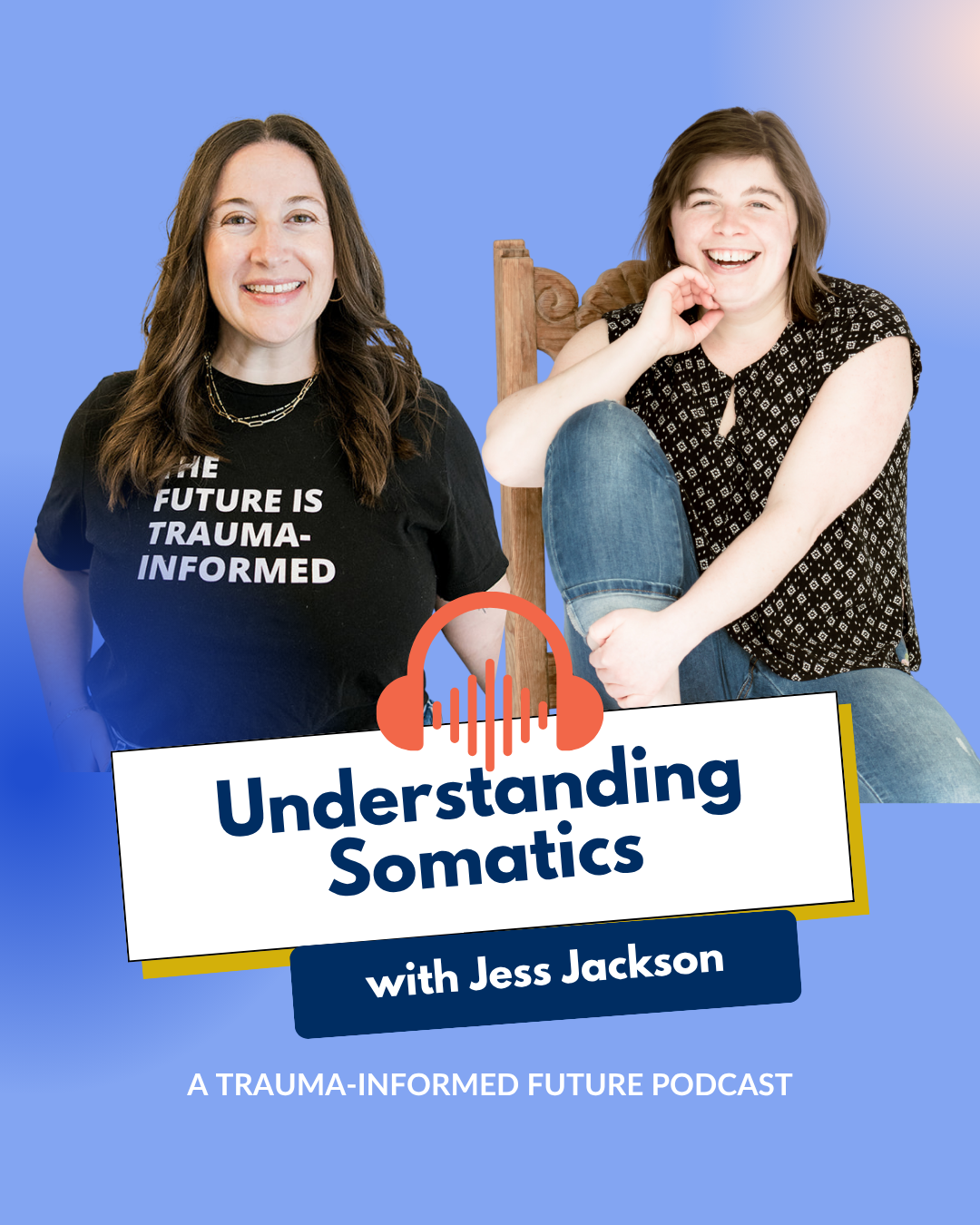
Have you been hearing the word 'somatic' a lot but not quite sure what it all means? In today's episode of " A Trauma-Informed Future," host Katie Kurtz is in conversation with guest Jess Jackson where they get real and discuss all things somatics. The conversation embraces the broader understanding of the term "somatic," emphasizing that healing can transcend traditional practices but still require ethics and discernment. They highlight the value of both lived and theoretical knowledge in providing trauma-responsive care, underpinning the role of trauma work as a social justice effort.
Learn more about Jess:
Jess Jackson (she/they, LMT, SSP), is a trauma-informed bodyworker, somatic practitioner and educator. She supports survivors through trauma-informed, nervous system centered offerings, and helps practitioners shape and strengthen their trauma-informed practice. Jess works in an anti-oppressive and attachment based lens, with the hope of centering survivors and supporting the dismantling of systems and practices in the healing community and beyond that perpetuate harm. You can connect with Jess at www.softpathhealing.com, and on Instagram and Facebook.
Connect with Jess:
@softpathhealing on ig, tiktok, fb
About SSP: www.whatisthessp.com
Show Transcript:
Katie Kurtz (she/her): There are so many different words that are being labeled buzzwords or trends. When you look at the wide world and wide field of trauma one of those big words is the term somatic. In today's episode, I'm in conversation with my dear colleague and friend, Jess Jackson where we're gonna really look at that word.
What does it mean? We're going to discuss the ins and outs of somatic work. The difference between trauma informed care and trauma responsive care. So many delightful twists and turns in my conversation with Jess today. Jess Jackson uses. She, they pronouns and is a trauma-informed bodyworker somatic practitioner and educator. She supports survivors through trauma informed nervous system centered offerings and helps practitioners shape and strengthen their trauma informed practice. Jess works an anti-oppressive and attachment based lens with the hope of centering survivors and supporting the dismantling of systems and practices in the healing community and beyond that perpetuate harm. Jess somebody I often send people to because of their amazing programs and trainings. And I am grateful for, to have as a peer and colleague in co-creating a trauma informed future.
So without further ado here is my really incredible, very fun and light conversation about all the hard and dark parts of our lives with Jess Jackson.
Katie Kurtz (she/her): [00:00:00] Hi everyone, and welcome back to a A Trauma Informed Future Podcast. I'm your host Katie Kurtz, and I'm always so delightful for, to talk to every guest on this podcast. And my guest today, Jess Jackson was like first on the list to, to have a conversation with, and I have no doubt it'll be one of many, as they say with every guest, but for, with Jess for sure. So welcome, Jess. So happy to have you.
Jess Jackson (she/they): Hi, I'm so glad to be here with you and with all of our listeners.
Katie Kurtz (she/her): So I gave a formal introduction to you and your experience of work in the introduction, but I would love for you to share just a little about the human the human first part of you , and just how you're arriving today.
Jess Jackson (she/they): Today it's funny. I am arriving having been a practitioner and having been a client all in one day. And I had a business showed up in my little business group, got to facilitate a little bit of healing and processing for a lovely client, and then got to be a client and now I'm here. So [00:01:00] it's been a full day.
And I think in my bio I probably mentioned that I do body work, so I think there's like a very gentle groundedness about me, but also I'm really fucking goofy I don't assess my dog like every other single elder millennial yeah, and I'm calling Maine on Wabanaki land home for now with the trees and the water.
So, and, and maybe I said this, maybe I didn't, but most people would not be too surprised to know I used to teach preschool. I'm kind of dorky, so I feel like in a funny way that kind of informs my work and just getting to be playful with people's inner, inner preschoolers.
Katie Kurtz (she/her): I love that. You also have a lot of patience as many of us might not have with preschool aged humans.
Jess Jackson (she/they): Well, it's, you know, it's so much easier for me to have patience with someone else's process. So, which I think is like so similar for a lot of folks. But yeah, I, I try to, I think like a lot can happen when we hang out in the [00:02:00] pause rather than forcing for something to happen. It's like that, that paradox of being accepting and like holding that soft accepting space means like things are able to shift within it.
And I obviously, I don't always do that talk to anyone who knows me really well, but I do try, especially in my, in my job.
Katie Kurtz (she/her): Absolutely. I always say, at least about myself, but just because I teach this approach and I attempt to embody it and practice it does not mean I'm trauma informed 100 percent of my days.
Yeah. Human first and my snarky, sarcastic judginess comes out and the pause and recalibrate and that's just, that's just it. That's why it's a practice, right?
Jess Jackson (she/they): Sometimes I joke that I'm off the clock.
Katie Kurtz (she/her): I love that.
Jess Jackson (she/they): Well, and I don't know about you, but I also think I'm a little sillier than I thought I had permission to be given that I'm in the trauma informed space.
So. I'm in one way often [00:03:00] like stewarding or shepherding trauma resolution and trauma informed care, whether it's like directly working with someone who's been through trauma or working with the people who work with people who've been through trauma, which I know we'll get there. And also like being a human and practitioner on the internet, like you don't always know if your starkiness comes through, but I'm trying to let that live in my work a little more.
And just so people aren't too surprised that I have these two, there's Justin's about to. Do a little massage and you're on the table setting. And then there's like me cracking up and being ridiculous. So yeah, I'm trying to let that live in my work a little more.
Katie Kurtz (she/her): I love that you named that. I've been trying to do that as well because I typically share a lot of educational content on social media.
But I'm not, and people assume I'm very serious and like academic, which is funny because I'm neither of those things. And , I just recently got kind of bored with like constant educational [00:04:00] content. And I started making the summer, like trauma informed memes and cause I'm actually, I'm, you know, incredibly awkward, introverted, also obsessed with my dogs.
Like kind of like a 85 year old at heart, but also feel like I'm still 28. I don't know, more towards the 85 year old. And I think people were a little shocked that I was like, attempting to be funny. I thought it was being funny. I don't know what other people interpret, but I just keep reminding people like joy is an essential element of healing of any kind.
And we don't have to take ourselves so seriously all the time. And this is what I teach in my trainings is we're human first, it's important to add your humanness to, to the approach and that this isn't, there's no arrival. It's an evolution. So you know, if you're aiming for perfection, you're not going to make it because perfection is not real.
And Being an online business owner for so [00:05:00] long, it is, it's hard to feel like you're losing yourself a little bit because you're focused on the content and not like the human I posted a photo of myself and now husband before we got married and it felt so vulnerable. I was like, Oh my God, I've never, never share practically anything, his photo, anything like that.
And I was like, this is a big part of my life. Like, why do I, it's funny.
Jess Jackson (she/they): Isn't it so funny to when are a lot of our clients have those parts of our lives? And I mean, and when I say client, I guess for folks listening, like for Katie and I think sometimes we're working with clients who are like other business owners and sometimes we're doing other more.
Therapeutic in quotes. I'm not a therapist, but we'll get there. I'm kind of work.
We are not therapists, but yeah, like why our clients get to show up in their fullness. Like it's. to everyone's discretion how much they want to share but I think it's nice to give permission of like it doesn't have to be so heavy and serious like it can [00:06:00] be but it's not a requirement like healing does not have to be this heavy serious somber or this like sultry earth angel gauzy I mean if you want that there are so many people on Instagram with like little sheepskin rugs and the quartz candles and that's not me babe But yeah, like it just doesn't have to be, and we get to be humans together you know, and I, and obviously there are like, there's boundaries and ethics and all those things, but I love the levity that gets to come in and just kind of lift, lift our spirits to be risen up to be able to do the work.
Katie Kurtz (she/her): Yeah, I started sharing every Sunday, like my favorite shares of the week. Because I also feel like obligated to only talk about trauma and I like that like people have called me in like In person world, like the trauma lady. And I'm always like, I don't want to be that. Thank you. Yeah. Katie suffices.
And there's more I think people also think I'm this like earth angel, gentle [00:07:00] soul, which like I have a lot of gentleness to me. But again I'm very snarky and sarcastic and dumb memes and, and. Sprinkles of other things. And so it's been really liberating in a very small way to just share what I save every week and it's people really enjoy it.
I'm like, Oh, good. I feel a little bit of relief that I can just kind of show my own humanity through it. And it's silly, but I really enjoy it. Yeah, Jess. All right. Let's, let's begin. By creating shared language and understanding, I find I'm a big fan of that helps create meaning making and then everyone on the same page and it's very common on this podcast for me to start here with a lot of folks, especially around terms that are becoming quote unquote buzzy or quote unquote trendy, which I'm not loving because we know trauma is not a trend.
Trauma informed care is not a buzzword, but to. Actually, I'm going to include three things. Let's help create [00:08:00] some shared language and understanding around the term body work. Somatics, which is definitely taking on a life of its own. And maybe even like nervous system stuff, because I'm also seeing that pop up a lot.
And to be quite honest, I get a little like shoulder to ear cringy when I see these terms being utilized without Or misused in a way or misunderstood because a lot of people like trauma and trauma informed care are seeing it as a trend and then capitalizing on it without any form of lived or learned experience qualifications that would make, create a You know, a space that is actively reducing harm and promoting safety.
Jess Jackson (she/they): Yes, I agree with that. You know what I'm thinking about is the human body. And if anyone listening to this knows me, this kind of windy answer won't be too surprising. But Each of these words [00:09:00] relate to having a body. Somatic, soma, that's, that's of the body. Our nervous system is housed within our body, and bodywork has to do with the body.
So I'm just thinking about bodies and it's so magical and also sometimes mysterious and painful to be a human in a body, and I don't know, I'm not gonna go down the tangent, but I just think yeah, I'm not gonna go down the tangent. We'll go back to the definitions. So Soma is just of the body, somatic, working with the body.
And you know, when we think of somatic, a lot of folks might think of working with trauma somatically or somatic experiencing, and I am going to contradict the definition a little bit in that somatic work doesn't always mean The same thing as body work. When we're thinking of body work, we might be thinking of massage or acupressure or cranial psychotherapy, [00:10:00] rolfing, any kind of hands-on work with the body.
And it usually involves like touching someone's body. Within scope of practice with those ethics and things. Somatic work has to do with your. lived experience of your body, what your body, the story your body is telling, and it doesn't always involve touch. So I know that's a little windy, but that feels important to say and again, this is not a definition, but there's a lot of oh, just shake, and then your traveling will be gone.
That's somatic, but sometimes it's a little deeper than just moving your body or feeling your body. And I don't want folks to feel like, if you have a tool that is working for you, for your stoma, for your body, for your nervous system, that's amazing. And sometimes I think there's a little bit of peddling these quick fixes where they might not work and then people are like, Oh, what's wrong with me?
Yeah, so somatic and bodywork, you do have things to add on those two. I don't know if I'm just confusing people further.
Katie Kurtz (she/her): I really love the distinction you made [00:11:00] between bodywork and somatics. I, and I think this, this idea of bodywork is more tangible, or with in you have somebody who is specifically. focused on movement or touch of the body to help shepherd someone into deeper, whether it's a deeper state of relaxation you know, pain management, chronic illness management. And absolutely, we know various forms of body work can be a part of people's healing journey. And I like that because I believe oftentimes when we think of body work, we typically tend to lean towards like massage you know, Thai yoga acupuncture, Reiki. And I've really have talked to, I work and train a lot of different industries and getting your hair done or nails done or waxing. That's also body work. We know salons traditionally are spaces where people enter a state of relaxation and comfort and [00:12:00] disclose a lot of information to stylists. And so that's why working with salons personally has been so great because this approach absolutely belongs there.
Even photographers, I train a lot of photographers any kind, but especially those who like boudoir photography, like that is a very, that's. I don't know, maybe you would disagree with me. I consider that body work especially if they're helping you put in different positions or there's a certain intention behind the photos.
This approach is so key because when you work with bodies, you're working with stress and trauma. And. Yeah, and I like how you differentiated somatic where it's more of like your lived experience. I guess it didn't, I should have thought of that, but I'm always like, oh, I love that that reframe because that makes a lot of sense.
I'm curious if you can share a little bit let's talk about somatic work, because I also think that I would never, I've never been a Like specifically trained in somatic work. We have taken continuing ed [00:13:00] stuff and like I'm in circles with several somatic practitioners. I would never identify as someone who specializes in somatics.
I've experienced it as a client. But that word's being used a lot. And we don't just take a 60 minute class and then they're like. We're like some somatic healer, right? So yeah, but it also looks, it can look differently. There's like different types , of healing pathways, but can you help us unpack somatic a little bit?
So people, cause I do think it's a term that makes sense. We know it's of the body, but then it's like all of these offerings these days. I'm a, as you know, big fan of self vetting discernment to find not just the appropriate modality. Cause I believe healing trauma informed care includes healing informed care.
And we have to honor. What may work for me may not work for you, but that doesn't invalidate my experience. And I believe healing comes in many forms, whether it's nature or animals and what brings us joy, somatic work, [00:14:00] body work, writing, dancing, cathartic screaming. Here for it all. But I would love to get, since you are somebody who has a lot of experience and training and both lived and learned, if you can help us just unpack this a little bit more.
Like, how does somebody become a somatic practitioner or what to look for in seeking one?
Jess Jackson (she/they): Yeah, I want to say first and foremost that somatic approaches to healing are very old and not white, and I am very young and very white, and a lot of the folks that I learn from are old, white men, and I try really hard for that not to be the case I'm pretty committed to that not being The majority of folks I learned from and so just like for folks to know that a lot of the certifications are colonized.
And so just to know that's a lens I'm bringing, even though I'm working to decolonize I just know that's a big piece. And I think that's a reckoning somatic [00:15:00] experiencing international has kind of been grappling with in their work and being more inclusive and intersectional. Yeah, so I have some thoughts.
I always have thoughts. I think it's really interesting thinking about somatic as a lens. And so I think a lot of people can adopt a somatic lens. I think there can be, for instance, a lot of therapists who might be able to go there with you in terms of what you're experiencing. Maybe you're living experience of being in the session or what's happening in your body.
Even body workers or folks who work with bodies who have more of an awareness of just that intimacy you were talking about. Yeah, we don't have to touch someone for there to be intimacy or vulnerability for folks who work with people with bodies. So I think one big piece of it can be this just this layer of awareness that it's a little loaded being a human with a nervous system in [00:16:00] a body, especially depending on your depending on who you are and and if you're safe or not safe and your identities and all these things.
And somatic experiencing, and I would say there's it's like somatic experiencing is this big body of water in somatics with a lot of little what are they called? Like estuaries, or? I don't know. Is that okay? Katie's nodding. Okay, cool. Great.
Katie Kurtz (she/her): I live on a great lake. Very familiar with types of bodies of water.
Jess Jackson (she/they): Okay, beautiful. So I've been in some of these estuaries around somatic experiencing and then finally was like, okay, fine. I have to take somatic experiencing. This is Peter Levine's baby. And it's very much like, of the body, of the present moment experience, and I want to talk a little bit about this approach not because it's the only approach that does this, but what's really different about it is, they're not going to say, shake, shake, shake, [00:17:00] and then you're going to let all your trauma go, it's can you make, does your body want to make a shaking motion?
And can you make a shaking motion while feeling your feet on the ground? And Can you stay with yourself while a big emotional wave is coming through? It's a lot about how do we move, move through, and I don't even know if I love the language of recovering from trauma or resolving trauma. Lately I really love this idea of integrating I know I'm just so all over the place, but if I, we think of our body as like this tapestry or this weaving and we have some loose threads that are just like, pissing us off.
Yeah. You poor little thread, but also you're fucking making my life so hard. How did we move it in? We can't always snip it off. We can't just shake and then we're over it. So somatic experiencing is a little different because you can be catharsis. You can be really big and they will encourage that if, if you have the capacity for it, Which is where we come back to the nervous system.
So, [00:18:00] for my personal entryway into somatics I was doing a lot of post trauma work. This will be actually great to talk about with a psychotherapist who was somatic. And I don't think she knew shit about containment, which Oh, we might need definitions in our show notes, but containment, boundaries, titration, like doing the work in a doable, digestible way.
I did not want to do it doably or digestibly. I'm like, let me just get into the muck and I'm going to sit there for the whole session. And she's cool. Well, it was kind of cool, but nothing really got integrated. And so then I stopped seeing her went to a different practitioner and they were like, what's your capacity today before we started?
I don't fucking know. No one asked me that. I didn't have really a relationship with my nervous system, except it was like, I just felt like a basket case. And that was my, you know, that was my baseline. So we worked with my capacity and [00:19:00] my nervous system. We worked with You don't have to touch the, the hot thing you shouldn't probably touch the hot thing, you'll, you'll be hurt, but we don't have to do this intense fireworky work all the time, and you actually are shorting your circuits out, this is what this practitioner told me you can do it, but you also, we could find a different way, babe come on, so, yeah, there's this whole school of of just the way folks work, which it's not just somatic experiencing, but it is Part of somatic experiencing where yeah, we just get to help folks do the work at the pace of their nervous system.
And so for folks who, who aren't able to be with the pace of their nervous system because they're surviving the world we're living in, which doesn't move at the pace of a nervous system, that can be really confronting. But I've also found it's really effective. Well, I mean, you might hate it. I hated it at first.
I'm like, why are you slowing me down? Why are you interrupting me? So, there's an art to helping our clients [00:20:00] feel seen. Where it's we have to go slow, slowly. One of my teachers has said. But anyways, I don't, that's like a long thing. But that's how I started. I'm like, oh, fuck, I have a nervous system.
And then I'm like, Oh, it's rude. It's like ruling or ruining my whole life. Okay, I guess I'll work with it. And then enter somatics. And that was like eight years ago. I've been in massage school and training since then. And I'm always going to be just a touch unhinged. But I'm in year two of somatic experiencing and I think I finally feel like I'm still fiery.
I always will be especially in these kind of healing spaces, but I think I finally feel like I'm sitting in my seat with enough capacity to be able to do the work. Whereas before I was thinking about this today, we, we students, I think, need a lot more self work before we can do the work. So I wish. If I could make a wish, I wish that would happen.
Katie Kurtz (she/her): Thanks for sharing [00:21:00] that. I think I'm a big believer in honoring both our lived and learned experiences, and perhaps This will kind of segue into the next part of talking about like unpacking somatics is I, I personally don't believe and I know a lot of people disagree with me. We cannot solely relied on our lived experiences to inform professional trauma related work.
There's a big difference between I think it's absolutely. I think people who have a known and lived experience of trauma and healing bring a depth that most people don't. But I also believe that the majority of us, if not all of us, have lived experiences of toxic stress and trauma. I've even been grappling with using the term survivor lately because I honor that.
And if somebody self identifies as that, I absolutely honor it. But also, we know so much more than we did. During the rape crisis movements, [00:22:00] and we know how underreported violence is, especially interpersonal violence, and we still culturally, and I would say, namely in the U. S., but also internationally, that we function from a very narrow definition of trauma, you know, war, violence, injury, yes, but we also know and acknowledge at least I venture, I guess both of us share this belief, there are many types of trauma and it's not just those things.
It is. And then there's also, and I don't do big T, I don't do hierarchy with trauma, like that's just using the same tools, but it expands that yeah, we know population studies have shown that it it's for virtually all of us, even again, whether you believe in pandemics or not. They're real and we will have existed through them.
So now we all have a shared lived experience of class, collective and historical trauma. So I honor, I, I don't disagree with the term survivor by any means. I don't want anyone to think that, but I grapple with it because [00:23:00] are most of us survivors and of some form of trauma. And I don't want to minimize anyone's lived experiences.
That was my tangent, but Yeah. I'm curious, like your thoughts on lived versus learned experience and especially with somatic work, because like you said, like you're in, it's a three year program, isn't it? Semantic experiencing. I mean, it's an intensive training, but I would venture to guess it also integrates.
lived experience. And I think it's such a poignant point that you made is that we, if we're getting into any time of trauma responsive, or I also don't love the term resolution or recovery, but if we're going into specific trauma responsive roles, we have to be also addressing our own lived experiences because if not, we, I mean, I believe trauma informed care.
Is capacity building and somatic work nervous system care work is capacity building. So we have to be looking at the bidirectionalities of these approaches. So our capacity can meet the capacity of others and help [00:24:00] expand it as if needed.
Jess Jackson (she/they): Yeah. Yeah, and I think so many things to name, but I'm just thinking and feeling into this layer of that's actually so hard to do in the world we live in, which is like that by directionality piece, like hard for our clients to show up in their fullness, hard for us to show up in the fullness of whatever fullness is allowed in our role hard for our clients to access healing? Yeah, hard for us to access healing or else we would have showed up to school already healed, right? Not that I believe in healing as a destination or like you have to be healed, but yeah, people need to be some level of equipped to do the, to, to take the role.
And, you know, I think this is what's. I was thinking of two things. One, the first thing people are probably not gonna and I don't know if it's the perfect analogy, but what the heck, I was thinking if you're going through a divorce, and you have your bestie who's just gonna validate the shit out of you, and that's great, but you probably don't want this person to be your lawyer, right?
It's really [00:25:00] amazing when you work with someone who has that lived experience, and you just know that they get it on some level. And that can't be taught. I honor that, folks. Most of us arrive with that, and I think it's part of what means we're able to attune, and, and hear what's underneath what someone is saying, and someone feels like, oh my gosh, I feel crazy.
We're like, you make sense to me. But that's not like I, I had all of that and I still am going to all these trainings to figure out like how to hold ethical space how to be with a person in front of me, even while they're triggering my stuff and letting that live a little bit to the side of our relationship in that session.
Yeah, I think lived experience is amazing. I don't think it's enough. I think certifications trainings licensure is amazing. I don't think they're enough so. You're going to ask me what's enough? I don't know. It's not up for me, a little white lady to tell you, but but I do want to say, because I think you asked this, unless I'm making it up for prospective [00:26:00] clients, I think it's for you to say if something is enough and it's hard to know, but I do think it's okay to trust that and it's just like heartbreaking when we can't quite find the right fit, but it's not anyone's Well, someone's fault, but it's not your fault if your practitioner isn't quite the right person.
And for folks who have a nervous system who's been through and maybe is still going through traumatic experiences, you probably have a high detection, threat detection system. I would, I would err towards trusting that. And I know a lot of us arrived to this work because our alarm, little alarm bells are always going on and won't turn off.
So there can be some nuance and discernment here. But yeah, there are amazing folks in this field and a lot of not so amazing folks in this field. So I don't know if that really answers it
Katie Kurtz (she/her): I, again I'm a big believer in peer support, which is founded on lived experience. Yes. [00:27:00] And have dear friends who are peer supporters. It's a certification. You go through 40 hours, at least where I live in the state of Ohio, we have 40 hours of training. You take a test, you have to do CEUs and there's a difference between having a lived experience and then how to harness and utilize your lived experience to support others.
And that's where that training comes in because it's not just Telling you, well, let me tell you what I went through. It's actively attuning to the other person. It's utilizing a trauma-informed approach, and it's about sharing your story in an effective, impactful way that's going to help the other person choose what's best for them.
So it's not centering you, the person with a similar lived experience, it's but centering other person and using your story to help get them where they need to be. Whether it's the resourcing or. Support building capacity, et cetera.
But yeah, I think that's such a good point and it's not like trauma informed care. It's not. This or that it's [00:28:00] and both and that we have to honor both things, you know, as a social worker, I was trained and raised in my career that I don't matter in the care I offer others. I was trained that way. I grew up with trauma informed care in my career.
It was published. The SAMHSA model was published like my. First job. So I like grew up with the approach and I was taught. This is only about the other person not about you. Shut it down right in social work. It's very specific to boundaries and ethics, which is great, but it causes like they they scare the the shit out of you.
If you ever just self disclose anything like even if I like don't share what your favorite color is, that's a boundary line. And I'm like, Is it like, I can't say like the color green I don't know. So I'm like, was scared out of my mind to ever say anything about myself. And I think now that I moved on from direct care work and started becoming a trainer and a coach like eight years ago, I was very reluctant to share my humanity, kind of go back [00:29:00] towards the original conversation here because I was like, I don't want people to think I'm not qualified or, you know, I have a very large capacity for feeling emotions.
And I. I am very open about how I feel. If I feel grief, I'm going to say that because we need to de stigmatize talking about grief. And so I'm very open and whenever I'm open, people are like, are you okay? Or do you need something? Are you, are, do you need a crisis helpline? I'm like, No, I'm, I'm just expressing my humanity.
Thank you for checking. And I'm allowed to say how I'm feeling, even if it's super joyful or like terrible or sad or angry or anxious, like we need to humanize people feeling and we need to humanize helpers and professional caregivers. Yeah. We wouldn't be caring. If we didn't care and likely have lived experience of why we care.
I have a podcast episode 21 with Nicole Lewis [00:30:00] Kieber about the link between trauma and entrepreneurship. And that episode, I was like, Oh my God, it all makes sense. Why I am, I am, and I cannot quit. Being employed, self employed, but I can trace it now back to why, why, like my childhood trauma. And I was like angry she shared that and also oh my gosh, I wish I met you eight years ago.
And I think the same with like our culture. And I'd love to hear your point on this. Like our culture suppresses our bodies with laws and policies with dehumanization, silencing oppression in so many ways. So we're taught. Especially if you're, you know, of an intentionally or historically marginalized identity to shut it off, we or disconnect, especially for those who need to disconnect to stay safe.
And then we also have created such a stigma around being human like feeling our feelings or [00:31:00] grieving, which is a universal human emotion, because death is our only one universal shared lived experience. And we don't just grieve death, we grieve loss of any kind. And we're told to shut that down.
We have, thanks to capitalism and patriarchy and all of those fun things, they, they disconnect us from our humanity and then each other's humanity. And I think by modeling these approaches and increasing access to healing modalities, in all its forms, we're slowly chipping away at, we're creating social impact, but we're also, I mean, these approaches are founded, well, trauma work is especially founded in indigenous practices and cultures.
Trauma informed care is a social justice framework. Like we're not out here just trying to be like caring and compassionate. Those are things, but utterly, we're chipping away at these systems. That we, that traumatize us.
Jess Jackson (she/they): Yeah. That's a whole, that's a whole big thing. And I'm thinking, I've been thinking about [00:32:00] this lately too for the genocide in Gaza and just everything.
I'm always thinking about this all was happening. My thoughts are like little clouds. I'm just training them in. I think culturally, systemically, historically, in the Like white supremacist dominant culture, I would say, and I'm generalizing, so send me an email if you don't like it. I'm a generalizer.
I can be specific with one little person in front of me, but other than that, I will generalize. I think we are like condemning and deciding there's a problem with the wrong thing. So I'm just thinking about you know, black folks who are not safe to be angry. For instance, depending where they are.
Thinking about how our spaces we create like you and me and a bunch of folks who are listening and somatics and, [00:33:00] and yeah, a lot of these are also predominantly white spaces. So again, I'm generalizing, but I think part of the hope is that we're giving folks spaces to be able to safely be more of themselves to unwind to live from their nervous system impulses and not just survival and and So that's coming up for me.
And also I think that is the biggest shortcoming of our field is that a lot of like polyvagal theory even and a lot of this amazing nervous system neuroscience doesn't always take into account the limitations. That you know, in an ideal world, a lot is possible in the world we're living in, depending who you are, less is possible, if that makes sense.
So, yeah, I think about that a lot of, I think, I think about this too, kind of in these two ways where a lot of folks who come for like healing experiences or groups with me want to change stuff about themselves. And then I realized well, it's maybe it's like [00:34:00] sensory integration struggles or well, let's just say that for an example and then they realize this is just another generalization, but from a handful of folks I work with.
What they're doing actually isn't the problem. What they're needing isn't the problem. It just can't be met or held or accommodated. And that finger can just point right outside to the things that aren't meeting, holding or accommodating it. And that's where the change has to happen. And I'm also just thinking about how I'm trying so hard these days to leave spaces where people can live their actual lives and be in their nervous systems without needing to brace or mask to be there.
For And I think a lot of healing, I don't know, I just think a lot of our quote unquote healing spaces, we don't always get to do that, and so sometimes it's sometimes it's because someone is marginalized and they're in a room full of white people, or whatever, sometimes it's just we feel like we have to Come in [00:35:00] with like armor on or we have to be all soft because our practitioner is soft again.
I'm so sorry for soft practitioners or whatever. I'm just saying examples, but what's the point if we're not like, what's the point a, if we're not doing political work to dismantle the systems that are quote unquote, broken on purpose, so people can actually exist and be alive safely. And what's the point of a healing space for the nervous system.
If people can't actually be with the nervous system, they have. Those are my thoughts.
Katie Kurtz (she/her): I keep saying this a lot, and I need to really stop, but some people will interpret this as a hot take. I, first and foremost, To put a disclaimer to this, I, and again, I don't want to assume you, but we've shared space together for a few years now.
So I'm going to venture a guess if I'm wrong, please correct me. But I don't believe, I personally don't, whenever I teach or talk about trauma, trauma informed care, I'm never coming from a place of [00:36:00] authority or expertise. I really only believe we're experts in ourself. Although subject matter expert is a term often people use for me or It's one I use just because of the subject I've many years experiencing and teaching, but, and I never speak in prescriptives.
There's way too much nuance to our humanity. And. I know for sure we are never done learning. There's so much continuing ed that's mandated by our, our professions, but also we believe that these are practices that don't have arrivals, especially if we're doing any healing work, like healing does not have, it has several peaks of arrival.
And then sometimes you fall back down a hill and you have to get back up because life is always working. But there's, there's that very binary thinking culturally that we've adopted where we have to checkboxes, and that's just not here. But here's my hot take that's not really a hot take. I don't think we can do any type of somatic nervous system care or body work without being trauma informed.[00:37:00]
And trauma informed care is not the same thing as trauma responsive, trauma specific, trauma focused. They're all, those things are Fairly common competency level terms, like you can't really have one without the other. And I feel very strongly that we cannot be doing any work, soma work, body work, nervous system work without integratively practicing trauma informed care.
And I, I think like what you said with somatics, like it's an integrative. Modality, and as is trauma I don't care how many CEUs you took , on trauma informed care, it's not going to be enough because you're not learning, you know, trauma work of any kind is not a brain based modality. It is somatic because we're tuning to our nervous systems to co regulate or regulate when we're dysregulated.
And so, I also say this, I think I say this on every podcast because I firmly believe it and I too am [00:38:00] a white woman living in the Midwest, that we cannot do any type of trauma related work without simultaneously doing our own personal divestment and addressing forms of systems and collective and individual forms of oppression.
Yeah, capitalism, racism, religious affiliate affiliated, discrimination. Any type of dehumanization, violence, like they go in tandem and I especially think what you said for people and cultures that actively and systems we exist in that actively dehumanize others, we can't properly hold trauma informed space for people, the global majority, if you will.
If you aren't creating and promoting spaces that resist harm and promote safety and that type of safety includes cultural safety, like it's just not possible. You can't say you want to help someone feel safe or heal and [00:39:00] then not do any type of anti oppression work because then you're assuming safety and that's just harmful.
It's so necessary and I hope we can start elevating, amplifying and centering. Voices indigenous voices, you know, BIPOC voices, people who culturally, ancestrally have done this work for ages and not all the older white men in academia where we've sent her trauma work around. I'm not saying it's all bad.
I would definitely discern who you're learning from. Mm hmm. And beware of all the 999 courses out there that are going to make you a somatic healer in 60 minutes, because that's not how you're going to throw your program. You know, like my, my graduate school degree was two full time years and some summer classes.
Like you're not going to learn how to be a quote unquote healer because also we can't heal people. So there's that, there's your first red flag. Second, like qualifications go beyond 60 minute [00:40:00] webinars.
Jess Jackson (she/they): Yeah, well, they should. They should. They really, really should.
Katie Kurtz (she/her): Yeah. Yeah. Yeah. Anything else around this work that you somatics, anything, running a trauma informed business online, which is also really amazing and also can be very tricky cause, do you do your, tell us first about the SSP, because you do that all virtually?
Jess Jackson (she/they): So I've been working virtually since the pandemic. And I, the SSP is, is short for the safe and sound protocol, and it's created by Stephen Porges, who created polyvagal theory. So one of the nervous system lenses that I think is awesome and a little incomplete for the reasons we've been talking about, but, you really informs this work, informs a lot of work, informs my work.
And yeah, the, the SSP is [00:41:00] cool because, well, my brain is just still on what we were talking about. But the, yeah, the SSP is cool in that it's a really direct route and mode of healing that is also kind of an easy lift. You know, and I don't know, folks listening will have tried somatic, any sort of somatic where someone asked you and where do you feel it in your body?
Or and what color is that? Or and, and what's the feeling? And you're, like, I just want to keep talking. I could not tell you. I don't, I can't feel any of my body. Or you know, it can be, like, kind of hard. You're, like, kind of put on the spot nervous, like it's testing. Or you, or you drawing a blank, or you don't have to draw the blank because you're already dissociated ahead of time.
Lots of options. But the SSP, it's really weird and really cool. And there's a lot of neuroscience. You can go to whatisthessp. com for a more scientific explanation and some visuals if you're a visual learner. But I like to talk about it with dogs. So [00:42:00] I think about my dog. This will not be a direct representation of his experiences or character just for HIPAA, I've changed, changed some things, but my dog is Bub.
He's really amazing. And let's just imagine like Bub is outside on his walk with me and we live like I live in Portland, Maine, and it kind of a smallish city and he's out on a walk on the leash and, you know, he's using his, his. paw pads. He's using his nose and his ears and his eyes and just all of his senses to kind of check what's going on.
If he can find any chicken bones, you'd be shocked the amount of chicken bones in the city. I don't know if it's the same for you now where you are. I don't know where they come from, but
Katie Kurtz (she/her): we're on acorn and walnuts and sticks right now. Okay.
Jess Jackson (she/they): Oh my gosh. They just pocket them in there for later.
Katie Kurtz (she/her): I have to sweep mouths to get all the walnuts out.
Jess Jackson (she/they): Katie, I didn't know. They are a lot. They have a lot of oral fixations. Huh. [00:43:00] My, yeah, my dog, too. He's sleeping right now, but mine, too. It's, for folks who were listening before we started recording, it was like, oh, I hear Bub chewing. Let me make sure it's not the cushion. We imagine he's just his regular self.
He's out on his walk, and he's just taking in the world around him as he, as he moves through the world. And me too. And we might imagine that he hears a barking dog, and then something changes in him, in his nervous system, in his physiology. So, for dogs their haplos might go up, so getting a little bit spiky along the spine with that fur, maybe his ears are pricked, maybe he's in a little bit of a lunge, or he's frozen.
Dogs will do whatever they do. And if there's a tiff that happens, maybe, with a barking dog This can change how he shows up on future walks. So we might walk in the same neighborhood the next time or each day or whatever, and something in his system is like scanning. The fancy word for this is neuroception, but he's and we can [00:44:00] remember before, it's like he's using his paw pads, he's using his eyeballs, he's using his ears, just any kind of information he can get.
End. On this first walk, he might be looking for a chicken bone, I mean, or a piece of bread, or pizza, whatever. We live near some college students. But, after this altercation or tiff with another dog, he might be trying to see if he can hear even the faintest sense of a bark that sounds similar to this dog.
So already, his physiology, his body is different, his nervous system is different, his relationship to the world around him is different. And the SSP, because I promise I'm coming back to the SSP, works with this exact thing, through music, through the vagus nerve, and through our social engagement system.
So, how it works is that Stephen Porges created A special filter for music that just sounds like maybe elevator music plus [00:45:00] radio music minus their cover songs, and he filters this music so that you're not hearing the low lunge of a barking dog. You're not hearing the low sounds of threat. You're not hearing the high sounds of someone in distress or needing help, you're hearing these middle sounds, like maybe hearing for Bob, maybe it's oh, he hears the treat bag that I'm wrestling or he hears me like talking to him because I have no, nothing else to do on my walk but talk to my dog.
And for thinking of human relationships that might be like a caregiver, which I know this is like a Sensitive piece, because not everyone has this kind of idyllic relationship with their caregiver. But generalizing again, it's oh, the calm tone of a caregiver for a little baby. Just something that says I'm here, I'm with you, and you're safe, and you're okay.
And so if he's hearing that during his walk that's just, you can imagine that might be a different experience in his body. He might not need his hat holder to be on guard. It just fundamentally can change his nervous system. And for [00:46:00] folks listening to the SSP, it's the same. So, we listen to this music, and it's coming in through your inner ear.
So, they're working hard to be like, Oh, safety's coming in. Oh, safety's coming in. And they might freak out, because they're not used to so much safety coming in, because of the world we live in. And the filtration for the playlist kind of fluctuates, like it ebbs and flows how much of the safe midtones are coming in, so it can get a little more challenging for your ears and, and the rest of you to do this work of, Okay, now there's safety and a little bit of high and low, but can I still find the safety?
So it's like we're reorienting to a safer world. And I just want to say two things. One is that anyone who knows me will think it's fucking bananas. I'm doing a protocol. I think that's called a protocol, by the way. It sounds so clinical, but it has the word safe in it. Because I know, Katie, we're like, we can't promise a safe space.
Two, [00:47:00] I, It's a little bit of a bubble of an experience because I'm not it sounds kind of bypass y. I could see how it could sound bypass y because I get it that we can't just change the world through what we're taking in. And the reasons that folks are on high alert are wise, wise, wise, and sometimes there might be a little bit of room and possibility for those to soften while people are still keeping whatever protective layers or measures they need to keep themselves safe.
If that makes sense, just kind of as my disclaimer that I'm not expecting folks to do the S. S. P. and for sometimes they change in the world around them doesn't that really sucks, which I think is to your point, you were just saying, that's why we have to be involved in dismantling the makers tools and the systems.
Right? And also for a nervous system that is just so taxed from having to be protective and not connective and having to be on high alert. It can be a relief to be like, [00:48:00] oh, just for these two hours, I can put that down. Can I? After a life of carrying this high alert, do I have the is it in me to put it down?
So we just get to practice that.
Katie Kurtz (she/her): I love that. That's the SSP. Yeah, I love that. I feel That helps me clarify more. I have some sensory like processing. I don't, they're not like a struggle. They're just really interesting. I've synesthesia. So I see the color of sound. So I really I really resonate with sound healing modalities, whereas other types of healing modalities make me very dysregulated.
And I only know that because I've looked at it. Probably too much in the variety of modalities. And that's why I so strongly believe that there is not one way. We need to be open and create accessibility to the many different types of healing modalities. They don't always have to be highly, I know this is going to be controversial, like [00:49:00] all evidence based, all research cited academics.
Like I, I think a lot of that, like you said before, like I honor that, but it's incomplete. And I also think you're sharing of that again. And Yeah. Would you, is SSP kind of like, would you consider that a somatic healing art?
Jess Jackson (she/they): So I would, I'm not, I'm not sure if Steven Porges, I've heard it referred to, it sounds so clinical.
I've heard it referred to as like a vagus nerve simulation tool. I think it's somatic or senses because it's a, it's senses, it's coming through your, your body and into the system. So I would,
Katie Kurtz (she/her): yeah, I just think about the term containment, obviously, as. Somebody who teaches about space holding and contain and group work it's such an important thing and it kind of goes back to kind of a theme of this podcast is that If we are solely relying on our lived experiences [00:50:00] to hold space, but we don't have the capacity to be with that person's experience, which again, healing is not linear, nor is it always, it's not, I wouldn't say healing is a fun thing.
It's, I mean, like some, there's moments of joy and realization, but it's, it's hard. It's work. And that makes sense. That it's, it takes time and, you know, we need to honor the pace of our nervous systems, but that's why having learned and lived experience helps build our capacity to hold space for people and their healing experience.
Because if we don't have the capacity, again, we're creating pathways of harm to occur and you're not going to be able to honor the full humanity of the person or people in front of you because you don't have the capacity to do so. And this again also ties back to the fact that we too, as the space holders are experiencing the collective trauma that we're existing in right now.
And so we have to honor our [00:51:00] capacity and sometimes we don't have it, but we still have to show up. And so how do we get attuned to that so that we're not simultaneously causing pathways of harm to others, but to ourselves?
Jess Jackson (she/they): Yeah, yes. Yeah, I was the thought or phrase of like water from an empty well was coming to me and just thinking of so many.
I think I can say indigenous practices and I think that, well, maybe that's like a little incomplete, but just thinking of some of the modalities and practices that we even explored in massage school of like, how can the resource come from outside of ourselves, not that we're not in the session, but Just I think some a theme for me in our conversation cutie is kind of like zooming out not only just in zooming out of yes, it's about the person in front of us, but it's also about.
Their their lived experience and the world around them and then also that I think our layers of care and where we're [00:52:00] resourcing, maybe those get to be a little bigger than than we think they did. Maybe there's more support for us than we thought existed and maybe. Some of that resilience like we don't have to work so hard that it's all coming from you know, the, the little drags of us.
Cause a lot of us, I think are down to some drags and still showing up.
Katie Kurtz (she/her): Absolutely. I'm a big believer that resilience is not grinning and bearing it and gutting it out as my aunt Gerry always tells me, but rather it's about building capacity and we our capacity through safe connections and joy and.
It's relational, like we can't, it is resourced from within, but it's also catalyzed through connection and spaces to access safety in all its forms. Yeah, Jess, I could probably talk to you for three more hours, so I want to honor your time and capacity. So, let's enter the gentle spritz of segment of this podcast, and then I'll have you share [00:53:00] just where people can connect with you, learn from you, or access your services.
Does that sound good? Yeah, that sounds amazing. So again, in one word or several, what does, what does trauma informed care mean to you?
Jess Jackson (she/they): Okay. The question on my sheet is if I could describe it in one word, what it would be. Same. One or many. I just, because otherwise my answer won't make sense. My word is depends.
Hmm. Maybe that seems like a fake answer, but one of my favorite somatic experiencing teachers, Linda, her answer is almost always. It depends. And I just think it does. It really does. That's typically my answer to most things.
Katie Kurtz (she/her): So I'm glad that you said that. I resonate with that deeply. What is your current go to for nervous system care?
Jess Jackson (she/they): Okay it's not shaking in my living room. Your pinkies? Yeah, it's not my pinky dance. It's not a cold plunge. Let's just tell you what it's not, you know, I've been thinking [00:54:00] about this. I think a friend of mine who practices somatic experiencing we did a virtual session and she was like, you know, you could see this on yourself.
And it really landed somewhere in me. So I think my practice lately has been just creating a little space to affirm the thing that's actually happening to me, for me, to me, in me, or that I'm feeling and I think part of that is that I don't, I can look outside to get a little affirmation, but sometimes I don't need to, it's just staying with myself, like making a little space for it and Yes, this is what's happening.
And just for folks who are like, how the heck is that a nervous system practice? I just want to share that often it's really regulating for us and for our nervous systems when we name something and call a thing a thing. Especially if we've been through like situations of abuse or gaslighting or like developmental trauma where You knew something was happening that wasn't okay and then no one was talking about it.
It can just be really soothing and [00:55:00] stabilizing to call the thing a thing. So that's what I've been practicing lately.
Katie Kurtz (she/her): I love that. I love naming things. Even just naming things out loud to yourself or to others can be very It seems so simple, but it can feel liberating and Oh, I just released. It's like a release.
I'm all for grounding. I love grounding, but I feel like sometimes we don't need to ground or we associate and we I've personally been in an era. Of release, or I need to, to move and I have to be cautious because my tendency, my nervous response tendencies tend to be flight. And so I get, I have to be like, am I doing this to be helpful?
Or am I just feeding this, this very hyper arousal response? But yeah, like it's even in my own healing journey, I found too much grounding thing. Disconnects me from everything and it's just not doesn't [00:56:00] feel good in my body and not know like I need to work on this because it doesn't feel good, but like I get more triggered by it.
Jess Jackson (she/they): Oh, yeah. Okay. We could have a whole podcast about that. That's a whole thing. And then people feel like they stuck at grounding. Yes. It's like maybe that's not what you need. Exactly. Okay. Can I just say, yeah, as a segue, I was at a somatic experiencing training. Maybe a couple weeks ago and we do a little practice triad and I was supposed to be I was the practice client and I was supposed to be looking around at my at my desk and seeing everything I can see and all the colors.
I was so annoyed and I thought it was like my own shit. I'm like, oh, great. I'm so messed up. All my stuff's already coming up. And then it was later. I was like, Maybe that just was not what I needed, because with a, in a real session, hopefully someone would have attuned to what I needed, but we were practicing what we were practicing, and it just reminds me of this conversation we were having of what's the actual problem?
Is it that like you need to work on grounding or is it that [00:57:00] that is the last thing you need because it's not attuned to the pace of your physiology. Yeah. Yeah.
Katie Kurtz (she/her): Yeah. I love that. Never know. You never know. It depends. And lastly, what does a trauma informed future look like for you?
Jess Jackson (she/they): You know, I was thinking it looks like we don't really need trauma informed care anymore as some intervention or other thing, just that it is baked into everything that we do so that it's, and that's not very poetic or articulate, but that would be my hope that it's just what happens.
In like everywhere, like we've talked about like salons and dentists and schools and just everywhere and that we don't have to think about post trauma care and preventative care and maybe sometimes we do, but that as long as people are alive, they have access to a lot of trauma informed spaces.
And I think part of that. [00:58:00] Is that folks are armed with more information about their bodies and their resistance. Because I think that will help to, to kind of steward a trauma informed future.
Katie Kurtz (she/her): The most common response to that question. Yeah, and it's hard. I should have said something spicy. No, I love it because I've been thinking about creating like some old school word cloud of these, these answers that I'm receiving because this is the most common one.
And it's, it's also tricky because as long as we have weather and humans, trauma will likely exist, but that doesn't mean we have to settle for that. And when we make approaches like this, just intuitive and the standard that even if, and when trauma does occur, And trauma of any kind that we are lessening the impact and we're being more preventative because we have shared language and understanding and tools.
Yeah. Thanks so much, Jess. I'm definitely going to reach out for part [00:59:00] two to go a little deeper into our nervous system. But for now, I'd love for you to share the best way for people to connect with you to learn from you, be in your orbit.
Jess Jackson (she/they): Yeah, so I have a website it's just softpathhealing. com, and I have an Instagram, softpathfeeling I have SSP groups, I try to have three or four going at a time, and it's, I think, the cheapest way to work with me, and it's, we didn't talk a ton about SSP groups, but if you're nervous about doing stuff in a group, but you still feel a little curious, it's, I encourage you to apply anyways, because the folks who are nervous about the group part of it and often really loving it and getting a lot out of that.
And yeah, and then I do some of the stuff in the same vein that Katie does in terms of working with practitioners and, of course, somatic session. So. That'll be that'll be on my site with a lot of horses on it. I'm a horse person now.
Katie Kurtz (she/her): Love it. All of that's linked in the show notes. And I, [01:00:00] I will say, I often get folks who've taken your trainings come to mine, or I usually send a lot.
I send a lot of people to you and they're, they're similar and they're different. And I think that's the beauty of trauma informed community is that like there, it. We all just want the same thing for everyone. And although it's essentially the same, it's also the space is different. The topics are different.
And it's so, I love having people I trust and can refer to in these spaces. And yes. So please check out Jess and all of her amazing things. Everything's in the show notes. Thank you so much for being here in conversation with me.
