

Decolonizing Coaching with Shirin Eskandani
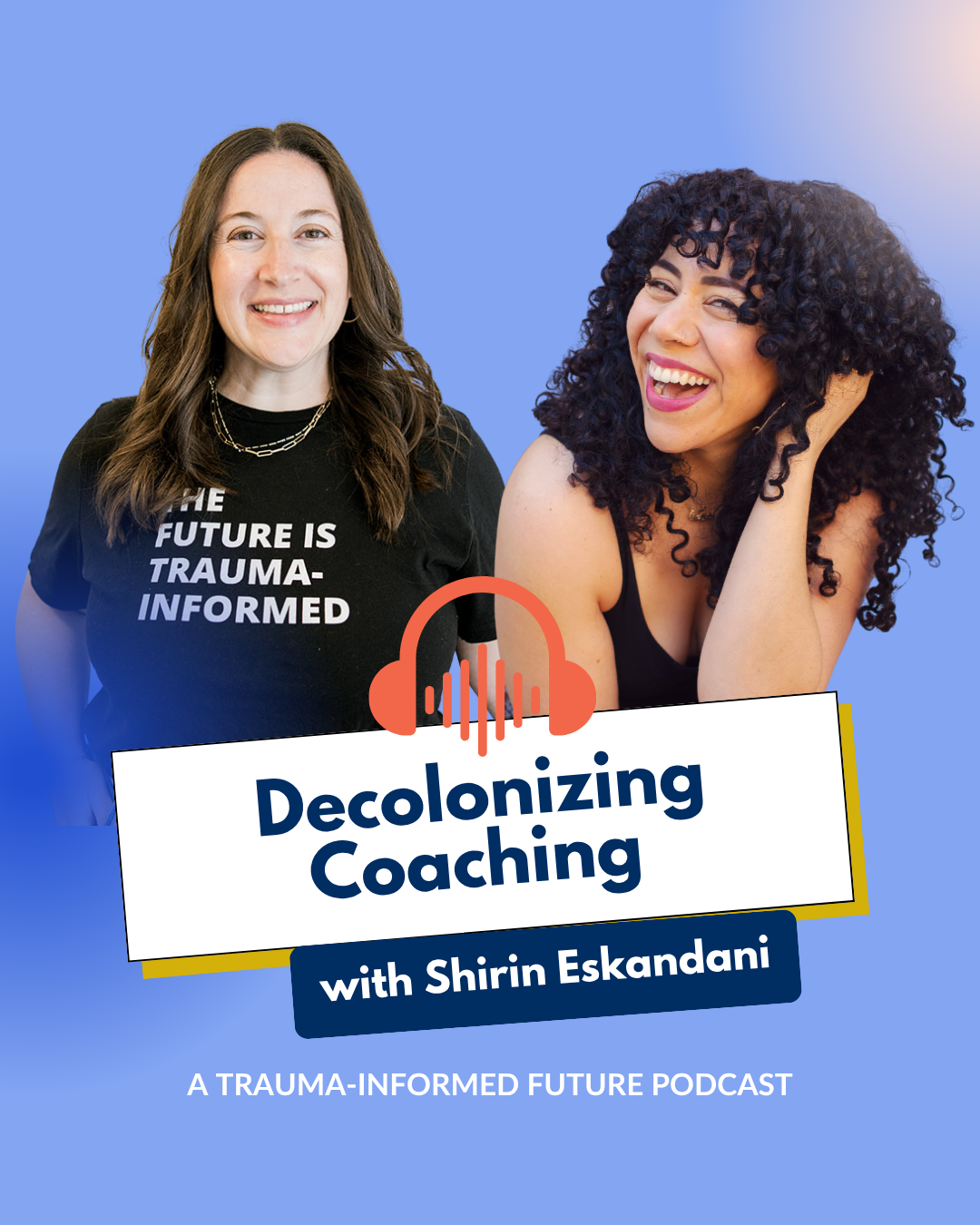
Trauma-informed care is both an individual and collective approach. It is about going within to shift not only how we see but relate to ourselves and others. It’s about embracing our wholeness. But what if our wholeness includes identities and cultures that have been intentionally marginalized and colonized? In today's episode, Katie is in conversation with coach and trainer, Shirin Eskandani about how trauma-informed care and decolonization are tandem practices. As an experienced coach and coach trainer, Shirin shares how she is creating a more ethical, decolonized, and trauma-informed future for the coaching industry. This episode reminds us that the road to a decolonized, trauma-informed future is an ongoing journey of collective learning and unlearning.
Learn more about Shirin:
Shirin Eskandani is a teacher, coach and public speaker who specializes in mindfulness, and mindset. She has been a featured wellness expert on the Today Show, The New York Times, Shape and Cosmopolitan Magazine. Prior to building her successful coaching business she was an award-winning opera singer, performing at Carnegie Hall and The Metropolitan Opera. She is the founder of Wholehearted Coaching and the Wholehearted Life Coaching Certification.
Connect with Shirin:
Instagram: @wholeheartedcoaching @wholeheartedcoachingcertification
Podcast: Whole Hearted Coaching Podcast
Whole Hearted Coaching Certification -currently accepting applications for the Jan and Sept 2024 cohorts of the certification
***Transparency Disclaimer: I am honored to be a guest teacher and an affiliate of the Whole Hearted Coaching Certification Program. I highly respect Shirin, her leadership and that the future of coaching is decolonized. As an affiliate, I may earn a commission if you sign up using my name as a referral source. I chose to become an affiliate because I strongly believe in this work, Shirin, and this program. I have been sharing it widely as a resource to anyone seeking to start or continue their coaching training and education.
People/Things Mentioned In This Episode:
Show Transcript:
Katie Kurtz (she/her): When I set out to start A Trauma-Informed Future podcast, I knew that I wanted to bring on guests and colleagues and people new to me. Who would help us expand and deepen our understanding of trauma-informed care and its intersection into other similar practices. And today I am excited to share my conversation with one of those colleagues, Shirin Eskandani. I committed to also ensuring that throughout this podcast that I bring on folks who specialize in and amplify the work they are doing around anti-oppression decolonization and liberatory practices.
And so today's episode is really focused on decolonization, especially decolonizing within the coaching and wellness industry.
I'm so excited to share this conversation with you today, and it helps us again create shared language around a lot of terms that are being thrown around on the internet that we really need to remember to use with intention. And this conversation just once again, reinforces and reminds us that trauma informed care is integral to other social justice, frameworks and practices and liberatory practices. Trauma-informed care is about individually and collectively shifting our culture and building our capacity, expanding our capacity to create systems change . And so when we talk about decolonization or inclusivity, DEI anti-racism anti-oppression practices. Trauma-informed care is integral to that and vice versa.
These are tandem practices and they are lifelong. There is no arrival and it's so deeply starts within and so I'm excited to introduce you or maybe re-introduce you, if you're familiar with Shirin Eskandani. Shirin is a teacher, coach and public speaker who specializes in mindfulness and mindset.
She has been a featured wellness expert on the Today Show,, the New York Times, Shape and Cosmopolitan Magazine. Prior to building her successful coaching business she was an award winning opera singer performing at Carnegie Hall and the Metropolitan Opera . She's the founder of Wholehearted Coaching and the Whole Hearted Life Coaching Certification. I wanted to be sure you're aware that Shirin is currently enrolling for her Whole Hearted Coaching Certification Program. Which is looking at creating a decolonized approach to coaching. And we talk a lot about it and this, and I do want to be transparent because that's how I roll. That I am a guest teacher in the certification program and Shirin recently invited me to be an affiliate for this program.
And I like to be transparent about that because I believe in amplifying people and programs that are centering ethical and trauma informed and socially conscious and decolonize approaches, especially now within that coaching and wellness industry. So I am always here, whether I am an affiliate or not to promote and amplify people in programs that are centering that work.
And especially this episode highlights how we often our only hearing about the negative and harmful things within the coaching industry, which we should, we should be able to have conversations and find ways to seek repair and healing. But we also need to remember to amplify people who are and have been leading with integrity and intention and ethics , and trauma informed care to make sure we're also amplifying and centering those voices. Because that is so key and so important. So without further ado, I'm excited to bring you this conversation today with Shirin let's get started.
Katie Kurtz (she/her): Hi, everyone, and welcome to A Trauma Informed Future podcast. I am delighted to be here today with Shirin Eskandani. You exude so much joy and I don't know. Like connection that I'm just so eager to be in conversation with you and I've said this already, but I'm going to say it again.
We're probably going to have to cut each other off because I just have a feeling we are going to have a lot to talk about or so many like inroads to uncover. So I'll likely invite you back in the future, but so happy that you're here today. And thank you so much for joining us.
Shirin Eskandani (she/her): Oh my goodness. I am so thrilled to be here. And those words, joy and connection. I feel like I associate them with you. I guess we're just like mirrors of each other, which is beautiful. And yes, I have a feeling we're going to have to cut this podcast down. So it's actually a size in which people can listen to in one sitting, but really thrilled to be here.
Katie Kurtz (she/her): Thank you. Thank you. So we. Obviously, everyone gets your full professional bio, but I would love because this is a human first space, like, how are you arriving today? How would you like people to know you as you're here today in this moment?
Shirin Eskandani (she/her): Oh my goodness. I am arriving to this podcast really excited to be in conversation with you, and Also really tired.It's right before the height of the holiday season and I find this time of year just a little overwhelming and so I'm very eager but also a little bit tired right now. Yeah.
Katie Kurtz (she/her): Yeah. Oh, and both always right and both and I feel that very deeply. On like a cellular level.
Shirin Eskandani (she/her): Yeah.
Katie Kurtz (she/her): Let's just start off the gate.
Many people know that I am a big believer in shared language. And when we have shared language, we create shared understanding and meaning making. And there are so many terms and concepts being thrown around on the internet these days. And I live most of my life online, like I'm sure you do, and many people do, because it's just the nature of being an online business owner.
And, the nature of life right now, right? And it's not uncommon for people to say, trauma is a buzzword or trauma informed care is a trend. But I'm also starting to see a lot of people say the same thing about decolonization or taking a decolonized approach. And I get very I get this body jerk reaction.
when I see people create those generalizations and assumptions, for so many reasons, that I'm sure we'll talk about today. So I would love, just before we get started, to let's unpack a little bit. What do these terms mean? Why are we seeing so much of these terms being used?
And can we create some shared language and meaning making together?
Shirin Eskandani (she/her): Yeah. So I love that you bring up this point because I think we both believe in values that are very trendy. Right now for better or for worse. These are things, whether it's trauma informed or decolonizing or DEI, whatever that may be inclusivity.
That's another word. That's so trendy right now. They are values that we need to see more and more of within the wellness space. But as I say, values have to be embodied. They have to be a living and breathing expression of what we do. And I think a lot of what we see are just people putting it on their websites.
On their social media bios and, with I think the term decolonization, I think people put it there because it makes you feel like, oh, this is a quote unquote woke person. This will be a safer space. This will be a more inclusive space. There's so much we can talk about when it comes to decolonization.
But for me, really when we think of decolonization, when you think of colonization, you think of the brutal occupation of a land, right? Someone coming in and taking over land. however, what we have to understand is that. Colonization isn't just about taking over land, it's about also then taking over the customs and the habits and the beliefs and the ways of being of people.
So colonization isn't just about like our outer landscape, it unfortunately also becomes our inner landscape. And so all of us, regardless of our own history, who we are, what we may look like, have been affected. by colonization, right? Colonization really is the ways in which we think and believe. And so to me, to decolonize means to really have to question what we believe and what we think and what we even dream about, right?
Because all of this is connected to The systems and society and things that are much bigger than us. And we most in our day to day, we don't even realize that we are operating from a set of values and behaviors and beliefs that really aren't intentional, right? So for me, decolonizing all of this is really about getting to what is actually the things that I want, the things that I believe, the things that I truly desire in my life.
We can go so much deeper than that. Of course. Yeah,
Katie Kurtz (she/her): I think one thing that, so many things, but one thing that often gets, I think things get separated so easily because when we think of colonizing, it is the land, but then I think we, and then the people and the culture and then a myriad of other compounded things, and then we forget that the land isn't just , This very binary thing.
It's also so much integrated into those other parts that the land provides nourishment and water and food for those people. It provides resources in a myriad of ways. And the land isn't just this thing. It's a , living, breathing thing and that it's so interconnected. Everything is so interconnected, and we tend to, as humans, and especially in our, this very oppressive culture we live in, dissect it, right?
And we forget that we are a part of the land, and the land is a part of us, and that when we experience colonization in a variety of ways, that It's meant to separate us and that I feel like what I'm personally learning in my own journey of decolonization is coming back to connection and finding that reconnection and my place and also the place of the land I live on and exist on and honoring it.
And in all of its parts. And but that's a tool of the oppressor, right? Is this like the separation? So I really appreciate you providing that overview. And I'm curious. So why do you think people are talking about it and labeling it as a buzzword right now? Let's dig into that a little bit because we see it. I know you see it. I see it. And it's I don't want to assume here, but I would venture to say it's similar, like really great. We're talking about this. It's about time. And also in what way are we talking about it in what context and what spaces.
Shirin Eskandani (she/her): Yeah. So again, just like , I'm sure with you and trauma informed, it's that folks within. Whatever world we work in the wellness world are understanding that these are actually really important and they're really beneficial to the communities we work with. And, but I think the issue is that with any of this work, and I really focus on the idea of decolonizing.
It starts first with you, right? So I have my coaching certification and it's a decolonized coaching certification. And so much of the work we do around decolonization is really just with the coaches. Which then changes our approach to how we coach. It's not that that means that we go into every coaching session saying we have to tear down the structures and, bring down systemic oppression.
That's not what that means. It means that we, as the person, understand how We unconsciously are upholding right systems of oppression or causing harm and unintentional ways. And so I think that's where the disconnect is that a lot of folks who are using these words aren't actually doing the deep work.
Of untangling their own, in my case, inner colonizer, like all of us have this inner colonizer, which is upholding, I don't know whether it's perfectionism or overachieving or, resistance against joy and ease and rest, right? We all have this within us. And as practitioners, it's really first and foremost, this work is for us.
Really it is. And I think that's where a lot of the disconnect is people are just using the labels are like, oh, decolonization means that I'm inclusive, that I've done some DEI work, but that's it's much more internal. Yeah.
Katie Kurtz (she/her): Yeah. I think I've shared this before on this podcast, but it's always bears repeating that I used to think that too like this very surface level, box checking, wanting to maintain, being a good white person.
And it wasn't until I started to do some deeper work with Andrea Ranae Johnson and their Coaching is Activism program I don't even, it feels like a million years ago at this point. I don't even know when it was what is time. But. That's when I really felt this rumble of, and the rumble I meant is, it's like getting your feet stuck in tangled roots, right?
And that's where it was like, oh, this isn't about what's on the surface, it's about going deeper. And that's when I really made the connection between perfectionism and overachieving And this resistance to rest with oppressive systems, racism, colonization it just. Didn't fit. And then it did.
And I was like, Oh my gosh, everything makes sense. I was like, Whoa, this is wild. And goodness, I have a lot of work to do. But I know something a good friend of mine always says, and I say it to myself, probably every five minutes is we don't know what we don't know till we know it. And I think that because it's so common for then the shame and guilt to rush, and then we get flooded With the shame and guilt then we don't have the resources or capacity to sit with that and then move through it so we can actually do the work.
And that is, I think, such an important to have spaces to untangle and sit with and and practice acceptance and to do better and learn, which it's a long game. This all takes a lot of time, which is a whole other thing, right? Like we want a quick fix. We want to get there quicker, especially when things are uncomfortable.
We want to skip to the good part. And you and I both know, because trauma informed care is founded in social justice frameworks, like this is the long game. We have a long road to go. And so I'm curious if you can talk a little bit about the long game, because I venture to guess in your coaching program, you have a really beautiful container that has a lot of time and pace and resources, but, it, it has an ending at some point, right?
Like, how do people then, how do you encourage people and guide people in this long game of decolonizing their mindset, whether they're in the coaching wellness world?
Shirin Eskandani (she/her): As you said it's a constant practice. It's a practice that, again this is a very colonial way of thinking that There's no way to do it perfectly.
And there is no end point, right? That is a very colonial concept that we do X, Y, and Z and then it's done, right? And no, that's, it's not. And so really, especially within our certification so one of the things we do is in the, it's a six month program and throughout it, like the beginning and the middle and the end, we check in with the cohort and ask them, how do you define decolonization now?
And what does that look like in your life and in your practice with your clients? And it shifts and changes. And this is a practice we want them to continue because it will shift and change as you shift and change as you do more work. And it's really, as you and I know, education, working with people from all over in different fields.
I think that's another colonial concept is that like we have to position ourselves as experts or that we, I think it's one of the dumbest things in the coaching world. This idea of I know everything. And also if I collaborate with other teachers, that makes me not as like masterful quote unquote in what I'm doing.
So this work of decolonization is liberating, not just for the communities we're working with, but for ourselves as well, because also what I see so often. In the certification, we have this section on liberating our leadership and, decolonizing our business is okay, so maybe you're coaching in a way that is very present and grounded.
However, then your business is upholding all of these oppressive things, you're like overworking yourself, you have no boundaries within your business, you're not valuing yourself. And so this is a constant practice and it will show up in different ways when it's ready to show up. But we have to be mindful of it at all times.
I'm sure it's the same in your field as well.
Katie Kurtz (she/her): Yeah it's so similar and so aligned and very intersected and I know you've heard me say this and I say it a lot is I don't, I personally do not believe we can be trauma informed without unhooking, dismantling and acknowledging and naming systemic oppression, racism, colonization, genocide. We can't, I don't speak in binaries very often, but this is a pretty hard stop, is we can't practice trauma informed care without also examining and doing the tandem work. And also, especially around the 2020 era I had to do a lot of reminding that trauma informed care alone is not Anti racism work like you can't just say I'm trauma informed and like you're good like it's a tandem practice and it goes, it's very intersected they're different but intersected and I'm like, I'd love to talk a little about that I always love to talk to people who are in the either the DEI inclusion spaces or in, anti racism, anti oppression, decolonization work. Like, how do you see the intersection between decolonization and trauma informed care?
Shirin Eskandani (she/her): I think for me, all of this work is really about being able to be present with the wholeness of the person you are in community with.
Whether we're calling it DEI or trauma informed, and yes, all of them have their own tools that I think are really important, but the end goal is the wholeness of the person and their lived experiences and who they are, right? The person in front of you. And I think when we can really see the wholeness, that's when we can allow for healing and transformation to occur, right?
But I know for me, when I started within the coaching space, like 10 years ago, this was me as a client, not as a coach. My wholeness could not be present, right? Because it wasn't about my experience as, immigrant. who moved from a war torn country, who then grew up in a city where I was one of a handful of, kids of color.
That was, that couldn't be part of my healing story because I had to work on my mindset. I had to focus on my goals. And that was an excuse, right? Those were like to use that as, Hey actually, this is a little tricky for me because of my past experience. That was like a failing on my part.
Like my past was a failing. And so I think all of this work, what it does is actually really allows for healing and transformation and growth, which is what ultimately all of us want. I think everyone who listens to your podcast in some form or another is in the service of transformation, right? And so really, it's about the wholeness of the person in front of us.
Katie Kurtz (she/her): Yeah, a hundred percent. And I think that when we think of, I don't know about you, I'm going to be really honest. I talk about this all day, every day. And not just like talking about it on the podcast. I talk about it to people, to potential clients. I'm posting on LinkedIn. I'm in people's DMs. I'm on social media. I'm writing about it. I think about it nonstop. It's just like what I do. And sometimes I'm repeating myself so much that I'm like, Am I making sense? Like, when I say that we should care about people's full humanity, I still sometimes get people looking at me like, What is that? And I'm like, Wait a minute.
Do we not understand what being human is?, and then I have to pause because I will admit I'm not 100 percent trauma informed all the time. My snarky, sarcasm, judgy self comes forward and I'm like, how do we not get what being human is? And I have to remember, a lot of people don't understand that. That our humanity includes our feelings, which are complex, and we feel multiple things at the same time.
And our neurodiversity, and yes, there is... Diversity amongst our brains, and our physical health, and our abilities, and our identities, all the intersection of our identities, our lived experiences, and the cultures we exist in, and the systems we exist in, and all these things make up us as humans. And so our wholeness isn't just, our personal, our personality, right?
Or what goal do you want to manifest? Okay. It is, and there's so much when you explain, so I'm just going to ask you this, because this is our conversation we know, and I say this so much, that I'm annoyed with myself at this point now more than ever, we need this.
I'm sick of saying that, but every day I'm like, oh my god, now more than ever, do people get it? And I don't know how to say it any differently, but how do, because I think part of the long game is being able to sustainably show up and continue to show people both how you lead out loud and how you share through content, through how you talk, through whatever it is, the importance, and I dare say, and I will say, the imperative nature of applying these approaches to our, especially to our coaching spaces.
I'll say everywhere, but since we're specifically talking about the wellness and coaching spaces, like this is non negotiable in my eyes. Thoughts and feelings on that.
Shirin Eskandani (she/her): I concur. All of the above. Tick tick. Yes. What I, as you were talking, when you were saying, it's just like, how do people not understand this?
And I'm like, yes I have those conversations sometimes too. And you know what I think it is. I think if you've never experienced a space or a community in which your wholeness hasn't been like seen and held without judgment. You just don't because you just don't get it. You just don't understand, right?
It's I don't know. If you've, this is such a bougie metaphor. I love metaphors, but it's like going to Italy and having the best gelato and then coming here and having I don't know. Breyers ice cream, like Breyers ice cream is great. But when you've had that Italian gelato, you're like, Holy crap.
That's actually. That's ice cream, right? And so I think terrible analogy, but I hope it made some sense. I think, I can see this so much with a lot of folks where they're like I made do with cutting off parts of myself and look at me, look at my life and it's totally okay. And here you are.
My wholeness, like you don't need my wholeness, but really, I think when you experience that there's no going back and I think this is especially important in coaching and wellness and healing because as I said, like transformation has to be All of us, all of our parts, like our wholeness and, sneaky ways that, that I really started to realize I was like, Oh my gosh, like we need to decolonize this like sneaky things like, so coaching is goal oriented.
That's goals in and of itself are a very colonized concept, right? Within the certification, we really talk about dismantling what our idea of goals are. What I started noticing very early on in my coaching career was that folks were coming to me with like similar goals. Like everyone wanted to go back to school.
Everyone wanted to get their MBA. And I was like, what is what's going on? What's these MBAs? And I started to realize that people were making what I call practical dreams. So dreams that were within this box of possibility and a box of what society told them is possible for them and people like them and what they had seen was possible.
And so this simple idea of just a goal, I was like, this is not actually your goal. There's something deeper in here. Maybe it's your MBA, but usually it was something wilder and more, something we, neither of us could have ever imagined. And I was like, Oh my gosh, like we have lost the ability to dream, right?
So a big part of certification is really tapping into for both the coach and then the client of what, how do we dream again? How do we tap into that? And there's a beautiful Adrienne Marie Brown quote, which I'm going to butcher, which really for me was one of my, when you can like, There's quotes in books that you're like, that was pivotal in like something in my brain changing.
And Adrienne Marie Brown wrote, again, I'm butchering this imagination is one of the spoils of colonization. Who gets to dream up a geography is are the dreamers, right? And we this kind of comes back to what you're talking about. I was like, Oh my God, my, my imagination has been colonized.
These like 5, 10 year goals, are these actually my goals? I'm telling you this was one of those red pill, blue pill, matrix moments for me where I was like, and even if the goals were the same goals. The intention behind the goal was different if I actually sat with it, right? So maybe I was like, yes, I want to get my MBA, but before it was more about proving to people or ticking off a box but after I did this work, it was more, no, it's because like I want to, this will bring me joy.
This is about me making an impact in the world or whatever that is. And so just an, even a simple thing, which isn't a simple thing at all as a goal, right? Which is literally like the basis of what coaching is. Understanding that, in and of itself, is influenced so much by society, by our own lived experience, right?
Those of us who come from trauma, those of us who come from marginalized communities, our goals and dreams, unfortunately, not always, are a little different, right? They're sometimes a little more safe. This is why I always say I had a post that went quote unquote viral. It was when all those white dudes were going to space.
And it was about like, why is it that this white dude can dream of this totally outlandish thing and make it happen, right? Privilege. Access to resources, but also there is a privilege to dream and privilege to dream is rooted in our safety, right? So this intersection of trauma and it's all of this is so interconnected.
Sorry, I could talk about this for hours. But, as you can see this is all so intertwined. It's all so interconnected. Yeah.
Katie Kurtz (she/her): Yes. And I think even listening to you, I have to pause, and I appreciate you bringing in that, bringing forward the empathy there, that it's, it is. really easy for me to get like frustrated when people just don't get it, or you have to explain why people should care about other people's humanity.
And I have to pause and remember that I'm also in a position where I have not had to, on many levels, explain my humanity or defend it to other people. And that is inherently because of the external and internal advantages I hold as a cis white woman living in the United States. And so it's pausing, coming back, pushing empathy forward, and reminding myself too that there's and both that like I can feel frustrated but also re center myself and recommit and refill my cup because I think so much of this is capacity building.
Like how do we build our capacity to be with our humanity. And I think a lot of people don't have that capacity. They don't know how to, witness people's feelings beyond mad, sad, glad, right? Some people are still there, or they don't know how to witness somebody in grief or witness somebody who has a different identity than them.
And there's. There's, of course, some nuance there, but a lot of it is building the capacity to do that. And I appreciate the, I always love a metaphor, especially if it has to do with ice cream. So thank you.
And I so resonate with what you said about the coaching industry and goals. I always struggled with goals as a coach because I think having lived experiences that I have had, especially growing up near poverty, like safety and goals, like it was hard to dream when you had to make sure your immediate needs are met.
And I think that's a big component when we talk about like self care. Yes, self care is great, but if you can't even. Have security around safe and affordable housing, safe and accessible food, just basic needs like that. If your basic needs aren't being met, including your physical safety, then all these other things are a moot point.
Like you can dream as big as you want, but there's still an access like an access point of safety that needs to be felt. And I think that's something we often. forget in coaching. And we also forget, too, that the pace of safety does Is not felt as the same for everyone. So let's talk about the coaching industry.
You posted something the other day where I just , Loved it and was cackling a little bit and then also was just like, Oh, we have so much work to do, right? We're in this big shift. I don't know. Am I feeling it? Maybe it's just me. I feel like we're really shifting. And it's not just like the everyone posted a black square in 2020 kind of shift. We're really starting to see an industry shift because we're starting to see coaching, I know, at least in the U. S., become a billable service. So people are looking to, especially in health care and wellness, to bill for coaching, but it's unregulated, and that doesn't bode well for large hospitals and companies.
So there's some big shifts happening. There's a lot more conversation around unethical coaching. There's a lot more discernment happening, which I'm here for. Ask those questions, be discerning. And unfortunately, a lot of people coming forward to share their stories of being harmed in coaching spaces.
And I love to talk about this because I full heartedly believe in the art of coaching. I love it. I have felt that transformation that , that you mentioned. I'm so grateful for the coaches I've worked with. I have found more healing inside coaching containers than I have sometimes in therapy containers.
And those coaches were doing their job in their boundaries, right? They were not, it's just, we've confined healing in many forms. But there's quite a rumble happening, and I'm curious your thoughts on it, because despite their feeling like there's a shift, we're still centering. the same white old men at the forefront of influence coaching.
And not only is it frustrating and harmful, but it's so boring. And I'm just curious your thoughts on the coaching industry right now, because I feel like there's a shift, but sometimes coaching can feel like an island where you're just like, what's everyone doing? And I do surround myself with a lot of like hearted people, and my cohorts of ethical coaches. Find community there is really important, but to still see what's going on. So what do you think?
Shirin Eskandani (she/her): Yes. This is such a great talking point. Yeah. One of the reasons why I became a coach, I love therapy and in, some of my coaching containers, that is where I really experienced the most healing or insight.
And I really was like, this is a really powerful modality. And what I also loved about it as a practitioner was. And this is a double edged sword is that there is so much freedom. Like I can bring in so many parts of who I am into my practice as a coach. And one of the phrases we use for the certification is that, coaching with care, skill, and ethics, right?
So when we coach with care, skill, and ethics, that is when it is at its most powerful. And, as we're recording this, we have the twin flames documentary. Have you seen that yet, Katie? I have not. Oh my gosh. Okay. It's wild. So we have things like that happening. And then the post that Katie is referring to is a post I made about, oh my God, USA Today had made a an article about their, the top five mindset coaches in the world.
And it was literally, Five white folks, four of them men, all looked roided out to me, except Brendan Brouchard. I don't think he's ever, I think he just probably jogs or something. But it looked terrifying. I was like how is this, how are these the right? And so I agree with you because I think the silo I'm in on social media is very much like hearted, valued and then things like this happen and I recognize that the coaching industry is huge and it is unregulated and there's a lot of stuff happening there that is harmful. And unfortunately one of the blocks that I've come across within the certification as a lot of the coaches who are practicing amazingly, right? Like I would give them my money to coach me are like I'm like really worried about telling my friends I'm a coach.
I'm really worried about telling my family I'm a coach. I'm really worried about telling my colleagues I'm in a coaching certification, and this is because of the negative stereotypes that are associated with coaching. And what I am hoping is that this new wave of coaches that are really intentional and they're not just using the buzzwords, but really embodying them and learning them will change that, but it's really tough because even within the regulatory board of coaching.
So we have the ICF. That's like the one board International Coaching Federation. I did a certification that was under the ICF, but even within that. Just because something is ICF does not make it actually an incredible coaching program that is, really focusing on harm reductive practices, anti oppressive practices, right?
Because that ICF does what it can, but it's really more about ticking off boxes. So I think for me, this wasn't the question you asked at all, but I do think things are changing. But it's going to take some time. Something that for me, I really realized when I was creating the certification coaching has been around for centuries.
It's not something new that showed up when Tony Robbins got on a stage. We have had right folks who are akin to coaches in our cultures for a long time, whether it was an elder or an Oracle or a family member, whatever that was right. And I started doing a lot of research and and I, you really discover the shift and change in the 1900s, where this modality that centuries old is co opted by a bunch of white folks.
And what's really wild is like when you look at that history of what happened in the 1900s, Not much has changed from what we see on those big stages, right? The Tony Robbins's, the Gabby Bernstein's, the Joe Dispenza's, not much has changed, right? The Science of Growing Rich, How to Win Friends and Influence People, Think and Grow Rich.
Those three books were published in the, in like the 1920s. Katie, those books are still selling out today. And those books really are this beginning of what we see is like that sleazy part of coaching, which is a focus on wealth and status and power, which is a focus on not the wholeness of a person, but the mindset of a person.
And if their mind isn't thinking properly, then that is why their life doesn't look a certain way. And it's really wild how 123 years later not much has changed. However, I do think a lot of things are changing. I do. I agree with you. I don't know. I said a lot there, but I'd love to hear your thoughts.
Katie Kurtz (she/her): I often forget that. And I appreciate you bringing up that tie back to history of kind of the, That profitizing and it is when you look at the Venn diagram of these big influencer coaches and like just this wealth profit it's a full circle. It's all the, it's all the same thing.
I have a lot of conflicting feelings about regulation and, as a social worker, I sit in a very highly regulated field and there's still a lot of harm that happens and I'm seeing a small but mighty of people trying to dismantle that regulation board and the way that's handled and I don't think the answer to the shifts of coaching and to minimize harm is necessarily a regulatory board.
I am not ICF accredited. I have not gone through the ICF process. I'm familiar with it, it's very, it's a lot of information and not super easy to understand. Maybe make that easier, ICF, just saying. But It's conflicting because you want there to be some sort of standards and best practices and ethics and also from a decolonized approach, I would venture to guess it's all also founded that progress and productivity and the things like checking boxes like you said before. is likely all rooted back. So it's just okay, how much are we circling again into the same thing? Just like a new font and new brand.
Shirin Eskandani (she/her): I'm so glad you brought, cause it's very true. So when I first created the certification and Katie and I, you and I spoke when I was first creating, cause I, one of the first things I knew. Okay, listen up, y'all was Katie had to be part of the certification. And so very early on, we were talking about and at that time I was like, yeah I'm making this an ICF credentialed course. And the more and more I dug into it and was trying to make that happen. The more and more if I was like, if I'm making this a decolonized certification, this is going against all of that. And I think there's a lot of really great things that the ICF has. And we've adopted those. So things like, you just posted something recently, mentorship and supervision. I think those are huge. And I think that's one of the big missing pieces within the coaching world is that there isn't mentorship happening.
I can't even imagine having a certification And not having some form of mentorship is this person actually applying these tools in a way that is harm reductive that is in service of the client, right? So things like that and we created a curriculum that is ICF aligned.
So really taking all of those things that are really great about the ICF, but then other things like, for instance, we couldn't bring in teachers from the outside who weren't ICF credentialed. And that makes the pool really small. And I wanted to bring in folks who really were embodying the work that they're doing, like you and Tristan Katz.
And and there were other things too, even with, I think sometimes with regulatory boards, which, testing becomes less about. embodying the skills than just like ticking off skills. Just, so I was like, I want these coaches to really be embodying the practice, not just taking a test because they learn some things and they're ticking off a box.
And so I love that you brought that up because regulation is helpful. And yet also Who created these regulations? Who, who is the ICF and why do they get to say what coaching is and isn't? And ultimately listen, I went down so many rabbit holes creating the certification because I'm like, who am I to create a certification?
But then like universities, colleges, schools, all of these things, some white guy was like, I'm going to make a school and it's going to be called Harvard and here you go, everyone. So it's just, it's got to start somewhere. And I think the more and more diverse voices and diverse experiences we have within the creation of certifications and all of these other things, I think that just serves the communities better. All communities.
Katie Kurtz (she/her): I agree completely. And I've been wanting to do a certification of some kind for a long time and I have not done it because I get stuck in the who am I to do that? And also what even is a certification? And I've gone down probably the same rabbit holes.
I should have waved to you. I was down there of What makes something even a certification? What even is that? And it, and then I realized that people just do it. People just make it up and that's what it is. And I think, okay, now as I, I come back to it and work on a trauma informed certification, it's more about the alignment and more about really aligning the values and the practices and the space to create an experience and honor the nuances that like. That just because you get certified in something doesn't mean you get like some, you get knighted and then you're like, good to go. It's like this, it's this ever ongoing thing. And I, it is, it's really tricky. I don't know. I usually never have the answers.
I always just have a lot of questions, but I'm curious to see how and where the coaching industry goes because there's so much stuff shifting. And I resonate with, your cohorts of people like I struggle sometimes to still say that I'm a coach. When I got my coaching certification eight years ago, I was really proud of it, but nobody knew what coaching was.
And I live in the Midwest, like that's when Oprah's Super Soul Sunday was really getting off. So like people like knew who people were. But that was it. And then all of a sudden now, literally everybody's a coach and I get a lot of like side eye and it's my own thing. Like I need to work on that and own it because I know the type of coach I am and I know the type of coaching I believe in, but it can be hard to feel like you're associated with the harmful parts. And I'm a big believer in as much as we shed light on the harmful and exclusive nature of coaching that exists and has for a very long time, that we also need to take extra care in amplifying the people who have been committed to integrity based coaching, to ethical coaching, to trauma informed care, to decolonized coaching we need to be really elevating and shouting from the rooftops to make that heard because we exist, and we aren't, we often don't hear about it because we're doing the work and we're busy, training people and doing it and it's not always the light isn't always shed on really good programs like yours and. And the countless people you train because, it's not as, I don't know, flashy as like Tony is Tony that's still a thing, huh? Like I totally blocked out everything.
Shirin Eskandani (she/her): You know what someone did point out was in this list of five coaches, Tony Robbins wasn't there. And they were saying that the one woman who was there, who was Mel Robbins someone in my comments said, They probably put Mel in because of Tony Robbins because of all the lawsuits against him.
And I thought that could be true. That could be true.
Katie Kurtz (she/her): I believe it.
Shirin Eskandani (she/her): Yeah, but here's the thing. And I think you bring up a really good point. First of all, Katie, we need a trauma informed certification from you. Please. So if you ever want to chat about that with me, let's do it. Cause I have met, I had many dark souls of the night dark, but is it dark, so dark night of the soul?
Anyway, I had many of those creating,
Katie Kurtz (she/her): I will definitely take you up on that,
Shirin Eskandani (she/her): but I think what's really also what I've found within the certification is that some of the student coaches who come, they have such a respect for this work and such a reverence for it that actually it's a double edged sword because they think they're not good enough or they're not enough or it's just to become a coach, right?
And so that reverence and that respect actually ends up sometimes working against their favor. And I'm like no, you are the exact person we need coaching because you're always going to approach it with such humility and with respect. And so as you were talking about the certification, I was like, Katie, you are the exact person we need to create the certification because of that same reason.
So that was just a boost of confidence for you to do it.
Katie Kurtz (she/her): Thank you. Thank you. I I'm thrilled that your certification exists. I love and honor being a part, a very small part of it. And I think it's such a great example of how one of the things I love about the coaching world. And again, this might just be because of the coaching world feel like I was raised in, which is, the world of people who really have ethics and values and lead them out loud is there's such a beautiful community here. And I am always eager to amplify other really good, trusting ethical coaches doing integrity based work, especially if it's towards creating a trauma informed future and I'll say a trauma informed future is a decolonized future. Yes, like I, it has to be and they go, again, hand in hand and if that's what we want, we have to work together to amplify that. So really grateful for you. Is there anything else before we close with my little gentle spritz of, not heavily loaded questions at all that, if anyone's curious about maybe learning about, obviously about your program, but just more about taking a decolonized approach to coaching, where could people be either begin or affirm their process, their practice?
Shirin Eskandani (she/her): If you want to find out about the certification you can head to wholeheartedcertification.com/programs. I also have a podcast as well where I interweave topics about decolonized coaching with other things as well. But also there are so many great great resources out there.
So some of the readings in the certification include have you Decolonizing Trauma Work?
Katie Kurtz (she/her): I have it and it's on my list though of so many books to read.
Shirin Eskandani (she/her): It's a great book. It's a thesis. It's like a university thesis. So it's sometimes you're like, I don't know what's happening here.
But it's a really great resource. Within the certification, we also Emergent Strategy by Adrienne Marie Brown the Anti-Racist Business Book, Trudi LeBron I'm trying, of course, when you have to think of things, you actually don't think of them, but those three really stand out.
But I think, again, when we think of decolonizing, we complicate what it is, right? And we think it's about sticking it to the man. And really, it's just as trauma informed work is, it's really about healing what's within and really understanding and unlocking who you are and what maybe was given to you that you no longer want to hold on to.
And whether that's just you as a person or a coach who's working with other folks. So yes, it's, it, please do not overcomplicate it. , I think we've talked about so many things, but that thing of our wholeness, it's allowing our wholeness to be present.
Katie Kurtz (she/her): Absolutely. And our wholeness exists in a pool of so many others.
And that's why it's so important to go within and then also expand and widen that view towards other people. So yeah, thank you so much. All of that will be linked up. I'm so grateful. to have you here again. I'm sure many more conversations to come, but I would love just to enter our gentle spritz of questions.
So if you could describe trauma informed care in one word, and if you have more than one word, that's totally fine. What would it be?
Shirin Eskandani (she/her): It would be intentional.
Katie Kurtz (she/her): What is your current go to nervous system care practice?
Shirin Eskandani (she/her): Listening to music and dancing.
Katie Kurtz (she/her): Yes. Yes. Anything in particular right now?
Shirin Eskandani (she/her): Oh my gosh.
It really is like mood to mood, but I'm actually listening to a lot of I just turned 40. So I aged myself from like the nineties, which seriously I thought the nineties was 10 years ago. It is not everyone. I have a nineties playlist and I'll put it on and just dance out to it.
It's. So great. I feel like, yeah, I feel like that 20 year old again. It's wonderful. I love being 40 though. I love being 40. Nothing about my age, but there's something about the nostalgia of that music. That's so special.
Katie Kurtz (she/her): Love it. That was the theme playlist of my like cocktail mocktail hour at my wedding.
It was fantastic. Yeah. Amazing. And what does a trauma informed future look like for you?
Shirin Eskandani (she/her): So I think this is such a great question. And when I thought of the first thing that came to mind is that trauma informed work is so embedded in the ways that we do things that we no longer label it as trauma informed, that is just the work of being human and being in community and just being with one another, right?
So I think that it's just not Oh, we're doing this because we're trauma informed. It's just, we're doing this because we're in community and we're working with one another and we are being human with one another.
Katie Kurtz (she/her): Yeah. You're not the first person to say it just becomes. The way in which we connect the way in which we're engaged.
And I think that. When I think about this question, because I get to think about it every time I talk to somebody, it is, and Alyssa Chang, a dear friend of mine, was on recently, and she brought up the Mandalorian, which is like a Star Wars, it's very nerdy, and they say this is the way, and I always think I never want to be like, This is how you have to do things because it's obviously not how I am but it is like this is the way like here's this path like this is how we can walk together and it gives that blueprint of how we communicate how we engage how we relate.
And it also brings along everything else like we said this podcast a testament to like the tandem work of so many other things so thank you so much.
Shirin Eskandani (she/her): Thank you, Katie. This was a wonderful conversation. Thank you for having me.
Katie Kurtz (she/her): Absolutely. Is there anything else or anywhere we can direct people to learn more about you and the amazing work you do?
I know you shared your podcast and the coaching certification, but if there's anything else please feel free to share
it.
Shirin Eskandani (she/her): yeah, you can find me on Instagram at Wholehearted Coaching and the certification on Instagram is Wholehearted Certification. So those are some great places to see what I'm up to, what the certification is up to.
And yeah.
Katie Kurtz (she/her): Awesome. Thank you so much. Please be sure to check it out. The podcast, the certification, just like being in your orbit is it feels so welcoming It's so informative, and it is like, for a place where it can be so hard to find where you land I feel like your social media is just it's a very soft place to land.
So grateful for you, and thank you so much again for being here.
Shirin Eskandani (she/her): Thank you, Katie. I think the world of you, and I'm just so honored to have been on the podcast.
