Making Neuroscience Approachable with Alyssa Chang
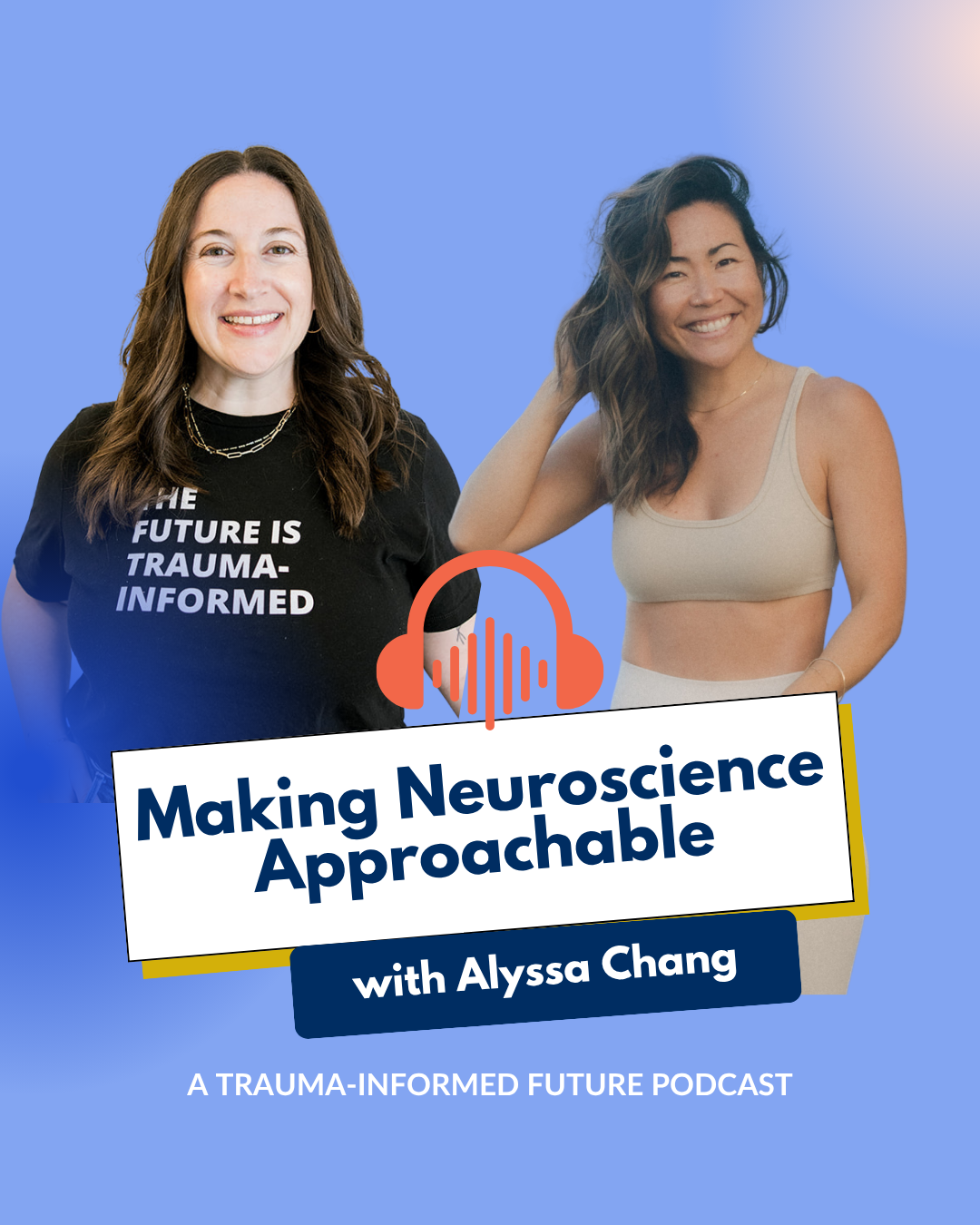
Our bodies are brilliant and they are designed to keep us safe and to protect us so that we survive every day. So how often are we listening to the wisdom of our bodies? And more importantly, how do we even know how to listen, especially if we've experienced trauma or toxic stress? In this episode, Katie is in conversation with her colleague and friend Alyssa Chang on how to make neuroscience more approachable so we can find which healing pathways are best for us. Alyssa offers valuable insights on how to build a more connected relationship between our brains and bodies.
Learn more about Alyssa:
Alyssa Chang (she/her) is a Neuroscience Health Coach. Neuroscience health coaching involves deeply understanding the inner workings of the nervous system and its role in how it governs how we think, feel, move, behave and live. This scientific and compassionate approach focuses on training the brain to give options back to the body. So healing feels both sustainable and possible again.
Connect with Alyssa:
Website: www.coachalyssachang.com
Instagram: @coachalyssachang
Brain Better Membership - A private membership and resource library to helping you learn how to work with your body from a neuroscience lens.
Better Expert - A 6-month group coaching program where we equip you with tools rooted in neuroscience, so you can move towards your goal with your body instead of against your body.
Show Transcript:
Katie Kurtz (she/her):Hi, everyone, and welcome to A Trauma-Informed Future podcast. I'm your host, Katie Kurtz. I'm so delighted to welcome Alyssa Chang here today. Alyssa, hi, how are you? Welcome to the space. I, introduced you formally before we hit record, but I would love for folks to hear how you're arriving today and maybe anything you'd like to share about
Alyssa Chang (she/her): Yes, thank you. I'm always so grateful to be sharing space with you. I think I've always been able to just breathe, a sigh of exhale in your space. So thank you. So my story, I think I've gone through many iterations of the best way to share it. And I feel like the best way to tell it is in like chapters.
And so I currently work as a neuroscience health coach, but arrived at this place through obviously my own struggles with my body, my relationship to myself And it all started from years of being a competitive athlete, where pushing your body, punishing your body training past the point of fatigue was all accepted.
And so I had this hard wiring of I needed to perform at a specific caliber and the way to get there was through this very intense style of training. And so I already had this very complex relationship with my body. And then the years of training it in that capacity, just led me down to this next path where I got into these competitions where it was very much so focused on how now can you control the way your looks versus what it can do.
And it happened very randomly from a colleague that asked if I knew what figure competitions were, and I did it. And so I went home that night and I like, Googled it And when you do a Google research around bigger competitors up, pop these like very beautiful, seemingly very happy women standing on stage tan with their trophies.
And I was like I want that. I want to be happy and lean. And my brain just computed those things together. And it was interesting because it came at a time where the identity I had with my body had now a new focus. So I could now shift it towards instead of performance. It was like, I'll just diet really hard.
I'll, shift it towards this competition. And after competing, and if you know anything about these competitions, they're very intense from the standpoint of the prep, there's a lot of restriction. There's a lot of Yes. And no, like you can do this. You can't do this. You can eat this and not that.
And so it really fed into my perfectionism. And unfortunately led me down a path of then coming out of that with what we coined metabolic damage. And with that, I was living in a body that did not feel like my own which we'll definitely talk a lot more about where that lives in the brain and struggled with a host of symptoms.
I was chronically in pain from someone that like never had pain. I had pain that just traveled through my body that was debilitating. I had bouts of vertigo, leaky gut syndrome, had a very rapid weight gain in a very short amount of time. It was about, I think, 60 pounds in a span of five, six months.
And, I had uncontrollable cravings. I had binge eating episodes was very removed socially. So struggle with anxiety and depression. And through that whole experience, I just questioned, I was like, why is this happening to me? Why does it feel like my body's rebelling against me? And then I ended up stumbling into what I do now.
And all traditional approaches to healing my body just didn't work. It was like rest and you'll feel better meditate, you'll feel more relaxed. And I was just like, I feel more anxious and I feel more tired. And I was like, what is happening? And so neuroscience is a study of the nervous system. And so I went through this whole curriculum of really understanding each structure of the brain, what their independent responsibilities are and how we can more practically integrate these areas so that we can create a sense of safety in our body, a sense of connection to ourselves.
We'll talk probably about threats and mitigating those and really at the root of it, understanding that we house the tools to heal ourselves, but we're often given the impression that we need to seek out external advice, support. Support is definitely helpful, but external like experts to tell us what works for us.
And I think through this work of understanding the brain, I've been able to understand how I can heal myself.
Katie Kurtz (she/her): Thank you so much for that. Every time I invite someone on this podcast, there's always some personal connection of lived experience to the work they're leading. And I'm a firm believer that our learned and our lived experiences are integral into formulate who we are and what we do in our professional lives.
You and I connected several years ago and. As somebody who studies trauma, who is in the trauma field, I'm very familiar with neuroscience and the brain and, I've taken many classes. I always say I'm not a neuroscientist. It can feel intimidating.
The clinical therapeutic world, there's a lot of gatekeeping with who's appropriate to talk about this and that and all of that, which is a whole other topic, but it wasn't until I really met you and started to really learn from you. I feel like I really started to better understand the mind body connection in a way that is founded in the neuroscience because you do such a beautiful job of dismantling the starchiness of it like this very like contrastual, very clinical sciency kind of things and you humanize it in a way that allows you to really understand, Oh, this is my brain. This is my body. Here's this connection and the language that is conversing between the two, and I just love your approach and what you do and in an age right now, everyone's using nervous system language, and it's this like word salad of therapeutic words, and I'm like, what's going on, and it's hard because I sit at both the excitement that we're destigmatizing these topics that have been for so long, whether it's related to eating disorder recovery, addiction recovery, mental health, whatever. And also what's happening? What exactly are we doing? Are we just using terms and words? And are we, do we know what we're talking about?
And also, can we look to people who have You know, the background and qualifications. I was just talking to someone how I am seeing these new nervous system programs pop up everywhere over "for $9.99 you can be a nervous system coach". I'm like what is that? I'm always curious. . I'm a little judgy, but always very curious.
Like what is that? And so I'm so excited to have you here to, have people be introduced to you and your work and just so many of the resources you share from your emails to your social media and your incredible spaces you hold, but also just to help us get on the same page. I'm a big fan of shared language. What is neuroscience coaching? And I know you use the term a lot, brain based, like brain based coaching. What is that? Help us understand. what that means.
Alyssa Chang (she/her): Yes. Thank you for that transition sentence. It's very fascinating because I think trauma informed is also something that has been very trendy. And I'm like, but what kind of space are you actually holding? What is your criteria for trauma informed? And yes, the same thing with nervous system space, right? Or regulation. And brain based training on a very let's talk it through. We have a neural hierarchy. We have our visual system. That's at the top. We have our vestibular system and then our proprioceptive system. And what I do is I basically take my clients through movement assessments. My background is a movement coach. So while I'm assessing someone's eyes, the way they breathe, how they balance, which lives in the inner ear their gate cycle, I am getting a beautiful snapshot.
And a very like trajectory, like fast trajectory to understanding, oh, this part of their brain may not be working for them. So hypothetically, let's say someone is in a gait cycle and they both their feet are turned in when they're walking. We've seen these people walk around. I know that is a reflection of the cerebellum. And the cerebellum is a part of the brain that controls or Yeah, I guess control is the best word. Controls your movement ABCs as we call it, which is how accurate you are, how balanced you are and how coordinated you are. It also plays a huge role in inhibition. So this client is walking with both feet internally rotated. I'm like, Oh, they have a cerebellum need let's put it in quotations "a need". And so I already know. If they need input to their cerebellum, the best way to integrate it is through brain based movements, which is the cerebellum gets activated through nonlinear movements. So a lot of their mobility is going to be figure eight circles. So we go through the proprioceptive mapping system. But I can also look at the inner ear cause the inner ear and cerebellum work very closely with one another. So I might want to move their head. Have them coordinate their ears with their eyes through. vestibular work. So the root of it is understanding these three systems.
And unfortunately the health and fitness space tends to ignore visual inputs and vestibular inputs and focuses solely on the neck down, which is our proprioceptive maps. So that's like, How I would definitely describe brain based training is that it actually falls into categories and this is like the action items we can take to helping someone just feel better, right?
I improve their gait, they probably have a clearer brain path, and then they move through the world more entrusted themselves in their body.
Katie Kurtz (she/her): It's so fascinating and I think it can get overwhelming when, as a trauma informed trainer, I definitely talk about our brain and our nervous system, but I really limit how much I share because it can, we can find a tipping point and then people are like, Whoa, like what is all of this?
It's so much information. And I can tell like when people start to get confused or it becomes too much. I'm a firm believer we don't need to be neuroscientists to be trauma informed, but I do love the way you talk about our brain and our nervous system and just our body connection to it because It puts healing into different contexts and I talk a lot about being healing informed and I'm a big believer that healing comes in many pathways and, we saw over the last few years within the pandemic, the coaching industry boom into a billion dollar industry right and, even therapy and mental health , also booming into mental health tech and there's this tension between coaching and mental health, and I sit in the middle because I'm not a therapist. In another life I was, but I'm not in a clinical position, but I'm a coach and I sit in these worlds and I see the benefit of both. And I'm curious when you talk about brain based coaching, like who are you working with? Who benefits? I would venture to say we all benefit from this, but who do you think are typically coming to you for this kind of care and coaching?
Alyssa Chang (she/her): Yeah, the typical clientele usually are people that have again, sharing my story have exhausted a lot of traditional methods to feeling better in their body.
A lot of the times they've had very unfortunate experiences with health care practitioners where maybe they weren't even listened to they were gaslit right they were told it's all in their head. And so they're actually not held in safe space for their story to be heard and I think that is like one of the most healing things I can provide someone is the space to just be heard and validated for what they're experiencing. Because if someone tells me "I feel like there's an earthquake happening in my body" I'm like, okay, that's a great place for us to start versus that's crazy. That's all in your head. And I just get a lot of those clients that have, again, had, have had those experiences.
So they've been turned away. They've been told that. Their symptoms aren't real. They have symptoms that have only gotten worse. And, I playfully coined it as like "the unicorns", right? They have a lot of very interesting symptoms. And again, by understanding like the occipital lobe is where we interpret visual input. If both eyes aren't moving together, when I do their assessments, I know they're going to be anxious. I know they probably will have pain in their neck. I know that the pain in their neck is probably going to impact their SI joint. So their walking is going to feel very uncomfortable and then they're not going to want to move their body, but maybe they want maybe they have a performance goal of being able to run a mile.
And so I'm able to break it down into more action, actionable steps to help them see the process and create that predictable map for their brain. So they're the unicorns are the people that typically carry anxiety. I have a lot of clients that have anxiety and when they can understand that anxiety is this survival symptom protective symptom by the brain, we can better befriend it and work with it as that signal on that detector of Oh, you're just feeling unsafe.
Let's create safety for you.
Katie Kurtz (she/her): I love what you said. And I think it's so resonant, unfortunately, especially in our American culture of healthcare. That, who among us hasn't been in a healthcare provider's office where we don't feel safe, we feel like we're being put on the spot, maybe we're saying something, or we're unable to find the right words because we feel rushed, or they're speaking in a language that isn't translatable and, for myself, I know I've been in experiences that, and as a caregiver, with my parents, like being in situations where we just can't find the answer we need and, what an incredible thing to pause and recognize that if we can't be heard by the people in our healthcare system where we automatically often have to trust in order to survive. How are we also then supposed to listen to our own bodies and I know we've been in a little bit of a dancing the perimeter of a conversation about this whole notion of listening to our bodies like what does that even mean and how.
It can be so easy to, get on your yoga mat and just listen to what your body needs, but what if we, we can't, or we've been taught not to, or nobody else is willing to listen. I'm curious your take on that, because it's a thing that has a lot of contrast, right? Because we're taught not to listen to our bodies, right? Or not to trust them. And then we're in an age where we're like the spiritual wellness, another trillion dollar industry that we're in is listen to your bodies. It's what is it?
And how does one even do that?
Alyssa Chang (she/her): Yeah. I'm going back to answer your question. Most of my clients are the ones that are wanting to listen to their body, but they've either learned to survive by disassociating from their body because they had to as the safest. Actionable step for them to take to ensure safety. They're also living in a body that maybe when they connect to, it's very painful. And so it would make a lot of sense to not listen to your body. Cause you don't want to listen to the pain. That's been like, Alarm bells all day long. So they disassociate. And so again, holding with a lot of space and compassion that like, it makes so much sense why you don't hear your body in addition to why you wouldn't want to connect to your body.
And so the freeze trauma response is again, that protective survival strategy, your brain learned at a very early age that I need to go off on the spaceship and disconnect from myself because being in this argument, being in this space. Is too overwhelming for my nervous system to appropriately integrate that it's safer for me to disconnect.
It makes me think of all the embodiment work and the trends out there of okay, let's do embodiment work, but we want to really understand like, what is this person's capacity to connect to themselves, right? If they rub their hand, but this is also a site of trauma is that going to elicit more threat and have them further disassociate?
So there's a lot of time that needs to be understood of what is this person's capacity? So I think that the concept to listen to your body again is very complex. What I have found so reassuring for myself and my journey with the clients I work with is, it also lives in your brain.
We've heard of like proprioception as we talked about extra reception and there's also interoception. So interoception is this ability to sense what's happening in your body. So it's Oh, I have to use the restroom. I'm thirsty. I feel my heart rate shift. Most of my clients are my insular babies where they don't have that attunement to that part of their brain due to trauma due to disassociative habits.
So it's If we understand that it is a brain thing, it's not a you thing that you can't listen to your body. It's oh, this part of your brain actually just needs that brain based drills. And we can do that through actually to engage. I would say in quotations, engage the insular cortex is do a lot of tongue mobility, an area that the fitness health culture does not talk a lot about.
But it is extremely beneficial and helpful to integrating the vagus nerve, which that's probably a more popular nerve that's talked about which plays a big role in anxiety. But also when we mobilize the tongue, strengthen the tongue feeds into the insular cortex, then it allows us to more safely connect to our body.
So with time, my clients are like, Oh, I can feel a hunger cue. I feel when I'm full versus many of us have probably have had experiences where I don't know if I'm hungry or thirsty or, we go through all those questions. So it can come down to science. And it also comes to, as you often use the word, like our own lived experiences of trauma.
Katie Kurtz (she/her): As someone who grew up in diet culture and. In sports and the fitness craze, like we're always taught to move and move fast in order for it to count or lift hard things or whatever it may be. Never have I ever considered moving my tongue in certain ways to better help my mental health, like it's not, or I know you do a lot of like eye work and you're saying like the inner ear, like having, learn from you and watch, like you share so many great brain based, drills and skills and things that help us create that connection.
We never think about. Because we attach value to more, faster, and these quick results, and we both know that it's actually the pace and the consistency and the cohesion of all of this is what creates more of those results and whatever those may be, but that's not the It's counterintuitive to our culture, especially within the fitness, wellness, whatever world we're in.
But it's so fascinating that so many of us, I'm going to venture to guess by myself included have really struggled in the last few years, especially within this historical context, trauma context of the pandemic with a heightened anxiety more lingering, just anguish and depression and just the state of the world constantly and we're also stuck in. We have been stuck in a survival mode and our bodies are brilliant and I have to remind myself of when I get stuck in that. Oh, my, brain, my body, we're so brilliant that this, of course, this is how I'm responding, right? Of course.
But there's also these answers within us if we tap into it, and I love how you help guide people back to that within themselves through all these different tools.
Goodness. There's so much nuance here, of course, but I think there's something so I don't know supportive and almost dare I say comforting about learning about neuroscience in the brain because there is a little level of like clarity and something tangible in such an like trauma so complex and subjective and contextual and nuanced, but when it comes to our brains, there's a little more we can point to things, we can see things, there's a little more of a map there, right?
And for me, that sometimes it feels a little comforting to know oh, okay, there is something there. And I would venture to guess maybe for the folks you work with when they learn or work with you, they're able to get maybe some of that reassurance.
Alyssa Chang (she/her): Yeah. It's if you've been told that the symptoms are in your head, but then every day you're waking up with the experience in your body that like, this doesn't feel like my body. Like I've had clients feel like my head is over here. My body's over here. I look in the mirror and I don't recognize myself. And if you can just. Absorb that statement and be like, wow, imagine if that was your reality, right?
And then someone saying, that's not your reality. That is such a stuck, a feeling of stuckness and that can just obviously increase other symptoms. And so the nervous system just craves predictability. And what neuroscience, this type of work does is it creates a blueprint, right? I share with my clients, let's assess.
Let's look at how you're moving. Do you see that your hand does this thing? They're like, yeah, I'm like, okay this stuff, this comes from the frontal lobe and they're like, okay what does the frontal lobe do? And I'm like, oh it's responsible critical thinking and executive decision making willpower lives there.
Do you have a hard time, being in compliance with your nutrition or being consistent? They're like all the time I fall off the wagon all the time. I'm like, oh, great. Now we have a path of. We need frontal lobe activation. They're like, really, is it that kind of path? And a lot of my work is creating predictable maps for my clients because they don't know yet how to get there, but I can paint them a picture and then walk with them as we go through all these like experiments together, yeah.
Katie Kurtz (she/her): I love that. I'm just sitting here. I'm like, I need that one day you'll see me. I'll be contacting you. So you talked a little bit about it. And I've also talked a little bit about it on the podcast, but I would love from your just your experience in and your wealth of knowledge as a neuroscience based and brain based coach and somebody who really specialize in this we hear all the time fight, flight, freeze, fine, like these trauma responses.
Now we're seeing people say the wrong Starbucks order. I'm having a trauma response. And it's becoming more part of our cultural vernacular. And I think there's also again, I. Great. And also let's make sure what are, I think we're misusing. We're misunderstanding. And so I would love just from your perspective to share walk us through these nervous system responses.
What exactly are there, because there is a big difference between feeling like, Uncomfortable or not liking something and then also feeling like you're in an actual like flight or freeze response, right? There's a difference, but also it could be and there's that nuance again. So I'd love from just if you don't mind from your perspective can you walk us through a little bit of that from the neuroscience kind of perspective.
Alyssa Chang (she/her): Yeah, totally. I had one thing that'd be really interesting to chat with you about is also differentiating between trauma and intuition. I think that is such an interesting, complex experience we carry it very often because they can be very similar. And that's a lot of the work I do with my clients is like having them sit with does this feel like I'm in a survival response or does this feel like. Actually, I can trust myself. And that is Ooh, that skill set is very hard to get to in a place of clarity.
And it may always feel a little bit gray too, to answer your question around the trauma responses. So inherently they're survival responses. They're the ways that our brain has figured out how I can keep Alyssa safe. And so for Specific survival trauma responses, fight, flight, freeze, and fawn.
So the fight response is this very I'm armored, I need to fight back. I may have control tendencies. And what I like to really explain more in detail about these responses is how to actually rest when you're in this response. Because in many cases, A blanket statement. People are often given my clients in particular when they go to the doctor and they're like in that sympathetic overdrive state, they go, we'll download calm and meditate.
And if they're a fight responder, they're like, why does this make me more angry? And I'm like, cause your nervous system is like rebelling against being still. And so for you to rest in a fight response, you probably need movement. And this is where actually like heavy lifting can play a really beautiful role.
And. It's ironic because can someone lift heavy and actually rest and you can, if you're very attuned to I feel really activated right now, or if I'm, navigating a lot of anger, scream into a pillow, you don't have to sit and Oh, let me breathe through this. Like love and light. No, it's actually let's move that.
Let's get that out of your body.
Katie Kurtz (she/her): Can we just normalize people screaming into the void? We need just to be able to scream and let it out. I don't know. We need more screaming rooms, please.
I love that you shared that about heavy lifting because. I started doing more strength training this year with a trauma informed personal trainer, and I was really resistant to going twice a week to a gym to do this, and it has become such a consistent part of my week, and I never thought it's meditative. It is actually I'm very relaxed while I'm lifting heavy weights. And it's such a weird feeling and also quite lovely. I never associate like weight lifting with nervous system care. And it's been a tremendous part of my Specific nervous system care plan this year alone and connecting that with the fight response.
It all just makes total sense. So I had to share that. I was like, Oh, great. Yeah. Yep. Makes sense.
Alyssa Chang (she/her): It makes me think of a question one of my students asked me, she's Oh, Alyssa and I love when my students have worked with me for a while because They start to then observe their life through this neuroscience lens.
And she was like, I'm wondering the people that listen to very loud music and super intense when they're at the gym, are they just chasing that stress response? And I was like, let me just clap for you. That is an amazing reflection. So when we're talking about resting in that fight response, heavy lifting, screaming into a pillow, right?
We're moving , that activation out and through your body. And if we can do that, while we're also have noise canceling headphones on where we're listening to, maybe we're actually listening to calming music. So we're meeting ourselves just enough, but we're not over activating ourselves as well. So it's a very balance of the two, but if you are someone that needs right, high intense music to then get your nervous system revved up, that may be something to explore, right?
With curiosity, with a lot of space to be nonjudgmental and be like, Oh, why is it that I need that level of stimulus? To then feel like a boost in energy, a boost in like intensity. What am I chasing? Has my brain then created the predictive map that I have to stress myself out in order to be in a stress state?
Or can we be in a stress state with weightlifting and still, like you mentioned, enjoy it, right? Develop a different relationship that stress is there for a purpose too.
Alyssa Chang (she/her): It always makes sense. That's why I love neuroscience. Cause I'm like, Oh, it makes sense.
So the flight response is where people often think of that's someone that like fleas a intense conversation. They just escape, they run away, they abandon you, but really it's, they're actually moving their own nervous system towards safety, which could be a breakaway from intense conversation. It could be I need to get out and go on a walk and move my body. So similar with the fight response sitting and being in a meditative state can be re triggering or reactivating for their own body. So for them, it's really about When I think of embodiment, I think about very different ways of creating connection to the body.
It could be, I have clients that literally have heavy kettlebells that are just like out in their living room. And they like, if you're feeling flighty, go up there to the kettlebells, stand up with them. That's it. Put your body actually under load and to go back to the insula cortex. That's a great way to actually provide input to that area. So then you get a sense of connection to yourself. So the flight response again is. You're just activated and you're moving. You need to move that energy stillness is gonna be very it's not gonna be the best thing for you in that state.
Katie Kurtz (she/her): I always think of flight in something you've shared a few times of like cleaning, just cleaning and I always think of you like, I'll be like over cleaning something and I'm like, what is this? What's happening right now? This is not as typically clean as it should be, but I've been spending way too much time at my sink. Like what am I, where am I? Sometimes I'm a little hyper aware of my nervous system responses, but I always, I remember what you share about that and like that stress response and cleaning at 3am
Alyssa Chang (she/her): Oh my God. They're the busy bees, the multitaskers, right? Like it's really funny. Cause I'll be sitting on my couch and I'm like, Your apartment is spotless.
And I'll be like what's going on? It's like a good check in for me to be like, Oh, you're anxious. You've been in a flight response because your apartment is countertops squeaky clean, kitchen sink clean, right? Dishes put away. And so sometimes I'll be in a flight response similar to you. And I'm like with a toothbrush, right? Scrubbing my sink. And I'm like, think you're, I think you're running, but then sometimes I'm just like, and this is what I'm going to choose to do. You often use the language of agency and like practicing, like advocating for your needs. And for me, I do that all the time where I'm like you're okay.
This is what you're going to choose to do right now. You'll process what you're anxious about later after you clean the sink. But right now this is what's helpful in the moment. We have the fawn response, which is You're often the peacekeeper, the mediator. You have learned to, people, please self abandon, unfortunately, your needs in order to keep the peace. And so I definitely relate to this. And this one's a hard one because a lot of my work is helping my students learn what their needs are. Cause they've spent a lot of years either disassociated from their body.
So they don't know what their body needs. And then they're developing self awareness of the, art of what does rest look like for me? What does fueling my body actually appropriately look like? And again, when you have so many repetitions of attuning to others, and these are the empaths, right?
You walk into a room and you're like, I know exactly how everyone's doing. But when I asked them, how are you doing? They're like, This is the first time I've asked myself that. I don't know. And that's normal, right? So it's like a, it's more specific questions. I'll typically need to ask them of what's in your threat bucket.
Do you have pain in your body today to get them in conversation with themselves? But a large part of their work is really understanding that their needs really do matter. Like your needs matter and they're not selfish, right? Pretending to yourself. If you feel selfish and you feel guilty, that's expected because you either had an upbringing where you weren't provided the space to assert your needs or given the conversations to express them. So over the years you just didn't attune to them.
Katie Kurtz (she/her): Fawn is always the response I receive the most questions about. And it's, you're right, it's a little more tricky because it, It is often developed within attachment wounds or relational trauma of some kind and it's not as tangible as the other responses in that it's a more behavioral response, and I'm curious how you go about reconnecting it within the neuroscience kind of umbrella because I think that's something that comes up a lot, and it's a newer response. We're very familiar with fight, flight, freeze, but fawn is newer for some folks and, but very relatable, especially for folks who were, socialized as women and the gender norms, it can be tricky to decipher what's what and when it is an actual stress or trauma response.
Alyssa Chang (she/her): Yeah. And I think that , because my background is movement. A lot of it is, can I get them to safely understand what embodiment truly feels like in themselves? Because I was in a conversation with a friend and we talk about, we laugh about how our body's just like this meat suit. We were just in this meat suit moving through the world.
And when we can understand that there is value and connection to this meat suit. Because that's how we feel things, right? The pleasure, the pain, all of that. That's our lived experiences live in this need suit. And so if someone doesn't understand or is struggling to understand their needs. They're not going to be able to, or struggle to understand them, feel their needs.
There's no way like I can tell them like, Oh just say no sort of boundary. They're like, what? Like, how do I know when that's going to happen? When I need to say no what's that going to feel like for me? So it's really developing. The practice and capacity to honestly sit with activation. And I try to do it in a super contained way. Maybe it's something as small as if we use the cleaning at 3 am, if I decided to not continue my cleaning with my toothbrush and my sink and to sit with my anxiety and to create the space to trust myself that I can hold anxiety. And obviously I equip my clients with tools. So maybe for me, it's I'm going to sit with it for a little bit and allow it to like, expand and then do some breathing. Watch how it changes because the nervous system is super fast. So I may notice that on a scale of one to five, initially it's like a five, it goes down to a four with my breathing techniques.
And maybe I do some vision therapy and I just play with how anxiety starts to move. And once my clients can develop a relationship with feelings and feelings again, come from that insular cortex when we're so disassociated, that part of the brain is just deeply craving input. A lot of tongue mobility, a lot of deep breathing.
There's a lot of like sensory input that we can also create through pressure. So co regulation being in a big hug, that's so therapeutic for a lot of people.
And then we have the freeze, which I think is also pretty common too. It's and what's often misunderstood is that they can appear very calm on the surface, but these people have a lot of internal activation. So sometimes their symptoms show up very unexpectedly. They're surprised that all of a sudden they have a gut flare up or they're sensitive to this type of food, or they're all of a sudden really exhausted for a string of days.
And I think freeze is the, I should say that's what we're noticing now within the ongoing pandemic is there's a lot more of this overflow. I like to coin it like a neural hangover where we're starting to notice that Oh, I've been living in this very hypervigilant state for years now. And it makes sense that now I'm arriving at a place of exhaustion, even though like things actually feel more quote unquote under control, right? I'm back in the office. My schedule has returned, like normalcy has returned, but the nervous system. It has no understanding of time. It understands feelings, right?
It understands what we experience in real time. It can't compartmentalize these things. So the freeze response is really about either we need to remove input noise, canceling headphones, sunglasses, cozy blankets. Or maybe we need safe forms of embodiment which could be washing their hands under cold water it could be just like squeezing their arms to create tactile feedback. But again, it's very individualized. Does this person need reduction of input or do they need like safe forms of input.
Katie Kurtz (she/her): I had this moment where I almost stood up and clapped when you shared that, but refrained. I think. Just because I think we need people to hear that. I think there are a lot of people feeling, I love what you said, that neural hangover right now. It's 2023. I know we want to be out of whatever we live through, me included, but I'm feeling that. I'm feeling it on a deep level. Everything you've said Weird gut things popping up, utterly exhausted, just like staring into the void, constantly being like, what is time? What is happening? Something I did last week feels like four years ago, and the mental gymnastics of trying to go through all the things, plus all the other compounded layers of just our personal experiences and direct impact of what we've lived through the last few years alone, and then the collective and systemic It's way too much like it's just an overload and of course we're responding this way, but we're not living within conditions or environments that are allowing us to move through it in a way that would support our brains and our bodies.
And I'm curious, for anyone who may be listening, we all have nervous systems and I think it's a language. We're learning more about and hopefully from qualified people who know what they're talking about, not just using the language, but actually like embodying it and qualified to talk about it, but I'm curious, like, where do we go from here?
If we're struggling with our neural hangover, both individually or just collectively, how can we begin or what do you suggest to folks just to begin to either be in relationship with their nervous system or care. We talk so much about self care, but to be honest, I don't even talk about self care anymore. I'm strictly talking about nervous system care because I need it. And everywhere I go, we collectively need it. So I'm just curious, like, where would you suggest to begin?
Alyssa Chang (she/her): Hopefully just I'm listening to you share that is like a beautiful first start of I'm experiencing it and you have tools and resources and support and I'm experiencing it and I'm a similar boat like I have these tools and I can wake up tomorrow and be like, why am I exhausted? When I've slept well, and I think that's the confusing part is you may take, you may be taking great care of yourself and. The return of the benefit of that caretaking may not be transactional yet. And that's normal. I think the part of all this healing nervous system work is it takes time, the amount of repetitions we've all incurred over the last three years of social distancing of like the hypervigilance around germs and washing hands. We had to learn new skills that then became habituated by the brain.
And now when, like mandates started to shift, I remember writing about it because I felt I was noticing it happened a lot in my clients where I was like, if you don't feel safe reentering the world the way it was that makes more sense than you realize because you have, again, developed the repetition of it is not safe to enter a grocery store.
It is not safe to shake hands or hugging. Do you remember when you first met someone again and you're like, do we hug? Do we like what do we do? It's this really interesting awkwardness that kind of surfaced and you and I often talk about how hardwired we are for connection and the fact that we're all now on zoom more often still, right?
From a nervous system standpoint, our eyes are not moving as much. We're not sharing that energetic space in real time with people, which is again, that word of co regulating it's a beautiful way to co regulate our nervous systems with one another and feel a sense of belonging. And that's so valuable.
So again, a first step I think is just knowing that what you're experiencing and if it is feeling confusing, makes a lot of sense, you and I definitely relate to it. And so really, I would say you and I talk often about how important community is for this, like, how can you find the people that you really do feel safe with to voice exactly what you're feeling like, because when we can really have that space shared, I think that is, again, just a wonderful first step, next step, I should say, and like then moving out of it, because if we can be validated, heard, seen, then I think the action items of can we walk, I love walking, I think walking is one of the best forms of like parasympathetic, like the nervous system, utilizing that as a form of like recovery.
And redefining rest to like rest it's funny, I'm like a, in the health and fitness space. And most of my posts are like, you need to rest. Remember rest is part of the work. And I'm just constantly talking about rest, even though like I do love movement. I think there's so much value in it. I just feel like what's not talked enough about is rest.
Katie Kurtz (she/her): Absolutely. Alyssa, this is so great. I love being in conversation with you. I feel like I have to hold myself back because there's so much we can talk to, talk about. And that's why I selfishly created this podcast is to be in conversation with folks and go deeper and see where it takes us and this has been so informative and I hope so supportive for people listening and. You create such a beautiful invitation to learn about our brains and bodies in such a way that, again, allows us to feel seen and heard in times where it can feel very isolating and, or non approachable, and you've made neuroscience approachable.
Thank you. I, before we close, I want to invite you to share how people can connect with you. But before we do I always invite people into my anti rapid fire gentle spritz of questions. And I'd be curious for you to share with us, if you could describe trauma informed care in one word, what would it be?
Alyssa Chang (she/her): It's so funny because I was like literally asking my sister on the car ride. This morning so this is what trauma informed care is. And this is the question I have to answer today. And I was like, what would you say? And she's has she had other guests? I was like, yeah, I've been listening to like your podcast episodes, to see other people's responses.
And it's been hard because I can't come up with one word other than a string of them, which is I feel or maybe it's I don't know. Is it Star Wars that says the way. Is it Star Wars or the Mandalorian?
Katie Kurtz (she/her): Yes.
Alyssa Chang (she/her): It's literally the way it's the way of living. It's the way to approach, like being in space with people as someone who holds space.
I think it's just, there is like you and I've talked about today, there's so much nuance. And if we can show up in a space honoring our full humanity, where we've been, we don't project, we share, we co create, all that beautiful language. You've helped me really integrated my work through Cultivate.
I think, yeah, it's the way.
Katie Kurtz (she/her): I love that. So much. I also laugh because I hate putting things into one word, so I don't know why I even created this, but I'm encouraging us all to try to find it, but that makes so much sense. I love that little Star Wars reference to it. It helps my nerdy heart. So what is your go to care practice for your nervous system right now?
Alyssa Chang (she/her): I often talk to my students about creating minimums. And how I define minimums are minimums survive your hardest day. And so they are something that you can integrate and it has a pretty quick return of benefit as well. So for me, something I do in my minimums every day is I always have my yoga mat out.
The first thing in the morning, luckily I have my dog that needs to go out. I always take a morning walk and this can be a five minute walk. It can be a 30 minute walk, but I always start the morning walking. I'm fortunate to live in Hawaii where I can't expose myself to sun very early in the morning.
So I do that. I drink water first thing and then. I'll either get down on my yoga mat to do some gentle movement, or I literally just lay on the yoga mat and I just ground, like I'm literally grounding into myself and into the floor and, grounding practices, like taking your shoes off and just standing in sand or grass.
Like it is. It's more powerful than we realize as to what's happening for us. And it's such a de stressor and in many cases, you can feel an immediate response.
Katie Kurtz (she/her): Yes. I love that. Dogs really help with those walks.
Alyssa Chang (she/her): Yes totally.
Katie Kurtz (she/her): And what does a trauma informed future look like for you?
Alyssa Chang (she/her): I think what you did such a great job of explaining today is that while there's these trendy words like nervous system regulation, like trauma informed care, I like to think about it as creating more specifics.
I would like to hope that it becomes the norm. It becomes the norm that the only way you are cared for is through this trauma lens. The only way that we are sitting in a doctor's office is when we are held in a way. That it's not about getting, 15 minutes in with this person. It's about feeling complete at the end of an interaction.
It's not hierarchical, right? It's let's meet together as two human beings. So I would like to think of it being much more of the norm and especially these very vulnerable spaces in the healthcare system.
Katie Kurtz (she/her): Yeah. Oh same. The norm and the way, please.
Alyssa Chang (she/her): The norm and the way, title of the podcast.
Katie Kurtz (she/her): Yeah. Alyssa, thank you so much for being here and being in conversation and also sharing so many helpful insights and invitations for people to be in relationship with their brains and their bodies. I'd love for you to share. What is a great way for people to learn more about you or to connect with you if they want to learn more or maybe about what you offer or just gain your, and be in your presence in space.
Alyssa Chang (she/her): Thank you. Yeah. So I'm probably the most active on Instagram and my handle is Coach Alyssa Chang. That's the same for my website, www. coachalyssachang.com. And I do send out nerdy newsletter notes, which are dropped every Monday.They're bite sized. They go into more detail. I've actually really enjoyed newsletters because I think it provides me a space to like blog in ways. And I'm, you'll probably find errors in my newsletter and I'm just embracing that human part of myself leaning into imperfection.
And those are probably the best formats to find more about what I do. I offer a private membership and it's really dedicated around this nervous system healing space where everyone that joins has. Some experience in regards to understanding that the brain and body are always working with me.
How can I now provide myself like the resources to empower myself to heal? So I have a private membership. My signature program is better expert, which I will open up doors in January and it enrolls once a year. And it's a wonderful, I always feel so grateful. Every cohort I have, I feel like they're just an amazing group of women and students that are just so brave. I think it's so brave to step into this work of being like, I want to heal myself and I'm willing to sit with the discomfort and lean into support, which I think is really hard if they do carry as you and I mentioned, that freezer or fond response of, self abandoning and taking care of everyone else.
So yeah, those are probably the best ways.
Katie Kurtz (she/her): I love it. I have a nerdy note folder in my email where I just always save your emails like, oh, gotta save this. And I'm like, it just is all your emails that I saved. Oh, this is another one.
Alyssa Chang (she/her): Like how I have a cultivate folder.
Katie Kurtz (she/her): I love it. I love it.
Thank you so much. I'm so grateful that you joined us today, and I'm sure hopefully we'll have you back for many more conversations, especially about trauma and intuition.
