Why I don’t believe in big T and little t trauma
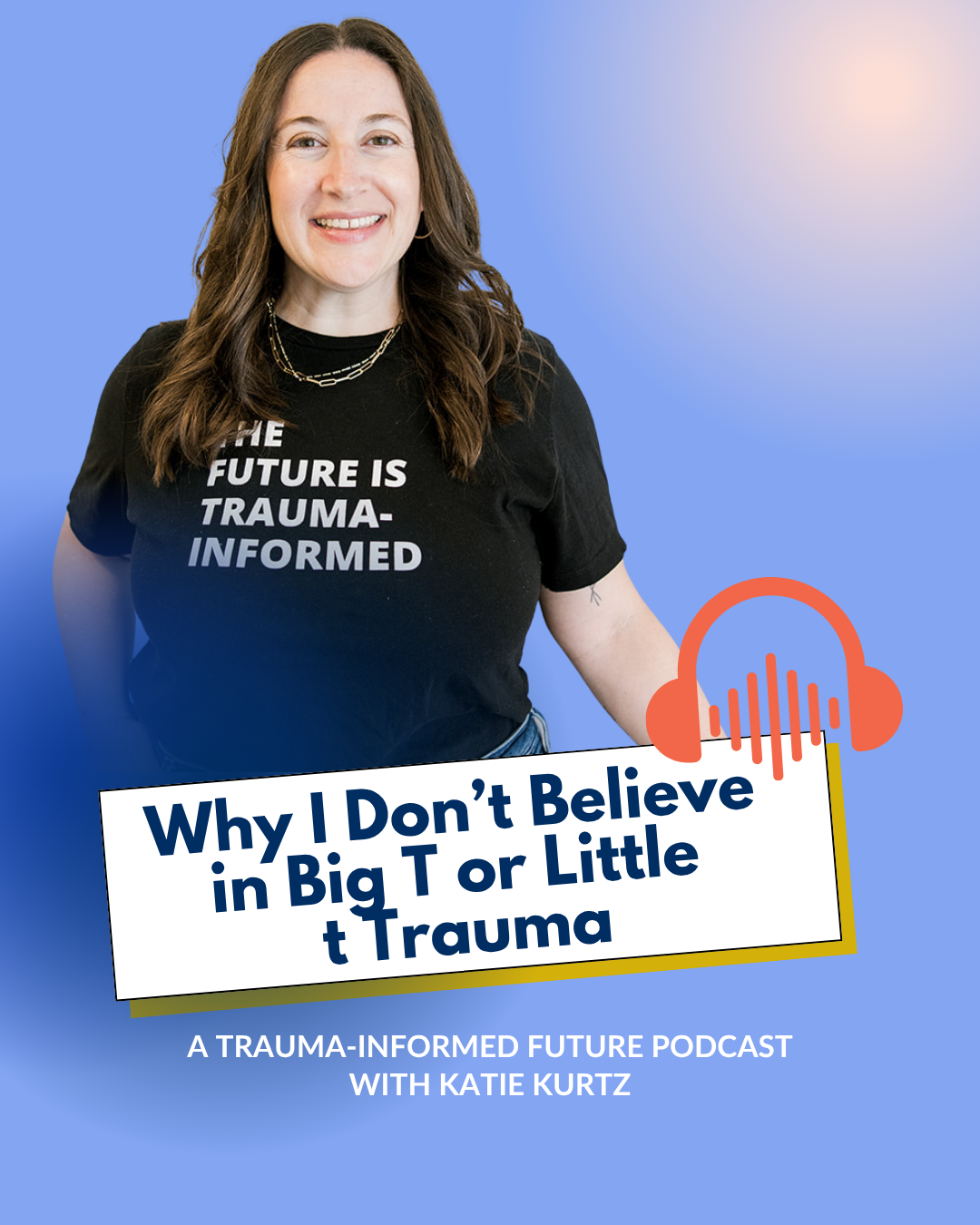
Have you heard of the concept of big T and little t trauma? In this episode, Katie is going to break down what this concept means and why it exists. She is then going to share why she no longer believes in or teaches this concept. This episode invites us to embrace nuance to honor the varying impact levels of trauma while simulataneously understanding how hierarchy promotes more exclusion. Kick off season 2 of the podcast with this informative and nuanced conversation!
Resources Mentioned In This Episode:
Show Transcript:
Katie Kurtz (she/her): Hi everyone and welcome to A Trauma-Informed Future podcast, I'm your host Katie Kurtz. I am so thrilled to welcome you back to this podcast-season two.
We took a short break there from season one, and I just, again, want to extend my gratitude for everyone who has shared how the podcast is impacted them, how they've shared the podcast, how it has helped them either begin or strengthen their trauma informed practice. And I am just so delighted that people are finding this podcast supportive and that we are engaging in more conversations because as you know, from season one, I emphasize nuance when we discuss anything related to our humanity, but especially our lived experiences. And when , when it comes to trauma, and our conversation today, there is so much nuance and that is why.
Pausing and being in conversation and discerning is so important so that we don't get stuck into binary thinking either or good, bad, right or wrong that we can widen our lens to really understand complexities and that multiple truths can be true at the same time. And sometimes answers are not clear cut and that there's a lot of gray.
A reminder that if you're new to this podcast, welcome, there are so many good episodes in season one, incredible guests, and I encourage you to start with the first four episodes, it'll really help you create shared language and understanding. As we move through the murky waters of nuance in talking about trauma and trauma informed care.
It is fall in the Northern hemisphere where I live. And so with seasons changing, , I am excited to literally start this new season, which will take us into the end of 2023. We have some incredible guests joining us for season two. And some really deeper conversations. And I want to encourage you if you ever come across something that you want to hear more about, or people you want to hear from or conversations you want to see represented on this podcast, please feel free to contact me either on Instagram or LinkedIn, or you can email me at hello at katie-kurtz.com I would love to hear from you. And I would love to know if there is something specific that you would like to hear, because there is just so much we can talk about.
For today's episode. I really wanted to discuss something that I sort of mentioned in season one, but it's been coming up a lot in my conversations on line, especially on LinkedIn. And it's a really good conversation, but again, really nuanced.
I thought I could spend some time today discussing it. I want to talk a little bit about why I don't adhere to, or believe in the concept of big T and little T trauma. Now to be fully transparent with you. I used to subscribe to this belief that big T trauma, so trauma with a capital T and little t trauma trauma with a lowercase team. This differentiation that helps us understand the differences. Between different types of trauma. I totally understand it.
To be honest, I went on a little bit of a Google research to see where this concept originated from. And I had a hard time finding the origin or the author or the creator of this concept. And so I'm still looking, I'll come back, hopefully to share that with you, but this concept, I don't even remember when I really heard about it. I think it was still early on in my career, but it makes a lot of sense. So again, I'm not throwing any shade against it. If this helps you great. I'm just going to share a little bit about why I do not teach this concept nor do I believe in it. But you make your own choice for you.
So I totally understand this concept. I'm going to share what it means, this big T little T trauma differentiation and why so many people utilize it and why it's helpful.
Big T little t trauma was really created to help us categorize different types of trauma. And traumatic experiences to help us better understand the distinguishment between the impact so big T trauma is different types of events and environments that cause a greater impact on our nervous systems. So shock trauma, larger chronic traumas-these really big events or environments that cause us to have a trauma response that are typically, these larger events.
So a violent crime, a shooting serious accident. These types of big T trauma include chronic or ongoing trauma. Which can be repeated abuse or neglect and oftentimes result in post-traumatic stress disorder or PTSD or complex PTSD. So that when we say big T trauma, we're referring to these really large life-threatening events or situations.
So oftentimes we see little t traumas described as death or loss or a breakup or losing a job or bullying. These situational life stressors that can still have a traumatic response. Or cause harm, but they are not likely to create, a sustainable impact that may result in PTSD. So these differentiations help people and have in, especially in the mental health world.
And honestly, anywhere when I went on my little Google search, I saw big T little T trauma being discussed in mainstream media there was an article that recently came out in The New Republic that talked about and was on the cover called the “One Nation Under Trauma” and it talks about trauma in a new way that hasn't really been in mainstream media.
So people are talking more about trauma than ever. And I'm seeing as we discuss trauma in mainstream media, that we're still functioning from a very narrow definition of trauma. The same definition that we use, or we thought trauma was 50 years ago. And again, I'll refer you back to our first four episodes of this podcast, which are really helpful and supportive. I give an overview of the history of trauma informed care and the origins and some shared language and understanding around these terms that I use today.
But we as a culture and what we're seeing with mainstream media and the rise in conversations around this is that we're still functioning from a very narrow definition. We used to think that trauma was experiencing war or violence or a serious accident. It was a very narrow definition that only certain types of events caused a traumatic response. We also thought that trauma back then was the event, not our response to the event and over the years, what we have learned and what we have expanded is that trauma is our response to events and environment. Not the event or environment itself. It's not what's wrong with you. It's what happened to you?
And so that inderstanding of trauma expanded our lens to realize that war violence and accidents aren't just the only types of events and environments that can create a trauma response. And that's where we started to see the differentiation or distinguishment with big T little t trauma to really understand and decipher these different types of environments and situations and events to help us see and create an understanding of the impact of trauma.
I totally understand that. And I, myself used to utilize these types of terms, this hierarchy of trauma, to understand , and share it with others, but what I've realized in my own trauma informed journey and just doing my own practice is that when we create hierarchy with trauma, big T little T trauma that some events and environments are more traumatic than others, we are using the same tools that cause trauma to describe it.
In this understanding and what I mean by that is trauma disconnects us from our sense of self from community, et cetera. and you may have heard me say this before, I say it quite often is that we can't use the same tools that cause trauma to prevent mitigate or heal it. And what I mean by this is that when we think of trauma, it thrives in isolation. It thrives in hierarchy and authority taking away, power and control from others.
We do not choose trauma. We do not consent to trauma. And therefore when we create these power dynamics, these power over dynamics, which hierarchy is in a way, a power over dynamic. It is the same type of environment in which trauma can thrive. And trauma informed care is about power sharing. It's not about creating authority or hierarchy. It's about creating equity and inclusion. And so the more I learned and the more I expanded my practice of trauma informed care, I really released this belief in big T and little T trauma.
Again, I'm not saying it's good, bad, right or wrong. If you subscribe to this belief, great. That's for you to decide and discern. But I do not believe in it nor do I teach it. I believe trauma is trauma. What may be traumatic for me may not be traumatic for you, but that does not mean it's invalid or any less or more. Than mine or someone else.
Now I totally understand. Here's that nuance that some people experience. A tremendous amount of trauma, all different levels, acute and chronic and systemic and ancestral and historical, et cetera, all in different levels. And that, especially, I am not sharing this to minimize our bypass, the realities of people who live with complex post traumatic stress or complex PTSD. We know that there are people who have very complex trauma histories and that has impacted their health outcomes and their mental health, and their wellbeing. And some people have had different experiences of trauma where it hasn't impacted in that way. It doesn't manifest into C PTSD. But when we start to create hierarchy, it starts to , put people against one another and it can sometimes, and I've seen it happen and create this “Trauma Olympics” where we're trying to see which one is worse than the other.
And again, I understand the distinguishment because it helps us determine the best course of therapy or modality or treatment for people who have more complex or big T traumas. However, I think if we want to create a trauma informed future, when we perpetuate hierarchy in this way, we're never going to get fully there because we're still creating this delineation.
That's why I teach trauma more on a spectrum, that there are these different types of trauma. And when we better understand the nervous system and the context and the systems we live in and take a more holistic approach. That we remove this hierarchy and rather look at the spectrum of trauma and its impact and the other variables that come into place. So that we can understand, expand our empathy for people who have compounded or complex trauma, versus those of us who have different types of trauma or exposure to, or length of exposure to. So it doesn't create hierarchy where there could be again, more binary involved, but rather creates more of a spectrum where nuance and those gray areas can be honored.
And I know gray areas and nuance can be really uncomfortable. And it's really important for people to be able to name their lived experiences and find that may be that they perhaps have, PTSD or other diagnoses. So again, I am not saying anything against this type of differentiation, but I want us to pause and really discern. Is this the type of belief that we want to hold onto and adapt to? Or do we want to step back, pause and look at it a little differently to understand that it isn't just clear cut big T little T hierarchy?
I've seen people talk about big T and little T traumas. One is legit and one is not legit, but again, how are we to say that one person's trauma is not as legitimate as someone else's? And so this is where this concept, I don't know if it will follow us into a trauma informed future, because it does create potential conflict between , trauma informed care and this very hierarchical belief.
So I really wanted to talk a little bit about that and why, you won't be seeing me talk about big T and little T trauma. I've had people ask me that before and why you don't teach this in all of my professional development trainings or talk about this in toolkits or anything I do. Because I start with shared language and understanding and really understanding trauma again, as the response, not the event or environment. And so we can have different responses based on so many different factors. Our previous lived experiences, our intersection of identities, the systems we exist in, our resources, and whatnot.
We can define specific events and environments as potentially more innately going to cause an impact of trauma. And as I discussed in season one in those first four episodes that we know that things like war violence, serious accidents are in nature are likely going to cause a traumatic response. But to say that losing somebody experiencing a loss or a breakup or something like that is less traumatic than, someone else's experience is very comparative. And when we create that hierarchy, we're just perpetuating these beliefs where trauma and inequity and exclusion thrive in.
So , it's taking a step back pausing and discerning and allowing for that nuance to understand that yes, some people are experiencing or having traumatic responses to certain events and environments that may be more ompactful or more serious than others, but we don't need to be creating hierarchy. We need to be creating empathy and more utilization of a trauma informed practice so that equity and inclusion can be promoted.
And we can look at if there are these different types of responses, away from this good, bad, right or wrong, better, best, less than of that binary thinking and more into this non binary thinking this nuanced thinking.
There are so many different opinions and beliefs, even just in the health and human services, mental health field. I've had some conversations lately. With folks in the mental health field who very much disagree with me and , my belief around trauma, the way I teach it. And I appreciate being in conversation. I always welcome listening to different viewpoints and all of that. And again, want to be clear as we see more people talking about trauma in everyday life, but especially as we see it enter more mainstream media.
Practice that pause. Ask questions, be discerning, listen to who , the sources are for some of these articles and these conversations and really be able to listen to varying viewpoints. I am of the belief that more conversations around trauma and trauma informed care is not a bad thing. That the reason why we are having more conversations is not because it's trendy or it's a buzzword . It's because we are creating more shared language and understanding around this very real human experience of trauma. And more people are understanding that they are getting language and they're getting, information to understand that. The things they experienced, especially maybe growing up wasn't just normal or typical or something was wrong with them. It was trauma. And so we're seeing more people awaken to their own lived experiences and allowing and engaging in healing pathways so that they can address that.
I don't think there's anything wrong with that or bad , or trendy. I think like anything when we have the language for something it creates meaning, and then we're able to better navigate whatever it may be and this expands that reality that virtually most of us, if not all of us have experienced trauma and I don't think that's being, an over-exaggeration and I don't think that's minimizing people who experienced complex trauma. I think it's having this reality again, that, yeah, there's a spectrum and there's different, impact levels depending on the context of the individual and the experience, but trauma is trauma and we don't have to create these hierarchies to prove anything.
What this is proving is that we need more conversations. We need more spaces where people can understand and wade in the waters of nuance and complexity of trauma. Where we can have more systems and policies in place that hold an understanding of trauma and then are informed and using that information to shift the culture and to create cultures of care, where we can have more access to treatment modalities and healing pathways. And access to training so we can have representation so safety and trust can be felt and that there's access, including, insurance and payment and all of these things.
And that the healing does not just happen in six sessions of cognitive behavioral therapy, that there is more to healing than just in your therapist's office. Although therapy is huge and helpful. There's more to that. And that we all benefit from not just trauma informed care, but nervous system care. So when we get stuck in these boxes, when we see conversations or we ourselves want to get stuck in or have a hard time moving. That is an indication that is a yellow flag to pause and ask yourself, why am I so stuck here? Why am I holding onto this belief? How may I be able to open up a little bit to understand maybe the nuance that lies here?
I could talk about this alot, and that's why I have a podcast. And that's why we do talk about this. But I really wanted to address that before we move further in this podcast where you won't hear me talking about this specific differentiation. Of course people I invite on this podcast, many of them do believe in that, and that is okay. Again, I'm emphasizing, I am never coming into this space saying I know what's right or I am an expert in everyone or that something is good, bad, right or wrong. I am just sharing my perspective on this and offering a way to look at things a little differently and invite you into discerning and creating your own belief as well.
So much to look forward to in season two more conversations like this, where we're going to talk about the nuances of trauma and trauma informed care, some great guests , and conversations coming as well. And so again, if you have any questions, clarifications, or topics you would love to be discussed, please feel free to reach out.
Please connect with me on social media, because that is a great place where we can also continue the conversation. You can connect with me on Instagram as well as LinkedIn, or feel free to shoot me an email at hello@katie-kurtz.com all of the links for everything are in the show notes, or you can visit my website at katie-kurtz.com That's it for today's episode. I can't wait to get into season two, but for now take good care.
