The Future of Fitness is Trauma-Informed with Laura Thomas
*Content Warning (CW) for today’s episode: there is mention of traumatic loss to suicide, eating disorders, diet culture and fatphobia so please be mindful and honor your capacity.
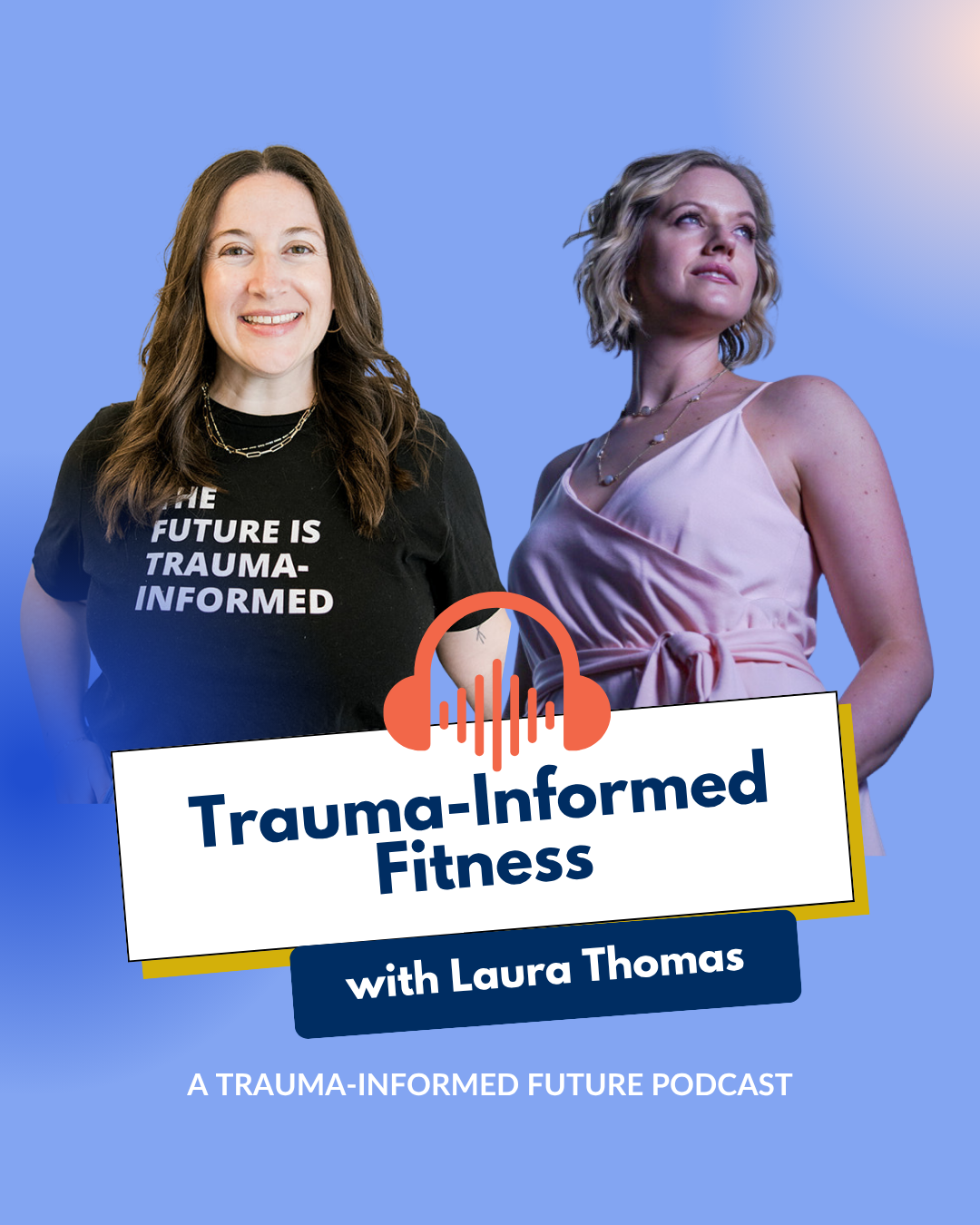
The fitness and wellness industries are rapidly growing and now more than ever does trauma-informed care need to be at the forefront. On today’s episode, Katie is joined by trauma-informed fitness trainer and wellness coach, Laura Thomas. In their conversation, they discuss the history of the fitness and wellness industry and shared desire to shift the narrative so that the future of fitness is trauma-informed. Laura shares her personal journey of becoming a trauma-informed fitness professional as well as some practical resources and tools for folks in the industry to easily adopt. This is a must listen conversation that is just the beginning of many to rethink and envision the future of the fitness and wellness industry through a trauma-informed lens.
Learn more about Laura:
Laura was born in the western suburbs of Chicago and lived in the south suburbs until she was 8. She moved with her mom and brother to Florida and lived there until her high school graduation in 2000. Laura was a ballerina from ages 3 to 13 and being active was instilled in her from a young age. Laura and her brother frequently visited Chicago to see their Dad and family and she considers it her second home.
Laura graduated from the University of Iowa in 2003 with a B.A. in Film and a minor in Journalism. She returned to Florida and started her career in non-profit work. A few years later, she started dabbling in weight lifting and cardio. After having jobs in the home building sector, retail and non-profit, Laura decided to see if things were brighter up north and moved to Cleveland in 2008. After losing her brother unexpectedly, Laura decided to stay in Cleveland with her Dad and step-mom and met her now husband 6 months later. She found full-time corporate work in the summer of 2009 and stayed there until she started her fitness business in 2017.
Laura took 72 hours of class time and became an ACE-certified trainer in December 2016 in Cleveland after her desire to obtain the certification for a few years finally came to fruition. She had been active most of her life and wanted to do something that fulfilled her passion for supporting people through their journey. Laura had also been diagnosed with knee issues and had been able to get off of migraine medication using a more holistic approach.
In June 2018, Laura completed extensive Pre- and Postnatal Coaching from Girls Gone Strong’s Coaching and Training Women Academy, which she renewed again in 2020. In June of 2022, Laura renewed this certification with their latest curriculum. In addition, she completed Katie Kurtz's trauma-informed space-holding training "Cultivate" in 2020 as she felt called to learn how to hold a safe and supportive environment for her clients regardless of race, sexual orientation, body type, gender, or any lived experience clients may have. She continues to study and actively participate in anti-racism work both in the fitness industry and personally. In addition, she is anti-diet culture and does not believe in cleanses, detoxes, or anything of the sort. Laura does not focus on weight loss for her clients.
In March 2021, Laura became a 200 hr. certified yoga teacher with Awake to My Soul. In June 2023, she became a certified Girls Gone Strong-1 Coach to further her knowledge of working with cis-women/non-binary folks during other life transitions outside of pregnancy and postpartum.
Laura primarily supports:
+Expecting & new parents who want to achieve strength and form sound nutrition habits while going through an exciting new time in their lives.
+Encourages professional women and non-binary folks to take time for themselves to strength train and become knowledgeable about their bodies while working full-time.
Connect with Laura:
Website: https://www.laurathomasfitness.com/
Resources Mentioned In This Episode:
Ylonda Rosenthal Greene - Awake To My Soul Yoga Teacher Training
Trauma-Informed Weightlifting Research-Center for Embodiment and Justice
Show Transcript:
Katie Kurtz (she/her): Hi everyone and welcome to A Trauma-Informed Future podcast. I am your host Katie Kurtz, and today I am so thrilled to welcome my friend and colleague, Laura Thomas, to this show and to be in conversation with her about trauma-informed care and fitness and movement and all the things. So welcome, Laura. So happy to have you.
Laura Thomas (she/her): Thank you so much for having me, Katie. I'm really excited to be here.
Katie Kurtz (she/her): So let's get started. I just would love for folks to meet you and can you just introduce yourself, like who you are, how you're arriving today?
Laura Thomas (she/her): Yeah. So my name is Laura Thomas. I am an ACE certified personal trainer.
I've been a personal trainer since 2017, so I left my somewhat toxic job in 2017. I think a lot of us business owners have that same story. And I became an ACE certified trainer actually through the tail end of 2016. And then in 2018 I decided to study more into the pre and postnatal world. And I myself have chosen my partner and I, my husband and I have chosen not to have children, but it was brought to my attention that, 85% of cisgender women that I work with are probably going to have had children.
And wouldn't it be ignorant of me to say I really know what it's like to work with cisgender women, but I don't have that knowledge base of something that's such a, prolific event that they go through in life. And I was really drawn to that. And even if I had children, and we'll go into this later, I'm sure, it would've been really easy for me to say oh, I experienced it this way, so it must be this way for everyone.
And we know of course that's not true and that everyone's lived experience is different. So it was really important to me to get a more objective training around pre and postnatal. So I did that in 2018 and then I guess luckily in a way, but not so much. In 2019, I took an online training certification, which thankfully I did that because of course we know what happened in 2020 and how everyone really had to shift their businesses to more of an online or a hybrid model during the pandemic.
And I was really fortunate that I had a lot of those tools and resources to do that and had that knowledge and all that sort of stuff. And then during the pandemic, I did my yoga teacher training with Ylonda, the same person that you did yours through. And it was amazing experience and I'm so glad that I did that, especially during a time when things were really limited in terms of in-person connection and so on and so forth.
And then I did your training actually at the same time, in 2020 I took CULTIVATE and I was in your first cohort, which was really amazing. And again, it was just one of those things that you were saying, oh, I'm wanting this training for trauma informed. And I thought, oh my gosh, I think this is a really good time for me to do this because we're all at home.
We're not going many places and doing many things. I distinctly remember doing one of your trainings when I was visiting family in Pennsylvania for Christmas, 'cause it was my dad's 70th birthday. And so I had gone out there in 2020 and I was like, I need to get on this call, but I'll be down in a couple hours.
And it really just transformed a lot of my outlook and my business and things like that. And then right now I'm actually going through a training call, the Schatz Method. And it's not really like a nationally known training. Gina Schatz is the local anatomy and physiology practitioner. However, a lot of the people that are in my cohort are from around the country, which is really great.
I love this training because it's not just anatomy and physiology, it's a year long training, but we're also going into a lot of things that we talk about and cultivate, like the nervous system and how people come with different trauma and different stories in their bodies and things like that.
And how to really communicate and connect and talk with people in a way that makes them feel seen and heard, and not just looking at them as a body, but looking at them as an entire human. .
Katie Kurtz (she/her): Laura, I'm always so impressed and admire two things. Your commitment to see people in their full humanity and your parallel practice of a commitment for continuing education so that you can show up to support the full humanity of the people you work with.
And I think that's evident of what you just shared, of really recognizing that the people you are working with as a. Professional fitness trainer and personal trainer and working with people in the, in yoga and all of those things aren't just coming for a class or to, lose weight or, be strong or whatever the goal is that it's, their full humanity.
Their lived experiences, their identities and the social contexts we live in impact how they're gonna show up in their, 45 minute yoga class or, personal training sessions. And so , I'm always just so grateful and admire and point to how you are so committed to that. And I'm really curious if you can share.
What drew you to trauma informed care? Like why in your path to, professional development and as a yoga teacher, personal trainer, somebody who is really established in the fitness wellness movement industries why trauma-informed care? What drew you to this?
Laura Thomas (she/her): I think I can probably share this. I've been in your spaces for a long time, I think since probably I think you and I connected somewhere in 2016 maybe, or 2017. And I was always drawn to how you held space. And I know that you've spoken about in past episodes how, you kept your professional and your, social work life and then your other stuff really separate for a long time. And then you brought them together and infused trauma-informed into your business. And I always felt really safe and secure in your spaces and the spaces that you held. When I would go to your in-person group spaces and group containers that you would hold here , in Cleveland.
And for me, I never, even when I started doing personal training in 2017, I never felt comfortable with transformation photos. It was something that I never really liked about the fitness industry. I always thought and I never forced clients to do them. I never was like, okay, I need to take your picture.
And I never forced clients to do measurements or anything like that. That was always something that I gave them the option for. I know that, in the grand scheme of things, like that's something that may have catapulted or, made my business grow a little bit quicker.
Had I done that type of marketing, but I never felt right about it. I just, I never felt good in my soul to do that type of promotion. And when I saw you starting to bring into the fold the trauma-informed care and stuff like that, I was like, oh, like I wonder if that's where that's coming from. And I know part of it is the fact that, and, content warning here I lost my brother to suicide in November of 2008.
And I think that part of me has always been, and that he was my younger brother. We were two years apart. And I think that since then, I definitely wore like my heart on my sleeve a lot as a kid, but I think even more so after his death. And then I had, unfortunately leading up to his death, I had other family deaths that were somewhat, I wouldn't say planned, but somewhat expected and then some that were very sudden.
And I went through a lot of grief between the ages of 24 and 26. And so I think that because of that I always felt like I was a big sister to like anyone that came into my space. I had that, caring and nurturing way of being like, no, you're welcome here. I'm not gonna make you feel shame or guilt.
I don't wanna put anything into you that makes you feel unsafe. But I didn't know how to articulate that until I started doing more trauma informed care and doing your course CULTIVATE and things like that. And then being able to translate that into my business was really key. And I remember you mentioning too, that it was something that could benefit anyone that works with people, and especially people in their bodies.
And, working with people in their bodies is a very vulnerable experience. Whether that's, I know it's really vulnerable for people who do manual therapies, so people who are massage therapists and things like that. And the, but it's also very vulnerable for people who do movement and things like that.
And I don't think people who do movement necessarily sometimes connect the dots that like, movement is very vulnerable to people. How people move can be very triggering or like that you can see things and go, oh, okay, like maybe something happened there. And so I was just really drawn to it because I felt like it was something that I had been seeing, like I've been reading between the lines, but I couldn't really pinpoint what it was.
And then when you started talking about trauma informed, it just clicked for me and I was like, this just makes sense for me to go down this path because. This is something that I've been infusing, but I didn't know how to infuse it like a hundred percent into my business.
Katie Kurtz (she/her): Thank you so much for sharing that.
And I think it's such a testament to how so much on this podcast and in my world, we're talking about applying trauma-informed care to our professional lives. How do we infuse it and augment our existing services, programs, products, et cetera, to ensure it is done through a trauma-informed lens. But I always tell people we can't separate the personal from professional.
And it's not uncommon. It's actually quite common for folks to then tell me how this approach is impacting their personal lives and how common it is for people to utilize their own lived experiences of trauma, which always includes grief that helps enhance the informed part of this because they have both now the lived and the learned experiences to really inform the approach and deepen the connection between the two things and just expand their empathy.
And I know you, having known you personally and being held in the spaces you hold, you have a great deal of empathy for people because of your own lived experiences of loss and traumatic loss. So I appreciate you sharing that. I'm wondering if you brought up such a good point about movement and I think you used the term manual movement for, I never heard that before.
So like massage body work, we often think of that or physical therapy things, in that nature. But then also movement is also body work. And. I will also say breath work meditation is also body work as well as so many other things. And I think, something I always say, and I know you've heard me say this a lot, is the issues are in our tissues.
Like how many times have you been in a yoga class? I know I'll use myself. How many times have I been in a yoga class where I do a certain pose and then all of a sudden I'm sobbing in the corner and it's don't mind me, just over here in my feelings. And I don't know how many times, even before I was really , focusing on trauma-informed care in the spaces I am today, I've been in classes where people say opening up your hips, there's opening up your trauma history.
And I always would look up from like my practice and be like, okay, if you say that , are you creating a space to hold that? Because that's quite a thing to say. And yes, we know certain parts of our body, and especially from the traditions of yoga not just Western influenced yoga can really bring a lot of impact and reaction.
And so are we prepared and equipped to hold space for that and for people to have that. And I know you do such a great job in your spaces of not just being equipped, but really being able and capable of, and competent to hold that space. I'm wondering if you can share a little bit more about how since you've adopted a trauma-informed approach, how that's impacted your work.
So working with clients, with teaching classes, your business your life.
Laura Thomas (she/her): In my business, I think that I always, when I first started, I think that, we look at social media and some of my clients come from social media. A lot of 'em, I think most of 'em come from a referral.
And I always would have some type of call so people could get to know me a little bit more and be like, is this the person I wanna work with or not? And after taking CULTIVATE, I decided to do more of an application, first process, and then a call, second process. And the reason I did that was because I wanted to make sure that the values of myself and my potential clients were aligned.
And again, this isn't to say like you have to believe everything that I believe, on my application I ask people like, do you believe that L G B T Q lives Matter? Do you believe Black Lives Matter? Because it's important to me that we're coming into this and we're creating.
A brave space for people and we can't do that. I don't feel like I can do that if people are having some type of bias or they're not actively working on it. If they're not actively doing some type of anti-racism work or they're really trying to understand stories and things that aren't theirs.
And so doing that I think has really, it like self vets people and they can self filter and say oh, okay, yeah, she's the person I think I wanna work with 'cause she caress about this stuff. Or that's a little too political for me. But bodies are political whether we like it or not, they just are.
We live in a very fat phobic society. We live in a society that shames people who live in larger bodies. And so I never would want to bring somebody into the fold who had some type of, huge bias against people who are in larger bodies or people who are even in really smaller bodies.
'cause there's a broad spectrum, like the pendulum kind of goes both ways there. And so I think that's really been a key component for me because people can self vet and then when we have that call, they're already like, are going in knowing okay, this is what is important to her. And I also put it on my website.
It's very front and center. This is what I believe in, this is what I am, going after. I don't, I say I don't promote intentional weight loss. And I never really, again, that was something that felt funny to me in my early parts of my business. I was like, do I wanna promote weight loss? And even if you look back at my Instagram from years ago, I was never like, you have to lose this weight in order to be a certain, to have worth.
Like I never wanted, I just, that message just never felt good for me, even though I myself was going through a lot of diet culture stuff with my own body at that time. And so I feel like doing that is, and one of the great questions I love on my application, and this was from somebody I follow on Instagram.
She's become an Instagram friend, Jenna Jozefowksi. She always asks on her application, I love this, would you still engage in this type of coaching movement, whatever, if it meant you wouldn't lose weight, if it just meant that you could heal your relationship with movement. And I think that's so powerful because I don't think that we're doing anyone a service when we're saying exercise equals weight loss.
I think now we're just giving it like this very short term. It's very superficial relationship to movement. And movement should be something that you have in your life long term, and it's going to look different and different parts of your life and different seasons of your life. It's gonna ebb and flow.
It's not gonna be linear, but I think it's super important, especially for people who identify as female, that we have this more fluid and more connected relationship to it. And so that's one of the ways that I feel like I've really infused it. I have been also working towards doing a group training with pre and postnatal and in there I took from CULTIVATE, having group agreements and, pre and postnatal can be a pretty, it can be a lovely time for some people and a that's so lovely time for other people.
Some people really enjoy being pregnant, some people don't. And again, I can't control the stories that might come into that. We might be dealing with, a miscarriage or some type of loss coming into that. We might be dealing with somebody who had to have, some type of dramatic decision later in the game.
And I can't, again, hold a very brave or safe container if I don't say, Hey, we're all coming in here with different stories. We're coming in here with different experiences. If someone makes their decision and you don't agree with it, I can't have you going behind my back or behind the scenes and.
Attacking them. That's just not fair. It's not fair to them. It's not fair to the experience for everybody else. So I think group agreements are huge and I wish that more people, and I hope as more people go through CULTIVATE that people will adopt that. I think that is just a huge thing.
Because if it's more transparent, I think people will feel more brave in showing up in a space, and when I don't see group agreements, it's almost like I'm like, Ooh. And that's one thing that's happened too, is like now I have very high expectations of other space holders , but like it's pros and cons.
Not everyone has gone through a trauma-informed training and I feel like everyone could, I don't like to say should, but everyone could. And then lastly one of the things that I do is when someone decides to work with me, I always have a health history questionnaire that I go through. And again, it does not ask questions about weight or anything like that.
And I always tell people, Hey, There's a question on here that's any type of triggering or anything for you, just put n/a and I won't bring it up. Like it doesn't have to be something we talk about. No big deal. I won't bring it up. I do the same thing when I teach yoga and I teach yoga sporadically.
I always give people options for, the asanas and the different types of poses and things like that. I'm always like, your options are for your arms, your options for your, knee out or knee up or whatever. And I don't do that in a way that creates a hierarchy. And I think that's something that's really important too.
I find that in some yoga classes, it's like the fullest expression and like that's not that supportive for a lot of people. I feel like we need to make sure it's an option. So it's like an option versus like a modification. I think those words are, some people think those words are interchangeable.
I think option has a little bit less of a judgment coming from it than modification. Modification to me sounds oh, I have to take it down a notch, or , it's a less thing or whatever and it's not. And then, like I said, lastly I create like an online sequence of emails.
So when someone decides to work with me, they get a drip campaign over five days. And it just introduces 'em to the program, introduces them to how things are gonna kind of work. And I do it very succinctly. So it's just like a real gradual okay, today we're gonna talk about how your workout was planned.
Okay, today we're gonna talk about equipment you might wanna buy. And then I also have an ebook in my intranet, I guess you would call it. And people can go through that at their their own pace. But it talked about things again, that we talked about, CULTIVATE self attunement. When you go to execute your workout, how are you feeling?
How are you feeling energy wise? How are you feeling nourishment wise? How are you feeling in all kinds of different components? Because I think that's really important because. One thing that I would notice, especially when I was working with a lot of people that I worked with were working moms, and they would come in and they would just feel really depleted.
And I'm thinking in my head an hour long session for them is just not what they need today. And I even saw this the other day with a client, like she didn't need me to, I could tell her nervous system was on overdrive and I'm like, she didn't need me to introduce a bunch of new movement for her.
She needed to talk things out with her. And then we needed to do like just some gentle like yoga and stuff like that. 'cause I could tell her body was just not feeling like going into a workout. So knowing that about yourself, and I think it gives people autonomy back to their body. There's this whole message, like never miss a Monday or something like that in the fitness world.
That can be really toxic. And I think when we push through, Feelings or when we push through biofeedback, self attunement , where like we don't feel great. We wake up in the morning, we're like, oh, I had a crappy night's sleep, but oh, I don't get to my workout, like I'm less of a human or whatever.
It's not helpful for people. It's just pushing them through something that they probably shouldn't be pushing through. Like maybe an hour at Orange Theory isn't what they need. Maybe they just need 20 minutes of foam rolling and some mobility work, which is still giving them movement in their tissues and it is good for their body.
It's just a different way of approaching it. And so that's where I come in and that's why I really like what I do in terms of a hybrid model. Seeing people like one to four times a month or doing online group coaching versus you have to see me twice a week and push through it and come no matter what.
It's just, I think it gives people way more, like I said, autonomy and way more options for themselves.
Katie Kurtz (she/her): That's such a beautiful example of self consent. I'm somebody that's always lived in a larger body. I grew up with a Weight Watcher's mom. My Mom is going to be 79 next month and she has Alzheimer's and suffered a incredible debilitating lung disease during the pandemic, which had nothing to do with Covid.
It was very bizarre. We're still not sure what it is. And because of that, she subsequently lost almost, 70 pounds. And it was one of the most heartbreaking things was when she turned to me after one of her weight checks and said I'm so happy I lost this weight and the ingrained diet culture in her and this.
thrill that she lost this weight that she tried her whole life to lose being, an onaga again, off again Weight Watchers person. And growing up with that, it was just so heartbreaking because she wasn't losing weight in a healthy way. It was she's sick. And it just showed me how ingrained the toxicity of fatphobia and diet culture and how you can't separate it from, the patriarchy, and these oppressive systems that we live in.
And I think about how I have a lot of stories related to, unhealthy body image, eating disorders, all of those things over exercising. All of these things where we get ingrained that it has to be a certain way or not. There's very binary thinking, and I've come a long way from detaching and unhooking from those systems, but it's still hard sometimes that it's oh, I need to run or have this high intensity workout for it to like matter quote unquote count when really I'm depleted, I'm burnt out, my nervous system is spent, I really just need to lay on the floor or do some gentle movement or something.
And that still quote unquote counts. And that simple act of. Asking yourself what you need. And then taking it, that is self consent. That is trauma-informed care for yourself to say, I have a choice. I'm making a choice that's best. I'm giving myself back, honoring my bodily autonomy and then giving myself permission to do that.
And I think that is something that is absolutely non-negotiable when we're in the fitness wellness movement worlds to be teaching and sharing, but also to be encouraging and creating. And I think something you do so beautifully is to center your clients in their own experiences rather than yours or whatever training program you're certified in or whatever.
Whatever the new trend is and the influencer world.
Laura Thomas (she/her): And even like the other day, like I had a client, we, I had initially, so like when I meet with someone, I do an initial assessment, usually are the first session. If I'm working with someone one-to-one, I do a movement assessment.
And I do this really to make sure that I'm keeping 'them safe physically, right? I wanna make sure that if we're dealing with any injuries, ailments and alignment and things like that, and again, what I'm going through in this more anatomy and physiology training is getting people in alignment and alignment's gonna look very different for everyone.
By the way, this isn't saying everyone must walk around with like perfect posture and, dah da. But optimal alignment for that particular person. And, my client. So I usually will go in and I'll say okay. And I know in the beginning like where I'm gonna start them.
And then as we're progressing slowly. Again, depending on their schedule and things that come up and so on and so forth. And I will say, I think because of my history, and I also, by the way, I also was diagnosed, I had depression in my late teens, early twenties when I was in college. I had took medication for a few years.
And I don't think it's an accident, I don't think it's a coincidence, but a lot of clients that I bring on live with some type of mental health diagnosis, I think that's something I was made to just hold space for people who live with some type of mental health diagnosis, which I'm really grateful for.
I've had clients who've had really serious. I'm not giving away any type of personal information here, but it really types of serious things that happen with their children and, illnesses and really being, like you were talking about earlier, like I know you caretake for your mom with Alzheimer's and I've had people who've had to really caretake for their children and navigating through that and some serious health issues.
And with that, of course, like things don't go, linear. It might be like, okay, I got in one workout this week and I got in two last week, and so on and so forth, then that's fine. And one of my clients the other day said to me, she's we've been working together for about four and a half months and usually I do a program and it's about a three month program, give or take, whatever.
And she said, something to the effect of I may have Messed up your process or something like that. And I said to her gently, I said, it's not my process. Like I'm not trying to fit you into my framework. I have a plan, I have an idea for you, but this is your journey.
Seriously, this is not me saying you have to do this certain way, or you're failing, or you're not doing it correctly, like this is your journey. I'm seriously just the guide here. I'm in the passenger seat, you're the driver. , I don't want this to be like me saying to you like, you have to do it this way, or it doesn't matter, or whatever.
Like I was thrilled when she shared with me one day, like I just was really tired and feeling exhausted and I did three reps of everything and that's what I could do that day. And I was like, that's amazing. I'm so glad because going back to your point, I think, and I'm gonna say women here in general, but I think women a lot of times, we're taught from such a very young age that we disassociate from our bodies because we're.
Given this, and this is in a book called More Than A Body by Lindsay and Lexi Kite, which is a phenomenal book that we're taught to be like, there's a third perspective, of us objectified and we're objectified at a very young age and what we look like is the most important thing, right?
And I was always in a very thin body as a kid, I was a dancer. I had that like body type that everyone like vied for but it didn't save me from getting bullied. It didn't save me from any of that kind of stuff.
I think people think like I must have had it really easy, and I did in the ways of like beauty standards and things like that. But I didn't have it easy in terms of like people thinking like, oh, you just waltzed through life or whatever. And then, in the last couple years my body has changed as well.
I've gained some weight and for someone who's always lived in a thin body, it's been a very different sort of experience because I'm like, oh, now I'm not as thin as I was and I've had to buy bigger clothes. And I've had to shift things around a little bit in terms of what feels comfortable and stuff like that.
And I think it's actually a good thing that this happened because now it's made me go, okay. I obviously always knew that people in larger bodies, it didn't mean that you were unhealthy, but I also grew up with my mother, same as your mother. And I think that boomer generation is just, can we cuss on here?
Yeah. Okay. I think that boomer generation is just really fucked. Like I think that there's just a lot like do I think I know if it's because they're. Children of depression era parents who were very much there was a lot of scarcity mindset I think in that generation because they were depression era and like they didn't have a lot sometimes and things like that.
And that boomer generation is probably one of the worst, I would say, in terms of diet culture. But they were brought up in that everyone in the seventies was like rail thin and like doing all kinds of not so great things to their body to be real thin. And then in the eighties, all like the fitness craze came out with, all the workout tapes and things like that and fat free and right.
And all that sort of chaos ensued. And even in the nineties that still perpetuated. And so I was always literally, it was ingrained in me like, you need to be thin to be accepted. If you're thin, your life will be so much easier. And it was, and then again, when I started gaining weight and I actually was working with a dietician at the time,
I was gaining weight, but like my health numbers and things like that were way better than they were when I was thinner. My blood pressure got better when I gained weight. My fasting glucose, like all these numbers that you get like at a physical or whatever, were better than when I was thin in 2018. And I think that people forget that and it's such an easy thing to say oh, you're thin so you must be healthy and it's just not the case.
And then what are you doing to live in that body because you're, are you forcing yourself to live in that body? Like I diet cycle a ton for years. I would say probably 15 years probably. I diet cycled and tried different things and did different things . And it's natural for women, especially as we age, to gain weight, especially in our hip thighs belly area.
That's just a natural thing. And so I get a little irked when I see things on Instagram like, Oh yeah, it's natural, but also let's see if we can combat this by doing X, Y, and Z. And I'm like, but it's normal. It's a normal human thing to do this. Like it's just normal. You can exercise well, you can have, you can be privileged and have access to nutritious food.
And still, this is just a natural your body. And I, there's a dietician that I follow on Instagram who works with a lot of women in menopause and she literally says it's your body protecting you. Just like it protected you during . Puberty, it's the same thing. It's just doing it again.
And I was like, thank you. Like it's, your body is so smart. And I think when we are younger and we start to disassociate from our body and we split in two and we're not like, and we just do things to our body, even though our body's I'm hungry, but we're like, no, just go drink some water.
It's not helpful. And then again, our bodies are smart. They're always talking to us and they're always telling us like, I need more food. I need more water. I need to move today. Or maybe, like you said earlier, I need to do more gentle movement. Like we just forget to listen to them. One of my goals is to bring people back to that.
Listen to what your body is saying. Forget all the noise. Forget all that you should feel this way, or you should do this when you feel this, or whatever. What do you actually need? What do you actually like? If you want a piece of cake and your body's piece of cake sounds really good right now, then have a piece of cake and don't feel bad about it.
You know what I mean?
Katie Kurtz (she/her): Something I really wanna focus on for a moment that you said it's two things, but again, they're connected. It can be really easy to say, just listen to your body. Eat the cake. Don't do the extra mile, whatever it is.
But if we have lived experiences of trauma, especially developmental trauma, so meaning in our childhood, while our brains are developing and our bodies are developing and we're living in social context and culture where we're taught to dissociate from our bodies, we may not know how or able to listen to our bodies.
We may have a hard time feeling safe in our bodies or being connected to them. And so that is why I think it's imperative and non-negotiable, like it, it has to be mandated that anyone working with people's bodies in any way, and absolutely fitness, yoga, movement of any kind because.
It's more than just the thing they're coming for we don't know. And we don't need to know the lived experiences people have unless it's related to the context of the care. But when we say these things, we have to be mindful of the reality that our relationships with our bodies are fraught for many of us, especially if we have histories of trauma.
And I think that this leads me to what I would love to hear you talk a little bit about, is a really important distinction for people to, understand in our conversation today, you work with people as a personal trainer and yoga instructor and. You are leading them through your existing practices, per, expertise in your programs and methods with a trauma-informed lens.
So you are taking your understanding of trauma and, understanding , social determinants of health, social influences of health, understanding, the systems of oppression many people live in especially if they hold intentionally marginalized identities. And you're using that understanding it's insidious nature, how it impacts our bodies and our being to inform what you're already doing, which is very different.
And here's the key part I want people to understand than working with individuals to utilize fitness and movement or yoga. To help people heal their trauma. So there's a big distinction here and there's a lot of incredible research coming out right now on the relationship between trauma healing and weightlifting.
And I'll include the link to this research from the Center of Embodiment and Justice. And they have a trauma informed weightlifting certification. And it's really incredible research to show how the use and the modality of weightlifting and that kind of movement can really impact the healing of people's trauma.
And that's incredible. Those people doing that are highly trained and it's within their scope of practice to hold that kind of space. You mentioned earlier how you have a gift because of your learned and lived experience to hold space for people with mental health diagnoses, who experienced loss or caregiving.
The distinction. I want people to make sure that people listening understand you hold that understanding and create a space using trauma informed care to hold that, but you are not actually supporting people in their mental health, their healing, et cetera. And I think that's the big distinction people often miss.
I think a lot of people miss that in the health and wellness industry. And I'm curious what your thoughts are on that, because, or what you're seeing, because I think it's often we confuse the trauma, healing, and recovery with trauma-informed care. And this is where it gets a little confusing.
Trauma, healing and recovery absolutely needs to be trauma-informed. Don't assume it is. Because sometimes it's not, it absolutely needs to be trauma-informed, but trauma-informed care is not trauma and healing and recovery work. So there it, that's where we need to really understand the delineation of this work.
Laura Thomas (she/her): Yeah. I think that, when people come to me and they say I'm going through x I'm going through Y and let's say it's like they're going through health issues with their kids or something like that. I purely listen and I'm always, some people I know I work with, they see a mental health counselor as well, which I think is really important.
I would never want to step in and serve as that. I'm not licensed to do that. I'm big on scope of practice, huge on scope of practice. So much so that people out there in the personal training and fitness world think that they have the bandwidth or they have the knowledge to, prescribe meal plans and things like that. And they don't to me, that's very murky waters. And I get really, I get pissed when people are like, oh, I told my client to follow this diet or that diet or whatever.
And I'm like, how,? Do you know how to decipher blood work? Do you know how to decipher a fecal exam? You don't. So you are actually not helping them. Like you can do very superficial things and say, eat more fruits and vegetables, try to get more protein, blah, blah, blah, blah, blah.
You can share recipes, but going deeper into that work, that's where the waters get murky. And same with, dealing with people and their trauma. I've had people that have come to me with some, have been very open and have shared some very personal things with me, and I just, I thank them and say, thank you for sharing that with me, or, I think hairstylists say this a lot, people sit in their chair forever and they're just talking about all the things they're going through.
And hairstylist is, taking all this information in because they're with them and they just needed to like vent or whatever. And I've had a lot of people vent to me. And I always say I'm sorry that's happening for you. , is there a tool or a resource that I can provide to, support you in this?
And things like that. But no, never am I trying to heal their trauma, I think that's a very important distinction because I love it when people come to me and then, four or five months later they're feeling more confident and things like that because they're moving their body and they're feeling good.
But I would never say that, fitness is a substitute for mental health support. It's not, I think the two can work in tandem really well. But I would never say that one trumps the other. Or , I've seen people on like social media be like, just work out.
You'll feel better. And I'm like, but not if they're actually dealing with a very serious like issue like people need some type of professional license support in that regard. And I would never take it upon myself to try and counsel somebody in that way again. I will hear them out. I'll say Hey, I'm really sorry, or Thank you so much for sharing that with me, and things like that. But I would never try to, heal their trauma in that way,
Katie Kurtz (she/her): And I, look I'm of the belief that healing comes in many pathways and yes, of course, so much of healing and healing, just like trauma is complex and different for everyone, and I don't believe we can be trauma informed without being healing informed to realize that trauma
healing, whatever that looks like doesn't just happen in a therapist's office, that it happens in nature and rebuilding safe and healthy relationships and with art and movement, I think movement and fitness and wellness are incredibly healing modalities. And with that being said, if you are somebody who provides those types of services, it is a responsibility you hold then to ensure you understand that people you might be working with have lived experiences where they might be utilizing your services for their own healing journey.
But that doesn't necessarily mean you're involved in that. It's just you need to be equipped with the understanding and then ensuring that you're resisting harm and promoting and prioritizing safety. And I think that the health and wellness industry has grown over the last three years.
I read something like into a trillion dollar industry. And because it's highly unregulated that a lot of people and we've seen a shift, and I know you have been a mental health advocate for a long time, especially since you lost your brother. And I think you can attest to this, even in the last 10 years, we have greatly reduced the stigma of mental health.
It's incredible to see how much we're talking about mental health. We have the language, we have the resources. And what we're also seeing from that though, is the overuse and misuse of therapeutic language and people.
Not finding the healthy boundaries of sharing their lived experiences and applying it to their scope of practice, their professional boundaries. And so I think we can absolutely hold both. I'm not saying like this is no shade or judgment ever, but I think we have to be mindful of how we hold both.
And if we are talking about mental health or our own mental health, that we again, are centering others in their own experiences and not our own. And practicing and talking about it in a way that is, is not confusing people or blurring those boundaries because that is where we could open up possible pathways for harm.
And there's a lot out there, and I am of the belief that it's fantastic. Like we, we need to be talking more about mental health. But there's also this dire need for people who work with other bodies to adopt a trauma-informed approach. And not just being aware, but really, like you said, integrating it and embodying this into your programs.
Not as an extra thing, but really to enhance it. And I'm curious what your thoughts are, like why is trauma-informed care so important when it comes to the fitness and wellness industries?
Laura Thomas (she/her): Yeah, and something I wanna mention too is before I to CULTIVATE, a behavior that I noticed that I would do, and I think that we do this sometimes to be like relatable to people or to make them feel like not alone, is that, if someone would share something with me, whether this was professionally or personally, And I've seen this come up a couple times again on social media is, when someone shares something, you feel like you need to share something back that's similar to make it feel relatable.
But actually what we're doing is we're centering ourselves right. In that regard. And so I think that sometimes people think oh, if someone shares something, if I share something back, right? Say oh, I knew someone that went you're making them feel like you're not alone. It's it's okay.
But actually you're taking that story away from them. I feel like a little bit. And when they share something, you're minimizing it. So I've gotten a lot better at just saying like it just keeping the conversation to them and saying oh my gosh, like I'm really sorry that happened.
Do you have the support that you need? Like those types of things. And that's been a really eye-opening thing for me because I always want people to feel like they're not alone. That's a big thing for me because my brother felt like he was alone, even though my brother was like a huge extrovert, had a ton of friends.
Obviously he felt like he was alone because otherwise I don't think he would've taken his life if he didn't feel that way. And so that's like a big thing for me. But I think that going through CULTIVATE really taught me that oh my gosh, like I need to stop, like following up or feeling or I love what you always say, Katie.
You're always like, let there be a pause or let there be some time where there's just no talking, and what do you say? Uncomfortable silences. And that was something, and again, that's my own, that's my own thing that I've had to work on. That's not somebody else's problem.
That's my own issue I've had to work with is like uncomfortable silences.
And I think when we let that silence happen, people are like, oh, they're not trying to fill the space with a bunch of. noise they're gonna actually let me have a have a beat, and then maybe they feel comfortable sharing something else. Maybe not. It's okay, whatever. But I think that's so important.
I think a lot of times in the fitness industry we just are like, oh no. We try to move really fast. And I think that's really important. But I always aim to be really transparent with people and not judgmental. Again, myself, I really had to unpack a lot of, body image issues, fat phobic issues with the way I was conditioned that thin bodies are healthier and larger bodies are not and someone and so forth.
And that was something that I really had to unpack, especially in the last few years with, everything coming to light with, racism. Not that it wasn't before, trust me, I was very late to the game, but really more intentionally doing the anti-racism work. And then I found that I've become a lot more compassionate because I realized that.
We're not all living, with the same resources and accessibility. And, safety, as you always say, safety looks different for different people. We can't say oh, this space is safe, but okay, it's safe for you, but it doesn't mean it's safe for somebody else. And so I'm always very particular when I say I don't even say this is a safe space.
I'm always like, aim to make this a safe space, but I can't guarantee your safety. Like I just, I can't do that. And I think especially in the fitness industry, it gets really convoluted or it can be harmful, is that people just don't understand that. Not everyone has a grocery store close to their house.
Not everyone has the resources to go and pick up fruits and vegetables all the time. And, if someone is in a lower income situation and there's a fast food restaurant, like they can get an entire meal at a fast food restaurant for the same amount that they could spend on 20 dollars of fruits and vegetables at, Aldi even, and Aldi's pretty good, but still what do you think they're gonna do?
Like they have to feed their family. , I get irked by people who still create these like food hierarchies and it's like we don't know what people are going through. We don't know what people's relationship to food is. And again, like I have a client who's a boomer and like I know that and my parents too, like they grew up with a more processed diet and like I'm not going to shame them all day long
even though they have the resources and the privilege to get more nourishing foods. Like we just gotta like work at it from a small angle and be like, okay, like I understand you really like your bagel every day. That's cool. Like how can we also incorporate and add things in? I think that's al also an important conversation.
A lot of times when people start with the trainer, it's about taking away stuff, like all the things that you love. Like you can't eat cookies anymore, you can't eat this or you can't eat that. But what it really should be about is how can we add things in so it doesn't feel like you are, living in this scarcity mindset.
Like, how can we add things to things that you already enjoy, not take away things. And I think that's where people, and unfortunately, the trainers that have become really famous, like the Gillian Michaels and people like that, super toxic, right? Like super duper toxic. And that's what you saw. You saw 'em just taking away things from people like, oh, you can't have that and you can't do that, or da.
And it's terrible because people get pleasure from things for a reason and for us to just wipe this, like literally knock everything off the table and be like, here's what you gotta do. I don't think that's supportive. I don't think that's helpful. And so something that I work on too is asking more questions.
And I think that again, The word expert is I have pros and cons with that word, but I think a lot of times people in the fitness industry think they have to be like the expert and like they have to be the telling and they always have to have the answers. And something that I'm trying to work on is asking more questions, as Ted Lasso, I would say be curious, not judgmental, right?
Like asking more questions. And even when I see, and I hear like family members bring up some diet culture or some harmful beliefs, I'm trying to be like, why would that be a problem? Or why would that be an issue? And just trying to get them to think a little bit more deeply about like why they feel that way.
And I'm not trying to change somebody who's 70 years old. I think that sometimes they're just ingrained in what they're ingrained in. It just saddens me that people are in like the last maybe like part of their life and they're still so ingrained in diet culture. They're still unhappy with their body or their hair or whatever the case may be.
And it's I really hate to see you like leave this world and not be somewhat, you don't have to be, you don't have to love your body, but be somewhat at least neutral, with it. Yeah. I hope that kind of answered your question. . Just trying to make sure that, it's never binary and spending things beyond on spending time on things beyond your control is just really exhausting.
You know what I mean?
Katie Kurtz (she/her): Absolutely. I think, I say this a lot so this isn't new, but a reminder that sometimes trauma can feel like too much, too fast, too soon. If we were to think about the diet culture we've lived in, grew up in the health and wellness industry's trajectory of, losing weight, doing it quickly, talk about too much, too fast too soon, right?
And so one way we can. Counteract that is to honor time and pace. And I wanna really emphasize something you shared and you shared some really great takeaways, is that be mindful as you listen to this, of where you're swinging into extremes. I think sometimes what happens is that when I talk about the clarifying between trauma-informed care and trauma healing, that people then start to freak out or become overly cautious and then feel like they can't.
Talk about anything or like you were saying, people share their stories. A lot of things come up that's a normal part of human relationships is talking about ourselves and sharing our stories. So what we're saying here is not to, not share your stories, but can you be more mindful of how and when you are and to ensure that you're not doing it.
So in a way that bypasses or minimizes the other person in front of you. And so you really being, and that's what trauma-informed care is learning how to practice consensual communications and to listen, to understand, and to practice that pause so that if you do wanna share your lived experience or be in conversation with someone you know how to do so in a way that allows trust to exist and to prioritize social safety so that somebody in that social scenario can access that felt sense in your presence.
Yeah, for
Laura Thomas (she/her): sure. And I think that oh, I was gonna say, when I was doing my pre and postnatal and I actually did a, just a sort, like a general women's cert through Girls Gone Strong. One of the things they always, I love that, and I think I shared this with you before, like the first unit of all of their certifications is just about the coaching is just about the listening.
It's just about holding, intersectional identities. And I love that. And I don't know if all certifications are like that for fitness. I'm gonna assume not, but I think that's great. Like they cite like Bell hooks and they cite like all these people and it's just amazing to see that.
I think we've come a long way from that very superficial way of coaching and into a more deeper, I'm even seeing it, there was an email I was looking at right before we got on from my certifying body that's don't judge people based on their body size. And I'm like, thankfully we're starting to have these conversations a lot more in a larger with a larger audience.
But one of the things Girls Gone Strong always says is, When you're gonna go share something with somebody that's either your story or somebody else's, always run it through the lens of, is this harmful or is this helpful? And that's huge. And I think, again, a lot of people are always like, oh, I just need to like make them feel like, they're okay with me and da dah.
And it's chill out. Think about it for a second. Is this helpful? Is this harmful? And like now, instead of saying like me going, jumping right into something, I'll say, hey, I've used a tool to help me with this. Like when my clients as a business owner and I'm like, here's a tool that I've used that really supported me.
Would you be interested? Do you want me to send you information on it? Versus, oh my gosh, you need to do it this way and dah da. And jumping right into it. And the nervous system is like what? Making sure that it's more of an asking versus a telling.
Katie Kurtz (she/her): Such a great. Simple shift.
An example of trauma-informed communications. And again, the key here is, why that shift is important and that's why you do it. I think it's amazing to see what's happening in shifting in health and wellness. I was reading that potentially we're starting to see health and wellness coaching become billable to insurance, which is, huge.
And I think that's gonna expand. And again, I'm here to plea that if you are working with people's health and their bodies, you have to adopt a trauma-informed approach because it all is intersected. We cannot look at the delineation of health bodies, people's lived experiences. It's all the same.
And that has to also include the understanding of social influences or determinants of health, which brings all of like the social context of which can influence. , our health and wellbeing. I think that it's just absolutely imperative to the future of the health and wellness industry. And I'm thrilled to see people like you adopting this approach now.
This isn't new, trauma-informed yoga, trauma-informed weightlifting has been around not, forever, but it's been around and people have been adopting it. People are still considered early adopters, and we're seeing more of a movement towards that.
But it needs to become, the expectation, not the exception, because it's so imperative. And again, it only enhances your client experiences. It only enhances the ability for you to feel more competent and capable to support the people you work with or desire to work with. So yeah. Thank you so much for sharing.
Your lens of this work and continuing to hold these kinds of spaces and really highlighting the nuance here because always that we need to be mindful of getting stuck in that binary or that very linear thinking or swinging to those extremes. And how can we come back to neutral? How can that be when we start to think that way or see others talk that way, can we allow that to be a yellow flag to pause and then try to see, okay, how can we come back to nuance and understanding and questions and discernment so that we can really humanize what's happening and not just think of it into one specific
Laura Thomas (she/her): thing.
Yeah. I like that people are saying now, movement versus exercise. I think there's. For both. But I really like that people are saying just movement in general. Because I think we also forget that and this is another point too, is exercise and movement may or may not always be joyful.
I think that sometimes people feel like it's always gotta be joyful and sometimes it will be, sometimes it won't be, it should never be a grind. I don't think it should ever feel like, oh, having to grind myself through this and I just really don't wanna do it. But I think that it's great that we're talking about movement because sometimes it's me coaching somebody and saying you know what?
This week I think you just need to take some walks. Or maybe you need to do yoga and some mobility work. You know what I mean? It doesn't have to be like you, if you're not, like you said earlier, if you're not doing weight training, if you're not doing this or that, it's not. It doesn't count or it doesn't, it's not part of the plan or whatever.
No. I think sometimes it's actually better to scale it back and just call it more of a movement practice versus exercise. And I think that's really an important distinction as well.
Katie Kurtz (she/her): Absolutely. . Thank you so much, Laura. This is such a great conversation and I'm thrilled to start this conversation with you and know this is the start of many conversations around the intersection of trauma-informed care and fitness and wellness, and the dismantling of diet, culture, all of these things.
I know they're, you're in good company with so many other folks doing similar work, and I think that this is just the beginning of many conversations though, that will be had on this podcast because it's so necessary because fitness, health, wellness, movement, yoga, meditation, breath work is all body work, hair, nails.
Skin tattooing, piercing is all body work photography. If you photograph humans, that is body work. And so when we talk and work with other people's bodies, we need to be considering the full humanity, which includes trauma and stress and the social context. And so adopting this approach is so pertinent.
So I really appreciate you being here and in this conversation. And as we close, again, this is our version of a trauma-informed version of rapid fire, a gentle spritz, if you will, of just a few questions to close out our conversations today. So if you could describe trauma-informed care in one word, what would it be?
Laura Thomas (she/her): Empathy.
Katie Kurtz (she/her):What is your current go-to for nervous system care?
Laura Thomas (she/her): I would say for me it's meditation and breath work.
Katie Kurtz (she/her): Awesome. And what does a trauma-informed future look like for you?
Laura Thomas (she/her): I would say that the more fitness folks are cognizant of their clients' experiences and beliefs and that we don't paint everyone with the same brush.
Katie Kurtz (she/her): I love that. Anything else before we close, Laura, that you would like to share? How can people connect with you or learn more about you, your work and your approach?
Laura Thomas (she/her): Yeah, so I'm on Instagram and Facebook at Laura Thomas Fitness, and my website is currently still thomas fitness consulting.com, but it'll be shifting to Laura Thomas Fitness by the end of the year.
I do send out emails usually about once a week just to talk about, what I've got going on, or sometimes it's just a thought that I had in my head about different topics that come up for me and things like that. So it's usually only about once a week. I try not to inundate people too much and my one-to-one coaching is usually on an evergreen.
So it's always open and you don't have to live in Ohio where I live. For me to coach you. You can live in the greater US and that's something we can do in a hybrid or purely on an online format. Either one is fine with me and I will probably be opening up my pre and postnatal group in the fall called Onset, and I'm really excited to hold that container and hope to get about, five to seven expecting our new parents into that group container.
Awesome.
Katie Kurtz (she/her): I really encourage people, in the health and wellness industry, it's so saturated and we often only see the people with thousands and thousands of followers. And so I really encourage you, if you're listening to this, my guess is your values align and that you care about the humans you're working with, and you have, empathy and compassion and you're here to learn or continue and strengthen your own practice.
So I really encourage you to follow folks like Laura because. We can align ourselves and be in community with people who are like-hearted and in this work. And so it might not be as loud or as big as some people, but in an oversaturated industry. Look for the folks like Laura who are leading by example, who are leading out loud.
These really ethical and socially conscious and responsible practices that are shifting the narrative of this industry and really helping shape the, what the future will look like and hopefully a trauma-informed future is included in that. So thank you so much, Laura for being here.
Laura Thomas (she/her):Thank you Katie for having me. I really appreciate it.
Let’s Connect!
