

Creating A Racial Equity Lens with Annie Gichuru
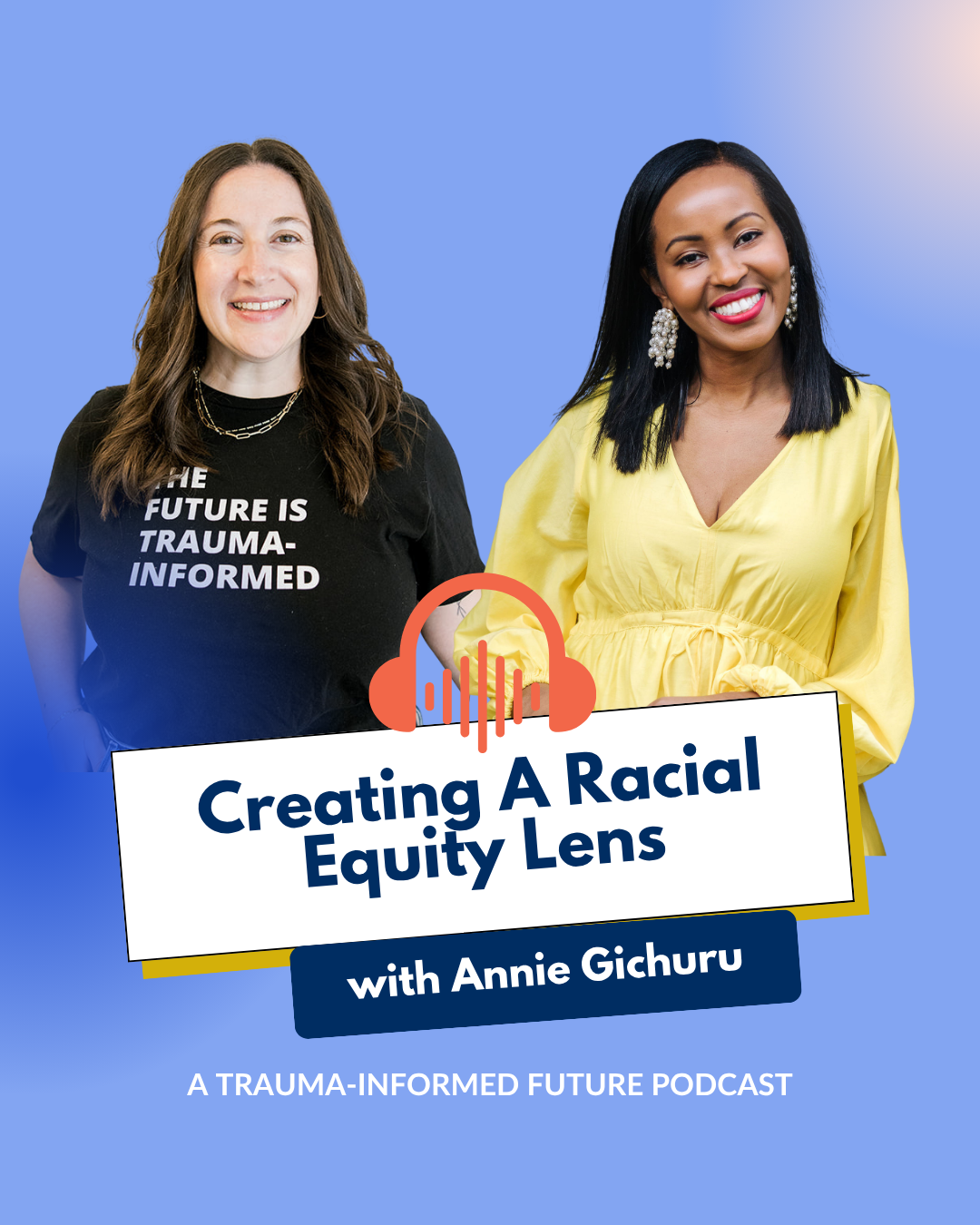
In today’s episode, Katie explores what it means to become trauma-informed in everyday life and emphasizes the importance of personal attunement, choice, and consent. The episode provides practical tools, resources, and insights for professionals and individuals seeking to integrate trauma-informed care into their personal and professional lives.
In order to create a trauma-informed future, we need to create a just and equitable one. We can't have one without the other. In this episode, Katie is in conversation with racial equity coach and consultant Annie Gichuru. They discuss the intersectionality of trauma-informed care and racial equity and justice work, and although they are not the same, they're both rooted in social justice and our parallel practices.
Learn more about Annie:
Annie Gichuru is a leading racial equity coach & consultant for online entrepreneurs. During the past 3 years she has helped many prominent online business leaders build intentionally inclusive businesses – the most notable of which is her partnership with The Beautiful You Coaching Academy, where she supports trainees and emerging coaches as a DEI trainer.
She is deeply passionate about representation through a racial justice lens, and combines her experience as an internationally certified life coach, her love of storytelling, and her extensive career as a Human Resource specialist to deliver REPRESENTED - a transformational online program, which has been described as ‘a must for all business owners who are ready to build a racially diverse, inclusive and equitable business’.
Annie’s grace, gentle spirit and passion for a racially equitable world is setting her apart in the coaching and personal development industry as a compassionate educator with an incredible space holding ability. Annie has called Australia home for more than 20 years, having relocated from Kenya as an international student.
Website: https://anniegichuru.com/
Instagram: https://www.instagram.com/annie.gichuru
Join the next cohort of Represented here
*please note that I am humbled to be an affiliate for Annie's program Represented. As a former participant, I believe in this program and Annie's work. What this means is by using my affiliate link, I receive a small stipend from that purchase. This model is based on mutuality and allows more visibility for Annie and her work.
Resources Mentioned In This Episode:
Show Transcript:
Katie Kurtz (she/her): No matter who we are or the identities we hold, we were not born into or raised in cultures that center equity, inclusion, liberation, or justice. This isn't language we automatically have or even mirrors we often see. It's something we have to actively learn and practice in relationships that we both have personally and professionally in order to co-create cultures that do center the humanity and inclusion of all people, especially those who hold intentionally and historically marginalized identities.
In order to create a trauma-informed future, we need to create a just and equitable one. We can't have one without the other. In today's episode, I'm in conversation with racial equity coach and consultant Annie Gichuru. We discuss the intersectionality of trauma-informed care and racial equity and justice work, and although they are not the same, they're both rooted in social justice and our parallel practices.
I'm eager for you to hear today's episodes, so allow me to introduce you to Annie.
Annie Gichuru is a leading racial equity coach and consultant for online entrepreneurs. During the past three years, she has helped many prominent online business leaders build intentionally inclusive businesses. The most notable of which is her partnership with the Beautiful You Coaching Academy, where she supports trainees and emerging coaches as a diversity, equity and inclusion, or DEI trainer.
She's deeply passionate about representation through a racial justice lens. She combines her experiences as an internationally certified life coach, her love of storytelling and her extensive career as a human resource specialist to deliver represented a transformational online program, which has been described as a ‘must for all business owners who are ready to build racially diverse, and inclusive and equitable businesses.’
Annie's grace, gentle spirit and passion for a racially equitable world is setting her apart in the coaching and personal development industry as a compassionate educator with an incredible space holding ability. Annie has called Australia home for more than 20 years at having relocated from Kenya as an international student.
Please be aware that in this conversation, Annie does discuss racism and justice and inequity. If you hold an intentionally or historically marginalized identity, please honor yourself throughout listening to this podcast. If you are someone who holds privilege and a non-racial identity, please remember that feeling discomfort is different than feeling unsafe.
So discern as you listen to this podcast. I hope you can stay with this conversation despite feelings of discomfort that may arise, and listen to the resources provided to you in this podcast to help support you in your own journey to address oppression and racism. Without further ado, here is our conversation with Annie Gichuru.
Hi everyone and welcome back to a Trauma-Informed Future podcast. I am so delighted to have my colleague, my friend, if I can say that I want to. I'm going to, and my own racial equity coach, Annie Gichuru here today, and I'm so excited to bring this conversation. When I launched this podcast, Annie has been on my mind and my heart to invite on here for what I anticipate one of many conversations about the intersection and the integral nature between racial equity work and trauma-informed care.
So I'm so excited to start the conversation today and to amplify Annie and all the incredible work she is doing. So welcome Annie. So, so grateful to have you here.
Annie Gichuru (she/her): Thank you so much for having me, Katie. I'm excited to be here and I'm excited to dive into this important conversation.
Katie Kurtz (she/her): so I wanted just to get started today by you introducing yourself in your own words, just how you're arriving here in our conversation today.
Annie Gichuru (she/her): So first and foremost, I'm a mom to two amazing kids. I am a wife as well, and a Black migrant woman who has called Australia home for over 20 years. I came here originally from Kenya and as an international student and ended up staying. The plan was never to stay this long. But 23 plus years later, I am still here.
Australia is definitely my second home and a place that I absolutely love. It's also the country that taught me that I was Black. It's not because I do not know that I am a Black woman, I do, but it is the country where the, the ratio of whiteness and Blackness there is just, I am in spaces where predominantly there are white people and so it has been that constant reminder that I am Black and I am different.
Even the questions that I get asked, so where are you from? And even though I say I am from a suburb in Australia, there's a more sort of interrogation. No, no, no, no. Originally, where are you from? So there's that constant feeling behind the scenes of you ‘you don't quite belong here’. And so arriving at this work with the intention of wanting to highlight the importance of representation, you know, just because you look different or sound different doesn't necessarily mean that you come from a different part of the world.
I think representation is something that we haven't learned well. To have conversations around it. It's either the topic that nobody wants to talk about, or it's the topic that when people talk about, they kind of put their foot in it. And so I think normalizing conversations particularly about race, which is my area of expertise and normalizing racial equity in how we do life is really essential in making us more human towards each other, and especially when it comes to the whole concept of holding space.
Having an understanding all the things that people face on a day-to-day basis and it doesn't mean that you have to be an educator or an expert in trauma or being trauma informed, but having that awareness goes a long way in helping you be a better space holder, a better expert in whatever space or field you are in because you appreciate the differences at a deeper level.
Katie Kurtz (she/her): Thank you so much for sharing that and I want start by touching upon what you shared about conversations. It all starts with conversations, but we can't have conversations without having the language to start to have the language to know what to talk about or feel brave enough to begin having conversations and.
Something that is so valuable that you are so generous in sharing. You have so many different resources from your social media page to your free glossary, like so many different resources just to help people get started to no matter where they're at in such a non-judgmental and really courage forward way.
So I'm curious if we could start there. I always love to start with shared language and understanding because it helps us all kind of get our footing and our start. And I think that when it comes to racial equity work and what your glossary points to is, there's so many different words and different terminology and different things, and what does one mean in the other.
And I'm hoping that you can help give us some clarity on like what is racial equity work? Who is it for? What does it actually entail?
Annie Gichuru (she/her): Hmm. Yes. I think language is such a connector. Language is what brings us together. It's what helps us understand each other. So if we don't speak the same language, then we are not on the same page.
Even when you think about language, language itself from different ethnicities and cultures, if you don't understand what they're saying, you cannot communicate. And so putting together the racial awareness glossary came from a place of me just being curious as to the historical context. I think a lot of times we use words, big words, words that we think we understand, but truly being able to define the meaning.
A lot of people get stuck and they go like, ‘I know what it is. I just can't articulate myself.’ And that's where I think it's so important where we do not make assumptions, assuming that we know that we actually go and do the work of learning and knowing how to articulate ourselves when it comes to describing the words that we use, particularly in subject matter, that we may not be very conversant with a subject matter that is important for us to know, but do not make the assumption that we understand, and particularly right now when we live in culture that tries to tell us that certain words mean certain things and us running with that, be it from a political context or whatever kind of context, and taking that as gospel and truth.
Not really doing the work of, ‘I will educate myself’ ‘I will look through the research and the resources and try and understand what the true meaning of this is’. And because racial equity work is work that a lot of white folks feel uncomfortable around, and even Black folks, let's be honest, it's just a subject matter that, that a lot of people don't feel quite comfortable about.
So it's not something that they fully will go ahead and do the research and find out, so what does this mean and in what context and how does this impact me and affect me? And that's what led me to create that glossary because it's a quick way of getting to understand something so deep and having the true meaning of this word.
When it comes to racial equity in itself, and what is racial equity? Really, it's the study of being anti-racist. It's the study of treating people based on their individual circumstances and not based on, okay, you come from this culture and this background will treat you in this way. Is treating people equitably regardless of where they come from, regardless of their race.
And we see the need for this, not just in how we do business, but in how we do life. It's essential because we've seen the unfairness, we've seen the injustice that exists, that certain groups continue to progress and grow and develop while other groups, despite whatever systems, have been say, dismantled, say taking it back to slavery.
There is still a “modern form of slavery” in air quotes that is still keeping people of color separate from white folks who continue to progress. And it's not to say that they don't face challenges and this getting into like white privilege and so on. It's not to say that white folks don't face any challenges.
Of course they do. They're human, but not from a race perspective.
Katie Kurtz (she/her): Yeah. Thank you so much for all of that, because I think sometimes it does, it can get overwhelming to know and then sometimes we speaking as a white person can get caught up in, ‘am I using the right words?’ And then we freeze. There is a paralysis of not knowing and then allowing our nervous systems to fall into that and instead of.
Choosing to courageously to do it imperfectly. And I think that one of the biggest things I've learned from my own anti-racism journey is that perfectionism is a tool of white supremacy. And how that, I never, it didn't really click, and I think I first really learned about that from Andrea Ranae Johnson, like, I don't know, 2017 maybe. It really just like it clicked and I was like, ‘oh, this makes sense’. It made sense and it unlocked, I think I, this was, I don't know, five or six years ago, like years, decades of programming that it, it wasn't just perfectionism harming other people, but it was harm towards myself.
And when I started to really understand that and learn about anti-racism, white supremacy, all of these things. It really started to make, it just makes sense and I'm really, I'm fortunate that I grew up in a household-my mom especially, we never used terms like racial equity or anti-racism. I don't know if my mom has those words in her vocabulary just because of her age and how she grew up, but we were, she was always promoting learning about other cultures, celebrating, understanding empathy from a really young age to know that our differences, no matter what they are, don't define who we are. We're human first. And although looking back, I didn't have the language, I can see how that was installed in me in a young age. But then growing up in America and in Midwest, which I, and in a city especially, that is still highly segregated and to be really clear, I live in Cleveland, Ohio. We were just ranked the most unhealthy and stressful city to live in for Black women.
And so I have had to take responsibility and understand I hold power and influence and what am I gonna do with that? Am I gonna choose to stay in? The comfort of not knowing or not talking or step out and do it imperfectly and uncomfortably and mess up and be human, but still move forward because it's important. It's aligned with my values and not just personally, but professionally.
I'm curious, Annie. I have been fortunate and honored to work with you in a few different ways in your program Represented. As well as receiving some one-on-one work for guidance on scholarship reviews and so many different things, and we're, we share mutual community with the Beautiful You Coaching Academy and so many different intersections.
But I've had the experience of being held in the space you hold and I have learned from many people, and it, this is not a comparison by any means, but it was, it just felt different and I was very cognizant walking into, Represented that I am a white woman living in the United States and not in Australia or in another country.
And that, that, it's a little different here that for a variety of reasons, but I was, I wanted to be sure it was still applicable, if you will. That was one of my biases, my judgments going in, making sure it was applicable. And I have to say that it was one of the most transformative experiences I had because of how you not just created and curated the program, but held that space and allowed for that community practice where we could have this dialogue where you guided these conversations even if they were messy or imperfect or whatever.
And it showed me, and it affirmed, it both affirmed and also strengthened my ability not only to lead my business in a more racially equitable and with through the lens of anti-oppression and anti-racism, but also strengthened my trauma-informed practice.
So I'm curious, how does, in your, from your point of view, how does racial equity, we talk about representation, anti-racism, Why is this so important to running a trauma-informed business or a business in general?
Because these practices aren't the same, but they're so integral. We can't be trauma-informed without also looking at racism and oppression, and we can't talk about racism and impression without talking about trauma. They go hand in hand.
Annie Gichuru (she/her): Yes, you are right. They do go hand in hand. And I think what makes it unique for the people who step into the spaces that I hold is that I am first and foremost a coach.
And so being a coach is a skill-yes. It's a very unregulated industry and every, you know, just slaps on a title and can call themselves a coach. But when you're trained, when you are qualified, when you have the certification, and you are in the practice of holding space for lots and lots of people, you are able to ride that wave of the emotions that come into this work of anti-racism.
You're able to hold space in ways that other educators who may not be coaches may not have that skill to hold. In fact, one of the greatest lessons that my clients have taught me is that not all white tears are harmful. I came into this work knowing and having read and done research of how harmful white tears are.
And it's not to say they're not, they are. And they can be harmful and they can take away from what we are trying to study and learn and hijack the lesson. And whiteness kind of takes over and Black folks are left trying to console the white person who's feeling terrible about something. There are ways in which white tears can be harmful, but I've also learned that there is a way that you can hold space for it.
The tears that are not harmful, the tears where somebody is really being vulnerable about the journey that they're taking, the mistakes that they've made, or the injustices that they're seeing. And just holding that space for them and calling them in and allowing them to let it out, and you being there and just holding them through that.
Letting them come through the other side, and that is where it truly becomes healing work. Healing work for that white person, healing work for you as a person who's holding that space. It just becomes something where you actually watch liberation taking place. Now if you come into this work, looking at it from one lens and one lens only, and going, you ought to know better.
This is what you're supposed to do. You keep making mistakes and not allowing grace, not doing it with compassion, not allowing people to just come as they are. Yes, they're gonna mess up. How can we allow the mess ups to happen? But when you know better, you do better so that you're not just consistently harming or offending or whatever it is that you're doing.
And so why this work is so integral, particularly to those who are doing trauma-informed care, is you cannot be effective unless you are informed. If you are a white person and I'm coming to you and you are holding space for me, say in the capacity of helping me deal with whatever kind of trauma or issue that I am dealing with, if you do not have an understanding of my Blackness, you do not have an understanding of the challenges, the setbacks, the barriers that exist for me as a Black woman.
Are things that you will just not have the capacity, the bandwidth to hold space for, meaning you will not be effective. There are certain things you'll wonder, ‘well, I worked with this person; they were able to just kind of be able to go through therapy' and be fine, but I'm struggling with this Black woman.’
I don't know. And you might apply the lens of the stereotypical views of maybe Black people are just ‘not smart’ or ‘they're less human’, or ‘they're just certain things that we just can't help them with’, ‘they're a different breed’ sort of thing’. When you are not informed, you will have excuses as to why certain things are not working.
But when you are trauma-informed, when you have been doing the work of racial equity, you come at this work differently. And that's why even studying with academies and institutions like the Beautiful You. As somebody who has a marginalized identity, as a migrant, as a woman, as Black. All of those things and predominantly are white space that I occupy all of the time being seen in my identity and not being shamed for it, being understood, being celebrated for all I have to bring.
Being treated as an equal and equitably. There is nothing more empowering than that because then it allows you to bring your full self without reservation. And I think that is why institutions, academies like Beautiful You are so successful in attracting people who come from different backgrounds, and it's not just an institution whereby as you study to become a life coach, that you are doing it in a singular form whereby it's just for white folk or it's just for people of color.
Lately it's a mix of all of us, and there is so much learning when it comes to systems of exclusion. Be it not just in the racial realm, but in other realms as well-gender, disability, neurodiversity, all other forms of identities that have been marginalized. You just have a heightened awareness, appreciation, and when you come step into this work with that knowledge, you are so much better as a human and as a space holder.
Katie Kurtz (she/her): Yes. Thank you so much that. That is so key to understand, and this is something as a subject matter expert in trauma-informed care. Something I say very often because it needs to be said very often is that when we first learn about trauma-informed care, we start with shared language and understanding.
We start with understanding the different, we understand what trauma is, which is our response, our human response to events, environments, cultures, relationships. And that there are different types of trauma, and one of them is systemic trauma, which names racism and oppression, and we exist in those systems.
Therefore, a lot of people hear trauma, trauma-informed care, and they other. ‘Those people’, that's, if we start to look at trauma and the different types of trauma, especially systemic, we all have a role and a responsibility. To address trauma and that's not saying we ought to be therapists. No. What we can do is adopt a trauma informed lens by understanding the impact of trauma, especially systemic trauma on people especially who hold intentionally or historically marginalized identities.
And one of the core principles of integrative trauma informed care that I teach is intersectional inclusion. We have to look at honor the multiple intersections of identities people come to in their full humanity, which include many things, and that makes up their human experience. And because many people hold intentionally marginalized identities, that means they're more likely to have experienced adversity, toxic stress, and trauma.
And so, by being more informed we can skillfully then hold space, facilitate, run a business, do anything withholding that understanding, to promote a felt sense of safety in our presence, and also be okay that some people may never feel safe with us. And that can be a really tough thing to accept. We can practice acceptance, but that doesn't mean we don't stop showing up.
To promote safety in all its forms for people, especially who may not be able to access safety in our presence because of the different identities we both hold, or the social positioning or the privilege or whatever. And I think that is where, so similarly trauma-informed care and racial equity work kind of hold hands and go forward.
When we look at a business perspective, we may never talk about trauma, race or racism or oppression in any of the work we do. If we're copywriters or marketers or business coaches or photographers or anything, it may, that conversation may not come up. And I think that's where sometimes people get confused like, well, I don't talk about that, or that's not what I do.
It doesn't matter. Right, because it's the approach in which we lead our lives. I'm curious because I love the way you talk about it and give so many tangible examples and resources around integrating this lens into business because like trauma-informed care, it's not to add more to your plate. This isn't complicated.
It's a long game. They're both, it's gonna take time. It's an evolving practice. If anything, it amplifies, it augments, it elevates and enhances our client experiences and sustains our capacity. So I'm curious if you can speak a little to what that looks like and how some of the things you specialize in supporting, especially online business owners.
Annie Gichuru (she/her): When it comes to online business owners, there is this misconception that they are already inclusive, like ‘I'm a good person’, so getting stuck in the ‘good person vibe’, but ‘I'm a good person’. ‘I donate to this cause’, ‘I have Black friends’, ‘I'm married to a Black person’, ‘I have women of color in my space that I support and so I'm already inclusive’.
So whatever you are talking about me. This doesn't apply to me. It applies to those who do not have what we can physically see as an inclusive business, and that's not the case. This work is for everybody and more so those who actually think they're being inclusive because they think that they may not be perpetuating certain systems of exclusion.
They might think that, ‘oh, but I'm not racist’. Well, and then you begin to understand there's a huge difference between not being racist and actually being anti-racist. There's a huge difference there ‘cause anybody can say, ‘oh, I'm not racist. I'm the least racist person in the world you'll ever come across’.
And then you look at their behavior like, I don't know about that. I don't think you quite understand what this is. And it really begins from a place of awareness. So a lot of people come into my program Represented knowing that, or rather had enough feeling of, ‘I'm an inclusive person, I'm a good person, I just wanna be better’.
They step in and their eyes are opened in a way that they've never been opened before, and they go, ‘oh my goodness, Annie. I thought I knew quite a bit. But the more we are digging in step by step module by module, I am realizing how much I do not know how much I have contributed to systems that have been exclusionary’.
‘I am beginning to realize that how I'm holding space, even for my clients of color’, ‘I haven’t been quite equitable’, ‘I thought I was, and this wasn't even an issue’. ‘But now the more I dive into this work, the more I realize how much work I have to do on myself and how I can be a better, safer space holder’.
And that is what it starts with an education piece. It starts with having that awareness, but you've also got to have that curiosity within yourself that is driving you to be, how can I be better in this work? I know I don't know everything. What are some of the things that I need to know in order to be better in my business and as a human?
And also looking at this work or the racial equity, not from the lens of just my business. There's actually a lot of personal stuff that you need to unpack. And just going back to what you mentioned about being a child and growing up with a mother who embraced people who came from different cultures and that was celebrated.
That deposited something within you. Not everybody was brought up that way. There are people who were brought up to look at other cultures as less than they were brought up. To think that those are the other people, ‘those are the lazy people’, ‘those are the people who don't contribute to society’, ‘\you shouldn't hang out with those people 'cause they're gonna bring you down and so forth’.
And so that is something that is deeply entrenched in their belief systems. And so to undo that takes a lot of time, especially when this has been a childhood thing that has been, that has shaped their belief system. It has shaped how they look at people, the stereotypical views they have, the prejudices that they have, the implicit biases that they have.
So it really begins by unpacking that implicit bias and allowing people to see things as they are and seeing the biases that they hold. And then from there, doing a bit of an audit to see where are you from a business perspective, how can you improve this whereby you're not just using inclusive language because it's easy to adopt inclusive language.
But what happens when I come into your space? You are holding space for me, but I can feel there's a disconnect there. You might be saying how inclusive you are, but everything with your body language and even just your language itself with me tells me that you're not an inclusive person. And so that's when you begin to translate the things that you want to be into that reality of being.
And of course this takes time. This is not work that you take a course for like 10 weeks and you're like, ‘woo-hoo, I'm done’. I have the concepts. This is a lifelong work that you need to pace yourself and keep getting consistent knowledge towards and growing. And so it really begins at that base level of awareness.
A lot of people thinking they are already inclusive, stepping in and going, hang on. Actually, I do have a lot of work to do here. And then we go in the direction of how can you be consciously inclusive? Because this work requires a consciousness, it requires intentionality. How can I be that person in my life and in my business?
What are the areas in which I can make my work a little bit more accessible? Or maybe I'm not yet there in my business. What other ways can I contribute to a better community around me? And then stepping into being activated, taking action on an ongoing basis where this work is not separate. It's not something that is a good to have. It's something that I do on the side.
No, it's part and parcel of how you do life. And how you do business. The thing that you're consuming on the home front, be it from an educational piece or entertainment piece, is that you're consuming content that comes from people from diverse voices. And how is that then influencing how you show up for your work, how you show up for your business, how you are holding space, how you're understanding people with different identities.
So personal and business kind of go hand in hand. The personal really does influence how you then show up for business and hold and have that racially equitable business. Finally becoming that ally, coming an advocate for this work where you are not just sitting in the sidelines and watching or being a person who just speaks up when it's hit headline news, but you are in it, in and out of season.
And that doesn't mean that you have to be the loudest in the group. It just means that this is work that you are just ongoingly doing. When people step into your space, they feel a certain level of being held, they feel valued, they feel welcome, they feel like ‘this is a place I am okay to be here’, ‘I'm okay to be held by this person because they make me feel welcome and valued’.
Katie Kurtz (she/her): There's so many things we could pull from that and go for hours on this conversation. And I think that as you were sharing that I saw so many similarities of the things I say repeatedly about trauma-informed care. Again, honoring their very different lines of work, but very much in tandem.
There is no arrival in this work. It's an evolution. It evolves and it's not passive. It's an active practice that takes time and something I learned the hard way is wanting to be there, right? We want to get there, whatever there is. And after I took Represented, I did some work with Resmaa Menakem and his Somatic Abolitionism work and something that was so powerful about it was the nervous system practice of his practices called VIMBASI and really pacing and titrating and slowing down.
I know that's trauma-informed work, but when we start to really look at dismantling these systems that are, we've learned from birth. I mean, I had benefited as a white woman in the US from many of these systems and these things that dismantling creates these reactions in our bodies and we can't do this work from a reactionary state.
We have to find ways to regulate and come to neutrality so we can be responsive and not reactive. And that's for anything. And I would venture to guess, a lot of people come to work with you, like they come to work with me for professional development to enhance their business, to work on their leadership skill.
But once they get into this work, they realize that we can't compartmentalize our humanity. Our business is our life. Our life is our business. Everything is personal and. You start to realize how everything impacts that and how we show up anywhere is how we show up everywhere. I love those how you've highlighted the tandems of this work.
And I wanna reiterate to anyone listening who is identifying as trauma-informed is on their journey, is just starting out that again, we can't be trauma-informed, we can't look at trauma in any way without also looking at the role of racism and oppression and being actively anti-racist and anti-oppressive in this work is essential.
We can't, it's incomplete if we think we can do them separately or one without the other.
Annie, you've shared so many things that I would love for you to talk a little bit about. You know, we're a little over three years out from the infamous ‘black square on Instagram’, the listening and learning, whatever the tagline was.
We have gone through a global historical trauma of a pandemic that has been accumulating with other things. So we've had accumulation of toxic stress and adversity and trauma from witnessing just a shift in 'cause racism isn't new. But a lot of people, especially white people, woke up when the George Floyd was killed and Breonna Taylor and that 2020 marker.
We were four months into a pandemic. We had no idea what was to come. Accumulation of just one thing after the other. You know, political unrest. We saw that here in the us we've seen it in many other countries. War so many things, and that's just culturally and systemically. Then we have our own personal experiences. So much.
We've lived so many lives, so many things have happened and I remember distinctively when I was just witnessing this shift online of people really starting to talk about racial equity, anti-racism, and then a lot of people continued and a lot of people stopped. And here we are almost over three years later, and I'm curious again from a non-judgmental place of whether you're one of those people that got overwhelmed or you stopped or you continued or you've stalled.
What are some ways people can restart or start from the beginning or continue to sustain their work when it comes to racial equity in their lives.
Annie Gichuru (she/her): I think for me, being a Black migrant woman who lives in predominantly white spaces, this is work that I don't have the luxury to tap out all. I am constantly reminded of my identity, my racial identity, and so this is work that I am plugged in for better or worse.
So I haven't, I cannot say that this is work that I have kind of taken my foot off the gas. If anything, it has just been learning to regulate myself whereby how can I pace myself? How can I not get too in it? That it is affecting the my ability to hold space for white folks? How can I take breaks? And that doesn't make me less of a great educator.
If anything, it adds on to the skills that I have so it's just been a learning to regulate, but perhaps what I have seen shift and change is the urgency of wanting to do this work back in 2020. There was ‘educate me, show me, tell me right now what needs to be done’ and that being unsustainable because the demand was more than the supply.
It was just not sustainable. And then we've gotten to a place whereby now it's not such a priority to white folks who haven't been genuine in doing the work. It was like a knee jerk reaction. This is what the masses are doing, it, the trend thing to do to be inclusive and so on. And so you are finding a big, what I'm finding personally is there's a big difference.
Those who are absolutely genuine are digging deeper and they're doing this work and they're incorporating it and they're actually seeing the difference. You know, there are clients that I have worked with now for three plus years and their client base has changed in terms of they're now serving more people of color than they would have ever imagined.
And one thing that has also been surprising for them is as they've been a correlation between doing inclusion work and income generation, that they have been able to generate more income because of doing inclusion work. And so there are many benefits and advantages to doing this work if you genuinely stick it out and when you choose to look at it not as a separate entity when you choose to look at it.
This is like doing taxes. I have to do this for my business. It's part and parcel. I need to eat to exist and have the energy to live and be human doing this work. When you begin to understand it in that intricate and intimate detail, It will transform how you show up. It'll transform the kind of business that you have.
And it won't be a matter of, am I being genuine'? Am I being performative? Because this is what becomes embodied. If you are trauma informed, it becomes embodied in who you are, right? It's not something where you go like, oh my gosh, a need. Katie to tell me, am I ticking the box? What are the characteristics of somebody who is trauma-informed?
And checking that and seeing if you match up when you do this work and do it genuinely, and it's part and parcel of who you are in life and business. You embody that. You avoid what those characteristics are. And the same goes with racial equity work. It's no longer am I being performative. Am I being real?
Will I be called out? And I often liken this to friendship. When you're being a good friend, you know when you're being nurturing, when you're caring, when you're calling in to checkup, genuinely. And when you haven't been a good friend, you haven't stayed in touch, you haven't cared to, to follow up and fight when you're being genuine and when you're not being.
And the same goes with this work, you know, when you're being genuine, you know, when you're doing the work, when you're trying to understand. Even when you're making mistakes and you're still staying in the work to understand because you know you are better for it as a human and as a business and as a space holder.
And so those are some of the markers that I normally tell my clients. You know, ask yourself that. Are you being genuine? What's the intention behind doing this? Is it virtue signaling so that people know, is this person or is this genuine? When I come into your space, will I feel a certain way? And unfortunately I've come across a number of people who, it's just lip service.
You get into their space and you're like, oh, you are not what you say you are. You don't. You do not have that kind of space. This is not a priority. This is just something you're ticking a box and moving along very quickly. And I think we're going to get into that point in life and in business, Katie, where we are going to see people with how they spend their money. We've gotten to a point where ethical clothing has become a thing. Where are my clothes being made from? What kind of materials are being used? Who are the people who are working on my clothes? How are they being remunerated for this work? We are becoming very conscious and ethical without buying habits when it comes to clothes.
The kind of food we are eating, we're a lot more switched on than we were decades ago. The same is going to happen in this space when we're looking for people to support us. When we are looking for people to hold space for us, they're going to be things that are just going to be an absolute essential, going to be non-negotiable for you to be trauma informed and not trauma informed in the idea of it's trendy.
I am this 'cause in a lot of people who put that as a, as a title, but really to be that and to hold that space in a way that allows me to feel. I was seen, I was held, I was valued, and a lot of people are going to be looking for that. Is there inclusivity when I invest in this mastermind or this group? is there inclusion and diversity in this space or is it another group of just people who look and sound like me?
We continue to be part of those spaces that where we are thinking all alike and not being as inclusive as we possibly can, we aren't going to get to that point where people are going to be looking at for that as markers. And if you're not genuinely doing the work, now you're going to get into a point like 2020 where people are scrambling, tripping over themselves, trying to say, educate me, tell me what to do, tell me what to do.
And the thing is, with this kind of work, just like with being trauma aware and informed, You can't rush it. You cannot rush your learning. You cannot rush inclusion. It is work that takes a step and a step and it's work that is lifelong. You never get to the end, and so the sooner you begin, the better off you are so that when we do have those knee jerk moments, which will always be there based on something that's happened in the news or whatever.
You wanna be ahead of the curve. You wanna be able to be that genuine person. People look to and say, I know who I can go to. They're genuine. They hold space in a particular way and they're, that's where I want to invest my, my money, my support. That's my person.
Katie Kurtz (she/her): Yes. The expectation, not the exception.
Absolutely. Mm-hmm. I feel that so deeply from both a space holder and business hold. As well as a consumer of somebody looking to hire or work with is that discernment is so important, and I always tell people, ask questions. People who are really committed, who really value inclusion, belonging, trust all of these core tenants and principles of trauma-informed care, racial equity work, they will welcome the questions.
They will happily share their learning lineage and they will tell you when they don't know. We need to be in the practice of demonstrating what we believe in and what we value rather than just saying it. And this reminds me of the conversation I just had with Crystal Whitaker about values and inclusion and how we have to show and we have to demonstrate and we have to show up in what we actually are saying and have actions behind it or else it's not anything.
And people, it's tricky online, right? Because we use words and photos and things to appear a certain way. But once we're in actual dialogue and conversation and relationship building, that's when things may begin to crumble or strengthen, depending on the demonstration of skill and competency and work.
And I think that's such an important thing for people to walk away. Your understanding is to. Really ask those questions. Take your time and think and align yourself with people who share that vision for a future that is equitable and anti-racist and trauma-informed, and all of these things that promote and celebrate and honor people's full humanity.
Annie Gichuru (she/her): I couldn't agree more.
Katie Kurtz (she/her): Yeah. Well, Annie, there's so much to talk about and I have a feeling I will say this with every guest I talk to, If it's just going to be me on repeat, but I am so grateful to be in this conversation with you and there are so many. Different pathways and, and different things we could go down because there's so much to unpack and explore.
But as we close our time together, I am ending our interview and conversations with a gentle spritz, a light, a, a light dusting if you will, a little more trauma-informed approach to the typical rapid fire questions that we see at podcasts. But I'm curious if you can tell us:
Describe in one word, what trauma-informed care means to you, or what does it, what would it be?
Annie Gichuru (she/her): Hmm. Trauma-informed care for me would be being in a space where I don't feel inhibited by my identity. Like I can bring all I am and still feel valued as a human, not have to be something else. Code switch in order for somebody to think of me in a certain way and treat me in a certain way, it would be a space that allows me to bring all that I am and to still be held in a valued way.
In a way that I am made to feel welcome like I belong, and that I don't feel othered or less than.
Katie Kurtz (she/her): Yes. And not just saying that, but demonstrating that. Yeah. Oh, yes. What is your current go-to nervous system care tool? Self-care tool or practice you're using right now?
Annie Gichuru (she/her): I would have to say sleep. Sleep for me has, we've had our fair share of catching the bug here in Australia. Southern Hemisphere is winter. And so having a lot of illness in our home, what has helped me is the ability to sleep, to nap when I need to, and just catch my breath and get my energy to take care of two little humans.
And so that's how I've been taking care of myself, napping, sleeping, which is something that I don't necessarily like to do because I like to be switched on and kind of being in it all the time. But napping, sleeping has been healing to me.
Katie Kurtz (she/her): I love that for you, especially in the season of both life and winter, for sure.
And lastly, what does a trauma-informed future look like for you?
Annie Gichuru (she/her): Mm. Getting into spaces where people see you for who you are. They don't make assumptions. They celebrate you in a genuine way. Being in spaces that honor who you are, it's not a question. Also, you are this, so you are that. It's just honoring who we are as human beings.
Katie Kurtz (she/her): Yes, I'm here for that. All the way.
Annie, I would love for you to share with us how people can connect with you. I know at the time of this recording, you are welcoming people into your next cohort of Represented. If anyone listening, I’m happy to share my experience with being in Represented and any of Annie's work. It's so. Important, and it's so life-affirming and humanity affirming to be a part of and only amplifies your own life's personhood, business, art, whatever it may be.
So anything you'd like to share with anyone listening about what you're up to right now?
Annie Gichuru (she/her): Yes, there is the glossary. First and foremost, if you are thinking, where do I begin? This has been such a great conversation. Start with a glossary. Start by downloading that glossary and learning the 20 must know terms When it comes to racial awareness, trust me, it is something that will pique your curiosity and want you to dig even deeper just because it's bite-sized, but it's packed full of value.
And then the doors to my program Represented, which is a 10 week program that really walks you step by step to understanding the implicit biases that we all hold. Not just white folks, but all of us. How we can do better in personal perspective in business, and then how you can really begin to incorporate being intentionally inclusive and going on and being that genuine ally and advocate when it comes to matters to do with racial equity.
I think this program is one that has been described as a must do for all people who are in business. And I'm very humbled when I receive such feedback, but I have seen the transformation that is it has had on past students and students who continue to reengage with this work. And it's lifelong work, it's lifetime access.
And honestly, I do not know a better program that will hold you in your true humanity. Allow you to come as you are. You can be brand new to this work. You can be somebody who's re-engaging in this work held through the lens of compassion, grace, and kindness. Because I don't know how else to teach this work other than how I like to learn and to be held.
Katie Kurtz (she/her): Yes, I can fully attest to that. It was an incredibly brave space to be held in, and I felt that compassion and grace along the entire way. So thank you for sharing that.
Everything will be linked in the show notes for folks to explore, and I encourage you to please do that. It's so important to creating a trauma-informed future.
We can't have a trauma-informed future without. Equitable and just and liberatory future for us all. So Annie, thank you so much for being here. I'm so honored to have you as a guest and truly such a privilege to learn from you and be in this work with you.
Annie Gichuru (she/her): Thank you so much. Absolute pleasure. Thanks for having me.
