

Let’s Start with the basics
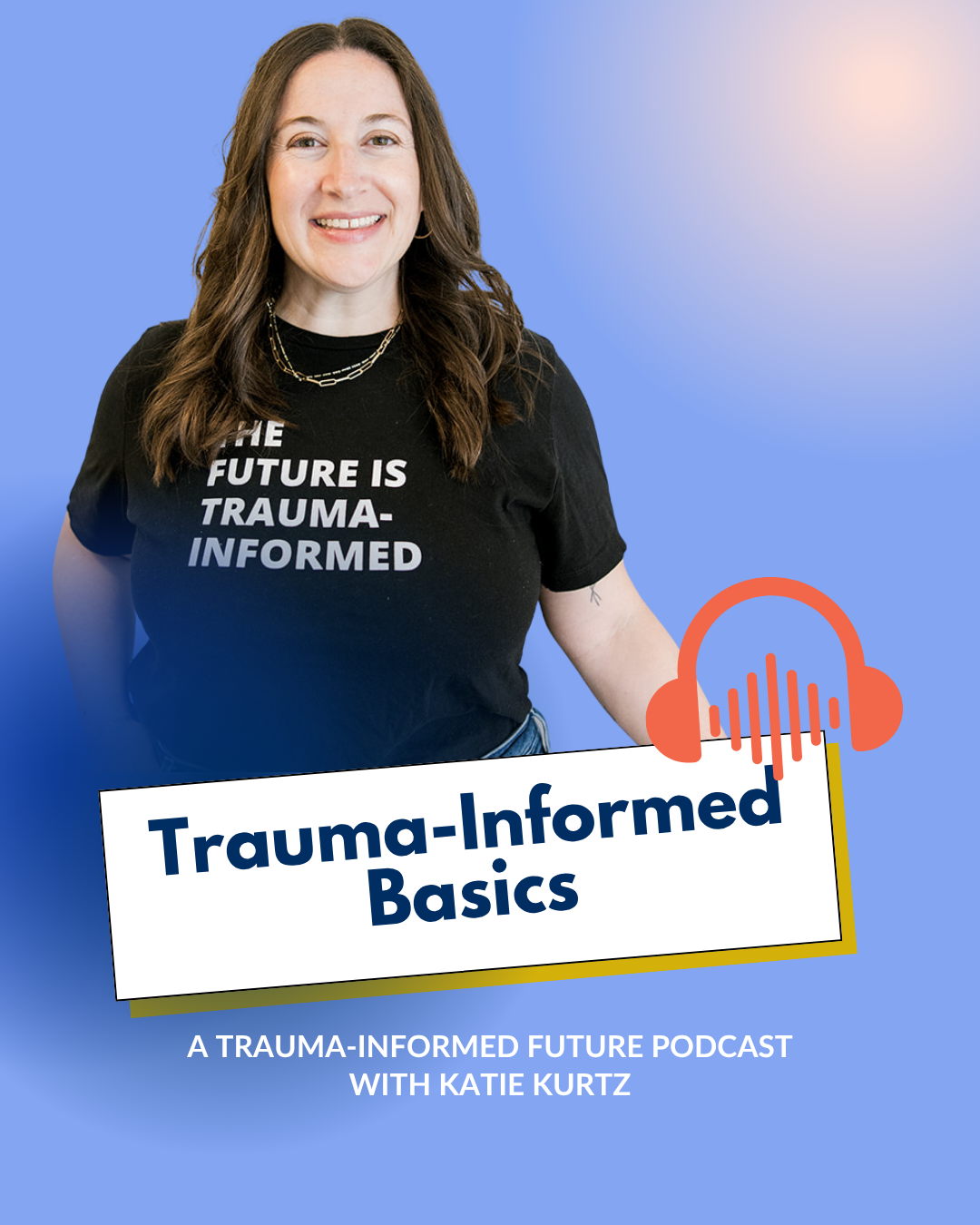
In this debut episode of the podcast, Katie emphasizes the importance of creating a trauma-informed future by honoring the origins of trauma-informed care and recognizing the complexity of human experiences and identities. She discusses the nervous system's response to trauma, the origins of trauma-informed care, and her goal to have meaningful conversations about trauma-informed care and its applications.
Resources Mentioned In This Episode:
Show Transcript:
Welcome to a Trauma-informed future. This podcast helps us envision how we can create a trauma-informed future for us all. I'm Katie Kurtz, a trauma-informed training expert who believes in honoring the origins of this approach by ushering it into the future in a way that's inclusive, doable, and non-negotiable.
If you are someone who wants to exist in spaces that allow you to access safety, Build trust and honor your full humanity, then you are in the right place. A trauma-informed future is possible when we come together to create it, and that begins right now.
Hi everybody, and welcome to a Trauma-Informed Future podcast. I am so delighted to be here with this first episode and to welcome you in to the community and the conversation. I'm Katie Kurtz. I am so excited and really grateful that you are here and you are listening. I. I'm so encouraged every day by the conversations I've been having, and this podcast is really to create space, to have those conversations, to talk about the nuance, to sit with and be with that liminal space of multiple truths being true.
At the same time, when we talk about our humanity, we can't help but talk about all the nuances and complexities that come with it, and we can't help but talk about the trauma and the healing that also occurs within our humanity. This podcast is dedicated to having those conversations, to going deeper, to be able to expand our understanding and our ed, and educate ourselves, and also to energize ourselves because the future is trauma informed.
I am so excited to be in conversation with you, to have conversations with guests, to share all of the different things that I train and, and educate on, and also be open to learning and unlearning myself because I am always in the work as well. I wanted to start today by really creating some shared language and understanding and a shared intention for what this podcast is gonna be all about.
I am always starting at this place of shared language and understanding, because I come back to what Brene Brown says in her book, Atlas of the Heart. That language is our portal to meaning making, and I don't think we can talk about trauma and trauma-informed care without having a conversation about what these big words even mean.
So this episode is dedicated to really digging into what is trauma? When I say trauma-informed care, what does it even mean? And giving you a brief history of why we're here, why trauma-informed care is even a topic of a podcast. Before we get started, I just wanna give you a little bit of info introduction to me.
If this is the first time we're meeting. So, I'm Katie Kurtz. I use she her pronouns. I'm joining you from the unceded Stolen Lands of the Erie and Great Lakes nations, also known as Cleveland, Ohio, where I'm living and recording this podcast. Right now. I have been a licensed social worker for the last 15 years, specializing in trauma, starting my career off as a trauma therapist, then moving into education and training, prevention and community programming.
I became a certified coach seven years ago and started my business where I was holding space for individuals and groups and communities where I was utilizing trauma-informed space holding. And about three years ago, I. I was living two different lives. I had my social work career, and I had my coaching business, and I kept them very boundaried and separate, and it worked until it didn't.
And then I realized I really wanted to bring these two worlds together, and so I decided to blend them together, and that's where I started to really harness my gifts and hone in on. Teaching and training and sharing and having conversations around trauma-informed space, holding and creating inclusive and adaptable trauma-informed care that doesn't just live in clinical settings where we often think it should, but bring it out and bring it in to industries because we, we, working with humans, we are working with stress and trauma and adversity, and we have not only the power and ability, but the responsibility to be able.
To promote trust and safety and healing in all its forms. So this podcast is dedicated to having those conversations, those conversations that don't often exist on the squares of social media, where we can go a little bit deeper and share more about the ver the so many different avenues and pathways about this approach.
If you are ever listening to this podcast and you hear a few Yelps in the background, those are my two puppies, Trudy and Mabel. They are little, still little puppies that have make lots of noises, so I am just keeping it real. As you listen to this podcast, I am going to commit to bringing you the best quality.
Sound and content, but I am human first. Everything else. Second. So as I sit and record this, if you ever hear a little Yelp in the background, that is just a super cute, fluffy little mess of a dog somewhere in my home. Okay, so let's get started at the basics Trauma. What is it? Even if you're coming to this podcast with a lot of information and knowledge about trauma, awesome.
I hope you can join me for a little bit with a beginner's mind, because if you were to Google trauma right now, you're gonna get about 50 different definitions, right? You can get the medical definition, you can get the mental health definition, this person's definition, that person, that system. Whatever.
So many different ways to describe and define trauma all kind of the same, but still a lot, a little bit different. The reason why we have so many different ways of describing trauma is because trauma doesn't fit into a box. It blows the box right up. It's non-binary. Our brains love either or thinking good, bad, right or wrong.
It's literally how we survive every day. If our brains didn't think that way, we would not make it. However, our humanity does not live in the binary, and when we get stuck in that either or thinking it can lead us down a path of potential harm towards ourselves or others, our humanity is complex. Trauma is a part of our humanity, and it's very complex.
It's very nuanced. It lives in the, and both the multiple truths at the same time. That liminality of not yet started or not yet ended, that in between space. So when it comes to describing trauma, that is why we have so many different interpretations. The other reason is because trauma is still a new field that doesn't have a ton of research behind it.
A lot of people are still functioning on the definition from way back, maybe 50 years ago, and we've learned a lot in the last 50 years about trauma and expanding our understanding about the lived experiences we have. So, for the sake of this podcast, I wanna be sure we are on the same page with, when I talk about trauma, this is what we're talking about.
I believe that trauma, and I use this definition of trauma in everything I do, is a human response. It is a human response to events or environments that disconnect us from a sense of safety, a sense of self security and stability, that it's beyond our capacity. So I wanna note here and emphasize that trauma is not the event or the environment, it is our response to the event or environment.
So with this being said, you could pause here and be like, well, shoot, that could mean anything. Could be trauma. Is everything. Trauma. And I wanna hold on because there's always gonna be a lot of nuance here. Yes and no. What may be traumatic for me may not be traumatic for you, but that doesn't invalidate or mean my experience is not real.
We have to remember that each of us have our own identities, our own resources, our own cultural contexts, our own bodies, our own nervous systems. So when we experience different events or environments, we are gonna have different responses. The big thing is, is it within our capacity to cope with, to be with, to overcome at the time.
When we're unable to cope with or have the capacity to be with whatever event or environment we're in, that is when we experience trauma, our nervous systems are dysregulated, and that is where that trauma response occurs. So I wanna be sure we're functioning from the shared understanding that trauma is our response to events and environments.
So what kind of events and environments. There are so many different ways and so many different things. So this is a non-exhaustive list, but so often we can think of different types of trauma. So acute trauma, maybe something you experience one time. Uh, it could be an one time event or uh, a specific type of injury or illness.
Trauma can occur chronically over time, periods of time. Trauma can happen systemically, where systems induce en events or environments towards individuals or groups of people where they're creating toxic stress and trauma. Trauma can also happen historically on our timeline that can have reverberating impacts across generations.
Trauma can happen. Ancestrally, we know through the study of epigenetics this, that trauma can transform our genetic makeup and can be passed down through our ancestral lines. Trauma can also be vicarious and that when we witness or when we hear accounts of trauma, that it can begin to impact ourselves.
Let's take a deep breath. There are so many different ways that trauma can manifest from different events and environments that we experience. And so the purpose of why I am sharing this is to help expand our empathy. So often when I'm invited into spaces to train or talk about trauma and trauma-informed care, it's always this often unintentional.
But othering, oh, those are those people. That's them. That's not me. Those are those people in that other neighborhood or community. And I'm here to really help us pause and expand our understanding that we know and that we have data that shows that virtually all people. Including us have a lived experience of trauma and or toxic stress.
We can't talk about trauma without talking about toxic stress. Stress. Not all stress is bad. There is positive stress, which is literally how we function every day. There's tolerable stress, those things that annoy us or stress us out, but we eventually, you know, overcome them. And then there's toxic stress when it becomes chronic and accumulative one thing after another.
Adversity and we just cannot catch a break. And sometimes it's so normalized that we just think it's part of life. We know from research and data that toxic stress has the same imprint on our bodies as trauma does. And when we're exposed to toxic stress, it can have that same imprint on our nervous systems and our emotional and physiological being.
So, although stress and trauma are not the same, they go hand in hand. We can't talk about one without the other. There's so much a part of our humanity. We also can't talk about trauma or stress without talking about our current situation. The last three years we have been living in historical trauma.
Whatever you believe, no matter what it is, global pandemics are considered historical traumas. Pandemics happen on our historical timeline and have reverberating impact on individuals, groups, and cultures. If we think about the last three years and continuing on is that we have had our own individual responses to the COVID 19 pandemic, and then we also have had our community response and then our culture response.
There is not one single person on this planet that has not been indirectly or directly impacted by the pandemic. And for the first time, probably ever, helping professionals are experiencing the same anxiety and stress as their clients. And so it isn't just what we experienced with Covid 19, whether we maybe contracted the illness or we lost a loved one to it, but also the accumulation of stress that has occurred from ongoing other systemic and toxic stress, ongoing systemic racism.
Economic uncertainty, political unrest, war, so many things. Grief and loss. Not just loss of life, but loss of experiences and opportunities. Again, take a deep breath. Whenever you notice you're starting to feel anything throughout this podcast, I encourage you to pause. Practice the pause, find your breath.
Take a moment. You can literally pause this podcast if you need to, or just take a moment to breathe. We are gonna be talking about trauma throughout this podcast, so I wanna be sure you know, and I will always give you trigger or content warnings. But this episode is really, again, to give you a basic foundation of shared language and understanding whether you're coming to this podcast.
Brand new. Whether you're coming here with a lived experience or perhaps you're experienced, you've taken a lot of education and training no matter where you're at in your trauma competency. I'm so glad you're here and I'm glad you're starting here because so many people have different interpretations and unique expressions of trauma and trauma-informed care.
And so by having this shared language, we are able to create meaning making of what this podcast is and how we can co-create a shared vision that is trauma-informed.
Wherever you are on your trauma competency journey, we could all use some extra tools to ensure we are leading with both competence and confidence. The trauma mindful toolkits are four different. For an interactive guides to begin or deepen your ability to integrate trauma competent care, you can choose from nervous system care, knowing your scope, consensual communications or humanizing harm toolkits.
The toolkits are accessible on demand guides. To ease the overwhelm and help you actively apply and integrate essential trauma-informed practices. To celebrate the launch of this podcast, you can receive $10 off each of the toolkits by using the discount code, a trauma-informed future. This limited time only discount is available now through the end of July.
So head on over to katie kurtz.com/toolkit. To get your toolkit and use the discount code, a trauma informed future, that's katie kurtz.com/toolkit.
So we talked a little about what trauma is. Again, this is kind of the brief crash course of it. But what does it actually mean? So our bodies are brilliant. We have this incredible thing called a nervous system that is made up of a network of cells and tissues that cover every organ in our body. And a note here, I am not a neuroscientist.
So again, this is the brief overview here. But our nervous systems are amazing, and they work with every other system in our body, our temperature, our heart rate, our organs, our digestive system, our hormones, and are connected to our brain. And our bodies are doing an incredible job of keeping us safe and surviving.
So when we are experiencing life every day, if we come into environments or experience events, And our brains interpret, okay, this is not safe here. It sends a signal through our nervous system that says, we are not safe, therefore we need to protect and survive. And so what happens is that message goes through our nervous system, through every organ and system in our body, and then we have external behaviors.
And what happens is we have those responses, our nervous system responds, or sometimes people call this a stress or trauma response, and those. Uh, responses. We typically, you may be familiar with fight, flight, freeze, or fawn. This is our nervous systems not being broken or bad. There's no good, bad, right or wrong here.
Our nervous systems, our bodies are brilliant and they're doing their job of keeping us safe to survive. And so what happens is we have this human response and sometimes if that is. Event or environment is beyond our capacity to cope with at the time. Then we get stuck in a dysregulated uh, response.
That is where trauma and toxic stress accumulates, and that's where trauma is. That's that response. We know that I myself, am coming to you here with my own lived experiences of trauma, and I recognize in honor that you, the listener, also have your own experiences of trauma. And the toxic stress, and whether you are aware of it or not, we are also living in the historical trauma.
And so I really want us to pause here and just take a moment to acknowledge that. And the reason why we're here is because we cannot wait a second longer to create spaces where people are aware of this reality and pervasive nature of trauma and stress in everywhere we go and can take. The ability and, and the power to apply approach that is longstanding, that is effective and doable to the spaces so that we can resist causing further harm, and that we can promote trust and safety and belonging and healing and all its forms.
So I wanna give a quick background on what trauma-informed care is. So again, shared language and understanding. When I say trauma-informed care, what am I talking about again? Trauma-informed care can be dis described or defined in a variety of different ways. But for the sake of this podcast, when I talk about trauma-informed care, I am talking about an evidence-informed approach that has a longstanding history with various origins.
But essentially it is an approach that promotes trust, personal safety, and autonomy so that each person can show up as a sovereign being. And it's an approach that. Is actively applied to resist and reduce harm and promote spaces in which people can access personal safety, choice and consent. This approach has a longstanding history.
A lot of times if you hop on the internet right now, you're gonna hear a lot of people talking about trauma-informed care, and I want to encourage you to pay attention to what people are saying because a lot of people are calling trauma or trauma-informed care a buzzword, and I understand why. However, we're gonna gently bust a lot of myths on this podcast.
Trauma-informed care is not a trend or a buzzword. It's actually a longstanding approach that has various origins, and I wanna talk about that very briefly. Trauma-informed care isn't something that just popped up in, started trending on the internet about 50 years ago. We know that trauma-informed care began to have its roots, although there are various people and.
Communities that really started to form trauma-informed care long before 50 years ago. But right around the time of the Civil Rights Movement of the Women's Rights Movement of Stonewall and the L G B T Q I A movement, we started to see people come together to. Look at the lived experiences of people with trauma who are returning home from the US from Vietnam War, who are experiencing post-traumatic stress disorder or P T D, and needing and requiring people to understand the impact of trauma and to be mindful and sensitive to that.
Over the years, alongside the grassroots efforts and also often the unnamed survivors and activists as well as trauma experts, people who did P ts D research, a variety of folks. Work together and sometimes not together cuz let's be real. And over the years we started to see more and more people talk and research and discuss trauma.
And then around 2014, um, a group of multidisciplinary mental health clinicians came together and started to really formalize what we now know as trauma-informed care, this formalized approach. And that's really when we started to see it becoming an actual thing, an actual formalized framework and model.
I know I first learned about it right when it came out, and I was initially trained on that model that was developed. And that was spearheaded by samhsa, which is the Substance Abuse and Mental Health Services Administration, which is a federal government department. What's really important to note here is that that model, that framework that was developed, About 15 years ago was intentionally built by and for mental health clinicians to support their clients because mental health professionals were at the helm of this approach because they were seeing the impact of their clients' trauma having on their lives, and that they weren't just existing in mental health care, but going to work and school and praying, and living and playing wherever they were.
That approach was never intended to be shared or widely adopted in every industry. It was built by and for clinicians so often, I know personally I've gone through many, many trauma-informed trainings, and they're very hyper clinical. They're very specific to people in clinical settings. But what's really important to note here is that trauma-informed care is not a clinical approach.
It is an approach available and. Needed by us all. It's doable. It's practical. It's meant to be applied like any other skillset you may have. So I really love to talk about the origins of trauma-informed care because it lays out the understanding of where we've gone and where we're going. When we think about creating a trauma-informed future, I always want to honor the origins of this approach because there are many people out there who say, oh, this is becoming such a buzzword or such a trend, we should change it.
Or maybe some people even wanna get rid of it altogether, and I understand all the various reasons. However, I would like to push back on that gently to say, I don't think we need to get rid of trauma-informed care. I wanna invite us to reclaim it, to honor the origins of this approach, all that we've learned over the years, and especially honor the people that go unnamed and unacknowledged, those survivors, those people who led and were at the helm of.
Advocating for this approach, who were civil rights activists? Who were, uh, people within the LGBTQIA plus community? The people of the rape crisis movements, those people that often go unnamed and unacknowledged, that we honor them and honor the origins of this approach, and also come together to create a trauma-informed future that is inclusive and adaptable for all people and all professions, because it's non-negotiable at this point.
If you're working with humans in any capacity, you need to be sitting in front of that human. And understanding they are more than the surface, that we are complex beings and that we show up in a space, whether that is in a doctor's office or in a yoga class, or in a coaching session or in a copywriting consulting session, that we are not coming for that service or that need or that class or that product.
But we are coming in with. Uh, host of lived experiences, an intersection of identities, and we need to be honored in our full humanity. That doesn't mean we need to get outta shovel and start digging and figuring out everyone's life history. It just means we can pause and honor the reality that all of us have a lived experience.
And so how can we expand our empathy and offer tools and approaches that center consent and choice agency and autonomy? We all. Know what it's like to have that ability to show up in a space or with a person that we feel safe with. That trust exists. What would be possible if we could feel that same sense, felt sense of safety and trust in other spaces?
That is a question I sit with every day and a question I'll be bringing up here in this podcast a lot. I am so eager to dive into all the conversations and all the nooks and crannies and all the different ways we can discuss the nuances of trauma and our humanity. Thank you so much for being here. I can't wait to go deeper.
This is a good place to get started again, just to create that shared language and understanding so that we can really begin to co-create a shared vision that is trauma informed for our future. I look forward to future conversations and take good care.
Let’s Connect!
