

A Call for Courage
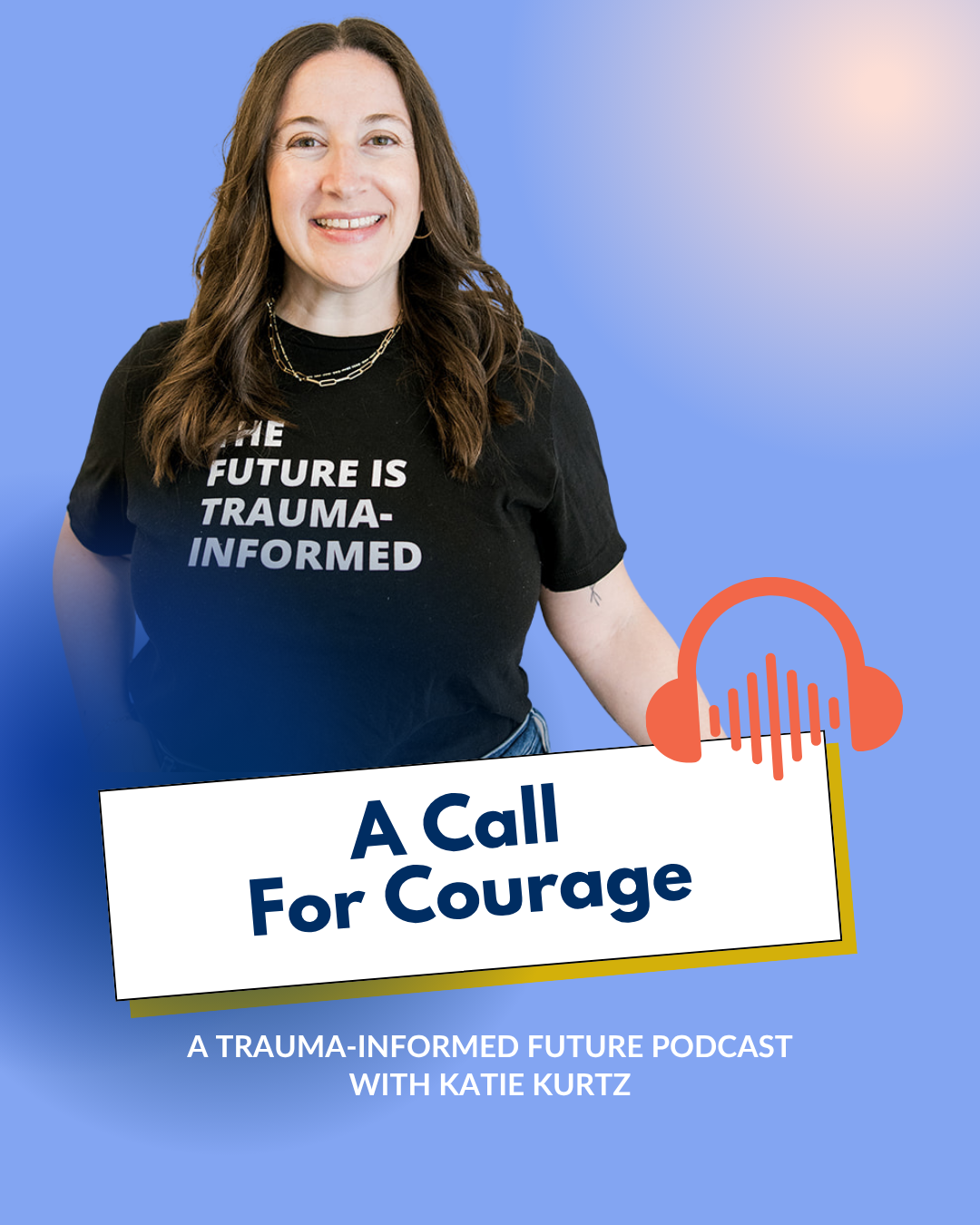
In this season finale episode, we are having a community meeting to compassionately and courageusly look at the choices we have to make in the coming weeks, months, and years. We are standing at the threshold of opportunity to open to lead our values out loud in the face of uncertainty, fear, and resistance. For those us willing to choose courage, how will we prioritize humanity in our own spaces and spheres of influence? This episode is a call to courage as a trauma-informed community to support each other in deliberately fostering connection and resilience.
Show Transcript:
Katie Kurtz (she/her):
Hi everyone. And welcome back to a trauma informed future podcast. This is actually the final episode of the season. As we wrap up and take a little break before heading into 2025. And as we do, I want to do a bit of a review on where we came from, where we're at and where we're going, especially when it comes to creating the trauma-informed future.
I'm recording this episode a week after the US presidential election. The last episode that I recorded was prior to that election and a lot has changed a lot hasn't. The results of that election, aren't surprising at least to me and many within our community as the roots of where we're at today are very deeply rooted in supremacy culture and fear and oppression.
And really [00:01:00] about this belief in power. Being finite and needing to at all costs. Get. Power take power, conquer over power coercion to get power money to get power in order to have it. But we know that is not what power is power is infinite that there is always enough power there's power around us power within us. And we don't have to take or hold it over others to access power.
But that power over dynamic is very alive and well visceral., although I'm not surprised and that America was just, being America. I feel grief. Grief is something I'm very acquainted with. And there are many levels and complexities of grief that I'm familiar with, and it's not just grief for myself, my future, my, my autonomy, my access and safety, [00:02:00] but really grief for my family, for my community for people who are going to be greatly impacted by and have been impacted by policymakers and these people who believe power is finite. And there is a surmounting uncertainty. And it's heavy.
It's a lot. And I want to name that the reason why I'm not surprised. And I say America being America is because there's a rich history here of us perpetually being shown the way to freedom and liberation and us not listening and us being the demographic I am in, which are white folks.
And I really believe as a trauma informed leader. We can't be trauma-informed for some and not all. We can't say we are a safe space or a safe person for some, and not all. This approach is not to pick and choose who [00:03:00] deserves safety, who deserves trust who deserves compassion and who doesn't, if that is where you or others. Are finding themselves and there are identifying and signaling to others, their trauma informed. That is absolutely not it.
I don't typically speak in binaries, but this is, that's not it. We can't. Actively dehumanize some people while claiming to uphold an, approach that was quite literally derived from advocates, activists, survivors, social justice movements that people are dehumanizing.
Like it just, it doesn't work that way. And I wanted to obviously have this episode as a wrap up of the season. And also as a little bit of a town hall community meeting for all of us for trauma informed leaders, whether you're curious and new you're emerging, you're experienced, maybe you're feeling the grief.
Maybe you're feeling confused. Maybe [00:04:00] you're feeling absolutely. Weary and tired. No matter how you're feeling I want to call us in to a moment of honoring our feelings, honoring our humanity. And to remind us me included. That trauma informed care is of the utmost importance right now. Because what's happening in America is a trauma response and what's likely happening. I speak for myself that I have definitely felt my nervous system, very dysregulated over the last week. And needing to take extra care, extra time extra rest. Both relaxation and actual rest to really deliberately practice joy and being and seeking out safe, healthy, nurturing community.
And there have definitely been several [00:05:00] moments over the last week where the fear and the hopelessness has crept up. It's so easy for me to get washed away with that. Especially as we look at the uncertainty of the future of trauma informed care of diversity, equity, inclusion efforts. And, we are at a threshold where people are going to need to choose to either stay back be held back in the comfort of being apathetic and quiet, or be Intrepid leaders and choose courage over comfort. And stay steadfast in their values. And what they believe in.
We can lead and choose to lead a trauma informed resilience focused anti-oppressive human centered life. But we have to choose it and that choice may be hard in the coming months, years. And it may feel feudal. [00:06:00] It may feel challenged. And it may even feel unsafe. And I want to invite us in. To pause. And continue to pause, but as Crystal Whitaker former podcast guests dear colleague and friend says "pause, but don't quit".
Find pockets of joy and restoration and nervous system tending. Remembering that resilience is relational and that resilience is our capacity to have resources and support and access so that we can. Have a little more capacity to show up when the stress and adversity and even trauma may arise again. We have to remember resilience is relational. And so we need to find safe, healthy, nurturing connections. We know that's the number one way to prevent, mitigate, and heal stress and trauma and diversity.
And so find those people. If you need and want and feel convicted to stay within your trauma informed practice because we need you. [00:07:00] Very much, we need you modeling and mirroring this approach. We need you helping us raise trauma awareness in spaces where there isn't any.
Remember we're your people, That we have community that we have a beautiful community of people. In our Trauma-Informed Leadership Studio where we talk about this, we have practice circles to co-regulate and discuss ethical dilemmas and Areas of strength and areas needed strengthening and peer support and truly a community of practice. Ongoing , education, resources, et cetera.
And just knowing people are in this with you and a place to also have a mirror reflected back to you of how to practice trauma informed self care to honor your pace, to practice critical thinking. Practice self consent.
something I've been thinking a lot about this week is how so many [00:08:00] policymakers people who are elected into office. Policies that are being written and approved and all these things happening that. are questioning or hindering or quite literally taking away the right to exist for some people, the right to access to healthcare for some people. The right to agency and autonomy on so many different levels.
When we have an absence of consent, when we have an absence of choice of self-determination. The wounding of that is going to be stressful. But depending on the context of where and how, and who is taking away our consent, our choice, or hindering, or barring us from that self-determination. That wounding can be so deep that it is traumatic. And so I want us to keep that in mind because , [00:09:00] those new wounds are happening or they're being reopened or they're deepening because of this election. And so if you are feeling that or you noticing it to others, remember how essential trauma informed leadership is.
And if it's ourselves we can begin to invite healing and resilience again, resilience is not pushing through it. It's nurturing our capacity. By practicing consent and choice and self-determination in the smallest and most meaningful of ways.
So perhaps you wake up in the morning and you get to choose what you put on your body that day. Maybe you're waking up, today I woke up and it was a very cold rainy day. And the last thing I wanted to put on my body was [00:10:00] cold, thick. constrictive jeans. I wanted to put on my body something warm and cozy and soft. You may think, oh, you're just deciding what you're wearing today, but choosing what to put on your body. In that moment asking yourself what would feel best for me? What would make me feel the best? What would make me feel. Allow me to fully express myself. Is something you can consent to in this moment and choose, which is a small act of resistance. And a way to reclaim your consent, your autonomy, your agency, yourself determination.
And we can do that in really small ways, but don't dismiss small don't dismiss. Simple. We can do this in so many different ways. This is why art. For so many reasons is so powerful. When we are given a prompt and given mediums and then told to create something. Yes, sometimes feel overwhelming for [00:11:00] many of us who may have. If you don't have artistic experience or you don't you. Fall into the thought that you're not a creative person. We're all creative beings. We're all creating all the time. But what a beautiful container, an example of ways we can practice consent and choice and autonomy through art.
By singing by music by poems by writing. By paint by collage, whatever it may be. Just being, given something and saying, I'm going to do whatever feels right for me. And it's again, a small, but meaningful and impactful act of resistance and reclamation. That I can choose what I want to paint. That I have my choice to go this way or that way. That I can determine the outcome and the results. And no one else can do that for me.
We can also use movement as a way to do this. Through simply saying, I want to move my body in a certain way. And that's why having trauma informed spaces, [00:12:00] especially in any type of places we're putting our bodies. Fitness studios, spinning studios, yoga studios. gyms. Etc. How can I choose in this container and how can I, the space holder create containers where people can move their bodies safely where people can move their bodies in a way they can choose. They get to consent. They get to determine we provide the space and the path and the container.
Being told if you're on a yoga mat. You can move into a shape that feels best for your body. Again, may feel overwhelming because maybe we haven't been given as many opportunities or spaces to show up and choose. So what a radical act of resistance and reclamation. To be on a mat to be on a bike, to be in a space and consent and choose to move your body into shapes at a pace. In a way. That is solely your own.
There's going to [00:13:00] be a lot of things on unfolding over the the weeks and months and year ahead of us. But one thing will always remain the same is that trauma informed leadership is essential. And we must choose it. And we have to sit here as trauma-informed leaders who are co-creating the future. Which has already begun. To say, will we stand back and let fear and let the unknown. And let what's easy be our choice. Or will we choose to listen to the people before us who have spent centuries in this position. Who have survived who have survived it. Who have. Found ways to move through it and build their own resilience capacity.
Will we listen to them and then do that work within ourselves within our own bodies within our partnerships, our families, our friends, our communities. And will we choose to take [00:14:00] the brave, bold choice. Of rooting into our values. Our principles and choosing courage to show up courage over comfort, courage over apathy. Courage in the face. Of. Fear.
And will we choose. To choose compassion. We choose humanity. And as for me and my house, we will be choosing the path of courage. It won't be easy. There'll be times we want to hide. And when we do, we're going to pause. We're going to rest. We're going to tend to our nervous systems. We're going to reach out to community for accountability and support. And then we're going to get back up and keep going.
But I don't know any other choice.
I can't imagine choosing any other way than to stand. Forward and face what's ahead by rooting down in my beliefs and values which are trauma-informed principles. And to stand [00:15:00] with to listen and to stand up for those who hold intentionally in historically marginalized identities. And continue to unhook. From the oppressive systems that everything we're seeing right now is rooted in.
So a big deep breath, my friends. I'm in this with you. There is a resilience roadmap and it is trauma informed care. And we know when I say trauma-informed that also means the intersectional practices of anti-racism anti-oppression. Liberation neurodiversity affirming care.
If you are just listening to us now, and maybe you're curious about learning more. Or if you've been with me in your, in community with us and you are wanting to help be a part of the groundswell raising awareness around trauma. Or perhaps your eye, you identify as trauma informed and you want to be better about communicating what that means to people.
I invite you to join me on November 20th at 2:00 PM Eastern standard [00:16:00] time for Beyond the Buzz workshop, this will give you tangible strategies on how to demystify trauma, which has become, labeled a buzzword. To really understand it and be given clear communication on ways to not only raise your own trauma awareness, but help raise trauma awareness around other people and use strategies to better communicate and invite people in to trauma informed leadership. So this workshop will be recorded and available for 14 days after. It's $35. USD. I invite you to join us. I invite you to share it.
And again, I will say this. Many people hold an outdated and narrow definition of trauma, viewing it merely as a specific event that triggers a psychological reaction. So this perspective, mistakenly identifies trauma as the event itself, rather than our body's response. Implying that trauma affects only certain people. [00:17:00] Therefore we begin to other, oh, that's just those people over there. Those people who've only experienced those terrible things. That's not me. That's not my family. That's not my neighborhood. It's those people.
I have led trainings and workshops and speaking for thousands of people. Even just over the last few years and within the first five to 10 minutes of talking with them. I use these tangible strategies I will share in the Beyond the Buzz workshop on November 20th. And I am able to help raise trauma awareness, reduce this mentality of othering. And help invite people into expand their empathy and understanding. The trauma awareness workshop I've historically done over the last several years. A hundred percent of survey results has shown that they want to learn more. And that's after obviously like a full hour of the workshop.
But I'm going to give you the strategies, the communication. First of all, invite you in, if you're still skeptical, you're curious. You're [00:18:00] unsure or, someone who is to invite them in to hear this, but also give you my fellow trauma-informed leaders. Tangible strategies to help raise trauma awareness, wherever you are in whatever field you are, whether it's personally or professionally. These are really proven strategies to clearly communicate what trauma is and what trauma-informed care is so that we can invite people in to join us in co-creating this future together. So that workshop is Beyond the Buzz on Wednesday, November 20th at 2:00 PM.
Eastern standard time. Again. I know we're all in different time zones. It is recorded and available for 14 days, just again, not to put limits, but more so to encourage the natural urgency of the importance of these conversations right now.
I planned this workshop. Pre-election this was already planned and ready to go. And it just proves that no matter what's happening in the world, this is needed. And there is this sense of not necessarily urgency, or [00:19:00] pressure, but this need to again, root down in our convictions and our principles and values.
And this is one way we can do that by really giving ourselves those key strategies to invite people in , with us to co-create this future. So I hope to see you at, Beyond the Buzz November 20th, 2:00 PM. Eastern standard time.
And between now and the next season, which will come out in 2025. I hope you can find rest in all its forms. I hope that you can find points of relaxation. I know that's really hard for me and my nervous system. And so my partner. I were just talking last night. Like we're really going to focus on that together and support one another in that. Really ensuring we're finding simple joys throughout the day community.
And not virtue signaling, but actual signaling of safety to others through our actions. By leading our values out loud. Because that's what needed, we don't need [00:20:00] bracelets. We don't need shirts. We don't need black squares. We need to action. We need to show up. We need to listen. We need to support. And we need to lead out loud. And please be sure to take care of yourself. That's how we sustain. I always say trauma informed care is a long game. This is why we need to focus on tending to our nervous system so we have the capacity for the next weeks, months, years to come.
And know that you're not alone. Find community, wherever you can know that our community, our doors are always open to you and the Trauma-Informed Leadership Studio. And keep breathing. Keep coming back to your breath. I'm in this with you. And we will talk soon in the next season to come. Take good care.
