

Acknowledging Collective Trauma
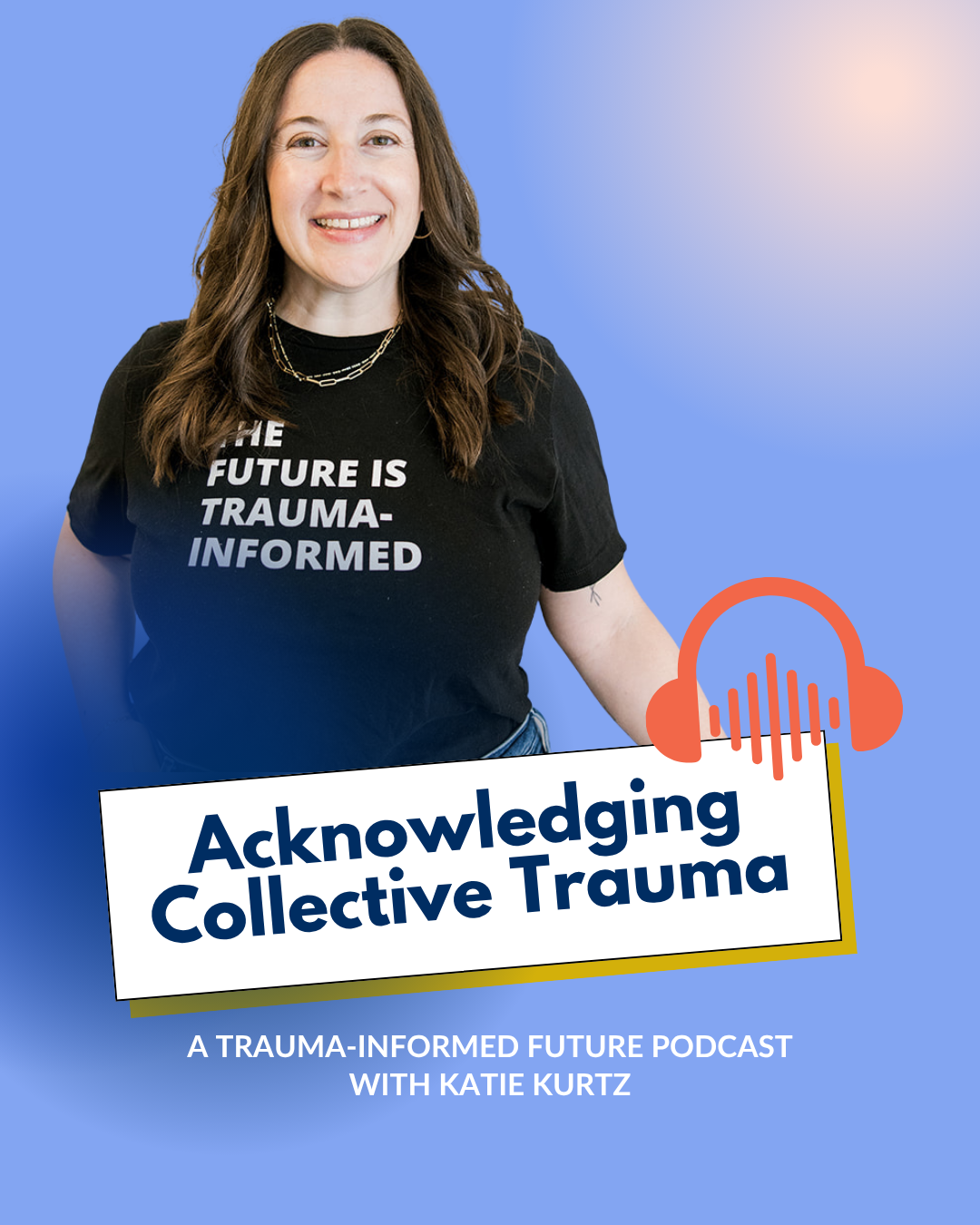
That palpable feeling of exhaustion, looming uncertainties, mounting moral injury, fast pace demoralization unfolding on our screens and in our streets. It's not an overreaction, it's collective trauma. Let's name a thing a thing and begin to look at ways we can begin to navigate how to live and lead during these times. Denying, minimizing and bypassing the realities of what is happening right now in the U.S. is not helpful, it's harmful. You don't have to know how to show up right now-let's be real, most of us don't. In this episode of A Trauma-Informed Future podcast, host Katie Kurtz shows us how we can make the courageous choice to utilize empathy as a strategy to help promote sustainable resilience on personal and collective levels.
Watch this episode on our new YouTube channel
Show Transcript:
Katie Kurtz (she/her):
Welcome to a A Trauma-Informed Future podcast. I'm your host, Katie Kurtz, a subject matter expert and approach called trauma informed care. I specialize in supporting people and companies in advancing their trauma informed principles, strategies, and skills .
I am joining you today to practice, some trauma informed leadership. Let's begin by acknowledging the times we're living in. It is February 2025. I live in the United States. And right now we are being faced with a compounded, poly, systemic, Crisis from our, the new administration an upheaval chaotic times happening at the federal level that's trickling down to states and local communities natural disasters, especially just the recent fires in California and so many things happening, unfolding before [00:01:00] our eyes, both on our screens and in our streets.
And I want to name a thing that what we're experiencing right now is collective trauma. We're feeling it both on a personal and collective level. And I think it's really important in times of stress, crisis, trauma, that we acknowledge and name what's going on. So as a trauma informed leader, one of the biggest principles is trust points, to have trust points that lead us to safety.
And in order for trust to be felt to lead us to our safety, we have to use the strategy of reconnection. How do we reconnect people to safety through trust? And that's what trust points are. And so trust points are various different strategies and skills utilized to lead people to build trust.
Because trust is not assumed, it's built over time. Transparency, transparent communications. Communications that are predictable, consistent, are how our trust points, it's how we build trust with other [00:02:00] people.
Like anything, if you're trying to decide what car to buy, and the car dealership is not transparent about the car, the type, the history, etc. with you, then how are you to trust what you are buying is a sound purchase?
We can think of this in the same regard if we are not being transparent with each other, with our colleagues, our teams, our clients, our communities, how are they supposed to put trust in us and what we're saying, what we're doing, et cetera.
And so when it comes to trauma informed leadership, transparent communications, transparency consistently and predictably is baked into everything we do. It's baked into our communications, it's baked into our skills, our relationship building, our critical thinking, it's just baked in, it becomes an intuitive thing, we just automatically apply, so we don't have to wait till times of [00:03:00] crisis, we don't have to wait till the things get really bad and boiling over, alarm bells going off, which is what we're living in, and so when we talk about these times, quote unquote, because I name it, it's collective poly trauma, right?
But most people don't have that language or not open or at a level of readiness to receive that language. So I've just been using this quote unquote these times because there's a lot going on and it's, we're feeling it on compounded layers, right? We're feeling it personally on an individual level.
We're feeling it professionally, whether or not you work within the government or have connections to the government. It doesn't matter. It's impacting all of us. It has a ripple effect across every industry and field.
It doesn't matter if you live in the U. S. or not. You're feeling the impact of it, whether you live in Canada or Mexico or anywhere else in the world.
We're also feeling it on a business level. Our clients are feeling these impacts no matter what profession you're in. We're feeling on a collective level.. Collectively as a community, as a culture, [00:04:00] and we're feeling the impact of policies and so there's a lot of compounded layers.
And I think what we're seeing, what I'm seeing as I'm in communications with my clients who represent government agencies, higher education, healthcare, hospitals, but also corporate small businesses, again, I work across industries, is that We're finding people trying to move for business as usual, but this is not usual.
It's not usual to have a government coup. It's not usual to have federal funds freezing in this way. It's not usual for so many unlawful things to happen. And although we may not be surprised or shocked by these things, it's still happening. And it feels like a shock to our system.
An overwhelming or extreme amount of stress is what trauma is, and so it's important to remember you don't have to have the answers.
No one's expecting you to. Even for those of us who have done this work for a long time, we don't have all the [00:05:00] answers or solutions, right? We're figuring it out as well.
So there is no expectation for you to have all the answers or the solutions. But what you can do is acknowledge What's happening, even if you don't even need to go into the details, you have to be the most informed person, but just acknowledge there's a lot happening right now, a literal dumpster fire of things, and that it has a varying levels of impact on all of us and just acknowledge that and see what happens.
When I acknowledge that when I start meetings, when I start emails, when I notice, you Yeah, thank you.
Thank you for acknowledging that. I've had many people in the last week say, Wow, you're the first person to actually acknowledge what's going on. Thank you.
Come on, y'all. We can do that. We can do that. We can acknowledge what's going on. Another thing we can do is validate. Remember, validation does [00:06:00] not equal agreement.
But we can validate because when we validate, that means we are seeing, we are hearing, we are honoring the person or people before us. I I just want to validate your feelings. Yeah. Feelings of anger, feelings of grief, of fear, uncertainty. Yeah. Those are really valid feelings when experiencing collective trauma, right?
You may not know how that feels. You may not have that same experience. You may not even agree with certain people, but we can still validate them.
Acknowledgement and validation so key right now two major trust points that reconnect us to a felt sense of safety. And we're talking about safety. We're not just talking about physical safety.
We're talking about psychological safety, social safety, moral safety, cultural safety, and we are going to be faced with choices each and every day.
We can start a meeting by acknowledging the times. Then we might need a little more grace and [00:07:00] space and care right now because there's a lot coming at us.
There's a lot coming at our families and our friends and our communities and our country. Or we can choose to ignore it. We can choose to bypass. We can choose just continue business as usual.
And you're going to be left with a choice to choose comfort or to choose courage. Now, I'm not going to negate the nuances here that sometimes we have to make the choice that is safest for us in the moment.
And especially for those of us who hold intentionally or historically marginalized identities, we may not be able to acknowledge the times because it is unsafe for us. For the very reason of why these times are timing, so please honor that nuance.
But for those of us who look like me, who hold a positionality and social location that allows us more ability to acknowledge these times without retribution or repercussions, we need to literally look and see [00:08:00] what are our values telling us?
What are our principles telling us? Is it telling us to be quiet, or is it telling us to name a thing? And I really hope and encourage all of us to name a thing. To choose courage over comfort, as Brene Brown says. I don't know how to lead during these times. I'm doing my best.
What I do know is that we've been here before. I've been here before in leading during times of collective trauma and what I am doing though is listening, tuning in, being in spaces with people who have historically faced these times before, who have Experienced situations, ancestrally, intergenerationally, and I'm listening to them and seeing how they're showing up and and learning and being led by them.
And that message typically, and that solution, quote, unquote, is typically community, right? [00:09:00] Resilience is relational. We need each other. And so how are we leaning into community?
I created a free guide for you, for me, for all of us on how to acknowledge, these times right now. I broke it down from formal to informal, personal, if it's like a one on one personal relationship and a more advanced level for those of us who are trauma informed and really want to use this language as a part of our everyday use.
So I have that as a free guide. I will link it in the show notes, or you can go to katie-kurtz.com/ podcast and find the show notes there for you to access this free guide, take it, use it, adapt it to your own, tone of voice, your own, words, whatever you may do, it's just to give you some guidance on how to acknowledge, just practice transparency and acknowledgement.
I am also planning to hold a trauma informed town hall with myself and other colleagues just to give an update on where we're at and where we're going, the future of trauma informed care and really, again, to build community and [00:10:00] solidarity right now. So if that's something you're interested, be sure to sign up for my email newsletter or follow me on social media so you can get the updates. We're just solidifying the date, but it'll be sometime in early March.
Let's just take a collective breath. These times are a lot, they're a lot, I'm feeling it and I'm feeling it from a personal perspective as a caregiver. I'm feeling it as a social worker who I am an adjunct professor teaching and I'm seeing this, my profession struggle during these times as a business owner.
And just collectively, and I want to name one more thing before we go today, and I'm going to do a podcast specifically on this, but it's the increase in moral injury that I am witnessing both within myself and others.
Moral injury is when we hold values, beliefs, principles, and we are then asked by our workplace, our system, our communities to go against those things, or they rub up against those things, and [00:11:00] that creates a friction.
And when that continues to create friction, it creates a wounding. And if that wounding is not recovered or healed, it can lead to burnout and trauma.
And we're seeing a lot of moral injury. And we know moral injury Has primarily been studied within military and first responders and health care.
We saw a lot more talk during the pandemic, which gave rise to moral injury, especially in health care. But it can happen anywhere, right? When we have values and beliefs and when we're asked to go against that, especially professionally, and when we're seeing these mandates, when we're seeing funding freezes, when we're seeing certain words we can't use be flagged That's when a moral injury occurs, and if left untended to or consistently exposed to, it can lead to burnout and trauma.
And so we need to be acknowledging and validating that this isn't just sensationalized news. This isn't just, the president being the president or people overreacting.
[00:12:00] Talking, naming, acknowledging, validating what's happening right now is not fear mongering. It's not being paranoid. It's not overreacting.
These are very real things happening in time, and the distractions, the placating, the gaslighting, the bypassing is all used as tools to suppress, to distract, to get us to believe a narrative that is keeping us distracted enough to not pay attention to what's actually happening.
I work across every industry. I am seeing the effects of what is happening, the direct impact. And yes, there is hope there are lawsuits. There are people , activating communities and organizing and coming together. But we can't just rely on that. We need to also find what our role is. What role we play?
What will we say? What will we do? What will we not? And just Acknowledge and talk.
We need to bear witness. Remember, resilience is [00:13:00] relational, and when we're able to pause and be with and listen and bear witness to one another, that is how we nurture that capacity, that nervous system capacity to build resilience, which we need our resilience reserves right now.
So again, deep breath reminding you that I'm in this with you and that there is a free guide. If you just need some words or examples or take it word from word, it's in there for you. If you need it, or maybe you know somebody who does need it, feel free to share it. Again, you can reach them in the show notes, katie-kurtz.com/podcast.
Stay tuned for the town hall and more episodes to come.
If you liked this podcast be sure to leave a rating and review subscribe. Those things really help me support this podcast without ads. And also it helps generate. more awareness around trauma informed [00:14:00] everything.
Clearly we need trauma informed everything right now more than ever. And so by subscribing, rating, and reviewing, it helps increase visibility and access to people. Because sometimes we don't know what we don't know until we know it. And so this may be the thing somebody needs to lead and choose an empathy forward approach.
All right. Until next time. Take good care.
