Nervous System Resilience with Jen Schneeman
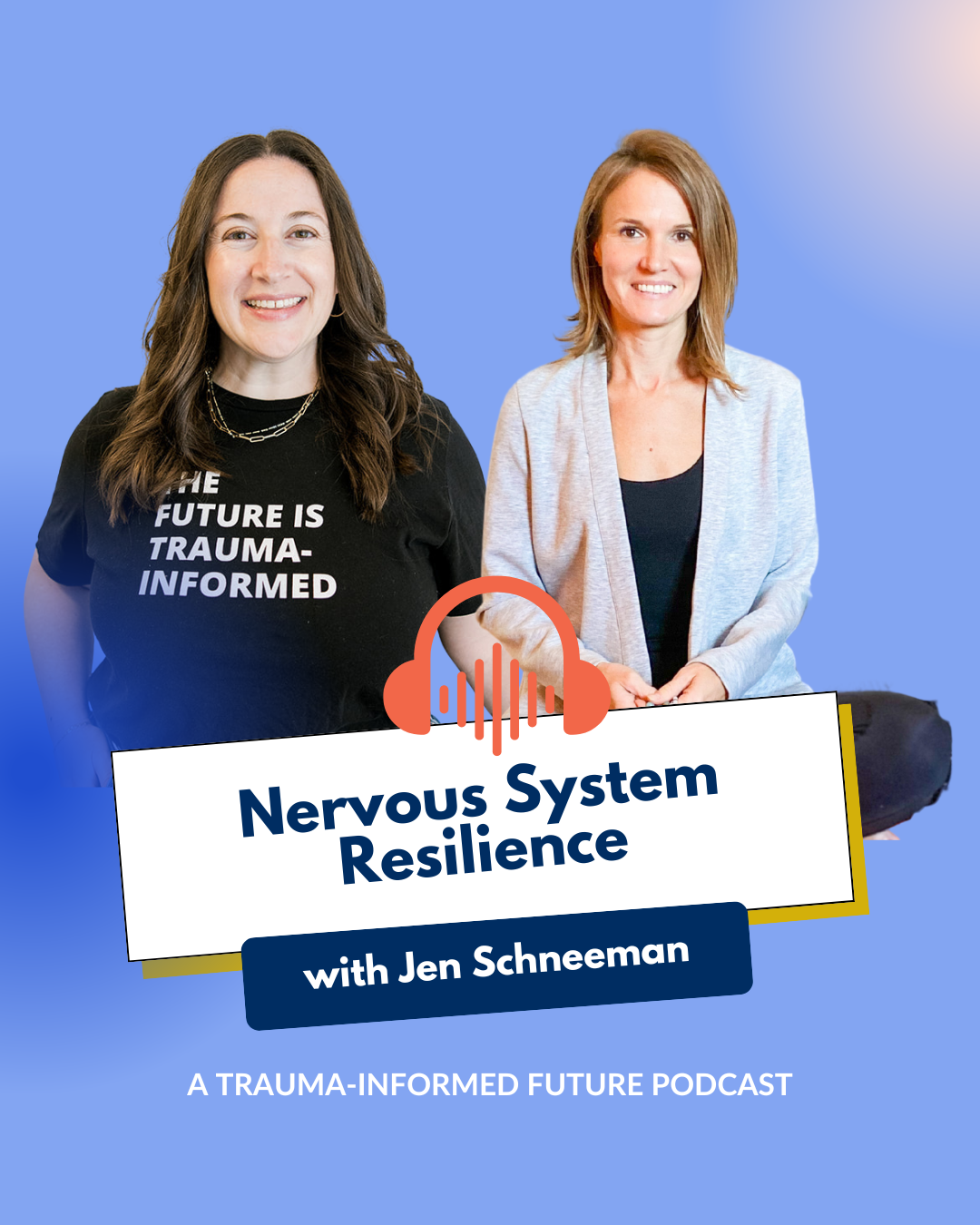
How do you define resilience? In American culture, resilience is often equated with “pulling yourself up by your bootstraps”. But in reality, it is all about. nervous system capacity. In this episode of A Trauma-Informed Future podcast, host Katie Kurtz is joined by Jen Schneeman for a rich, trauma-informed conversation that challenges the idea that people should simply “bounce back.” Together, they explore the difference between resilience and malleability, drawing on neuroscience, somatic wisdom, and lived experience to unpack how stress, trauma, and healing live not just in the mind, but in the body.
Learn more about Jen:
Jen Schneeman is a soul-driven scientist, holistic mental health coach and trauma-informed nervous system specialist who helps individuals and communities reclaim personal energy, prevent burnout and live in their bodies with ease. With a deep understanding of the nervous system, trauma recovery, and human energy patterns, Jen bridges science + spirit to guide people toward resilience, self-trust, and inner freedom.
Jen began her career as a science + tech advisor with the Defense Advanced Research Projects Agency (DARPA), Defense Sciences Office, and later as a Deputy at the Air Force Research Lab, Human Performance Wing. There she managed a collaborative research portfolio focused on how nutrition, disease, brain injury and stressors uniquely affect human susceptibility, resilience and future determinants of health.
Her lived experience of toxic stress-related burnout in a post-9/11 environment catalyzed her personal and professional transformation. Jen committed to the applied science of therapeutic mindbody connection programs to support sustainable healing and energy restoration. She knows firsthand that no amount of bootstrapping can truly reignite a system shut down by chronic stress, concussion, addiction, trauma, or pain — but that regenerative nervous system care can.
Jen brings this knowledge to life through her Self-Care and Resilience (SCAR) program, a multi-tiered nervous system restoration framework tailored to reduce stress, improve coping, and restore vitality. Her signature offering, Everyday Resilience, empowers people to stay present in joy and grounded in struggle using the ABCs of Presence that makes recovery and regulation tangible, practical, and embodied.
She has brought trauma-informed, nervous system-based programming to three VA Medical Centers, PTSD and TBI residential programs, addiction treatment centers, treatment courts, support groups, and beyond. She has also launched mindbody connection programs within two NFL teams, three military branches, four addiction treatment centers, dozens of corporations, hundreds of veterans and thousands of medical, mental health, and caregiving professionals.
Today, Jen facilitates resilience-based programs for medical professionals, caregivers and survivors of sexual assault, addiction, PTSD and brain injury. Since COVID she expanded programming to real humans just like us.
Jen is a sought-after public speaker, coach, facilitator of retreats and workforce wellness trainings, bringing humor, depth, and practical wisdom to her audiences. Her work is featured across local and national platforms, with data outcomes presented at major behavioral health conferences. Her passion lies in making mental health education trauma-informed, accessible, and regenerative. She’s also deeply committed to the power of peer support, serving as the resilience coach in Hey I’m Here Ohio, a youth-led movement growing resilience in Ohio’s young people.
She is also a mother, spouse, nature lover and an adventurer who values autonomy, awe, connection to spirit and walking barefoot. Her personal healing journey informs her work and fuels her mission to build a world where trauma-informed nervous system literacy is the norm, not the exception.
Connect with Jen:
Website: www.realhumanperformance.com
IG: realhumanperformance
LinkedIn: www.linkedin.com/in/jen-schneeman
Show Transcript:
Katie Kurtz (she/her): Hi everyone, and welcome back to a Trauma-Informed Future podcast. I'm your host, Katie Kurtz, and I am excited to be joined here today with Jen Schneeman. Welcome, Jen. So happy to have you here. Welcome.
Jen Schneeman (she/her): Thanks Katie, and I so appreciate the invitation.
Katie Kurtz (she/her): Absolutely. So Jen, let's just get started by having you introduce yourself in your own words to everyone.
Jen Schneeman (she/her): So I'm a soul driven scientist. That is what I do. I bring the left brain and the right brain folks together in conversation and love to talk about all things nervous system. I'm a trauma-informed nervous system specialist and a burnout prevention coach. I look at mental health from a holistic lens, and so as a holistic mental health coach and a chemical dependency counselor. I work with the whole person, whether it's in prevention and recovery or just in everyday, everyday resilience programs.[00:01:00]
Katie Kurtz (she/her): Awesome. And I know you have such a breadth and depth of. Experience and knowledge , and lived experience too. Both lived and learned.
So I'm curious, Jen, so often I just love hearing how people come into this practice, come into trauma informed care and whatever interpretation you hold. And I'm wondering if you could just walk us through, , how you got to where you are today being a trauma-informed nervous system specialist.
I asked this selfishly, because I also know a little bit about it and it, I think it's so intriguing and interesting and I think it's fun to share with people listening.
Jen Schneeman (she/her): The Odyssey question, right? Yes.
Yeah, so the trauma-informed lens that I live by is both personal and professional, and it's woven together over time.
And it really started long time ago, 40 years ago, when I was six years old, and I realized that I could see and experience energy and [00:02:00] it was. In that time that I knew that I looked at the world and experienced the world a little differently and just didn't really have language around it yet. And fast forward many years, and I found myself in health and human performance after moving 33 times and going to about six different schools in seven years.
I realized that I had this resilience and I believe that we all do, right? We are all born resilient, and it shows up and it shines differently. And just my experience of moving showed me so much about coping skills and also what's, made me curious about the right way of moving through life.
Fast forward, finding myself in health and human performance working for the Defense Department. Really, my first real job, I was looking at the World Bank or at the Defense Advanced Research Projects Agency, and it happened to be that I leaned in towards the defense sciences [00:03:00] office and I was a science engineering tech advisor, really looking at real world technology.
That had huge impact. So both impact in humanitarian, it's a dual use technology, both the humanitarian and military applications, but looking at biology and emulating nature in a way that helps us as humans advance our technology and have tools in hand to meet the stressors of the moment, which was at that time.
Post nine 11 environment. So this was 2002, 2003, and the world was just changed so fast for all of us, and science and technology were a huge component of that tooling and still is today.
Katie Kurtz (she/her): Thank you for sharing that. You talked a little about resilience and I'm curious. I'm a big fan of creating shared language, understanding, and I think resilience is one of those terms that we hear a lot.
We all have [00:04:00] different, we come into that experience very differently. I always shared, like when I was growing up, my Aunt Gerry, who is like a second mom to me, always told me like, you got it out, right? Resilience is like you just. Gut it out. And it's this like perseverance. It's just you don't like your job, just gut it out.
And she learned that from her mom, who learned it from her mom who immigrated here. And it was like, that's literally how they survived was just like, keep going. And later in life I realized, all right, that's not exactly what this is. That was more of like a survival situation. There's some truth to it, but I'm curious if you can define like what does resilience mean to you, and especially how it is, how you look at it now through the lens of the work you do, and maybe share a little background of the work you're currently doing.
Jen Schneeman (she/her): I love that you bring it back to language as you often do, Katie.
Words matter, right? And words hold energy, expression, our beliefs, and [00:05:00] as a society, as a culture, we also have all of these. Sayings like nose to the grindstone bootstrapping it all of these terms, the beliefs that further ingrain us just getting through it and it is survival. So I think that there's a, we have a culture in that and that each of us are born resilient, and yet we can also cultivate our resilience.
There's something to be said for. Just our circumstances are what they are, but we don't let them define us. I think that's there's beauty in that and real resilience. And as a trauma-informed nervous system specialist, I look at it as real time resilience just to know where we are, knowing how we're feeling, and the ability to have.
Agency and choice and not judgment, compassion in that moment to lean on, to be able to access those skills that we have to meet the moment to guide us through the moment or just to be where we are with a little bit more [00:06:00] support. And I think that's the. Honoring that wisdom of our body and honoring the wisdom of our coping skills, whatever they have been.
And seeing that there is, there's always an innate wisdom that sees us through the moment. 'cause we've survived a hundred percent of all of the challenges that we've experienced thus far. So that to me is just resilience. It's ingrained, but we can also hone it .
Katie Kurtz (she/her): I think, it's been so interesting to witness the evolution of resilience. I think we've heard a lot of it, a lot more discussion of it, especially as we live through a pandemic and something I consistently heard through the pandemic was, well, especially concerns regarding the rising mental health crisis within youth. And this well, kids are resilient, right?
They're gonna be fine. They're resilient. Dr. Bruce Perry, who's we, are both familiar with a very renowned [00:07:00] neuroscientist trauma specialist says, kids aren't resilient, they're malleable. And he, in his book what happened to you with him and Oprah Winfrey talks about this resilience.
Resilience and malleability and malleability kind of being resilience being like a Nerf ball. If you squeeze it, it like goes back to form. Whereas malleability is like a iron hanger that if you move it, you can move it back to its form. But unless you're like an expert hanger maker, you can never quite get it back.
And, that visualization always stuck out to me. As the like the subtle differences and kind of to your point, like language does matter and like how we create our realities around certain things. There's these very similar notions, right? But very different and. [00:08:00] Assuming a person or a group of people will just be resilient.
Yeah. There's going to be an essence of that. That's just like how we survive as humans, right? And that nuance of, and both and also there needs to be tools and support and these other things that build our capacity to keep continuing forward.
Jen Schneeman (she/her): In these unprecedented times, right? Yeah. This is the first time we've all collectively been here and the pace is just misaligned with our spirit, and I feel like that's part of the challenge that we have.
With resilience and with burnout specifically is just these unprecedented times. It also, hearing you talk about the Bruce Perry's that iron hanger, it makes me think of fascia and the thread, how I move from health and human performance into. Somatic mindfulness is really through the doorway of trauma-informed [00:09:00] and trauma responsive yoga therapy and bringing somatic practices to VA PTSD residential programs and TBI residential programs because to understand that the trauma.
The trauma lives in the body and how the fascia itself is representative is the communication highway. It does communicate our experiences, whether we're communicating that to ourselves about aches and pains and triggers and stressors. Also, how we. Literally take shape and hold ourselves. Whether we're, broing ourselves out, making ourselves more bigger or collapsed in, in that experience of life.
It is just that the fascia has just that imprint that carries us through in the way we talk about ourselves and how we show up in space. And then the beliefs that we carry. Just trans transmit non-verbally. Just by the way we carry ourselves. So I'm very much, although I've always been super sensitive to energy the subtle energy system is not so subtle [00:10:00] to me.
It's very visceral, very physical. We all have that experience of how energy moves through us, how emotions and thoughts impact our physicality, and it's a part in. In psychology that is coming online more now, but that's part of the role that I have, is how to live in, when I train therapists and social workers and peer support specialists and individuals, it's how to live in our body with more ease to make space for all of that nuance, that experience, the belief, so the layers of energy.
The interconnect. To me, that's the trauma-informed resilience is whole person.
Katie Kurtz (she/her): I love that you talked about the fascia and like I always say, the issues are in our tissues, right? Like we have to, we this delineation of brain and body as if like we have these floating heads. And I love that connection you made because that ener like we hear energy.
I think, again, people may conjure different [00:11:00] ideas, but we're also talking about like our nervous system mirroring, like how we mirror and how, we walk into a room, we can feel, we're gonna feel and sense before we can, it gets to that cortex, our brainstem, that part of our brain is already detecting what kind of space is this, what's the vibe?
How am I gonna, is this safe or not safe? And. That reconnection back to co-regulation is so, I just love how interconnected it is, and I love that we're starting to see a movement towards the interconnection rather than just everything being so piecemealed and siloed. And I think you represent and embody such a beautiful way that interconnection of all the things, especially the work you've done and demonstrated of taking something that traditionally would not be in, certain spaces and bringing it into those spaces. Yeah, I think it's so, it's exciting and it gives me a lot of hope to [00:12:00] see that movement.
Jen Schneeman (she/her): That means so much to me, and hope is one of the essence that burns eternal in eternally in me. And it gives me hope as well that the more that we can welcome our whole human self and we can welcome the other and have space for their lived experiences, their whole.
Self, the more chance we have of building this community, that's a collective where we can all have a space to live and be, and that energy, we know when a party is live or when it's, when there's something that's just a little off. And whether I'm speaking to the most. Entrenched person that doesn't talk about energy.
They know when someone's behind them. We have a sense of that, especially when we're living in survival for so long. So when talking about the language of the nervous system, I love bringing in the energy of the science. The science of the nervous system and really the spirit into this [00:13:00] conversation.
I don't know about you, but in conferences, I've just seen this readiness of people to talk about this vitality, this essence that is either with us or has left. And to me that, I mean, the getting into compassion fatigue and vicarious trauma and burnout is such a. Talking about energy and what depletes us and what sustains us is just so fitting in that conversation.
Katie Kurtz (she/her): Yeah. So agree. And actually I'm glad you brought that up because I think those three terms are so. Blaringly obvious right now, right? Like burnout, compassion, fatigue by areas, trauma, like I've known what they are. I've experienced all of them for many years as a, practice social worker. But I think, again, this is so common, right?
People are always like, oh, it's such a buzz word. I'm like, is it, or do people finally have language for what they've always been feeling? And now they're [00:14:00] equipped with more information. Maybe that's it. So reach it. Reach it. Yeah. So like maybe that's it. And maybe people finally have language understanding for what they've experienced and now they can, now you don't know what you don't know till you know it.
So now there's ways to find pathways to healing. And so I'm curious if you'd be able to share a little of insight again, back to shared language and understanding. Kind of the difference between these things, but how they're interconnected, burnout, compassion, fatigue, and vicarious trauma.
Because I think as we start to hear more of these terms I am seeing some misunderstanding or just lumping them all together as the same thing. And although very separate but interconnected I'm curious if you could help shed some light on that.
Jen Schneeman (she/her): Absolutely. And it reminds me of just the neuroscience that we have, that it takes time for the brain, for the cortex to catch up.
[00:15:00] Right. And so when you talk about now having language and how often have you seen in the conferences and meetings that you've held space and facilitated where people go? Oh. Right. And it's deep. It's a lot. When we have these aha moments in real time, I'm getting goosebumps just thinking about, the, just the emotion that's present when we realize this is what happened to me.
Oh my gosh. And having experienced burnout myself for solid times, I realized that it was a communication, it was a nervous system. Issue is an energy issue, and to me, burnout is simply the inability to hold a charge.
At the, and it comes back to containment, and when we talk about a container, a safe container, a clear container, I'm thinking about porousness.
That, that sponge, right? When we think about all the caregiver caregivers that are out there, most of us are also empaths and sensitive to other people's situation, energy, their, the human experience we have, big hearts and also very porous. [00:16:00] Energetic boundaries. And when I talk about energetic boundaries and redefining them, it's very much rooted in science.
There's a little woo in there too, but you know, the woo was around before there was the language of the neuroscience to explain what was really happening. And a lot of this is psychomotor skills and psychomotor education of how to. Do these micro slow movements, something as a society, we're not great at doing slow movements.
We're used to doing lots of reps and, squatting all the pounds. I know this, I owned a gym for 10 years. And so it's very much how can we create safe containment, create a safe container for us to hold the energy that we're experiencing, whether it's the energy of discomfort or comfort.
And as someone that has experienced. Stress, chronic stress, traumatic experiences, the container and the energetic skin, the energetic boundary becomes porous. Those matching pictures to someone [00:17:00] else's experiences lights up something through resonance and us that it's more challenging. Without skills and without everyday application of these skills to recognize whose energy is it?
Is this my stuff or is this the other person's? And I think I'm gonna take a pause there be, but that's one of the biggest differences that I see.
Katie Kurtz (she/her): I love that. I've never heard anyone explain it that way, and I think that is such a comprehensive and tangible way to understand it. Associating it with a charge.
Especially because like we in such a, like a tech phone, like we know we compare. Right? Here's my phone, like battery not charging out. And also using that as a metaphor symbol like. What happens is things start to slow down. The closer we get to depletion and like then what we were out of our basic need to [00:18:00] communicate with the world around us or get find a map or do whatever.
But that porousness, that created such a visual for me that I think is, I haven't heard anyone share it that way, and I really. Really appreciate that. I think that's so helpful. And I think whenever we can take complicated things like the brain and the body and the nervous system and make it tangible, people get it.
We get that. Oh, that's what you're that, that's what you're talking about thing. And I think you and I share this. Mission of trying to help people get there so that they can use this. Like we want people to use it, right? We don't wanna just live in concepts and theories. We want it to be practiced so that we can start to feel it around us and overwhelm us rather than, in a good way, rather than in [00:19:00] a depleting way.
Do you mind sharing kind of then the difference between burnout and compassion fatigue? Because I do think compassion fatigue is so prevalent yet, so it's still a newer term, kind of similar to moral injury, although been around, both have been around for a while named and not named previously or studied.
But I do think those are so again, interconnected. But, tend to get lost or lumped together.
Jen Schneeman (she/her): There's a lot of nuance and you speak very clearly to nuance. So I hope we get a chance to talk about moral injury. It absolutely talk about it. Let's do it. It's one of those topics that, like you said, it's been around for a long time and I think how it intertwines the nervous system so clearly is that, well, I'll tell you a story for in the PTSD residential program, and even now working in with stress related [00:20:00] disorders, we see a lot of.
Symptoms of anxiety, those, that higher charge, right? More the sympathetic dominant experience of the energy. And what I was seeing for the longest time was something different. And that was the low energy, that was the depletion, the giving up, the shutdown, the collapse, the weight, the heaviness, like all of these words, right?
That in our society is not as it, it's not as valued, right? In fact, it's devalued to slow down and to rest. Only now, thankfully, through COVID, I believe we're talking about it more readily and clearly, yet even in, in the clinical setting that when we're so used to seeing this, the manic aspect, the really the symptoms of anxiety.
That when we were looking at the low energy states that we just didn't really know what to do with them. [00:21:00] And so I went back to, after my somatic experiencing training, I dove into relational trauma therapy training with the folks in Denmark and Norway to really understand the hypo state hypo responsiveness.
So that we could be with the slowing down of the nervous system. 'cause when we, when our nervous system 'cause of attunement, when we start to talk about such topics, yawns happen, everyone starts to slow down and fall asleep because. Through the residents, we just start to also get sleepy. Well, that's not the, to hold space for that is really important.
And to realize what's happening is important so that we can hang out in these low energy states without collapsing and falling into the Biss is what one of my mentors calls it. That we can hang out with disgust and shame and these low energy homeostatic. [00:22:00] Feelings that come up when we are working with such heavy emotions that are related to moral injury.
How can we look at what's disgusting? How have we been? How have we acted against our morals? How as a society have we slipped into this space of living against our values and that interpersonal disgust that exists just through living in society, but we can't talk about it. And what that does then, well, it polarizes us into doing more.
And so we just keep this living in these extremes of keep going. And I feel that's the connection then to compassion fatigue in a way because we keep we have values and morals to care for one another, otherwise we wouldn't be in caregiving and we see the other human and recognize our humanness together.
Yet without the right tools, how that can slip into the [00:23:00] space of just needing to do more, just do more, just take care of there. There's so many needs and we put ourselves. Last or second to last at best. And our self care becomes something that we do outside of the day rather than something we're doing in real time.
Like I'm grounding my feet right now and I'm gonna take a breath right now, but something that we're doing in real time to, to create, to keep the rhythm, for us to keep going rather than for us to do that self-care at the end of the. Or at the end of the week, or maybe take that time next month.
Katie Kurtz (she/her): Yeah. Okay. Two things. First, the yawning thing is so real. I. Love yawning because that's when I know that I'm like coming down. Like I'm like, oh my God, I can relax. Yeah. Oh I like, I, it always happens if I go to [00:24:00] yoga or I'm just in a state of community care or something. Right. Like you just start yawning and I learned.
I learned about this years ago, but I forgot it got lost in the sauce and was reminded by one of my colleagues and friends, Dr. Jenny King, and I did a somatic immersive experience with her and she reminded me of yawning and I yawned the whole time. I was like, this is great. Like finally healing my nervous system.
I was so excited after years of being in just this like hyper fixated state. So yes, yawning, love it.
Jen Schneeman (she/her): Permission to yawn, right? Yes. And not disrupt that cycle, we, yeah. We disrupt so many cycles of energy completion, and so when we let that yawn just come through and complete oh, there is something just so delicious about it,
Katie Kurtz (she/her): it's not rude. It's not even [00:25:00] necessarily. Although kind of what you shared the connection to kind of coming down towards that hypo sensation, it's not even necessarily an indication of sleepiness. It's this I just love it now. I'm just like, let's, I love when people y and I just wanna be like, yes, okay, here we are.
That's a signal of just such a great signal of that regulation and practice. So yes to yawns. Love that you brought up self-care and I think this is a great time to talk about it. And I really love how you talked about self-care as a rhythm rather than the thing we just go to or check out.
I really struggle with self-care. I have over the years, not with the essence of what it is, but how we have created and turned it into this thing that it's not. And I remember when I first started off in [00:26:00] social work, self-care was, and this is 15 plus years ago, self-care was just starting to like permeate conversations where like people were talking about it in conferences and in, in a different way and.
It was taught, eat healthy, move your body, sleep. And then you won't burn out. And I was like, I always was like, but is that how that works? And then over the years that became, you can't go into Target without seeing 15 isles dedicated to quote unquote self-care. And now I'm just like anti self-care because that self-care is not what self-care is.
But I love self-care. And we also know self-care is rooted in cultural practices and people who've known this forever. Then we slap capitalism on it. Now it's like a thing. Billion dollar industry, right? Yeah. And it's like what just happened? The thing about self-care that always drove me crazy still does, are two things that we just check it [00:27:00] out off, pull it off our bookshelf when we need it, and we, then we just put it back and then okay, I'll leave it for a few seasons and then maybe I'll grab it again.
And that we equate it to base eat, sleep, move your body. And it's yeah, but isn't that how we survive as humans every day? So is there more what else? Yeah. And also, the complete disregard for the systems that I. Don't take ownership of the roles they play and causing us to burn out and have this compassion fatigue.
Jen Schneeman (she/her): So, so what have you found out, what have you, how has that settled into a comfortable and resourceful place for you?
Katie Kurtz (she/her): Yeah. Well, I've really had to unlearn a lot of it, and I think a lot of the self-care has for me. I have reoriented towards nervous system care. And that's what I focus on and that's what I teach and use and personally use.
But I've also have learned to redefine self-care and [00:28:00] especially influenced by Sonia , Renee Taylor, and like the work that they do and understanding, especially their book, the Body's not an apology like understanding. Shifting away from self-care in this very white capitalist, target ad kind of thing.
And like finding the connection between care, self-care, and community care. Nervous system care. And then back to that like resilience capacity building and how they're all interconnected.
So that's where I've landed in and constant learning. 'cause I, it's hard when you exist in systems and context, cultural context where. Everything else is like counteracting our need. As you mentioned, pace. Like we're not meant to have this much too fast, too soon.
This overwhelm this unnecessary urgency. So sometimes slowing down can be just feel like this huge [00:29:00] counter-cultural thing. Yeah. When it shouldn't be. But I know that you have. Done a lot of work around self-care and your scar method, and I would love for you to share a little bit about that and what that is and your own evolution with that practice, especially considering your work as a nervous system specialist and burnout coach.
Jen Schneeman (she/her): A few things that come to mind right away when you share this, how your definition of self-care has evolved is accessibility, and I think that's something. That I've really prioritized my thinking of what is accessible when we're talking about eating. Right? Well, what does that mean when one is living in a food desert?
What does that mean? To rest more when one is a earns an hourly wage, and when it's the trade off, survival always wins and basic needs win. So I also have been very. Mindful about what [00:30:00] self-care looks like, that it's not about just doing more. I think I slipped into that a little bit of, all the stress is more, I need to do more.
And I need, I did need something different, but it was it was it's a slippery slope of chasing more self-care. And I've seen a lot, even in my clients where there is this aha moment of, oh. I've now used self-care and started being a perfectionist around self-care too and almost creating this, this maladaptive coping skill around self-care because it becomes, if I don't do this, then it it becomes, it can be, it can easily become obsessive and this compulsion that if I don't do this, then the world will collapse. And so to me that's an important aha when I realize that pattern is present.
For my old self and for current clients is that we're slipping back into that rigidity around self-care. And one of the things [00:31:00] I love about talking with you is the inherent flexibility that we want in the nervous system. I've tried to have a really rigid and confined nervous system and yeah. Hello.
Burnout was on the other side of that, and that's part of the. I think greater conversation around self-care is that it is physical, mental, emotional, cognitive. It's energetic, it's spiritual, it's all human. And to have to know how we feel to be able to know how we feel is important. Part of that 'cause how can we tend to something that we don't know what it is.
It's. It's, that's expensive and that's, it's inefficient And I'm all about energy efficiency as we all are at the end of the day when it comes to our nervous system. That's why shut down is such that beautiful trigger or that trigger, but that, that that pathway is that we're our energy.
Our system is efficient and it will shut down when it's had too much. And so I'm [00:32:00] all about, it's not about doing more. There's no amount of bootstrapping that can pull us out of that shutdown when we are in it. And it really is being able to honor that space and have a sense of our personal container to be able just to hold a little bit of a charge.
Very often I see just having a little bit of energy back then we blow it all right? And then it leads to secondary exhaustion. And I think just tracking that pattern is so helpful when we find ourselves not just in burnout, but in the cycles of burnout. That's the basis of this self-care resilience program.
It is a personalized, nervous system based self-care program.
Katie Kurtz (she/her): Okay, jen, so let's debunk the infamous argument happening, right? That everyone self-care is entered our common vernacular, right? Like [00:33:00] my 80-year-old uncle talked to me about self-care the other day and I was like, what is happening?
Yes. And yeah. Wow. I'd be,
Jen Schneeman (she/her): I'd be so interested to know what his version of self-care is, because I think that's also, it's all relative. It's all relative. Yes.
Katie Kurtz (she/her): And so what I think I see happening, especially, 'cause we all know I love TikTok, like everything's self-care now. So like everything is, and then we lose, which like you do, you Absolutely.
Sometimes though we can just like things, right? Like we can just enjoy. Certain things and they can feel good, and we don't have to always label it as self-care. And also, I'm at the point of complete utter burnout of the world we're living in right now. And I'm like, I don't care. Everything is, we're surviving and we're caring.
So ice cream for dinner, absolutely. But yes, we're, it's murky, right? There's that nuance of the same argument with trauma, right? Like [00:34:00] every, everyone's calling everything trauma. Is it? And also who are we to decide that? And then their argument that at it kind of takes away from people who have complex trauma.
So I'm curious like how do you sift through those nuances when we're clearly in a time where we need as much care, self care, and resilience. We, so for now to get through these times, but also for what lies ahead, while also understanding that sometimes things are just nice and fun and enjoyable. Or is it all self-care?
Maybe I'm wrong.
Jen Schneeman (she/her): My, my flippant response is ain't that living, it, it's trial and error. I was kind of attuning to my own nervous system, responding to your question and how I, kind of letting the truth that whisper kinda come [00:35:00] in. And, because I was curious how I was gonna respond to it, and I don't think I.
Because I've experienced this personally that, when you have like those things that work for you, maybe it's yoga, maybe it's nature, maybe it's camping, maybe it's, a bubble bath. I don't know. Those things that just worked and they were, you go to items, but all of a sudden they don't work.
All of a sudden they're not having that impact anymore. And I think that's very often the client that I see is that they are holistically minded. They do have an understanding of self-care and the things that they like. Although that's part of the process is understanding our likes and our dislikes, our preferences, and having an opinion, especially when we're working in post-traumatic growth phase of life, is what do I like?
Who am I right? These big, important questions now. There. If we, if the nervous system, if we don't have the personal containment, the energetic containment, and there's so much porosity in our nervous system, it doesn't really matter how many bubble baths, how many, facial masks, how many runs, how many [00:36:00] miles, how many laps, how many, ice cream scoops we have.
It's not gonna be enough and it will never be enough. So we'll be in this perpetual state, caught in this perpetual state of burning out from self-care. 'cause we're just trying to chase the satisfaction that we can't, that energy of satisfaction that we can't contain. So I come back to just foundation.
Containment, how do we map in our nervous system, what it feels like? Discomfort of comparison. What does it feel like in our nervous system to be able to have that somatic mindfulness? So what it feels like when something feels good so we can map to joy and really let it imprint. Really let it like, soak up in our nervous system so that it becomes a pathway.
That's more of it, it's more accessible and, the laws of the universe are such that we need less self-care. When those [00:37:00] things we do, we let them move through and that they can move through.
Katie Kurtz (she/her): I love that. That is so so spot on and so important to remember too that like what, and I say this a lot when I talk to folks about nervous system care and encouraging people to become co-regulation in our spaces.
Is that what may have worked for, I know for a fact, like what used to work for me to care for my nervous system pre pandemic absolutely didn't work. In January of 2020 didn't work in March of 2020. Like I distinctly felt the shift and what worked for me in January isn't even working right now.
Right. Like it's, we change and evolve and I love that idea of being curious, not judgmental mapping or tracking and being just really mindful of that and noticing. [00:38:00] Where the constriction or rigidity may fall especially as a recovering perfectionist, like that's an invitation to soften and find, notice take, just simply noticing where those things are and that, that's why I love kind of going back to what you said, that it's like a rhythm.
It's this flow it's small really small things. And small joys. Those little things that build, that, those resilience reserves to keep us kind of down the flow rather than that checking out or keeping it very, that still feels very rigid to me. That like pulling on things or pulling out stuff when we need it, rather as just an integration ebb and flow.
Jen Schneeman (she/her): Yes. Yeah. Rather than another to do It's just lifestyle. Yeah. And how our cells, our neurophysiology shifts in response to that [00:39:00] and that. Molecular genetics program that I was a part of. It was, I've always been part of multidisciplinary teams, which I was thinking about and how beautiful that is.
It's diversity, right? It's another, multidisciplinary is another word for diverse. And when we have these multidisciplinary military science teams that included. Governmental organizations, research labs universities, industry, just we were able to advance faster and deeper and that rapid response was because of our diversity of thought and approach.
And I'm just thinking about that now. In today's world, of the multidisciplinary approach that takes to actually shift culture, to shift technology and how that diversity is beautiful. Yeah.
Katie Kurtz (she/her): Yeah. Yeah. And I think that is all that's so important to [00:40:00] di to diversify our tools to diversify who we learn from. I think that's all kind of circling back to like where we can practice these things and how we prevent too is making sure we're finding. Trusting relationships that we can engage with and stay connected to and notice where we're feeling disconnected and having diversified tools to lean on when we experience all the different responses that we will to.
To keep us resourced through kind of those ebbs and flows. Yeah.
Jen Schneeman (she/her): Love that spectrum of human experience, that, a full spectrum experience of life. And on that research team, we were looking at the molecular level of how stress. Nutrition disease injury impacted at the cellular level and [00:41:00] how then that led to traits, right, that we would see on the macro level.
Well, that's what we look at as we see as humans, as behavior. And so when we're talking about resilience or nervous system. Approach is a trauma-informed nervous system approach. We see the accessibility to tools that open us up to agent, open our agency, and choice on the macro level, on the behavioral level, just to have choice to choose this versus that, or, and we know from science that is impacting us at the genetic level, at the molecular level.
So that we can have those pathways available not only to us in the future, but also in future generations. And it's, it gets pretty deep and I just, I love that.
Katie Kurtz (she/her): Yeah, I love that too. And I think it's so important, kind of back to that and both of, and I think you're somebody that shares this [00:42:00] looking, by taking this very humanity affirming human first approach, we have to embrace the and both lens. And so honoring our learned and lived experiences, recognizing the concepts and theories and the practices. And kind of to your point, like we always think, when we're trying to explain. And I'm sure you've experienced too, like just trying to explain what we do to people who may be skeptical or unsure, just not at a level of readiness.
It can often be swayed to, oh, well that's for those people, or some people and not seeing the universality of this. And I think when we do trauma-informed work, it's holding the, and both of understanding the science and the evidence and the nerve, the neurobiology of everything and that so much is. This is still so new.
There's so much we don't know. There's so much that lives in the wisdom of our bodies and our culture, cultural bodies and the earth and so [00:43:00] much. It's so like holding both, right? When we get stuck in those constrictions again of it has to be evidence-based. It has to be this like, yes. And who's to say that the lived experiences of a whole group.
Generation of people is not also evidence. Right? Holding that. When we get stuck in the constriction of that, that also impacts the collective nervous system, which I'm sure we could do a whole other podcast on, but let's do it.
Yes.
Yeah. Oh, this is so great. I know so many people who are just really gonna love this perspective and giving language and again, I think language in different ways to conceptualize something that can be, so, you look at a. Picture of the brain and I still am like, oh gosh, I don't even know how to pronounce half the words right. And just being able to understand it in a really human centered way. Yeah, this was so great.
Thanks, Jen.
Jen Schneeman (she/her): Thank you, Katie. And I need to give a shout out to the. The [00:44:00] Vietnam veterans that I first started working with, because working with Vietnam veterans gave me such an opportunity to talk about energy in a very clear and practical way. I, at the end of the day, we're humans and we're wired to survive and to live.
And so when we talk about our vital life force, our vitality it's pretty. It's hard to argue with, the, that we under, we have an understanding of when we feel vital and vibrant and when we've lost our spark. And a preference for one versus the other doesn't mean that it feels safe all the time, but just that there's a preference to, for living and for being vital and light. So I think that. Working with skeptics is such a fantastic opportunity for us to connect on our basic humanness.
I bring on the skeptics same. That's, I love the beginner's mind because it is just finding that [00:45:00] human, that, that humanness and the shared language of, yeah, we, we all wanna feel good and we do some pretty funky things as humans to tune our energy.
Up or down. And that's just what we're trying to do, is to live in a space where we can function and function with a, based on what's familiar. Rather than what's healthy. But I love the skeptic. So when you talk about that newness, it's just some of the brightest and most eager spaces to be in of seeing oh yeah, this isn't so.
This isn't so confusing or this isn't so woowoo, it actually just makes sense. It's our wiring, but rarely, if ever we taught how to look at our whole human.
Katie Kurtz (she/her): Yeah. I totally agree. I also welcome that and I find it's so oftentimes once you have information. It does make sense and they're like, oh yeah, this makes sense.
And [00:46:00] they're more swift to adopt it than people who've known about it forever and are still dragging along and it's so cool. And I like, that's one of the reasons I love this work so much is to see that. That shift because it gives me so much hope that is so possible and that we're like more people care than don't.
It's just we need to find each other and build that groundswell. So fingers crossed
Jen Schneeman (she/her): there, there's that hope word again, right? Yeah. There's word and hope. It's also homeostatic. It has a feeling, it has a shine to it, and it's, it is a beacon. And I think just the more beacons, little lighthouses that we have around, it's oh, I hold that flame too.
Yeah. It's and there is some variability in how it shines and that's normal. Right. And that's that's counter to that. Expectation that we're always bright, always on, always going, always delivering. It's like also we can retreat and have a [00:47:00] sense of rest and repair so that our light continue to shine bright and we can burn bright after burnout,
Katie Kurtz (she/her): for sure. Yeah. Jen, before we go into our gentle spritz of questions, how can people connect with you and learn more about the work you do?
Jen Schneeman (she/her): Oh, for sure. So I do work with individuals, small groups. I work in addiction treatment centers and really embodied nervous system training. I love marketing via conferences. I love showing up to share with groups of people how to reclaim their personal energy.
So you'll catch me at conferences. I love receiving invitations to bring this work into. The workforce Professional development. I work with peer support specialists and caregiving, health and caregivers professionals. And so I bring this work to organizations virtually and in person.
You can find out more at my website, real Human Performance. [00:48:00] And specifically with the Self-Care and Resilience program, that personalized nervous system based resilience program, it's it's modular as it needs to be because it's personalized. It's a nervous system program that's set to each individual in a group.
And so we work through a modular format. Three. There's a three modules, six modules or 12, but it is a complete rewiring of how to have these nervous system techniques show up in your every day rather than something you just do after work. But how we can embed it and integrate it in real time for that real time resilience downstream. Any challenges with chronic inflammation, autoimmune disorders? That is my area of expertise, working with chronic pain as a lived and learned experience. So, that's the foundation for the Scar program leads into an everyday lifestyle integration and also into reduction [00:49:00] of lifestyle inflammation that reduces chronic pain.
So that's the progression of someone that works with me is not only looking to feel more agile but also often has the chronic pain of. Letting some of these energies, these stuck survival energies live in their body for too long.
Katie Kurtz (she/her): Awesome. And everything is in the show notes, so folks can check it out and connect with you.
Alright. Are you ready for the gentle spritz?
Jen Schneeman (she/her): Feels like a little light effervescence. Yes. Yes. Lemme shake it out. Alright.
Katie Kurtz (she/her): If you could describe trauma-informed care in one word, and if you have more than one, that's okay. What would it be?
Jen Schneeman (she/her): Whole self. Whole love.
Katie Kurtz (she/her): What is your current go-to for nervous system or self-care go-to for self-care is my nervous system practices.
Jen Schneeman (she/her): I greet my feet every day. I wake up my container. I do [00:50:00] small micro movements. To allow the joints to hold small charges of energy in my garden and camp when possible. And I've been a part of the Somatic Book Club for five years now. We meet biweekly and so with all of the news, it seems to be never ending.
My book club is a space for us to somatically process what we are experiencing in real time with one another.
Katie Kurtz (she/her): Awesome. Love that. And what does a trauma-informed future look like for you?
Jen Schneeman (she/her): It's bright. It's bright. It's whole. It's a recognition of the other as having a whole lived experience as well. It's trust, it's trusting in the other person that they know. About their experience better than anyone. It's trusting kids. Great book, by the way, trust Kids. But it's trusting the youth that [00:51:00] they also have a sense of their lived experience, trauma-informed future looks like.
The work that I do with the, Hey, I'm Hero Ohio campaign. We're training youth peer supporters in burnout prevention. 'cause the youth are our future, right? So trauma informed future looks like having trusting kids and the youth leaders are also trauma informed that have nervous system burnout, prevention training, that they are empathy driven leaders and that they.
Can hold conversations, tough conversations that they, and we can hold tough conversations where all voices are heard, but we're able to process together in a way that is that's inclusive of every experience.
Katie Kurtz (she/her): Awesome. Thank you so much Jen. Such a great conversation. Yeah. Thank you so much.
Jen Schneeman (she/her): Thank you Katie. Love always talking with you and sharing.
Let’s Connect!
