

5 Trauma-Informed Healthcare Considerations
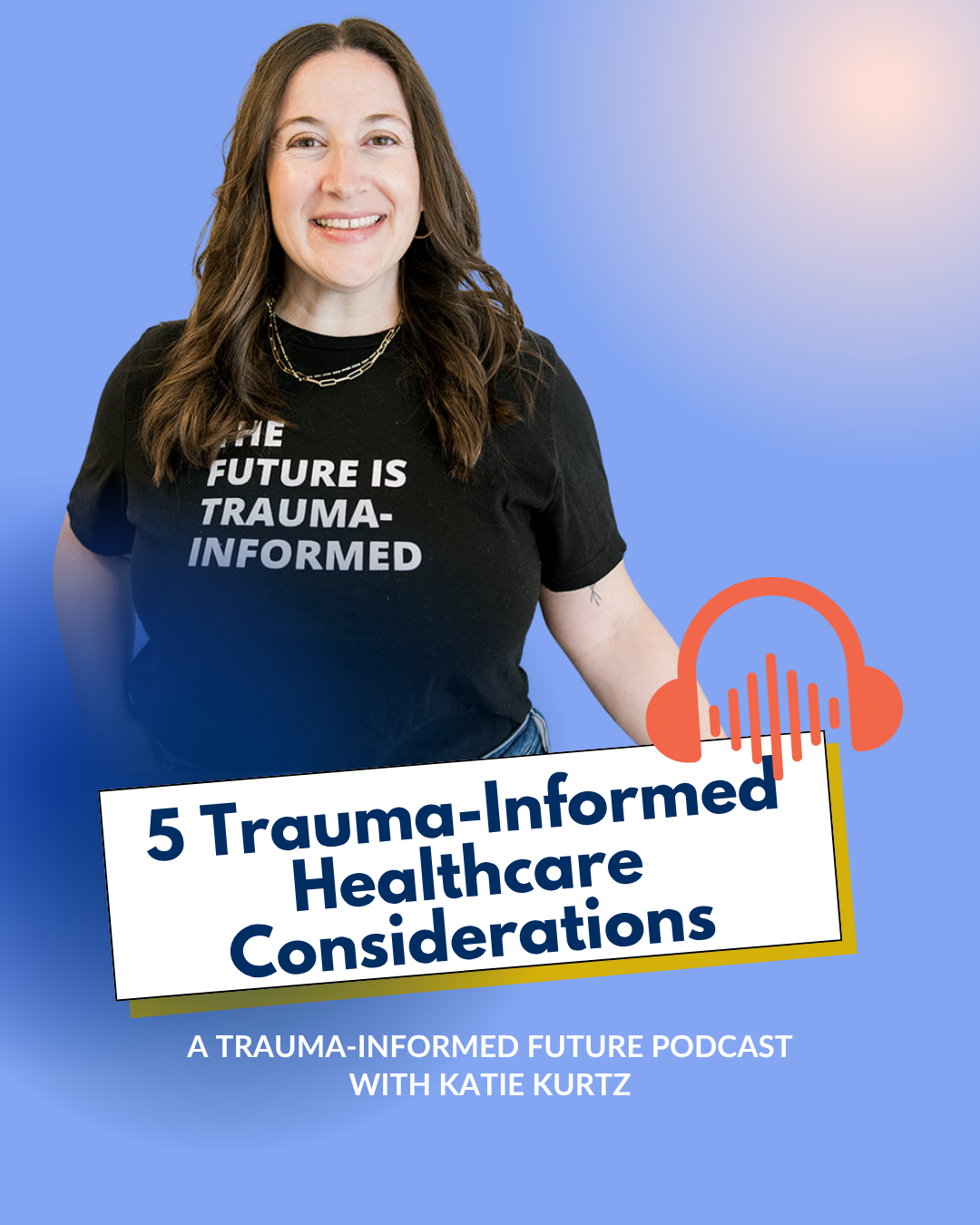
Trauma-informed care is essential in healthcare. Given the prevalence of trauma across diverse demographics, understanding and addressing trauma is vital for providing compassionate and effective care. In today's episode of A Trauma-Informed Future Podcast, host Katie Kurtz is sharing 5 key trauma-informed healthcare considerations. Traditional healthcare practices risk re-traumatizing individuals, highlighting the importance of creating safe and supportive environments. Trauma-informed care leads to improved patient outcomes by fostering trust and collaboration between healthcare providers and patients. With a vast lens of experience working both within healthcare and as a caregiver, Katie highlights practical steps any healthcare provider can take toward trauma-informed care.
Referenced in this episode:
Show Transcript:
Katie Kurtz (she/her): Hi everyone and welcome back to A Trauma-Informed Future Podcast. I'm your host, Katie Kurtz.
So for the last few episodes, we have been delving into the topic of trauma-informed care being applied within healthcare settings. Now, healthcare being a very large umbrella term that can be utilized for both hospital-based care, outpatient settings, allied health, wellness, et cetera. I encourage you if you already haven't to listen to the last two episodes with both Dr. Amy King and Ebony Williams, which are really great episodes, as we explore how and why trauma-informed care is so, so important.
As you know, I am a subject matter expert in trauma informed care, specifically, an integrative model that honors the origins of the approach while ushering it into a future that's inclusive and integrative for all professions. Most of my 15 years plus career as a social worker, and as a trauma informed care specialist has been within the healthcare setting, not just as a professional [00:01:00] working with in hospital-based settings, public health settings but also personally as a consumer of healthcare, but also as a caregiver. For the last 15 years, I have been a caregiver for both of my parents who have had chronic and acute illnesses. So I have been both a navigator and a patient advocate for them. So needless to say, I have and continue to spend a lot of time in healthcare settings. I work across multiple industries with people of all professions, but I would say the most common profession and the common, most common client I have are hospitals or healthcare professionals healthcare organizations. In this year alone, this podcast is being recorded end of May, 2024. I have already trained over 500 healthcare professionals. And I already have plans to train approximately 450 more people in healthcare systems by the end of 2024. As you know, I offer a lot of different trainings for individual leaders to participate in. As well as the [00:02:00] membership, the Trauma-Informed Leadership Studio, but they also offer private trainings.
So for teams, departments, organizations that want me to come in and offer private training and ongoing integration, support leadership consultation and culture consultation I do that as well. So I have a lot of private clients and most of them are within healthcare. Trauma informed healthcare is something I have a lot of experience in. I have a lot of passion for, and every single day, I'm reminded of the absolute necessity of making trauma informed care, the standard of care, especially in healthcare settings. And so for today's episode, I kind of wanted it to be a solo shorty. To provide just a very brief overview of some of the most important considerations when it comes to trauma informed healthcare.
These are things I obviously go into far more detail. I provide a lot of context\, a lot of [00:03:00] education and skills-based training when I work within medical healthcare, wellness settings. But for the purpose of this podcast, I really wanted to give you an overview. Some of the key things that I really emphasize and cover when I do trauma informed healthcare or my signature Trauma-Mindful Medicine training.. And this is something to consider whether you are healthcare professional, providing healthcare or someone receiving healthcare.
I think this topic includes all of us and it's just something to be mindful of. And of course as you may know where it's always helpful to remember whenever I'm talking about these things, although I'm putting them in the context of a specific profession. These are applicable to anyone, to any profession. This is why, you know, I train people across every single profession, all over the world.
Everyone gets the same training. However, I teach people how to understand their scope of practice, which is their professional boundary, and then how to apply these [00:04:00] specific mindset skills practices strategies across their scope of practice. So when I work within healthcare, I'm really specifically applying it to the healthcare setting.
Because of my experience in health care, providing a lot of case, examples, experiences, et cetera, both as a profession, a healthcare professional, but also somebody who is a caregiver and consumer of health care.
So depending on who I'm working with. Depending how much time really I have, because as we know, healthcare professionals have very limited time because we work in systems that are very time sensitive. Hospitals are usually never able to take breaks. Right? They're always open.
They're always providing care. And so time is limited and there's also a lot of other things such as expectations, insurance, things like that impact people's time and capacity. So, depending on the amount of time I have will really depend on how much information and how much depth I go into when [00:05:00] training healthcare professionals. But for a general overview and just again, considerations and never coming in here providing prescriptive techniques, it's always invitations and things to consider. A lot of times people are affirming what they already hear for me, but now they know why it's important.
That's the whole trauma informed piece. We now have the information around understanding trauma it's impact it's pervasive nature. The impact of collective and systemic trauma. And the role, especially for looking at healthcare, the role that system plays and systemic trauma and systemic healing, and then using that to inform and know why we may do what we do. And a lot of this, like anything around trauma informed care is not to give you something complicated or complex or new, but rather simple shifts, simple ways to apply this to what you're already doing, not to make it complicated, but to make it easier and more affirming. And what I have seen, especially within healthcare [00:06:00] is that it doesn't just impact the care you give to patients.
It impacts the care you give to yourself. Which can help improve provider satisfaction employee satisfaction, prevent employee burnout, which we know is very high within healthcare professions. And shift the culture so it's truly a culture of care.
I have so, so many examples and stories, and I have shared them on both on this podcast and as a person who's been interviewed on other podcasts around how trauma informed care can impact our receiving and giving of healthcare. But for the sake of this podcast, I really wanted to make it short and sweet to really review just a few key things we can really consider when we are looking at applying trauma-informed mindset and trauma-informed care in a healthcare setting.
The first thing we can consider, is to be mindful of people's full humanity. I am not disregarding or minimizing the extensive [00:07:00] and expensive education healthcare providers go through to be experts in providing our care.
We heavily rely on our healthcare professionals to access care we need, especially in emergency settings. There's a need to get very focused and specialized in certain areas of the body because the body is so complex and complicated, and there's so many wonders of our bodies that we just don't even still know. And so it's important for that hyper focus on certain areas of our bodies certain specialties, et cetera. However it's also just as important to as much as we zoom in on certain areas of our body and health and illness and wellness and disease, we also zoom out and be mindful of people's full humanity. Their full humanity, which include the different social contexts we exist in the intersection of identities we hold the lived experiences we have . Yes, we make choices in our life, and we have self-determination right? I [00:08:00] can make choices for myself. And as long as I'm not doing anything illegal or hurting people, like I can do that. You might not agree with me, but I have the right and the choice to do that. That may be smoking it may be drinking and maybe doing drugs it may be eating unhealthy not getting sleep stress, stressing out, being in certain relationships. Whatever it may be. We also know that there's a lot of things outside of choice that we do not have choice. We do not have control. Which is especially important to understand the communities environments and systems we existed.
You heard me talk with Ebony Williams in the last episode about social determinants of health, I use the term social influences of health. That 80% of our health is not happening in a hospital system or your doctor's office it's happening in our neighborhoods in our homes and our communities and our work, all these different places and only 20% of that is actually happening in healthcare settings. So when we zoom out we need to be mindful [00:09:00] that there's more than just a person's symptom, more than just a person's ache pain diagnosis. That what may be presenting at surface may not be the full story.
It may be an iceberg and so pausing to be mindful taking a moment to recognize the full humanity of the person before you. That they are more than just a chart. They are more than just their insurance. They are more than just their age , their weight, their height, et cetera. A lot of times we were like, yeah, sure. Of course the full human, but how much are we actually being mindful?
How is that our mindset of honoring the full humanity of the people before us? That's what trauma informed care is. If I had to really minimize and boil it down, which I hate doing. Trauma informed care in essence is being a better human honoring people's humanity, the fullness of the person before us with compassion, grace and respect and dignity.
The second thing I really encourage people to do in healthcare is to know their power. To [00:10:00] understand power dynamics and understand the systems through which they are working in and representing. I live in the United States so I can't speak for other countries and systems, but the healthcare system within the United States is wrought with practices that have caused a lot of harm, intentional harm and unintentional harm, especially towards people with intentionally in historically marginalized identities and bodies of culture.
We also know that our healthcare system is highly politicized that we rely on policies and lobbyists and things like that that dictate our access to care. Which include insurance and other different policies that differentiate our access to care that are. You know, our eyes and our teeth are different from our bodies, it's like a weird thing and I'm not going to go into policy and all of that to be quite honest, I'm not an expert in health care policy. And I would rather invite people on here who can speak more to this, which we will in the [00:11:00] future. So not only when we work in healthcare systems, we have to be mindful of the system we're working in. And that these systems still exist in capitalist structures that extract and are dictated by money-making machines, insurance companies that dictate access to care. And can limit people's access to care. And that politicians are debating access to care. Our bodies are on ballots. And so all of these things impact us receiving healthcare and accessing healthcare. So on the grander scheme, understanding when people come in to a doctor's appointment to get their labs drawn, to come into a hospital. There's already a potential trust. And oftentimes when we come into hospitals, this is very nuanced and complicated because we have to automatically trust people that are caring for us because our bodies are vulnerable. Our lives are in their hands. I'm not saying like, all hospitals systems are bad. This is not the binary of good, bad right or wrong. It's just the reality of naming and owning the historical [00:12:00] context of power that healthcare has and hospitals have had, and providers have had historically and still to this day. That's the zoom out.
If we zoom in to our own personal power . We may be moving forward, but these things still exist. And there can be a lot of really good shifts and things happening. And also we still exist in these systems.
When we zoom in more to our personal power. We have to recognize that power dynamics are always at play in any relationship, especially any professional relationships. There's always going to be power dynamics. And I always talk about and refer to the work of Just Associates. They break it down understanding, power over power, with power to and power within. And each of us but especially in healthcare, there is a big power dynamic. When you walk into doctor's office whether you are, a patient navigator, a nurse, a doctor [00:13:00] a surgeon, whatever.
There's a differentiation of power. And that again, it's not good, bad or right or wrong. It's just, what is doctor patient so when it's doctor patient nurse, patient whatever there's an automatic power difference. So how do you just be more mindful of that? How can you recognize that power differentiation? And then be more cognizant to shift towards, instead of powering over someone, telling them talking down to them using that power to yield over that person. Instead, how can you be more mindful of sharing that power and remembering as Ebony, remind us in the last episode that we are experts in ourselves, we are experts in our own bodies. So, yes, we are turning to experts in health, our doctors, our nurses, our surgeons, et cetera. But ultimately we know ourselves best.
And so how as a provider, can we make sure we remember that we, listen, we read between the lines. We ask better questions. We [00:14:00] try to slow down as much as we can, even though I know that's very hard. And just notice and understand that there is a power difference. We can work to share power. And that remembering that people aren't always going to feel safe in your presence and that trust might have to be assumed. We may not have choice in that, but we should still work towards building trust.
The third thing to consider is to practice the pause. I've worked in a variety of settings. I've worked in surgical settings intensive care units. I've worked within oncology settings in chemotherapy treatment centers. I've worked in. recovery settings emergency rooms and urgent care and all the things. And I acutely understand the essence of time and the necessary impact of time when it comes to receiving healthcare. And also that necessary urgency when receiving care. There's also a lot of unnecessary urgency in receiving care because [00:15:00] it's dictated again by insurance policies, protocols, both within the hospital setting from insurance and then larger policies Billing all of these different intricacies that impact time.
When you are a primary care doctor and you have 15 minutes to see a patient, but you know, you need probably 45. And you want to slow down, but you can't, it can create. what we call moral injury. Which can really impact the providers social, emotional, mental health, physical health, which could eventually into burnout and lead to other things. So if we were to integrate and make trauma informed care the standard of care in healthcare. We know how trauma-informed care is bi-directional. So it's not just the care we give to patients, but it would be the care we give to our providers.
And so, because this is a huge culture shift. And system change takes a lot of time. It's the longest of games. These are again, some invitations and considerations. One thing we can do is practice the pause.
Can you take five [00:16:00] seconds just to take a breath? I tell folks who are working in more office settings, primary care settings. Like you're seeing patients back to back. Can you just take a moment to go to the bathroom. Take a drink of water. Take a breath. Before you go into the next room. If you go into the room and you're with a patient. And I know you gotta take notes, you gotta document, you gotta make sure you go through the med list and all of the things. Can you pause? Make eye contact. Ask, do you have any questions?
Do you need me to slow down? Small pauses, help. Invite you neutrality , which we can invite in that, nervous system care and regulation. Yes there's a lot out of our control when it comes to urgency and time. But where can you find choice? And in that choice, can you integrate, pause?
The fourth thing that I think is super accessible especially within healthcare settings is shifting our language. How can we make [00:17:00] simple shifts of our language to promote more inclusivity, accessibility, intersectionality. To be more human centered patient centered. There's a lot of really simple shifts so when ever we're talking about our health, we're talking about her livelihood. And there's a lot of fear and a lot of unknown. Sometimes healthcare providers don't know answers or sometimes they have to deliver bad or unfortunate news. And sometimes we're caring for people who have received that news.
So I always encourage people instead of positive platitudes. You know, everything happens for a reason. Or don't think about it. Try to calm down. Try not to think about your stress. I have had healthcare providers like what kind of stress are you dealing with? And I'm listing off all the things I'm dealing with as a caregiver of people with complex health issues, And I had a healthcare provider look at and be like, well, just try not to be stressed about that. [00:18:00] Really how does that work for you to just like turn it off?
Do you think if I could have turned it off, I would've like, what is that? I understand. You may not know what to say. But then say that. Geez. That's so much. I don't know what to say. I'm sorry. You're going through that.
Instead of positive platitudes, which I know usually come from really good intention, but that impact of those good intentions may leave someone feeling unseen unheard and shut down. Instead validate. Oh, wow. That's so much. Or my goodness. I'm so sorry you're dealing with this. I can't imagine what you're going through. Remember, validation does not equal agreement. You can disagree with someone and still validate them and let them feel seen and heard.
Instead of referring to people by their disease, using disease centered identifiers, use person centered adjectives, a person with diabetes, not a diabetic. Now this can get complicated because some people self-identify. As a diabetic or a cancer patient or whatever it may be. But instead of [00:19:00] assuming, ask compassionately, inquire.
This is a big one. We're so used to in healthcare, learning all the jump jargon and complicated descriptions. I know for myself as a nonmedical professional, but working in healthcare, , I can speak medical. Like I know what things mean. I know how to speak it. If I need answers, I know what to say, to get answers and to get things to happen. But it's super complicated. And I'm going to tell you right now. As someone who's been by my parent's side in hospital settings. About six months ago was in the hospital for three weeks straight. I was by her side. She has Alzheimer's like, she can't be by herself. So I was with her or my aunt was with her. And people are by themselves. They don't have family. They don't have advocates, they don't have navigators. , I'm very fortunate that I can do that for my family. But I shouldn't have to. So I always like to remember healthcare professionals the best way to practice the pause is to pause and ask yourself of my using medical jargon right [00:20:00] now. And can I practice, you know, what Brene Brown says clear is kind and make sure I'm stating this in a more understandable way, a more human way. And then follow up with questions to make sure that the person or people in front of you understood it. And the other way is not to flood people with too much information, but to slow down and check in.
If you have to deliver a lot of information, that's fine. Can you do an in chunks? Okay. I just shared a lot of information. I want to check in, repeat back to me. What did you hear from me? Small shifts in our language. A lot of times we are taught in healthcare to build authority. Like we want people to trust us because they're vulnerably giving over all of their care to us. So to say, I don't know, can feel like, a failure. But I would rather my provider say, I don't know what to say. Rather than some harmful platitude. That reference I made to a provider earlier saying like, just don't think about your stress. I'd [00:21:00] rather her say, gosh, I don't know what to say, but I'm here if you need anything. I probably may have been more likely to stay in her care. Then to leave that provider because I don't trust people who are just going to say, oh, just don't think about it. Like, no, I am grateful and privileged to have control over my health care. And choice in who I see.
And I choose not to see healthcare providers who are going to minimize and dismiss my humanity. Other helpful phrases. Thank you so much for trusting me with us. I'm so sorry that happened to you. I'm here to support you wherever I can. How can I help you find the support you need? This is a little outside my scope of practice, but I'd be happy to connect you with a nurse, a social worker I'd advocate, et cetera. Simple shifts. Communication is always going to be our invitation to trust and compassion, which leads us to safety.
The last thing is be a mirror. I work in a lot of healthcare systems I work with a lot of champions are like, oh, why isn't this happening faster? And I'm in it [00:22:00] too. . I wish it was happening faster too. How do we make shifts in a system so big? How do we create culture change? And the thing I always say to people. Is two-fold don't lose hope. Find the thing, find the joys tend to your self, your nervous system care practices. Find people like hearted people in this with you. And show up and be a mirror.
Katie Kurtz (she/her): One of the most powerful ways we learn is through experiential learning. So if I show up and I utilize trauma-informed care and you receive it, And you see it and you feel it. You're more likely to start to pick up on it too.
And then in a system as large as healthcare, which is multilayered and complex. And will take a lot of time to change. The more people who are adopting this approach, who are being mirrors and modeling this approach. Create a groundswell. And with that groundswell will eventually lift and force the culture to change.
That takes time, but it's not impossible. I've seen it happen. I've seen the power of people mirroring this [00:23:00] approach for others. And the incredible possibilities that has.
I'm gonna repeat those five considerations for trauma, informed health care. Be mindful of people's full humanity. Know your power, practice, the pause, shift your language and be a mirror.
There are so many specific trauma informed healthcare related tools and skills and context to consider. And if you're in healthcare, and you're looking to begin it or deepen your practice, to really learn how to shift culture, how to really apply trauma informed care, not just to say it, but to be it. I would love to connect. This is what I specialize in.
So please reach out. I offer private training, both in-person and virtual. I offer keynote speeches. I speak at lots of conferences. I bring that wealth of knowledge over the years and experiences from working in world renowned hospitals to smaller public health initiatives. And across different patient populations. I also work with teams, collaboratives and full healthcare systems. I've been a guest [00:24:00] speaker and teacher in medical schools, nursing schools, social work schools so lots of different ways to integrate and start the conversation around trauma informed healthcare. If that's you and you're listening, I would love to connect and share information.
So that is it for today. If you gained anything from this, if you're loving the podcast, I would really appreciate you leave a rating and review. That really helps create visibility of this podcast. And again, that's one way to be a mirror. It's one way to create more visibility for people to search and access this podcast and to invite more people in to this approach and to help us create a trauma informed future.
I hope that you can discern and find ways to integrate this approach into your personal professional lives in any way that feels within your capacity right now. And if any of this lands feel free, always to reach out to me on social media, LinkedIn, Instagram, or email me at [00:25:00] hello@katie-kurtz.com. And that's it for today.
I hope you take good care.
