

Creating a Culture of Consent with Zabie Yamasaki
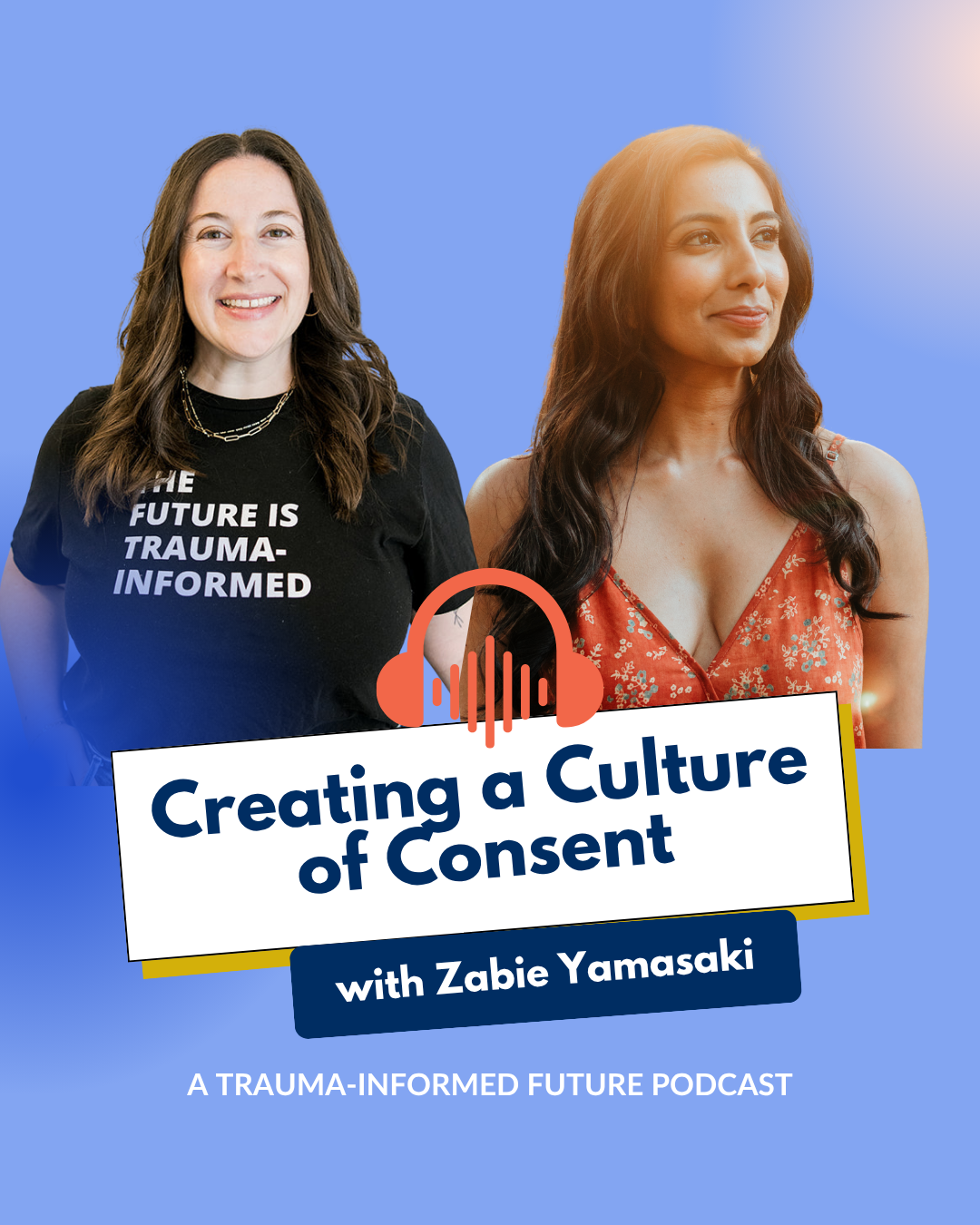
There are survivors among us. Underreported statistics show that someone in the United States experiences sexual violence every 68 seconds (source: RAINN). We can no longer assume survivors are in the minority when we know they are the majority of us. How can we focus on creating spaces that promote healing for us all? In today’s episode, Katie is in conversation with her dear colleague Zabie Yamasaki. In this conversation, Katie and Zabie honor the origins of trauma informed care, discuss the importance of intersectional inclusion and spaces for survivors to remember themselves and explore the importance of self-consent. When we prioritize trauma-informed care and integrate it into our everyday lives, we can promote a culture of consent for people to show up and honor themselves, their safety and capacity.
Learn more about Zabie:
Zabie Yamasaki, M.Ed., RYT (she/her) is the Founder of Transcending Sexual Trauma through Yoga which is an organization that offers trauma-informed yoga to survivors, consultation for universities and trauma agencies, and training for healing professionals. Zabie has trained thousands of yoga instructors and mental health professionals and her trauma-informed yoga program and curriculum is now being implemented at over 30 college campuses and trauma agencies including the University of California (UC) system, Stanford, Yale, USC, University of Notre Dame, and Johns Hopkins University.
Zabie received her undergraduate in Psychology and Social Behavior and Education at UC Irvine and completed her graduate degree in Higher Education Administration and Student Affairs at The George Washington University. Her work has been highlighted on CNN, NBC, KTLA 5, and The Huffington Post.
Zabie is widely recognized for her intentionality, soulful activism, and passionate dedication to her field. She is a trauma-informed yoga instructor, resilience and well-being educator, and a sought after consultant and keynote speaker. She has worked with thousands of survivors to support them in their healing journey, ground them in their own worthiness and remind them they are inherently whole. Zabie centers survivors in her work, and provides them with tools to help uncover trauma imprints, support the healing process, create balance of the nervous system, and lessen the grip that past experiences of trauma may have on the heart.
She is a survivor, mother, partner, daughter, sister, friend, and activist. She has received countless awards in victim services and leadership, including the Visionary in Victim Services award from one of the largest rape crisis centers in California and the Voice of Courage Award from Exhale to Inhale. She is the author of the book and affirmation deck published by Norton: Trauma-Informed Yoga for Survivors of Sexual Assault: Practices for Healing and Teaching with Compassion.
Connect with Zabie:
Website: www.zabieyamasaki.com
Instagram: @transcending_trauma_with_yoga
Facebook: Transcending Sexual Trauma through Yoga
TRAUMA-INFORMED FLIP CHART: A TEACHING TOOL FOR HEALING PROFESSIONALS
YOUR JOY IS BEAUTIFUL: THE MAGIC OF REMEMBERING THAT YOU ARE ENOUGH, JUST AS YOU ARE
Show Transcript:
Katie Kurtz (she/her): So hi everyone. And welcome back to a trauma informed future podcast. I'm so excited to be in conversation today with Zabie Yamasaki. Welcome Zabie. I am so delighted and I've been very eager to have you in conversation on this podcast. When I began it, I was like the first person I thought of somebody who is such a dear colleague, even though this probably is the first time we've met in like real life, if we can call that on zoom.
And someone I refer to often. So thank you so much for being here. How are you arriving in the space today?
Zabie Yamasaki (she/her): Thank you so much, Katie, for that warm welcome. I feel so grateful to be sitting with you and to be connecting with your community today. The way that I'm arriving today is a little bit heartbroken, a little bit trying to stay hopeful given everything that's happening.
in the world right now. I'm also feeling a lot for those who are caregiving or space holding or parenting through these times because I feel like We're constantly switching between the way that our heart might be breaking at what's happening in the world and then also trying to jump back in and regulate ourselves so we can be this safe and supportive presence for our kids or for the clients that we might be holding space for.
So that's what I'm arriving with today. a little bit heartbroken and a little bit hopeful. We can hold many things at the same time. I think that's the beauty and the complexity of our heart and of our capacities. So that's where I'm at today. Yeah.
Katie Kurtz (she/her): Thank you for naming that. I think this is something I sit with often.
Is this complexity and also an incredible gift that we as humans can feel so many things at the same time and that we, that so many things can be true at the same time. And we aren't taught to build capacity to hold that. And that's why so much discomfort around parts of our humanity exists because we just don't have.
Capacity, and I think the work that you lead and trauma-informed care in general is capacity building, is just how do we build our capacity to be with our humanity, which includes the joyous of joys and the depths of grief and pain and hurt and harm, and allow people to be. So thank you for naming that.
That's such a big part of why this approach is so special and so needed, is just giving language to what we're experiencing. What a great segue into this entire conversation. I gave your professional kind of bio in the beginning, but I would love for people to hear in your own words, what drew you to this work and to where you are today, which is so beautiful to watch your journey unfold and to see all the resources.
That you're providing us. I turn to. Daily, I share your books, your card decks, I've been gifting all the children in my life, your new children's book. It's so special to be like, I know this person, I do, and it's just like, internet friends, colleagues, I don't even know. You feel like this connection, even though we've never met in real life, and it's so special to have.
That, and your book is so beautiful, and every time I look at it, I'm like, oh, I wish I had this. Like, my inner child, like, needs this book. We all need it. So, I'd love to just hear and let people know how you got here, and any way you'd like to share that, and whatever feels best for you.
Zabie Yamasaki (she/her): Thank you so much, Katie, for this question.
I love it, because normally I come in with this professional hat, ready to say the different things that I've done, and the consulting work that I do, but This question allows me to tend to all parts of myself, and sometimes I forget that in my professional world. I try to be this one person that people know me as.
I, something I've been thinking about a lot is, I've experienced a lot of different types of trauma in my life, and One thing that I've never allowed those experiences to strip from me is my light and my joy. And I think because I've seen some of the depths and darkness of the world and of what I've personally experienced, it allows me to really anchor and cling to.
The light, when sometimes I feel like that's my guiding force in this work and it's like a life raft. And when I wrote the children's book, which honestly, I didn't think that a children's book was in my future. I've been so focused on the trauma informed care world and my trauma informed yoga work and consultation for campuses.
And I was just laying in, in the grass one day in my front yard in the sun. And the words came to me, I wrote them literally on my notes app on my phone, and they, it was like a channel, I can't even explain it, it was almost like this out of body experience where I had maybe had those words that were living within my body for a long time because I needed them, or they're the way that I try to hold space for my six year old son, and I just couldn't stop thinking about them.
When I didn't know if anyone would want to publish it, or where it would go, and I sent it to my literary agent, and I was like, I don't know if anyone is going to be interested in this, but I can't stop thinking about this little joyful book, and so here you go. The first publisher that she sent it to, Pessy, was interested and it's really taken me on this really joyful journey of connecting with children and my work in a way that I never even envisioned.
So I'm just so grateful for that and I think as a survivor, I feel like I'm creating a lot of the resources that I need it or in the scope of my professional work that I needed to be able to refer someone to there's as there's a lot of softness, there's a lot of intention. There's a lot of empowering and gentle language in my card decks and in my books.
And that's so intentional because I think that a lot of the resources out there, there's so many incredible resources out there, but many of them are written from this clinical lens. And they tend to forget that so many of us are survivors in the work and want to be held as we're learning how to hold space for others, that we can't compartmentalize these aspects of our identity.
And as I've been writing this, I remember that when I want people to remember that they can take their time and that they can go slow and that if they read something activating in my Trauma Informed Yoga for Survivors book, that they're invited to pause, close the book, maybe flip to some of the practices at the end.
And I don't know that there's many books on my bookshelf where I'm invited to even just take a pause. And notice how this might be lighting up or activating parts of my body that are holding traumas. Personally, I have a six year old little boy who is my rainbow baby and my soulmate and my whole world.
For those of you who maybe follow me on social media, you probably already know that. I have an incredible partner who we just celebrated nine years together and We always joke that he's the rock to my anxiety and he's got this great sense of humor and I tend to be very serious and I'm just, I'm really in awe of the way that our partnership has taken us through many seasons of our life and I wouldn't be able to do the work that I'm doing in the world without him.
And I love coffee and I just feel really grateful for the community of support that surrounds me and allows me to thrive doing this work because I think as trauma healing professionals, we deserve to let that light and that joy in and to remember that we don't always have to be in the trenches all of the time, that we can do this work in a way that feels Joyful that allows us to build our capacity and yeah, that's part of the work that I've done and in really trying to be intentional with the, with these various resources that I've put out.
Katie Kurtz (she/her): Oh, I love that so much. I'm so glad you mentioned that, because this is something that I see so often, especially with folks who are new to adopting trauma informed care. We tend to swing to extremes, which we do as humans all the time, but there is a swinging that happens where it's, oh no, I have to say this in a certain way or be a certain way and it's like constant hypervigilance.
We're reframing our typical hypervigilance around the approach. Which puts people into potentially freezing and avoiding and not practicing it, or trying to perfect it. And I always encourage people, of course, how human of you, to swing to those extremes, it's what we do, but to come back to neutral because Just because I suggest certain things to say or do, I want you to take it and use your own voice and your own personality and intersect it into yourself.
And I think that's something that often goes unsaid within the trauma informed care world is that there is no, there's a blueprint, but there's no script. There's no, this is how it has to be, that we can adopt it and practice it to be, to Organic within ourselves to allow our own personalities, our own senses of human.
I'm a very sarcastic person, and that I can be sarcastic and trauma informed, right? I'm not trauma informed 100 percent of my life. None of us are, because we're human, but it's a practice like anything else, and we learn our own language and our own way of really integrating it, but we, in a way that feels really good and natural and embodied, but we can only get there by practicing it.
And I think there's often this misunderstanding that trauma informed care is only the light and love and gentle coddling. And it's, no, it is quite gentle and Full of grace and an invitational, but that's because we're so used to everything not being that way. And it's actually not coddling, it's quite human to allow people to take their time and to pause and to have a little grace and permission.
So I really appreciate you naming that because it's such a helpful reminder to all of us that When we do go swing to those extremes to come back to neutral, you remember we're a part of the process.
Zabie Yamasaki (she/her): Oh, I love that. You said that so beautifully, Katie, and I think about this a lot when I'm leading trauma informed yoga certification trainings, because I think as you so beautifully outlined, trainings wanting the blueprint or wanting the checklist and then you.They can oftentimes grip so tightly to wanting to do it in a specific way. And like you said, this work is not about stripping parts of who we are. It's about bringing our full selves and our full humanity to the work. And I always say, I'm here to support you with helping hold space a little more tenderly.
Here's a number of tools that you can choose from to integrate into the scope of your work. And then empower the survivors that you're working with to choose what feels best for them. I think when we cling so tightly to that, I notice sometimes in the trainings people will start to sound a specific way.
They're trying to say the cues in the way that I think they should be saying them. And I'm like, let's take a moment and why don't we try approaching this, but honoring your true and your authentic voice. And then you see. That's one of my favorite spaces in the training is when people start to do the practice teach because they really start to lean into this space that they're allowed to be them and also just start to gently integrate these tools and I just don't think that people
We really need to be putting that out there more because I think we need more people to be trauma informed. Like, sometimes I forget I'm in such a trauma informed bubble and then I'll step out of it for a second and I realize how not trauma informed the world is. But we need to make this approach even more accessible to invite folks in, that it's not this scary thing.
There's so many small adjustments that we can be making. It's not completely revolutionizing what you're already doing. It's just helping, giving you a little bit of a roadmap, but not making you feel small within that roadmap.
Katie Kurtz (she/her): Yeah, if anything, it enhances everything and it creates so much more possibility.
I say that a lot too, that a lot of people, especially larger organizations, are like, oh, this is such a heavy lift, or we're going to have to do so much more work, or it's so complicated. And I'm over here like, hey, actually, it's not. It's not that complicated, and it's only to augment or enhance what you're already doing, and most people that I work with, and I venture to guess you do too, they're like, oh, I'm already doing this, and it's like, yeah, now you know why you're doing it, and you can feel more supported in doing more of it, and I agree, we need to find ways to make this approach more accessible and doable for people because it's overdue.
We should have been doing this a long time ago, but now we can't. argue anymore that it's non negotiable for any human care providers, which is all of us. Even if you're in a professional role that doesn't deal directly with humans, which I don't really know if there are any, I don't know at this point, but it's in our personal lives too.
And this kind of brings me to a question. When trauma informed care really got started, I was starting my social work career. So I grew up with this approach and I Saw the yoga community be one of the first kind of non traditional fields. to adopt trauma informed care. We, and we think outside the clinical setting, yoga is really who began to adopt it.
And we started to see programs like the trauma sensitive yoga program. And it's been really interesting to watch trauma informed care enter new fields, but grow within the yoga community. And I know that's where Your journey really founded in and so much of your work, although you do so many things, your trauma informed yoga practices and your curriculum, especially within universities.
I'd love to hear a little bit about what you've seen the trajectory of trauma informed care in yoga has been and especially because when this approach really started or formalized about only 15 years ago, right? It's still so new and young. It was very survivor focused, as it should be and should continue to be, but now we know as we expand our understanding of trauma and experience the context of historical, systemic, and collective trauma, we don't know who survivors are.
That's the majority, right? It's the majority, not the minority. We used to think it was just a small percent of people, but we know that's not true. And so, I'm curious if you can talk to us a little bit about the evolution of trauma informed care and yoga and what, and where you see it going, really with the essential nature of this approach in the yoga community.
Zabie Yamasaki (she/her): The first thing that came to mind as you were asking the question is, Trauma informed care really stems from the work of black and brown feminists who were on the front lines doing direct service work with survivors coming from early rape crisis center and anti domestic violence movements of these frontline workers centering the unique and culturally affirming needs of survivors.
And so I draw so much inspiration from these folks and also as a South Asian woman. Yoga started as a practice in India to transcend people's suffering. And so uniquely my work, a large portion of all of my professional roles have entailed giving presentations on trauma. When without a doubt, after every presentation, I would facilitate within these mental health agencies or on college campuses.
There would always be survivors who came up to me to disclose their experiences. And so often they were sharing things. I'm struggling with the debilitating, somatic pain of the triggers that I'm navigating every single day or I'm not quite ready to pursue talk therapy. What other options are there for me?
And it was interesting because I was in my professional roles doing all this outreach and trauma work, and simultaneously I was going through yoga teacher training. And at the time, I will be honest, I didn't, I saw them as two different compartmentalized aspects of my life. I knew that yoga was playing a role in my healing journey, but I didn't initially see until I was further down into the curriculum and the yogic learning about yogic philosophy and learning about the impact of trauma on the nervous system and then connecting it to these conversations I was having with survivors and really even thinking about my own lived experience of.
Just the GI issues and the insomnia and how debilitating navigating PTSD was for me. I'm like, of course we can be intersecting these two worlds to make yoga spaces more accessible, more inclusive. Because if you think about it, a medical provider might tell a survivor, You should maybe try yoga. It might be good for your anxiety or for helping you manage depression or with your PTSD symptoms and if they don't have a lot of context in regards to what to look for they may find themselves in a heated yoga class or in a space where the yoga teacher does not ask their consent for a physical assist and Suddenly, this experience that they sought out to seek healing has become really harmful.
And so, I think in many ways, I always share this story in my trauma informed yoga certification trainings that I lead. One of the first places I actually started teaching from a trauma informed lens was at a CrossFit gym. And so it was primarily male identified, masculine folks who were coming to this class with me, and They're like, I think at first they're like, who is this woman asking us to be in our feelings and giving us all of these choices?
And, but week after week, you slowly saw those layers come down. Those, that armor that we oftentimes put up and. People allowing themselves to feel and those emotions coming out in class and the class ended up, it was really full and the manager used to joke with me like, wow, more people are coming to your yoga class than to the CrossFit workouts.
And I'm like, no matter what space we're in, people can benefit from this level of compassion and gentleness because Katie, what oftentimes. What happens is we start to replicate the pace of our lives, this frenetic pace of our lives on the mat. And if we can't even learn to rest on our yoga mat or get to a place of working with a practitioner that allows us to feel safe resting.
It's no wonder we can't rest in our everyday lives. There's so few spaces that remind us that rest is praiseworthy or that remind us that honoring our capacity is praiseworthy. And so I think what's so powerful about where this work is headed is that there's so much that happens within the magic of these yoga spaces that people really start to integrate as they move through the world.
I worked with a survivor of domestic violence who, she made this intentional choice during the yoga practice to move out of a posture that was very uncomfortable for her. And while that might seem like a small choice, For her, it was incredibly revolutionary to say, you know what, I'm uncomfortable and I'm gonna, everyone else in the class may be in this shape, but I don't feel comfortable here.
And for her, it started to be a catalyst for her remembering to remember herself off of the mat. I can be intentional with my choices. I can choose myself. Ultimately, she left that abusive relationship. Now, I won't say it was the yoga practice that led her to that, but I think there are many elements, especially as we think about trauma informed care and various modalities that complement each other, it can just be such a powerful way for people to move through their healing journey.
And it's why it's so exciting seeing so many universities implement this program. And not just as a one time offering, really more as an integrated modality in their scope of services, because that's how we see real sustainable and systemic change. So I have no idea if I answered your question. Clearly, this topic is exciting to me.
So I'll pause there and see where it takes us.
Katie Kurtz (she/her): Yeah, as you were talking, I was like, oh, there's so much to talk about. First, just want to thank you for, again, naming the origins of this approach, I love talking about the history of trauma informed care, and I always like to remind people that there is no one origin of trauma informed care, but we really need to name the often unacknowledged people who were survivors, who were working within the rape crisis movement, and interpersonal violence movement, and those Black and Brown activists, LGBTQIA activists, those are the people that often don't get centered and they should be.
We often center white male academics in the trauma field, which there are, it's, there's nuance, there's things to extract from a lot of the research and the academia, but when it comes to why we're here today, and where we're going in the future, we need to name those that are often unnamed, and so I appreciate you sharing that.
And. Goodness, so much there. I really appreciate you sharing that story of that person you worked with, because it immediately took me back to why I started practicing yoga. I was very resistant to it, and it was because I was so disconnected between my body and myself, and yoga really put me in a space to reconnect, and I, although did not have the same lived experience as that student you worked with, I distinctly remember when I was given that permission, or gave myself permission, that self consent to get out of a pose that was uncomfortable and go against what everyone else in the class was doing, and it felt like a big deal, and it wasn't.
It was like maybe I put my foot down instead of having it up, like it was very simple yet very powerful, and It took that permission to do that, and I always tell people, because I talk about permission a lot, it's, this is self consent, it's being able to consent to, it's okay to move in a way that feels best, even if that felt different than yesterday, and it may feel different than tomorrow, and I think yoga is a Almost a playground of a container to try that out so that you can also maybe try it out in real life.
And I've always believed in that. And that's what led me to become, do my own yoga teacher training. And then I also completed your yoga, trauma informed yoga training as well. Not the certification, but your online program. And I. I believe in that space and honor the practice and the origins of that practice.
And I'm wondering if we can talk a little about consent because you've talked, you've weaved it through what you've shared and something I love so much about your book and the way you talk about trauma informed care, not just within the yoga world, but everywhere, is this culture of consent and self consent and consent with others and honoring choice and autonomy.
And why is it so important and necessary? It's a core element of trauma informed care, no matter where we apply it. So, I don't know if I have a question, but let's talk about consent. Let's talk about why, because it can feel really starchy, right? Like, when we think of consent, it feels very legal. We, and there is a whole legal component of consent.
We're not talking about that specifically. We're talking about consent. In the realm of our humanity and relationships and the environments and cultures are existing and I don't even know if I have a question, but can we talk about consent and creating a culture of consent and how wonderful it feels when you're able to access consent in our spaces?
Zabie Yamasaki (she/her): Absolutely, Katie. I also just love the word self consent. That's actually an aspect of consent I've been thinking a lot about lately, and whether it's practicing self consent before we take on More checking, doing an embodied check in before we really assessing our capacity before we overextend, or if it's our capacity to overwork, we're constantly overriding the messages of our nervous system.
And I think when I come back to that word of self consent, it's such a reminder that we matter too. And as you were saying that I started thinking about this image of when I was. Still teaching it in person, and I look around the room and everybody in the yoga class is doing something completely different.
It is, those are some of the most beautiful moments of teaching for me, because when people get to a place where they can honor exactly what their body needs in that moment, and we work so hard as practitioners to cultivate that. community of consent to foster that through our language, through our supportive presence, through co regulation, through nervous system capacity building.
There's so many aspects that go into this beyond what we say with our word. Of course, I'm always going to say that trauma informed and Invitational language is foundational to the work that we do, but there, again, there's so much that goes into creating these spaces where consent is embedded into every aspect of what we do.
And I think that. For yoga studios in particular, I will sometimes spend a, our section on consent in our training is so lengthy and there's a lot of tangible aspects of it, but I think what tends to land the most for people is I'll say things like at the beginning of every yoga class, take a few moments to send yourself gratitude just for arriving today.
So often, that's the hardest part. If you wanted to find one shape and stay there for the entire time, that would be amazing. There are so many ways for you to communicate your comfort levels in class. I'll go over just, sometimes we use yoga flip chips, or typically in my classes I'm not offering any type of physical assist, just verbal assist.
And you immediately see the collective nervous systems in the room just Gosh I can leave the room at any time, or I can drink water for whenever I need, or I could just take a nap. And that would be, this shouldn't be radical for people to be unapologetically choosing themselves in yoga class. But unfortunately, in all of the ways that the practice of yoga has been westernized and fitness oriented.
It's unfortunately become a place where many people don't see themselves or don't feel included or don't feel like it's a safe space for them to rest because So often the yoga teacher is praising the person who's in the headstand or in the most advanced version of the posture and I spend a lot of time helping us untangle these cues that were oftentimes taught to say one being like The pose begins the moment you want to get out of it.
I'm like, who taught you that? Like, where does that language come from? Honor what your body needs in this moment and choose the variation of the shape that feels best for you here. It's also, there's not a lot of it, there's not a lot of changes that we're making in our language. It's integrating those buffers and integrating that softness and it.
really has the ability to completely revolutionize the spaces that we're holding and also in trainings that we're leading to Katie. I know this is so in alignment with the work that you do, the consultation you offer, the trainings that you lead. And I even think about being in higher education and how many times I sat through lectures that were completely traumatizing and I was never given the choice.
Or offer that opportunity to consent of whether or not I felt comfortable being there or given the opportunity to leave without my grade being impacted. So much of this goes back to layers and layers of what we've learned. And I'm even seeing it now in kindergarten. My son's in kindergarten and we wonder why we struggle.
As adults with work life balance and perfectionism, when we've been told since we were five that we need to bring our work home or that we need to do it perfectly, so much of this is ingrained from a young age. So I want to remind folks who might be struggling with some of these concepts around rest and honoring your capacity.
You're up against a lot, given your unique lived experience and childhood experiences. What you've navigated in your adult life, but it is really radical for us to start to integrate this approach into every aspect of our lives. And I think that's also why I felt so, so passionate about the children's resources. I'm like, we got to start earlier, right?
Katie Kurtz (she/her): Yeah. It's not uncommon for people that I train to be there for professional development, but then. Either halfway through or at the end, they're like, wow, I didn't realize how much I'd be applying this to my personal life. And I'm like, I didn't want to say it, like, I'm here for the professionals, but you can't compartmentalize your humanity with this approach.
It's going to apply to you and to the people. Your partnership, your parenting, your caregiving, your just role in your community. It expands our empathy to include ourselves. And I think one of The things we have to begin with, which I've been in conversation all day around this specifically but in most days is that we still are functioning from such a narrow definition of trauma that is only looking at extreme events and like war and extreme violence and extreme injury, which yes, of course, that is inherently traumatizing on various levels.
But, we know that it's not the event or the environment that, that is trauma, it's our response to that, and so we, when we start to expand our understanding of trauma, that It's far more complex and nuanced, and that there's layers, it's not just us individually, it's our role in the collective, it's our role within these systems we exist in, the historical context we are living in right now, all of these layers impact us, so you don't have to have a direct experience with trauma.
to feel its impact. I've talked about this on the podcast. I don't adhere to the big T, little t trauma kind of hierarchy, right? Trauma is trauma. There's definitely a spectrum, of course, that people directly impact is going to be very different than an indirect impact, but it's an evolving cycle and so many layers to it.
But gone are these days that anyone can say they're not impacted by trauma and stress. And I'm loving this. Just this conversation around consent specifically, because that's so much the core of trauma informed care, right? It's being able to honor autonomy and agency. And no one doesn't benefit from that.
You don't have to have trauma to benefit from trauma informed care. But something specifically you mentioned that I can't stop thinking about is the capacity building. And I think this is the thing we don't talk enough about, is that we can offer all these beautiful invitations and allow for choice and consent.
But are we also looking at our personal capacity to witness and hold space for that? Because if we don't have the ability To hold space for people's choices or to be in different shapes and even in a class, if we don't have the capacity to just be with that and be okay with that and allow it, it's going to be challenging to give those opportunities or invite people into consent and choice in that way.
And that's why it's so bi directional. Like, we have to look at our own capacity. To be with people's humanity to, if we want to honor people's lived experiences, do we have the capacity to witness them, to bear witness to people's lived experiences, even if they're very different than our own, that we don't even understand that we, they might be very difficult to hold, and I think capacity building is trauma informed care, but we tend to not talk about it or name it as much, but I think through the practices, especially the nervous system care practice, because we know nervous system care is capacity building, that really helps us personally build it, right?
Like, we can, those pauses, those tools, like the card deck you have, even the children's book, like those things help us pause and really rest and digest this. ability to regenerate our capacity.
Zabie Yamasaki (she/her): 100 percent this is so integral to the work that we do. And I think part of why I talk about it so much in my work is that when I was a new professional, we weren't talking about it at all.
We were being praised for. Overworking for facilitating three or four trainings in a day for barely going to the restroom between clients or between presentations for doing all the professional development and taking on all the extras. And it was so intense. I think about when I first started out in this field, what my days looked like, and I have to catch my breath when I think about the way I used to do this work.
And I'm like, how was I even functioning off of, like, cashews and never going to the bathroom? Like, it was so bad. And I think, I didn't have a lot of models. Of not only models of rest coming from my incredible parent. I'm a daughter of immigrants and they worked so hard to create this life for us. And simultaneously, I never saw my mom sit down.
I never saw my dad only had Sundays off. It was. It's it feels pretty revolutionary for me to now be taking sabbaticals every year to be portioning my time to recognize that I have to lower my expectations in times where there's war happening in the world and to not. belittle myself because of that. I love when you say, of course, how human of me.
It's such a beautiful way to affirm that we have to be radical about the way that we are also centering our own nervous system. And if we're coming into the spaces that we're holding with that frenetic energy, with that running on fumes, that really prevents our ability to hold these containers of safety or compassion for all those that trust us with their healing journey, that we have to be able to do this work with integrity and care and.
A big part of that is remember to remember ourselves, it feels like a mantra that has been threaded throughout this conversation and I left what we were talking about earlier with so many professionals will come to my trauma and worm yoga certification weekend training and they come in with that hat of I'm going to get all the tools.
To help all the people and then at the end we're crying, we're like delirious, we're laughing, we're hugging, we're dancing. And it's so many of them say, I came here for thinking it was about holding space for others, but really I came here for myself. And when we really start to do that work of Let's meet our needs and let's meet ourselves where we are.
That I think is where the magic starts to unfold because. When we recognize that tending to our own capacity is one of the most powerful tools that we can model and mirror for all those that we hold space for, it really starts to shift and change this larger culture of trauma informed care where we live in this society where we're constantly pushing and striving for the next thing and barely coming up for air and I don't know.
I just, I don't want to live in that way anymore. I spent a lot of time in survival mode and I spent a lot of time doing this work in survival mode. And it didn't serve me or the folks that I was holding space for. I think we can learn a lot about ourselves and also have a lot of compassion for all the versions of us that are constantly learning and being in relationship with.
Our coping strategies, not an attempt to shame or minimize them, but everything's information. The way that I do this work now really feeds my soul and it allows me to take on projects that are fulfilling and it allows me to honor my yes in a way that when you wrote me to be on this podcast, it was an immediate full body yes.
There was nothing that communicated otherwise. And I think the more opportunities we give ourselves to lean into what is deserving of our yes, and what is it going to be a hard no, or maybe not in this season, like we're allowed to be in that constant relationship with our capacity. And I just wish we would talk about it and normalize it more for folk, because it's just feels like.
This ongoing conversation, again, those years of unlearning and creating these new models of care.
Katie Kurtz (she/her): Yeah. You talked about remembering ourselves, and I think trauma informed care gets wrapped in this very clinical web, and when we clip through it, when we get to the heart of this approach, it's really about remembrance.
And it's bringing us back to this practice of remembrance of how we are supposed to be connected. We aren't meant to do anything alone and that we are meant to go within and find our yes and reconnect with our bodies and not be in survival, but to be able to thrive. And when we practice it, and then also when we receive it.
It's bringing us closer to that remembrance, and that's what the essence of this practice is, and it can take a lifetime and more, but I so appreciate You talked about how we didn't have models. Same. I was taught this approach is about everyone else and you sacrifice everything to get it. And I was like, that doesn't sound right.
But whatever, that's just what you're taught. But we didn't have models or mirrors. You are that model and mirror. I'm in this work too. And I know we do very similar work, but in very different ways and with different people. But it's always like a good side hug and an exhale when I come onto your feet and I see you just in your joy.
Or I see you're just like, no, I'm going on sabbatical. See you later. We need those mirror, especially when so many of us have been living online because of the historical trauma of a pandemic and so many things. It's, we need. The mirroring and the modeling and not the superficial get ready with me, here's my morning routine kind of thing and more of this is me being human and I'm showing it and I'm sharing it and I see that and I'm grateful for it because it's okay, I can like remember you got to do that too and also it's coming back to that self consent permission to do the same and I think the more we do mirror that for others, In whatever way it is, whether it's feeling our grief and just being human or feeling the joy and being human, that is especially now more than ever is so key to our collective healing because we need to regenerate our capacities and I firmly believe and I venture to guess you do too that our nervous system care is essential right now for the collective healing of our culture and not just our communities that we live in, but just around the world. Like we need. That ripple effect, and we should not underestimate the importance of nervous system care because it's collective care.
Zabie Yamasaki (she/her): Absolutely. Those buffers of, we need so much more rest than we think that we need. Yes. We are so I'm such a huge fan of Tricia Hershey's work. Yeah. It's great because it's such a collective reminder that, We are undoing years of conditioning around our productivity being tied to our worth, which is such B.S. We're up against so much and so Taking a nap in the middle of the day is incredible. Like, those little moments of self celebration, to everyone listening. If there's one thing that you take away from the conversation today, it's what it looks like to come back home to yourself. To really lean into what that means for you, and to be unapologetic about how to curate that in your own life, because you're worthy of it.
Katie Kurtz (she/her): . Thank you. Thank you so much. I feel like we could talk forever. I say that to every person that I have on this podcast because I selfishly invite everyone who I want to talk to forever about this and it's always so lovely to be in conversation and that's, again, selfishly why I created this podcast because it can be so hard to be out in the world leading this practice through training but also leading it out loud and when you can find your community of people who get it, It feels okay, like we speak the same language, we're in the same realm, and it's just a different layer, and to be able to also mirror it for others who may listen, or who may not have that community yet, this is why this podcast exists.
So I'm so grateful you're here. And I always end the podcast with my gentle spritz. Of questions, please take your time. There's no urgency around answering these. And of course, if you have more than one word, you're welcome to share it. But if you could describe trauma informed care in one word, what would it be?
Zabie Yamasaki (she/her): Compassion, tenderness, and boundaries.
Katie Kurtz (she/her): Love it. Boundaries, yes. We always forget that, and it's such a boundary practice. What is your current go to for nervous system care?
Zabie Yamasaki (she/her): Portioning my time, really being intentional about taking stock of my week while simultaneously tuning into my current capacity and moving around or rescheduling things as needed.
Katie Kurtz (she/her): Love that so much. And what does a trauma informed future look like for you?
Zabie Yamasaki (she/her): A future that honors our collective humanity and I think, honestly, a future that's nervous, system informed, bringing the full senses of our mind, body and spirit into the way that we're interacting with one another in our embodied presence and the way that.
We are honoring ourselves and others and our various intersecting identities, really being able to hold all of it. To hold space for the grief and the joy. To honor the complexities and spectrum of what this work really looks like. Maybe I'm an optimist, but I'm hopeful.
Katie Kurtz (she/her): I'm hopeful too. I really am. I think there's a lot right now going on that can make us feel hopeless.
And I've felt it. I've felt pangs of hopelessness and helplessness, especially throughout the last month. But forgive me, I cannot quote who said this. I've seen it a lot recently, is that hope is that determination and practice, that we have to really stick with it. And I think trauma informed care helps me do that.
And to see it being adopted so much more is, it gives me a lot of hope. So, I share it with you, and I think we need each other, we need community to maintain hopefulness for sure. Thank you so much for being here. Do you want to share anything great ways for people to connect with you, your work, your amazing books and resources?
Zabie Yamasaki (she/her): I would love to connect with you -on Instagram it’s Transcending Trauma with Yoga. I'm sure Katie will share all the details with you. And my website is zabieyamasaki. com where you can learn more about. My trauma informed yoga certification trainings and the various published resources that I have in the world.
And it's just been such an honor being with you, Katie. Thank you for your voice, for the way that you do this work with such integrity and care. And I'm truly so in awe of you and such a big fan of your work. And it's been an honor to be with you today.
Katie Kurtz (she/her): Thank you so much.
